
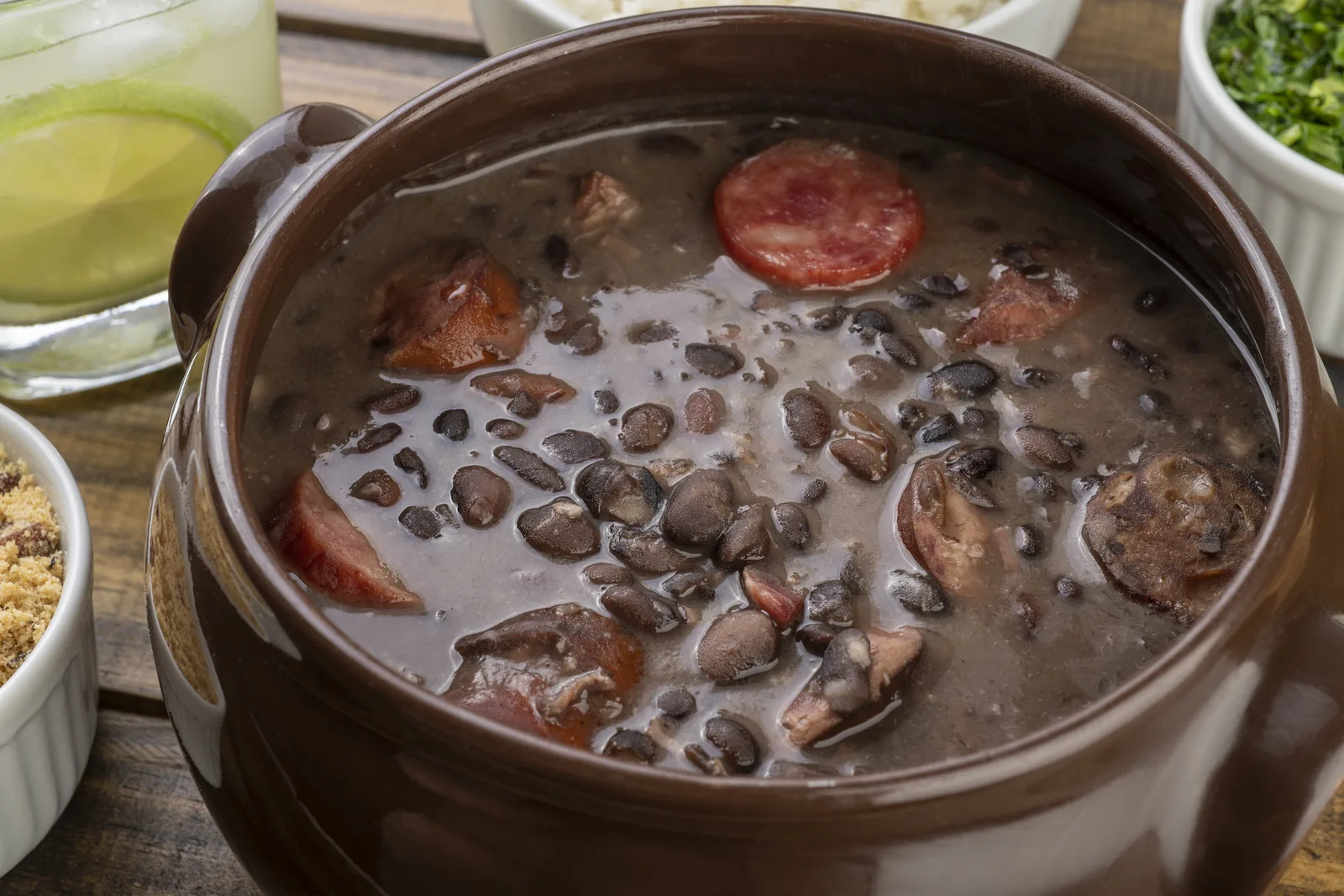

Feijoada (fay-ZHWAH-dah) is Brazil’s big weekend pot: black beans simmered for about three hours with salted, smoked and fresh cuts of pork and beef until the broth turns dark and thick enough to coat a spoon. It’s served over white rice with sautéed collard greens, toasted cassava flour and sliced oranges, and it’s meant for a table of people. Most of the work happens the day before, when the salted meat soaks in the fridge. Below are the recipe for 8, what to buy in a US or UK supermarket when there’s no Brazilian shop nearby, a pressure cooker version, and the sides that make it a full meal.
What feijoada is and how long it takes
How do you make feijoada? Soak salted dried beef and salted ribs in the fridge for 24 hours, changing the water, and soak 1.1 lb (500 g) of black beans overnight. Next day, boil the salted meat for 10 minutes and drain, brown bacon with onion and garlic, then simmer everything with the beans in 3¼ quarts (3 liters) of water for 1 hour 30 minutes. Add smoked sausages, cook 45 to 60 minutes more and thicken with 2 cups of mashed beans. 210 minutes for 8 servings, plus soaking.
Time. 210 minutes on the day you serve it, only about 30 of them hands-on, plus the overnight soak. Difficulty, medium. Nothing is technically hard. It goes wrong in two places: the salt (meat not soaked long enough) and the broth (watery, or catching on the bottom of the pot).
If you know black bean soup, feijoada is thicker, meatier and not spiced: no cumin-heavy seasoning, no chiles in the pot. The flavor comes from the meat. It’s also a different dish from Venezuelan black beans, a brothy side dish sweetened with a little raw cane sugar, and from Cuban congrí, where rice and beans cook together in one pot.
Your two-day plan
| When | What you do | Hands-on |
|---|---|---|
| Day before, morning | Cube the dried beef, cut salted ribs, cover with cold water, refrigerate | 10 min |
| Day before, every 3-4 h | Change the soaking water (at least 3 times) | 2 min each |
| Day before, evening | Soak the beans in the fridge | 5 min |
| Serving day, 3½ h ahead | Taste-test the beef, boil salted meat 10 min, start the pot | 25 min |
| About 1¼ h ahead | Add the whole sausages; make the farofa | 15 min |
| About 45 min ahead | Slice the sausages and return them; start the rice | 10 min |
| About 30 min ahead | Mash 2 cups of beans to thicken, then let it rest | 5 min |
| Last 5 min | Sauté the greens, slice the oranges | 5 min |
Want a calmer serving day? Make the whole feijoada the day before and reheat it. It’s better that way.
Ingredients, and what to buy in the US and UK
The recipe feeds 8: about 2 oz (60 g) of dried beans and just under 7 oz (200 g) of raw meat per person. The point of feijoada is the mix of three kinds of meat: salted (dried beef, salted ribs), smoked (bacon, sausages) and, if you like, fresh (pork loin or more ribs). If one is missing, make up the weight with another from the same group.
| Brazilian cut | What it is | US | UK |
|---|---|---|---|
| Carne seca | Salted, air-dried beef | Brazilian grocery; or corned beef, or plain unflavored beef jerky | Brazilian shops; or salt beef from a deli or butcher |
| Costela salgada | Salted pork ribs | Fresh pork spare ribs | Fresh pork spare ribs |
| Bacon | Smoked cured pork belly | Smoked slab bacon or thick-cut bacon | Smoked pancetta or thick smoked streaky bacon |
| Linguiça calabresa | Smoked pork sausage with garlic | Portuguese linguiça, kielbasa or andouille | Kielbasa (Polish shops and most supermarkets) |
| Paio | Thick smoked pork loin sausage | Linguiça, kielbasa or Spanish chorizo | Kielbasa or cooking chorizo |
What each swap changes
- Corned beef (US). Use a raw corned beef brisket, not canned. It’s brined, not dried, so cut it into 1¼ in (3 cm) cubes, soak it in cold water for 2 hours and drain. Brisket needs long cooking: before you thicken the stew, check that a fork slides in easily, and if it’s still tough, give it another 30 minutes at a gentle simmer. It comes out juicier and tastes more like deli meat. In the UK, ask for salt beef: tinned corned beef falls apart and won’t work.
- Beef jerky. Only plain, unflavored jerky. Teriyaki or peppered jerky will flavor the whole pot. Soak it like carne seca.
- Andouille. It’s spicy. Use kielbasa if you’re feeding kids.
- Spanish chorizo. Paprika turns the broth red and adds a flavor feijoada doesn’t have. Use it for the paio only, or keep it to half the sausage weight.
- Fresh ribs instead of salted. They work and skip a step, but give less depth. You may need a little salt at the end.
No dried beef and no substitute? Make it with ribs, bacon and smoked sausage. That’s the version most cooks outside Brazil make, and it’s still very good.
Feijoada completa
The “complete” version adds gelatinous salted cuts: pig’s feet, ears, tail or hock, about 10 oz to 1¼ lb (300 to 600 g) in all for this batch. They make the broth thick and sticky. Salted ones get the same 24-hour soak and 10-minute boil as the ribs and go in at the start. In the US they’re usually sold fresh at Latin or Asian butchers; fresh ones don’t need soaking.
Beans and equipment
Dried black beans (turtle beans in the UK). Canned beans won’t survive three hours of simmering; see the quick version below if that’s all you have. You need an 8-quart (8-liter) pot, a lidded container that fits in the fridge for soaking the meat, and a skimmer or slotted spoon.
How to make feijoada step by step
The salt test
This is the step that saves the pot. After 24 hours of soaking, boil a small cube of dried beef in unsalted water for 2 minutes and taste it. It should taste like salty cured meat, like ham, not like brine. If it’s briny, give it another 4 hours in fresh cold water. Always soak in the fridge, never on the counter.
The 10-minute boil that follows removes the last of the surface salt and fat. Throw that water away.
The long simmer
Render the bacon slowly so its fat becomes the base, then soften the onion in it for 8 minutes. Beans, salted meat and water go in together. After the first boil and skim, the pot should barely bubble, 1 hour 30 minutes with the lid ajar. A hard boil breaks the beans and clouds the broth.
Stir from the bottom every 15 to 20 minutes: beans settle and stick. If the broth drops below the level of the beans, top it up with boiling water, never cold.
Sausages go in whole for 30 minutes so they don’t fall apart or dump all their fat at once, then get sliced and returned for the last 15 to 30 minutes.
When it’s done, and the right thickness
It’s done when a bean crushes between your fingers with no chalky center, the dried beef shreds with a fork and the ribs slide off the bone. If the meat is ready but the beans aren’t, give it 30 minutes more.
To thicken, mash 2 cups of beans with a little broth and stir them back in, then simmer uncovered 10 to 15 minutes. The right broth is black, glossy and coats the back of a spoon. Spooned over rice, it sits there instead of running off like soup.
- Too thin. Mash another cup of beans, or simmer uncovered 10 minutes more.
- Too thick or catching. Add boiling water a cup at a time. It thickens a lot as it cools, so leave it slightly loose.
Taste for salt only now. Usually it doesn’t need any.
Pressure cooker or Instant Pot feijoada
With beans, a pressure cooker should never be more than half full, because they swell and foam; that’s why this version uses less water. The full recipe needs a 10-quart (10-liter) or larger cooker. In a 6-quart Instant Pot or stovetop cooker, make a half batch, halving everything, water included. Soak and pre-boil the meat as above.
- With the lid off (sauté mode on an Instant Pot), brown the bacon and soften the onion, garlic and bay leaves.
- Add the dried beef, ribs and 6 cups (1.5 liters) water. Lock the lid and cook 20 minutes at high pressure.
- Release the pressure, add the drained beans and 4¼ cups (1 liter) water. Cook 25 minutes more at high pressure, then let the pressure drop on its own (about 15 to 20 minutes on an Instant Pot).
- Open, check the beans, add the sliced sausages and simmer 20 to 30 minutes uncovered (sauté mode), mashing 2 cups of beans to thicken.
On serving day that’s about 90 minutes. A slow cooker works too: brown the bacon and onion in a skillet first, then cook everything, sausages included, 8 to 10 hours on low and thicken at the end with the lid off, because a slow cooker doesn’t reduce.
Mistakes that ruin feijoada
- Too salty. The meat wasn’t soaked long enough, or it was salted during cooking. Do the salt test and don’t salt until the end. If it’s already salty, cook another 7 oz (200 g) of beans separately and stir them in, or serve with extra rice. Plain water only makes it soupy.
- Beans still hard after hours. Old beans or no soak. Always soak, and give hard beans more time at a gentle simmer.
- Mushy beans and cloudy broth. It boiled hard instead of simmering.
- Scorched bottom. High heat and too little liquid near the end. Stir from the bottom.
- Red broth that tastes of paprika. Too much Spanish chorizo.
- A layer of fat on top. Bacon and sausage release plenty. Ladle it off before thickening, or chill the pot overnight and lift it off solid.
Allergens, heat and kids. Feijoada contains no gluten or dairy on its own, but check the sausage labels. It isn’t spicy; hot sauce goes on the table. Kids tend to like the beans, rice and sausage; the gelatinous cuts of the completa, less so.
Quick, big-batch and lighter versions
- Same-day version with canned beans. Four 15-oz (400 g) cans, drained, and only meat that needs no soaking: bacon, sausages and fresh ribs. Simmer the ribs in 4¼ cups (1 liter) water for about 1 hour until tender, add beans and sausages for 30 minutes and thicken the same way. Shallower flavor and softer beans, but dinner tonight.
- For 16. Double everything (2.2 lb / 1 kg beans) in a 12-quart (11 to 12 liter) pot with 6⅓ quarts (6 liters) water. Same times; it takes longer to come to a boil.
- For 20. Multiply by 2.5 and split it between two pots unless you have a 15-quart one. In a single huge pot the bottom scorches before the top cooks.
- Lighter. Skip the bacon, use lean fresh ribs and smoked turkey sausage, and skim the chilled fat the next day. It’s still a hearty stew.
What to serve with feijoada
Every side has a job: rice soaks up the broth, the greens add something fresh, farofa adds crunch and the oranges clean your palate between bites.
White rice
Plan on 1 cup of uncooked long-grain rice for every 3 to 4 people, cooked plain and fluffy. For a reliable method, this fluffy white rice is the one I use.
Brazilian collard greens (couve)
- 10½ oz (300 g) collard greens (UK spring greens or cavolo nero), 2 tbsp oil or butter, 3 garlic cloves, minced, and salt.
- Cut out the center ribs, stack 5 or 6 leaves, roll them tightly and slice into ribbons ⅛ in (2 to 3 mm) wide.
- Fry the garlic 30 seconds over medium-high heat, add the greens and a pinch of salt and toss 2 to 3 minutes, just until wilted and bright green. Longer and they turn dull and bitter. Make them right before serving.
Farofa
Toasted cassava flour, sprinkled over everything.
- 9 oz (250 g) Brazilian farinha de mandioca (coarse cassava flour), 5 tbsp (75 g) butter, 1 onion, finely chopped, and salt.
- Melt the butter over medium heat and cook the onion 5 to 8 minutes until golden. Add the farinha and stir constantly for 5 minutes, until it’s loose, lightly golden and smells toasty.
- Make it in the morning and serve at room temperature.
Look for bags labeled farinha de mandioca (raw or torrada, toasted) at Brazilian or Latin grocers or online. Tapioca starch and the fine cassava flour sold for gluten-free baking won’t work: they lack the coarse grain that crunches. That starch is what Brazilian cheese bread is made with, a different job altogether.
Oranges and hot sauce
2 or 3 oranges, peeled and sliced, on a plate in the middle. A bottle of hot pepper sauce for anyone who wants heat. For extra crunch, a few pieces of crispy fried yuca on the side won’t be out of place. To finish the meal the Brazilian way, a tray of chocolate brigadeiros can be rolled the day before.
Storing, freezing and reheating
Cool it fast. Divide it into shallow containers and refrigerate within 2 hours. A big hot pot takes too long to cool in the fridge.
Fridge. 3 to 4 days, covered.
Freezer. 2 to 3 months in portions with plenty of broth. Thaw overnight in the fridge.
Reheat. Over medium heat with ½ cup (120 ml) water for every 4 servings, since it thickens a lot when cold, until it boils and reaches 165°F (74°C). Then simmer gently about 20 minutes, stirring from the bottom.
Feijoada FAQ
Which meats are essential? There’s no fixed list. What matters is the mix: something salted, something smoked, and black beans. Ribs, bacon and one smoked sausage already make a recognizable feijoada.
Do I have to soak the beans? Yes. Soaked beans cook evenly and stay whole through three hours of simmering. Forgot? Cover them with water, boil 2 minutes, turn off the heat and leave covered for 1 hour, then drain and carry on.
How much should I make per person? With this recipe, about 2 oz (60 g) dried beans and just under 7 oz (200 g) raw meat per person, plus rice. If it’s the only dish and appetites are big, treat the recipe as serving 6.
Can I make it a day ahead? Yes, and it’s the best way. Cool, refrigerate and reheat as above. Make the greens and rice fresh.
Feijoada nutrition
Per serving (1/8 of the pot, without rice or sides), calculated ingredient by ingredient from the recipe amounts:
- Calories: 691 kcal
- Protein: 42 g
- Carbohydrates: 44 g
- Fat: 39 g, including 12 g saturated
- Fiber: 10 g
- Sugars: 4 g
The beans account for about 213 kcal per serving and the sausages about 174. Skimming the chilled fat brings it down. I don’t give a sodium figure, because it depends on how long you soak the meat and which sausages you use; it is a salty dish, so if you watch salt, use fresh ribs and less sausage. A cup of cooked white rice adds about 200 kcal.
If you grew up with Venezuelan-style black beans, slightly sweet and brothy, you’ll be tempted to add a spoonful of cane sugar to feijoada. It doesn’t need it: the sliced oranges on the plate bring the fresh contrast. What helps most is cooking it the day before, desalting the ribs properly and keeping the sausages whole until the end. And if there are kids at the table, the sausage rounds with plenty of rice and farofa on the side are usually the first thing to go. Josnaisis.