
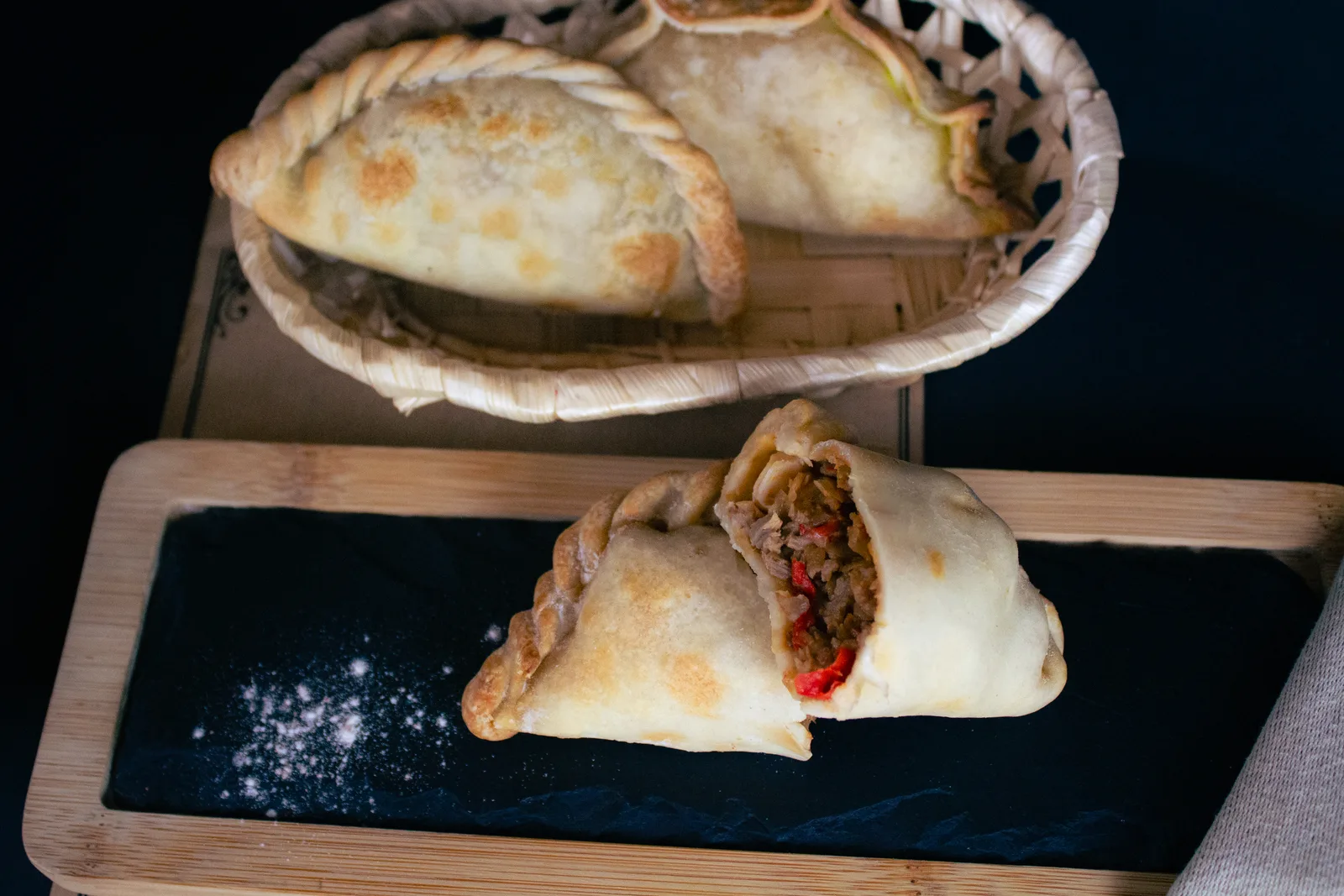

In Argentina an empanada is a hand pie of wheat pastry made with fat, folded into a half-moon and finished with a hand-braided edge called the repulgue (reh-POOL-geh). The classic one is beef with a lot of slowly cooked onion, paprika and cumin, plus a piece of hard-boiled egg and a green olive tucked inside, and it’s usually baked, though fried ones are common too. This is that empanada, with the one rule that keeps it from bursting open in the oven, a step-by-step crimp you can follow without a video, and what to buy in a US or UK supermarket if you’d rather not make the dough.
What makes an Argentinian empanada different
How do you make Argentinian beef empanadas? Knead 4 cups (500 g) of flour with ½ cup (100 g) of melted lard, about ¾ cup (200 ml) of warm salted water, and rest the dough 30 minutes. Cook diced beef with onion, paprika and cumin, chill it at least 2 hours, then fill 5½ in (14 cm) rounds with the filling, egg and olive, braid the edges shut and bake at 400°F (200°C) for 20 to 25 minutes. 105 minutes of work for 12 servings of one empanada each, plus chilling time.
If you’ve had empanadas from a Colombian or Venezuelan kitchen, forget them for a moment. Venezuelan empanadas and Colombian empanadas from Cali are made from corn flour, sealed with a plate and deep-fried, and so are the peanut and potato empanadas de pipián from Popayán. The Argentinian kind is a wheat pastry, closer to a savory hand pie, rolled thin and usually baked.
- The dough is flour, fat, warm water and salt. No yeast, no baking powder.
- The filling is juicy rather than saucy. The onion is cooked down until sweet and there’s as much of it as there is beef.
- The seal is the repulgue, a rope-like braid of small folds along the curved edge. A fork crimp holds just as well.
Time. 105 minutes of hands-on and cooking time, plus 2 hours for the filling to chill. It’s easiest as a two-day job.
Difficulty. Medium. Nothing is hard on its own, but there are 12 rounds to roll, fill and seal.
Ingredients, and what to buy in the US and UK
The recipe makes 12 large empanadas, each from a 5½ to 6 in (14 to 15 cm) round. Three make a meal with a salad.
| Ingredient | Metric | US | What to use |
|---|---|---|---|
| All-purpose flour | 500 g | 4 cups | UK plain flour; no self-raising |
| Lard or beef tallow | 100 g | ½ cup | UK beef dripping or lard |
| Lean beef | 500 g | 1 lb 2 oz | Bottom round or chuck; 90% lean ground beef works |
| Onions | 500 g | 2 large | White or yellow |
| Sweet paprika | 7 g | 1 tbsp | Not smoked; it changes the flavor |
| Ground cumin | 2 g | 1 tsp | |
| Green olives | 45 g | 12 | Pitted, plain or pimento-stuffed |
The fat in the pastry
- Lard is the easy choice: US supermarkets stock it in the Latin aisle or near the shortening, and UK supermarkets sell blocks of lard and beef dripping. It gives a crisp, slightly flaky pastry, close to the beef fat used in Argentina.
- Butter works at the same weight, but the pastry is more tender and buttery and browns sooner. Check the oven from 15 minutes.
- Vegetable shortening behaves much like lard, with a more neutral taste.
- Oil makes a harder, less flaky pastry. Last resort.
Diced or ground beef
Hand-diced beef in ⅜ in (1 cm) cubes is the traditional choice and gives a chunkier, juicier filling. Ground beef saves about 15 minutes of knife work and turns out finer and a little drier. Either way, cook it until no pink is left; it doesn’t go back in the oven long enough to cook raw meat.
Store-bought empanada discs
Frozen discs save about 40 minutes and come out smoother and more even than homemade dough.
- US. Look in the freezer section of the Latin aisle or a Latin grocery for packs of 10 or 12. The common US packs run about 1.4 oz (40 g) per disc, smaller than the rounds here. Argentinian brands label the packs para horno (for baking) or para freír (for frying). Thaw them in the fridge and peel them apart gently; if they’re still very cold they tear.
- UK. Discs are rare outside Latin American shops and online grocers. Ready-rolled shortcrust cut into rounds will do, but it’s more crumbly and buttery, cracks when you braid it, and browns faster. Seal it with a fork.
- Puff pastry discs puff up and flake. Good, but a different empanada with a softer edge.
Equipment. A rolling pin, a wide pot, a large baking sheet with parchment, and a 5½ in (14 cm) saucer or cutter if you want perfect rounds.
The two-day plan
Day before, 45 minutes. Cook the filling, cool it 30 minutes on a wide dish, and refrigerate. The fat sets white and the filling becomes firm enough to spoon neatly. Boil the eggs. You can make the dough too, wrapped in the fridge until the next day.
Day of, 60 minutes. Take the dough out 15 minutes ahead so it rolls easily. Roll, fill and seal (about 35 minutes), heat the oven while you work, bake 20 to 25 minutes.
Why cold filling matters. Warm filling steams the pastry from inside, so it softens and tears as you fold, and juice runs out through the seam in the oven. Cold, the fat is solid: the filling holds its shape on the spoon, doesn’t wet the edge, and melts again only once the empanada is sealed. Get it into the fridge within 2 hours of cooking.
Shaping and crimping, step by step
Rolling and filling
Divide the dough into 12 balls of about 2¼ oz (65 g) and roll each to 5½ to 6 in (14 to 15 cm) and about ⅛ in (3 mm) thick. Thinner tears at the fold; thicker stays doughy at the edge.
Use a heaped tablespoon of filling (about 1¾ oz / 50 g), 2 pieces of egg and 2 olive halves, leaving a clean ⅝ in (1.5 cm) border. Wet half the edge with a damp finger, fold, press from the filling outward to push out the air, then press the edge to seal.
The repulgue braid
- Hold the sealed empanada with the curved edge facing you. Fold one corner in toward the filling, like dog-earing a page.
- Right next to that corner, pinch about ⅜ in (1 cm) of the edge between thumb and forefinger, stretch it slightly and fold it over onto the corner, pressing down.
- Move along another ⅜ in and repeat, each fold overlapping the last, so a rope forms.
- At the far end, tuck the last corner in. A 5½ in empanada takes 12 or 13 folds.
The first three or four look rough; by the fifth it clicks. If not, press the edge with a floured fork. It seals just as well.
Baking temperature and doneness
Bake at 400°F (200°C) on the middle rack, 1¼ in (3 cm) apart, brushed with egg for color and shine. After 20 to 25 minutes, the tops should be golden, the bottoms golden when you lift one with a spatula, and the braid toasted. If your oven browns only on top, turn the sheet halfway through.
Frying instead
Skip the egg wash. Heat plenty of oil to 350°F (175°C) and fry 3 at a time for 2 to 3 minutes per side, until golden, then drain on paper towels. The filling is already cooked, so you’re only browning the pastry. Crisper and richer than baked.
Why empanadas burst, and other fixes
- They open in the oven. Warm filling, too much filling, or juice on the edge. Cold filling, one heaped tablespoon and a clean, water-dampened border.
- Juice leaks from the bottom. There was loose liquid in the filling. Leave any jelly or stock that settled in the dish behind.
- Dough shrinks back as you roll. It needs more rest. Cover for 10 minutes.
- Pale bottoms. The sheet was too high or the oven wasn’t hot. Preheat 15 minutes and bake in the middle.
- Dry filling. Stock reduced too far, or very lean beef overcooked. Stop while it’s still glossy.
Heat and allergens. With ½ tsp pepper flakes they’re barely spicy, and kids usually like them; leave the flakes out for none. They contain wheat (gluten) and egg.
Regional styles, and making them for a party
- Salteñas from Salta are smaller and spicier, with hand-cut beef and diced boiled potato in the filling.
- Tucumanas from Tucumán skip potato and olives, use fattier hand-cut beef, often matambre, a thin cut close to flank, and are known for a 13-fold repulgue and a touch of lemon.
- Mendocinas from Mendoza are baked, with olives, much like this recipe.
- Across the Andes, Chilean empanadas de pino are nearly twice the size, folded into a rectangle instead of braided, with black olives and raisins.
- Next door in Brazil, coxinha, the Brazilian chicken croquette, also wraps a cold filling, but in a dough of flour cooked in chicken broth, shaped like a drumstick, breaded and fried.
How many to make. As the main course, 3 of these large ones per adult, or 5 to 6 made with smaller store-bought discs. As a starter or party snack, 2 to 3 per person. Children eat about half what adults do.
For 24 or 36. Double or triple everything. Cook the filling in two pots or in batches so the beef browns instead of stewing, and bake two sheets at once, swapping racks halfway.
To serve. Hot or warm, eaten by hand, with a tomato and onion salad or green leaves. At a cookout, bake them before lighting the grill and serve them warm alongside Argentinian choripan. On Argentina’s national holidays they’re the usual starter before a pot of Argentinian locro, the corn and squash stew. For dipping, a spoonful of Argentinian chimichurri, the parsley, garlic, oil and vinegar sauce, is a natural match. If you like hand pies made with puff pastry, the Colombian chicken pastry uses it.
Storing, freezing and reheating
Fridge. Cooked filling keeps 3 to 4 days, and so do baked empanadas, refrigerated within 2 hours.
Freezing unbaked, the best option. Shape them without the egg wash, freeze on a tray, not touching, for 2 to 3 hours until hard, then bag them. They keep up to 3 months. Bake from frozen at 400°F (200°C), brushed with egg, about 5 minutes longer than fresh, until golden and the center reaches 165°F (74°C). Tent with foil if they brown first.
Freezing baked. Cool, bag and freeze for 2 to 3 months. Reheat from frozen at 350°F (180°C) for 15 to 20 minutes, until hot in the middle.
Reheating from the fridge. Oven or air fryer at 350°F (180°C), 8 to 10 minutes. The microwave heats the filling but leaves the pastry soft.
Argentinian empanada questions
Can I cook them in an air fryer? Yes. Brush with egg or a little oil and cook at 350°F (180°C) for 10 to 15 minutes in a single layer, not touching, turning halfway. They’re done when golden and crisp on both sides.
Can I shape them in the morning and bake at night? Yes, covered in the fridge for a few hours. Brush with egg just before baking. Any longer than a day, freeze them unbaked instead.
Can I use store-bought pie crust? You’ll get an empanada, but not this one. Butter pie crust is flakier and sweeter, cracks when you try to braid the edge and browns sooner. If that’s what you have, seal it with a fork and start checking the oven at 15 minutes.
Are raisins or sugar authentic? Some cooks add raisins to the filling for a sweet note, and some sprinkle sugar over the tops before baking. Both are optional.
Nutrition per empanada
Per empanada (one of 12, baked and brushed with egg), calculated ingredient by ingredient from the recipe amounts:
- Calories: 378 kcal
- Protein: 15 g
- Carbohydrates: 37 g
- Fat: 18 g, including 7 g saturated
- Fiber: 3 g
- Sugars: 3 g
- Sodium: 468 mg
The pastry carries nearly two thirds of the calories. A three-empanada main course comes to about 1,130 kcal; store-bought discs are thinner and lighter.
I grew up on fried corn empanadas sealed with a plate, so the Argentinian kind changed my order of work more than anything else: the filling is made the night before or it doesn’t behave. Now I shape all twelve calmly the next day and freeze half of them unbaked, and those are the ones I’m most grateful for on a busy evening. Josnaisis.