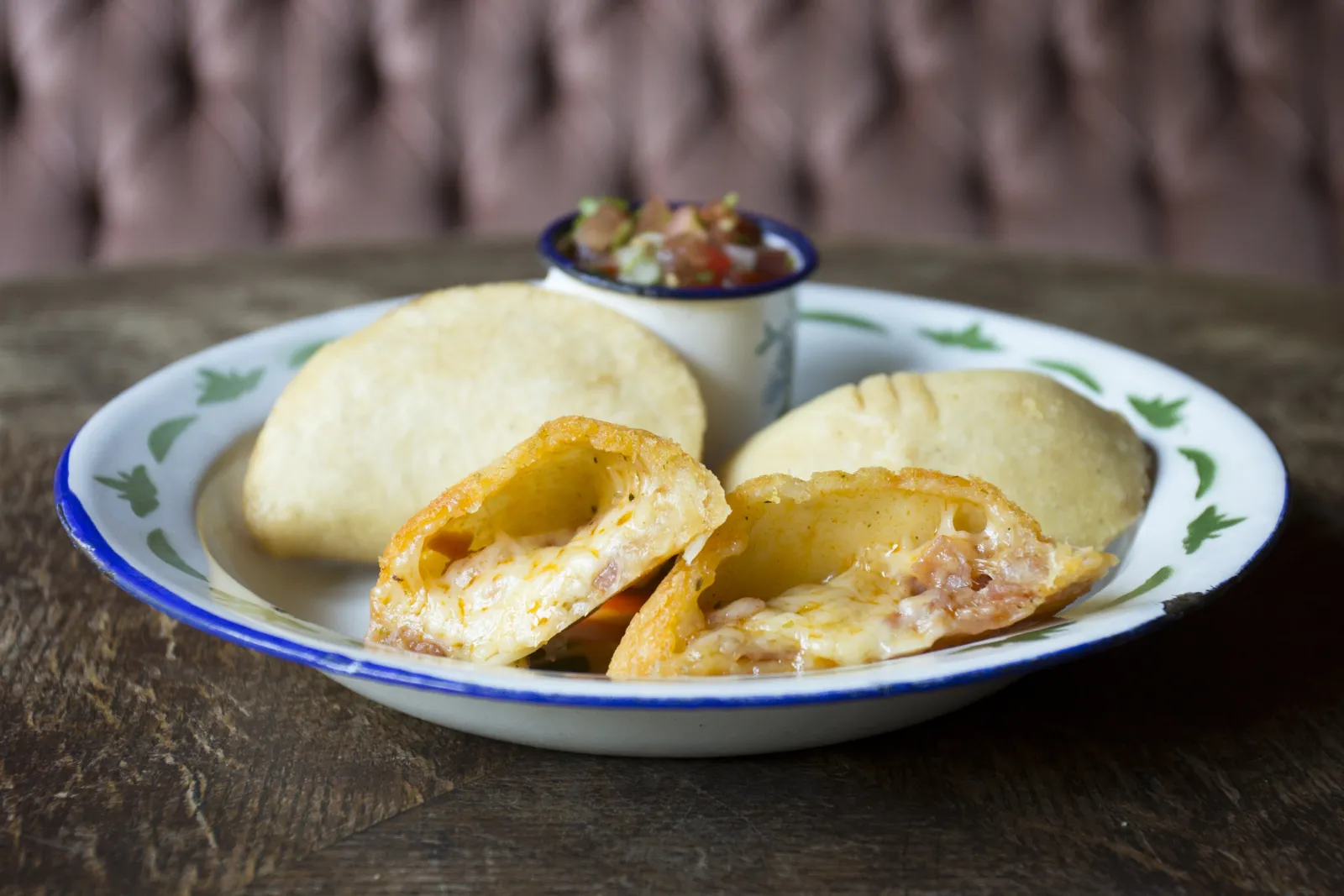

A Venezuelan empanada is a half-moon of corn dough, fried until it blisters and crackles, and stuffed with whatever goes into an arepa: shredded beef, chicken, white cheese, black beans. The dough is the same precooked cornmeal Venezuelans use for arepas, sold in the US and UK as P.A.N. or masarepa, mixed with nothing but warm water, salt and a spoonful of sugar. No wheat, no butter, no rolling pin; the shaping is done inside a plastic bag with a dinner plate. If you’ve only had Argentine or Chilean empanadas, forget the flaky baked pastry. This is closer to a crisp, stuffed corn pocket.
How to make Venezuelan empanadas, the short version
How do you make Venezuelan empanadas? Mix 500 g (3½ cups) of precooked white cornmeal with 780 ml (3¼ cups) of warm water, 1 tablespoon of sugar and salt, and divide into 20 balls. Press each one inside an oiled plastic bag with a plate to a 6-inch round, add 2 heaped tablespoons of cold filling, fold, and trim with the rim of the plate. Fry at 350°F (175°C) for 4-5 minutes. 70 minutes for 20 servings once the filling is made.
The ratio is the whole recipe, 780 ml of water to 500 g of cornmeal. With 700 ml (3 cups) the edge cracks as soon as you fold it; with 850 ml it sticks to the bag and sags. The sugar isn’t there for sweetness, you won’t taste it. One tablespoon per pound of cornmeal is what gets the crust evenly golden in under five minutes of frying instead of leaving it pale, and it’s how every Venezuelan kitchen I grew up around made them.
Time. 70 minutes with the filling made, about 55 of them hands-on. The filling is the slow part and the part to make the day before.
Difficulty, honestly medium. The dough works the first time. Folding without cracking takes three or four tries.
The ingredients, and what to buy in a US or UK store
The cornmeal, and the ones that look right but fail
The one thing you can’t swap is precooked cornmeal. P.A.N. is the brand most Venezuelans use; Goya and other brands sell it as masarepa. It’s sold in the Latin aisle of most large US supermarkets and online, and in the UK at Latin American grocers and online.
Yellow precooked cornmeal makes a golden empanada that’s closer to the Colombian kind. Masa harina, the Mexican tortilla flour, is a different product: it’s nixtamalized, tastes like a tortilla and cracks when folded.
Fillings and how much you need for 20
Every empanada takes 40 g (1.4 oz) of filling, so 20 take 800 g (1.75 lb). Whatever you choose, it has to be cold, dry and finely shredded. A juicy filling is a filling that bursts.
| Filling | For 20 empanadas | Notes |
|---|---|---|
| Shredded beef (carne mechada) | 800 g (1.75 lb) cooked, from 1 kg (2.2 lb) raw flank or chuck | use the shredded beef recipe, cooked until no sauce is left in the pan |
| Chicken | 800 g (1.75 lb) stewed and shredded, from about 800 g raw breast | reduce the sauce until the pan is dry |
| Cheese | 800 g (1.75 lb) firm white cheese, grated | queso blanco, queso para freír, or halloumi in the UK; never mozzarella alone |
| Dominó (beans and cheese) | 400 g (14 oz) thick black beans + 400 g (14 oz) grated cheese | Venezuelan black beans, drained, cooked down and chilled |
| Fish | 500 g (1.1 lb) raw fish + 300 g (10 oz) sofrito | in Venezuela, cazón (dogfish shark); cod or haddock at home |
Cheese. The test is whether it softens or runs. Queso blanco and halloumi go soft and stay put; mozzarella and cheddar boil inside the dough and split it. For a little stretch, mix 1 part mozzarella with 3 parts firm cheese.
Dominó is named for the black beans and white cheese, half and half. The beans have to be as thick as a rough mash.
Fish. On Margarita Island and along Venezuela’s eastern coast the classic is cazón, a small shark. The FDA lists shark among the fish pregnant women and young children should avoid because of mercury, so I’d use cod, haddock or any firm white fish when cooking for them; it’s less fibrous but still a very good empanada.
Equipment, and what to use instead
A gallon freezer bag, a flat 6-inch (15 cm) plate, a deep 8-9 inch pot and a thermometer. No bag: two sheets of oiled plastic wrap or parchment. No plate the right size: a small bowl or a pot lid with a thin rim. No thermometer: dip the handle of a wooden spoon in the oil; steady small bubbles around it mean roughly 340-355°F (170-180°C).
Shaping them with a plastic bag and a plate
This is the step that decides whether they crack, and I do it the same way every time.
- Press. Ball inside the oiled bag, bag closed, press with the bottom of a plate to 6 inches (15 cm). Even pressure, one push.
- Fill. Open the bag, 2 heaped tablespoons of cold filling on one half, ¾ inch (2 cm) of clean edge.
- Fold with the bag, not the dough. Lift the plastic and let it carry the dough over. Your fingers never touch the dough, so it doesn’t tear.
- Seal and trim. Still inside the bag, press the edge to push the air out, then press the rim of the upturned plate over the half-moon. It cuts and seals in one move and leaves the thin, smooth edge a Venezuelan empanada has.
What right looks like. The flattened dough shows the shadow of your fingers through the bag. The fold has no cracks. The edge is sealed with no air bubble. In the oil, the empanada sizzles hard as it goes in and floats within seconds.
Frying, and the temperature that matters
Fresh empanadas fry at 350-355°F (175-180°C) for 4-5 minutes, turned once. At that heat the dough seals in seconds, blisters, and the filling heats through before the crust darkens.
Batches of 4 in an 8-9 inch pot. Eight at once drops the oil below 320°F (160°C) and the dough drinks it.
Make ahead, freeze, and cook for a crowd
The day before. Cook and chill the filling; beef, beans and chicken keep 3 to 4 days in the fridge, per USDA FSIS guidance for cooked food. Don’t make the dough ahead: it hardens overnight and cracks.
Freeze them raw. This is how I handle parties. Shape all of them, freeze on a parchment-lined tray without touching for 2 hours, then bag them with the air pressed out. USDA FSIS says food kept at 0°F (−18°C) stays safe indefinitely; quality is what fades, and I use mine within 3 months, before the edges start to crack. Fry straight from frozen at 340°F (170°C) for 7-8 minutes so the center heats before the crust browns. Thawed first, they go soggy and burst.
How many per person. I count 2 per person at breakfast, 3 if they’re the main meal and 1 on a party spread with other food.
| Guests | Empanadas | Cornmeal | Water | Filling |
|---|---|---|---|---|
| 4-6 at breakfast | 10-12 | 250 g (1¾ cups) | 390 ml (1⅔ cups) | 400 g (14 oz) |
| 10 at breakfast | 20 | 500 g (3½ cups) | 780 ml (3¼ cups) | 800 g (1.75 lb) |
| 20 at breakfast | 40 | 1 kg (7 cups) | 1.56 liters (6½ cups) | 1.6 kg (3.5 lb) |
| 20, as the main meal | 60 | 1.5 kg (10½ cups) | 2.34 liters (9¾ cups) | 2.4 kg (5.3 lb) |
Even for 60, I mix the dough in batches of 500 g. It’s what you can knead comfortably by hand, and a smaller batch doesn’t dry out while you shape.
Air fryer, oven or deep fryer
Air fryer. Brush both sides with oil, 400°F (200°C), 12-14 minutes, turning halfway; 16-18 minutes from frozen. They come out crisp with a matte crust and no blisters, and one or two will crack, because corn dough dries out without oil around it. Good, but a different empanada.
Oven. 425°F (220°C), brushed with oil, 18-20 minutes, turned halfway. Dry and toasty, like a grilled arepa. My last choice.
Mistakes that ruin Venezuelan empanadas
- They burst in the oil → warm or wet filling, trapped air, or filling on the edge. Chilled filling, a clean border, air pushed out.
- The dough cracks when folded → too little water or dried out uncovered. Add a tablespoon, knead, keep balls covered, fold with the bag.
- Greasy and pale → oil too cool or too many at once. Thermometer, batches of 4.
- Golden outside, cold inside → oil above 365°F (185°C) or dough thicker than 5 mm (¼ in).
- Dark too fast → more than 2 tablespoons of sugar, or oil reused too many times.
Spice level, 0 out of 5. Heat goes on the table, not in the dough. Kids love the cheese and chicken ones; let them cool 2-3 minutes. Allergens. The dough is gluten-free as long as you don’t add wheat flour (some recipes add a few tablespoons for stretch; check the cornmeal label for a strict diet). Cheese and dominó contain dairy, fish fillings contain fish, and mayo-based sauces contain egg.
How they compare to Colombian empanadas
Colombia fries corn empanadas too. The Cali-style one uses yellow cornmeal or corn colored with annatto, and is filled with shredded beef and small yellow potatoes; it’s in my Colombian empanadas. The tiny Popayán one is filled with potato and peanuts, like the Colombian peanut empanadas. The Venezuelan one is white, bigger (65 g of dough pressed to a 6-inch round), has a spoonful of sugar in the dough and no potato in the filling.
What to serve with them
Guasacaca is the classic: 1 avocado (about 150 g / 5 oz of flesh), ½ green bell pepper, ½ onion, 2 sweet ají peppers or a little extra bell pepper, 1 garlic clove, a small handful (15 g) of cilantro and parsley, 3 tablespoons each of vinegar and oil, and salt, blended; the step-by-step guasacaca shows how to keep it green. Garlic sauce is 4 tablespoons of mayo, 1 crushed garlic clove, a squeeze of lime and parsley. For a Venezuelan party table, put them next to tequeños and mini reina pepiada arepas; for a weekend breakfast, coffee with milk is enough, and at lunch I pour ice-cold papelón con limón.
Leftovers and reheating. Fried empanadas keep no more than 2 hours at room temperature and 3 to 4 days in the fridge at 40°F (4°C), per USDA FSIS. Reheat in the air fryer at 350°F (180°C) for 5-6 minutes or in the oven at 400°F (200°C) for 8-10 minutes, to 165°F (74°C) in the center. The microwave turns the crust rubbery.
What they cost. I don’t have a reliable price source for Venezuela. In the US, with BLS average prices for August 2026, 1 kg (2.2 lb) of boneless chuck roast runs about $20.80 and 800 g of cheddar, the only cheese the BLS tracks, about $10.55. The cornmeal is the cheap part; the filling is nearly all the cost. In Bogotá, where I shop, the beef is 88 % of the bill.
Venezuelan empanada FAQ
What flour do you use for Venezuelan empanadas? Precooked white cornmeal, the arepa flour: P.A.N. or any brand labeled masarepa. Masa harina and regular cornmeal won’t hold together.
Why do my empanadas crack or open when frying? Cracks come from dry dough; bursting comes from steam inside. Add water until a flattened ball has smooth edges, and only fill with cold, dry filling.
Why is there sugar in the dough? So the crust browns evenly before the filling overheats. One tablespoon per 500 g (1.1 lb) of cornmeal; you won’t taste it.
Are Venezuelan empanadas gluten-free? The dough is, if it’s only precooked cornmeal, water, salt and sugar. Check the label and the filling.
Can I make them in an air fryer? Yes, brushed with oil, at 400°F (200°C) for 12-14 minutes. Crisp, but matte, and some will crack.
Can you freeze empanadas before frying? Yes. Freeze on a tray for 2 hours, then bag. Fry from frozen at 340°F (170°C) for 7-8 minutes.
Can I use mozzarella? Not on its own: it melts, boils and splits the dough. Mix 1 part mozzarella with 3 parts firm white cheese.
Nutrition per empanada
Per beef empanada (about 105 g / 3.7 oz fried), calculated ingredient by ingredient from USDA FoodData Central (SR Legacy), using degermed white cornmeal for the precooked flour and my own estimate of 8 g of oil absorbed per empanada:
- Calories: 249 kcal
- Protein: 12 g
- Carbohydrates: 22 g
- Fat: 12 g, 3 g saturated
- Fiber: 2 g
- Sugar: 2 g
- Sodium: 295 mg
About 70 kcal of each comes from the frying oil; air-fried, they’re closer to 190-200 kcal. Swap the beef for white cheese and each one comes to about 290 kcal, with sodium up to around 440 mg.
I ate empanadas from street stands on the way to school in Venezuela for years before I ever shaped one. My first batch in Colombia split at every fold because I left the dough uncovered. Now I keep the balls under a damp towel, fold with the bag, and freeze forty the weekend before my son Dylan’s birthday. On the day, all that’s left is heating the oil. Josnaisis.