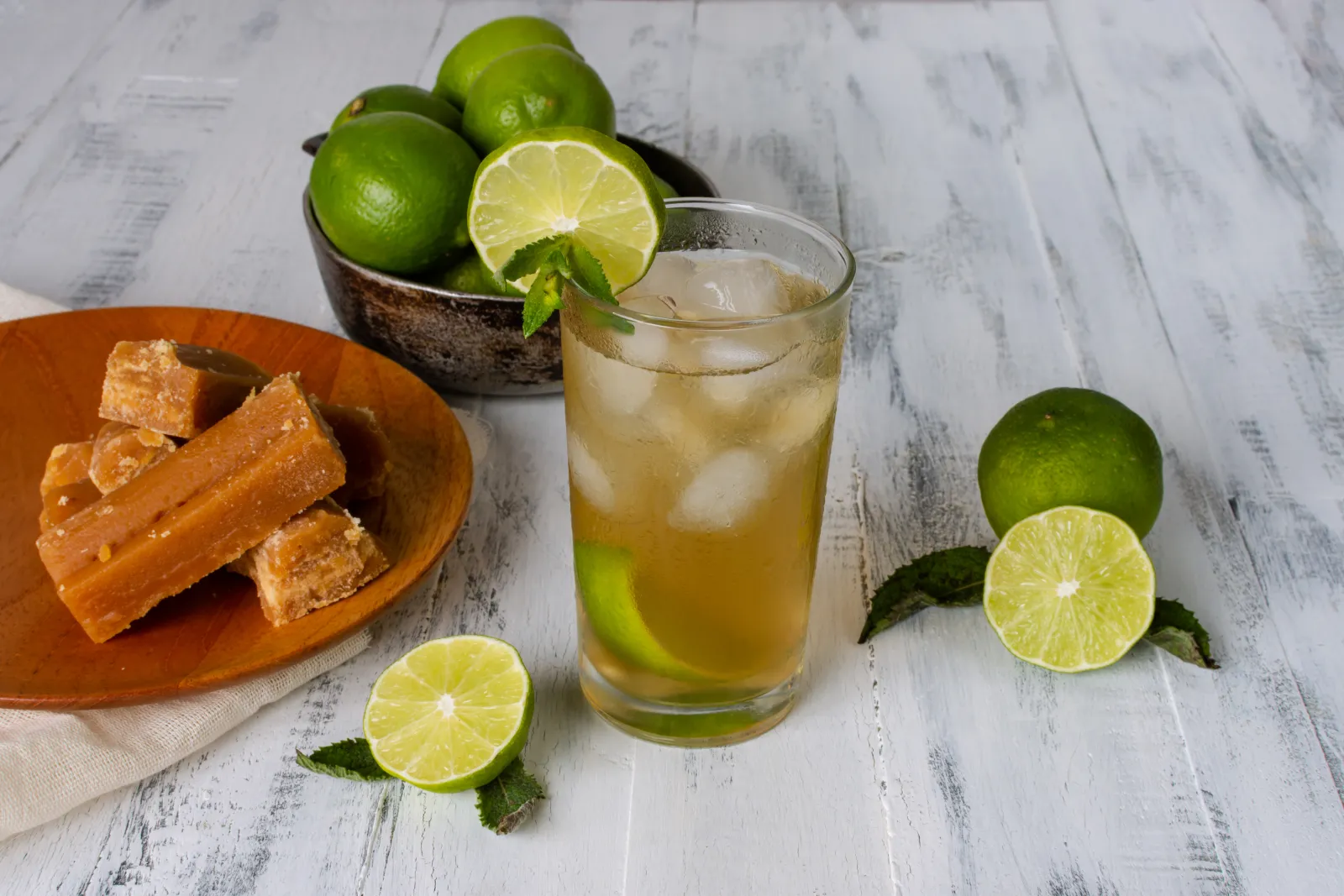

Papelón con limón (pah-peh-LONE kohn lee-MOHN) is what you get offered in Venezuela alongside a plate of arepas: a pitcher of unrefined cane sugar dissolved in water, sharpened with plenty of lime and poured over ice. Think of it as limeade made with a dark, molasses-rich sugar instead of white. Papelón is simply the Venezuelan name for the solid blocks of cooked-down cane juice that Colombians call panela and Mexicans call piloncillo, so if you can find any of them, you can make this. My ratio is 125 g (4.4 oz) of papelón and 60 ml (¼ cup) of lime juice per liter of water, and the fast way is to melt the sugar in a little hot water and finish with cold.
How do you make papelón con limón?
How do you make papelón con limón? Dissolve 250 g (8.8 oz) of grated papelón or panela in 500 ml (2 cups) of water over medium heat, about 10 minutes, without boiling. Pour the syrup into a pitcher with 1.5 liters (6⅓ cups) of cold water, add 120 ml (½ cup) of fresh lime juice, taste and serve over lots of ice. 20 minutes for 8 servings.
That’s about 10 minutes of actual work for 2 liters (roughly 2 quarts), eight 8½ fl oz glasses. The flavor is cane sugar and caramel with a sour edge, closer to a sweet iced tea than to lemonade, and it is meant to be drunk very cold with food.
It’s worth making if you’re cooking Venezuelan or Colombian food, or you simply want a cheap pitcher drink that isn’t soda. It’s not the drink for you if you’re cutting sugar hard: a glass at full strength has about 31 g. There is a lighter ratio further down.
What papelón is, and what to buy in the US and UK
Papelón is cane juice boiled until it thickens and then set in molds, without spinning off the molasses the way refined sugar is made. That is why it’s brown, slightly fudgy and tastes of caramel. The same product goes by panela in Colombia and much of Central America, piloncillo in Mexico, rapadura in Brazil and chancaca in Peru and Chile. Any of them works here, as a block or as a powder.
- In the US, look for piloncillo cones in the Hispanic aisle or any Mexican grocery, and panela blocks at Colombian and Central American shops. Online, search for panela or piloncillo by name.
- In the UK, Latin American shops and online stores sell panela and rapadura. When I looked, a third-party seller on Tesco Marketplace listed organic panela rapadura at £5.59 per kilo. Jaggery (gur), sold in South Asian grocers in both countries, is a close cousin and makes a very good version.
- Powder or block. Powdered panela dissolves in about a minute in the hot water; use the same weight, 125 g per liter. Blocks need grating or chopping first.
- Nothing like it nearby? Dark muscovado gets you closest. Light brown sugar works, but the drink tastes flatter.
A darker block gives a more caramel-heavy drink; a pale one, a cleaner, lighter one. Both are right.
Lime or lemon
Lime. What Venezuelans call limón is a small, thin-skinned green citrus, much closer to a lime than to the yellow lemon in a US or UK supermarket.
- Persian limes, the standard supermarket lime, are what I use outside Latin America. USDA puts the juice of one medium 67 g lime at 44 ml, about 1½ fl oz, so 3 limes give the ½ cup this pitcher needs.
- Key limes are smaller and more fragrant, the closest match to Venezuelan limón. You’ll need more of them for the same amount of juice.
- Yellow lemons work in a pinch. The drink comes out softer and less perfumed.
Squeeze by hand or with a lever press and stop before you crush the skin: the oil in the peel is what turns the pitcher bitter.
The ratio, and why the sugar goes in hot
The full ratio is 125 g (4.4 oz) of papelón per liter of water, with 60 ml (¼ cup) of lime juice per liter. The usual pitcher recipe in English works out to about 160 g per liter (two 4 oz discs in 6 cups of water), noticeably sweeter. I prefer it a little lighter, because the lime should taste of lime.
Dissolving the block in just 500 ml (2 cups) of hot water takes about 10 minutes. Dissolving it in 2 liters of cold water takes much longer. Once the syrup is made, cold water from the fridge brings the whole pitcher to serving temperature straight away, so there’s nothing to wait for.
Signs it’s going right. At 5 minutes the edges of the pieces look rounded and the water is amber. At 10 minutes a spoon dragged along the bottom of the pan finds nothing hard, and the water is steaming but not boiling. After the cold water goes in, the color is like strong tea.
No-heat versions
- Cold soak. Grate the papelón finely, stir it into the 2 liters of cold water in the pitcher and stir every 10 minutes. It takes 45 to 60 minutes to dissolve. Larger chunks can take twice as long. The flavor is a little cleaner.
- Overnight. Drop the whole block, or two halves, into the pitcher of water, cover and refrigerate at 40°F (4°C) or below for 8 to 12 hours. In the morning, stir, add lime, done.
How it differs from Colombian aguapanela
Same sugar, different habits. In Colombia, aguapanela is drunk hot with a piece of cheese at breakfast, or cold with a squeeze of lime as a working drink. Papelón con limón is the Venezuelan version and it is always cold, with more lime: about 60 ml per liter, compared with one lime per liter in a cold aguapanela. The lime is half the flavor here, not a garnish. It’s also tied to the table: it’s the everyday drink with arepas, cachapas, hearty soups and pabellón.
How sweet is it, and a lighter version
A 250 ml (8½ fl oz) glass at full strength has about 31 g of sugar and 123 kcal, slightly more than the same glass of lemon-lime soda, according to USDA FoodData Central. According to the World Health Organization, an adult should ideally keep free sugars, panela included, to roughly 25 g a day, which is 5% of daily energy; the firm ceiling is 10%. One glass of the full-strength drink is past that.
The lighter ratio is 80 g (2.8 oz) of papelón per liter, 160 g (5.6 oz) for the 2 liter pitcher, with the same lime. It drops to about 20 g of sugar and 80 kcal a glass and still tastes of cane. It’s the strength I make for children.
Mistakes that make it bitter or flat
- Dropping in a whole block → it sits there for hours. Grate it or chop it to ½ to ¾ inch (1 to 2 cm).
- Throwing it into boiling water → the outside seals and dissolves slowly. Start it in cold water over medium heat.
- Adding the lime to the hot pan → dull, sometimes bitter. Lime goes in last, cold.
- Squeezing the peel → bitterness from the oil in the skin.
- Fixing sweetness with more lime → sour and sweet at once. Add water, a little at a time, then taste.
- Ice in the pitcher → watery by the second round. Ice goes in the glasses.
Making it ahead and for a crowd
Allow two 8½ fl oz glasses per person with a meal, three on a hot day. The base, papelón dissolved in water, keeps in the fridge; the lime is always added on the day.
| People | Finished drink | Papelón | Water for the base | Cold water | Lime juice |
|---|---|---|---|---|---|
| 4 | 2 L (about 2 qt) | 250 g (8.8 oz) | 500 ml (2 cups) | 1.5 L (6⅓ cups) | 120 ml (½ cup), 3 limes |
| 8 | 4 L (about 1 gal) | 500 g (1.1 lb) | 1 L (4¼ cups) | 3 L (3 qt) | 240 ml (1 cup), 6 limes |
| 12 | 6 L (about 1½ gal) | 750 g (1⅔ lb) | 1.5 L (6⅓ cups) | 4.5 L (4¾ qt) | 360 ml (1½ cups), 8 to 9 limes |
| 20 | 10 L (about 2½ gal) | 1.25 kg (2¾ lb) | 2.5 L (2⅔ qt) | 7.5 L (2 gal) | 600 ml (2½ cups), 14 limes |
For 20, dissolve the papelón in a 3 liter (3 quart) pot the night before; 1.25 kg takes about 20 minutes. Cool it and refrigerate it covered. On the day, mix the base with the cold water and freshly squeezed lime in a drinks dispenser, and keep the ice in a separate bucket.
What it costs. In the US, the BLS average price survey doesn’t track piloncillo or limes. Using its August 2026 averages as a yardstick, 250 g of white sugar (1.024 $/lb) comes to $0.56 and 200 g of lemons (2.114 $/lb) to $0.94. Price the papelón from your own pack: at 125 g per liter, a 500 g (1.1 lb) block makes 4 liters, 16 glasses.
What to serve it with
It’s an everyday Venezuelan table drink, and one 2 liter pitcher covers a meal for four. With breakfast, a reina pepiada arepa stuffed with chicken and avocado, sweet corn cachapas with fresh cheese, or plain Colombian cheese arepas. At lunch, a plate of pabellón criollo, where the lime cuts through the shredded beef and fried plantain. Mid-morning, Venezuelan empanadas. In the afternoon, warm golfeados, Venezuelan cheese and anise sticky buns, glazed with syrup made from the same block of papelón. If you want a second pitcher on the table, tart and ruby-red agua de jamaica is a good contrast, with no molasses at all.
Storage
There’s no official USDA FSIS figure for this drink, so this is my own practice. The base without lime keeps up to 5 days covered in the fridge at 40°F (4°C) or below. Once the lime is in, I drink it the same day: it’s still fine the next, but the lime loses its fragrance. If it fizzes or smells sour, it is fermenting and should go. Frozen in ice cube trays, either the base or the finished drink makes ice that chills without watering down; I use them within 2 to 3 months.
Questions people ask
What is papelón? Unrefined cane sugar: cane juice boiled down and set into solid blocks. It’s the same product as Colombian panela and Mexican piloncillo.
Can I use piloncillo instead of papelón? Yes, it’s the same thing under its Mexican name. Use the same weight, 125 g (4.4 oz) per liter.
What can I use if I can’t find panela? Jaggery is the closest. Dark muscovado comes next. Light brown sugar works but tastes flatter.
Lime or lemon? Lime. Venezuelan limón is a small green citrus, much closer to a lime, and key limes are closest of all.
How many calories are in papelón con limón? A 250 ml (8½ fl oz) glass at 125 g per liter has about 31 g of sugar and 123 kcal. The lighter ratio drops it to 20 g of sugar and 80 kcal.
Can I make it without heating? Yes. Grate it finely and stir it into cold water; give it 45 to 60 minutes. A whole block needs overnight in the fridge.
How much do I need for 20 people? 10 liters (about 2½ gallons): 1.25 kg (2¾ lb) of papelón, 600 ml (2½ cups) of lime juice and 10 liters of water in total.
Is it the same as aguapanela? Same sugar, different custom. Aguapanela is often drunk hot in Colombia; papelón con limón is always cold and carries more lime.
Nutrition
Per 250 ml (8½ fl oz) glass, with 250 g of papelón and 120 ml of lime juice for 2 liters, calculated from USDA FoodData Central (SR Legacy). Brown sugar (id 168833, 380 kcal and 97 g sugars per 100 g) stands in for papelón, which USDA doesn’t list; raw lime juice is id 168156.
- Calories: 123 kcal
- Protein: 0 g
- Carbohydrates: 32 g
- Sugars: 31 g
- Fat: 0 g
- Fiber: 0 g
- Sodium: 9 mg
Papelón keeps a few of the cane’s minerals that white sugar loses, but in a glass that doesn’t change the picture: this is a sugar drink. The lighter ratio comes to 80 kcal and 20 g of sugar.
I learned the hard way that in Bogotá, asking for papelón con limón gets you a hot aguapanela with cheese. I drink both now, but on any day I make arepas, the cold one with too much lime is on the table. For me, that pitcher is what home tastes like. Josnaisis.