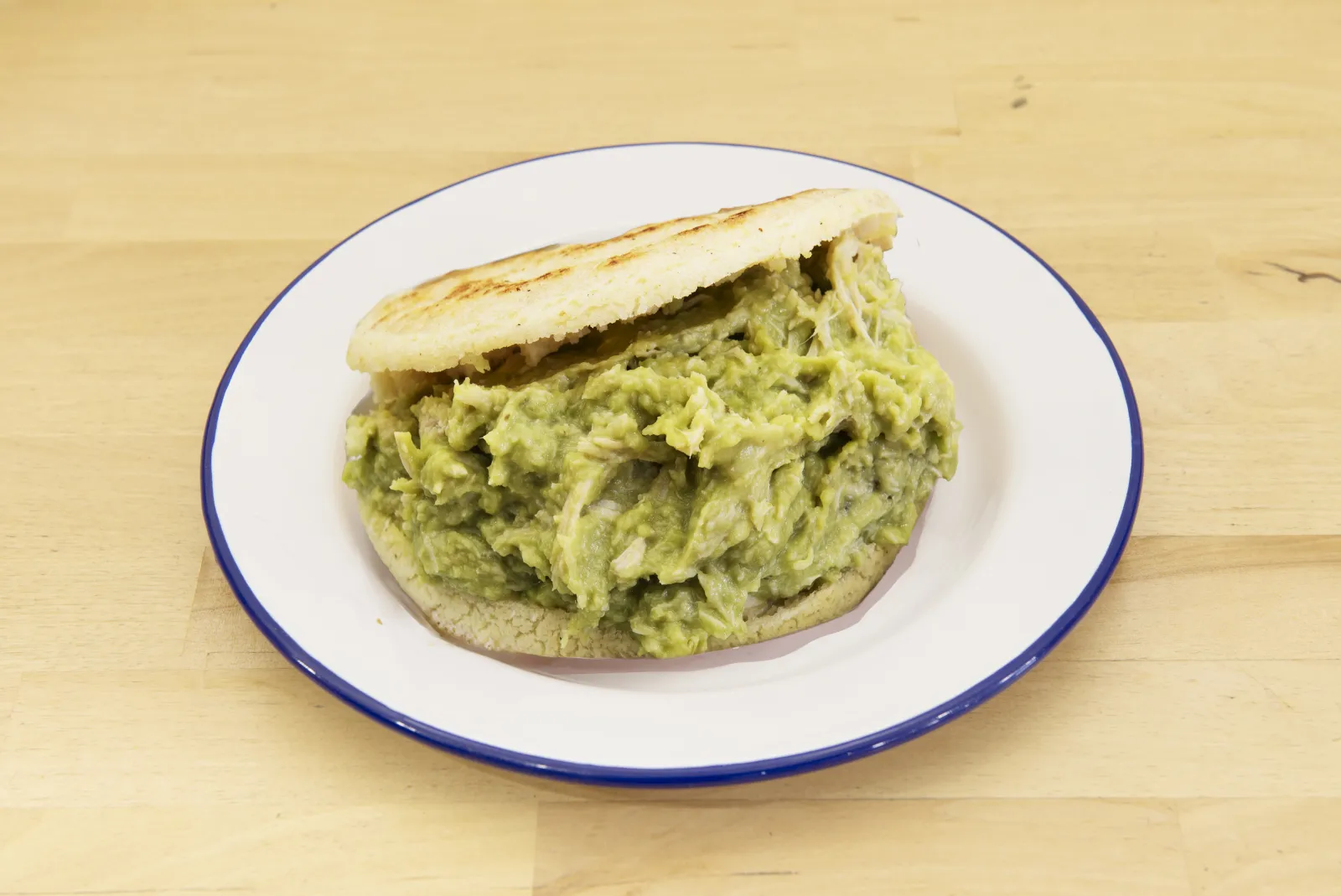

A reina pepiada (RAY-nah peh-pee-AH-dah) is a Venezuelan arepa, a thick, split corn cake, stuffed with a cold filling of shredded chicken, mashed avocado and mayonnaise. Think of it as a chicken salad sandwich where the bread is a crisp corn patty and the salad is green. If you’ve only met arepas at a Colombian place, where they’re thin and come with butter or cheese, the Venezuelan kind is a different animal: about ¾ inch (2 cm) thick, cooked on a griddle and finished in the oven, then opened like a pita and filled until it spills.
What is reina pepiada, and how do you make it?
How do you make reina pepiada arepas? Poach chicken breast for 18 minutes, let it rest in the broth, and shred it. Mix it with mayonnaise, onion, garlic and cilantro, then fold in avocado mashed with lime juice, roughly 4 parts chicken to 3 avocado to 1 mayonnaise by weight. Cook ¾-inch (2 cm) arepas 5 minutes a side on a griddle and 15 minutes in a 350°F (180°C) oven, split them hot and fill. 60 minutes for 8 servings.
The name means, roughly, “the curvy queen.” The most-repeated account, reported by the Argentine paper La Nación from a piece in the Venezuelan outlet El Estímulo, says the filling was named at a Caracas arepa shop run by the Álvarez brothers in honor of Susana Duijm, the Venezuelan who won Miss World in 1955. In Venezuela it sits on every arepera menu next to fillings like shredded beef and black beans with cheese.
Is it worth making at home?
Yes. Nothing in it is fried or stewed, and the filling can wait in the fridge while the arepas bake. Plan on 60 minutes, about 30 of them hands-on; with the chicken poached the day before, it’s 40.
It’s a good fit for a weekend breakfast, a brunch for 10 to 20 (more on that below), or a light dinner. At a Venezuelan Sunday breakfast it often shares the griddle with sweet corn cachapas folded over fresh cheese. It’s a poor fit for an outdoor table in summer heat: a chicken and mayonnaise filling shouldn’t sit out for more than an hour above 90°F (32°C).
Ingredients, and what to buy in a US or UK supermarket
Exact amounts are in the recipe card: 1½ lb (700 g) raw chicken, 3 Hass avocados, ½ cup plus 2 tablespoons (135 g) of mayonnaise and 1.1 lb (500 g) of corn flour for 8 arepas.
The corn flour is the only thing to hunt down. It must be pre-cooked white corn flour, sold as P.A.N. (the Venezuelan brand), Goya Masarepa or simply “masarepa.” In the US it’s in the Latin aisle of most large supermarkets and at Walmart; in the UK, look at Latin American grocers or order online, usually in 1 kg (2.2 lb) bags. Masa harina for tortillas is a different product (the corn is nixtamalized, not pre-cooked) and won’t hold together as an arepa. Neither will cornmeal, polenta or cornstarch. Yellow pre-cooked flour works the same and gives a sweeter, golden arepa.
Chicken, breast or thigh? Breast gives the long white shreds of the classic filling but dries out fast past 165°F (74°C). Boneless thighs take 7 minutes longer and stay juicier. Going by the protein figures in the USDA SR Legacy database (22.5 g per 100 g raw breast, 29 g stewed), breast loses nearly a quarter of its weight in the pot, so 1½ lb (700 g) raw gives about 1.2 lb (540 g) shredded. I use half and half. A supermarket rotisserie chicken also works and saves 25 minutes; the filling picks up a roasted flavor.
Avocado. Hass, ripe enough to give when you press near the stem. Three medium fruit give about 14 oz (400 g) of flesh, or a little under 2 cups mashed.
Mayonnaise. Any full-fat jarred mayonnaise. Kewpie works and tastes richer and sweeter. Commercial mayonnaise is made with pasteurized egg; if you make your own, use pasteurized eggs too.
The 4-3-1 ratio, by weight and by cup
| Weight | Cups | |
|---|---|---|
| Shredded cooked chicken | 540 g (1.2 lb) | about 4 cups |
| Mashed avocado | 400 g (14 oz) | a little under 2 cups |
| Mayonnaise | 135 g (4.8 oz) | ½ cup plus 2 tbsp |
That ratio gives a filling that holds on a spoon, looks pale green with visible shreds, and doesn’t drip when you bite. For a creamier filling, add avocado before you add mayonnaise: an extra 100 g (3.5 oz) of avocado adds 167 kcal, the same weight of mayonnaise 680.
How to plan it, and what to make ahead
One hour from a cold pot. Chicken goes on first because it takes longest and needs no watching; the avocado is opened last.
Make ahead, the night before. Poach and shred the chicken and keep it covered in the fridge; the USDA Food Safety and Inspection Service gives cooked chicken 3 to 4 days at 40°F (4°C) or below. You can even mix it with the mayonnaise, onion and garlic. Leave the avocado for the day.
Signs each stage is right.
| Stage | What you’re looking for |
|---|---|
| Chicken, 18 min | 165°F (74°C) in the thickest part, or white all the way through with clear juices |
| Dough, after 5 min rest | a ball pressed flat between your palms doesn’t crack at the edge |
| Griddle, 5 min a side | the arepa releases on its own and has toasted spots |
| Oven, 15 min | it sounds hollow when you tap it with a knuckle |
| Filling | it holds on a spoon, pale green with shreds |
Cooking thick arepas without a raw middle
The dough is the standard one, pre-cooked corn flour, warm water, salt and a little oil; I explain the kneading and resting step by step in my Colombian cheese arepas. What changes here is the thickness. At ¾ inch (2 cm), a griddle browns the outside in 5 minutes while the middle is still raw, so the arepas finish in the oven.
For the air fryer, brush the arepas with oil and cook at 400°F (200°C) for 16 minutes, flipping at 8; three or four fit in a basket. Skillet only works too: 8 to 10 minutes a side over medium-low, with a lid for the last 5.
Keeping the filling green
Avocado browns because an enzyme in the flesh, polyphenol oxidase, reacts with oxygen. Three things slow it, and I use all three:
- Acid. The 2 tablespoons (30 ml) of lime juice go straight onto the avocado as you mash it, not at the end.
- Fat. Mayonnaise coats the flesh and keeps air off it, which is why this filling stays greener than guacamole.
- No air. If you’re not serving right away, press plastic wrap directly onto the surface of the filling, not over the bowl.
In my kitchen the filling stays green for about 8 hours. By the next morning the top layer is darker; stir it in. Leaving the avocado pit in the bowl only protects the bit it touches.
Feeding a crowd, 10 or 20 people
Count 1½ stuffing-size arepas per adult if reina pepiada is the main event, or 2 to 3 small ones on a mixed brunch table.
| Guests | Arepas | Corn flour | Raw chicken | Hass avocados | Mayonnaise |
|---|---|---|---|---|---|
| 4 to 5 | 8 | 500 g (1.1 lb) | 700 g (1½ lb) | 3 | 135 g (½ cup + 2 tbsp) |
| 10 | 15 to 16 | 1 kg (2.2 lb) | 1.4 kg (3 lb) | 6 | 270 g (1¼ cups) |
| 20 | 30 to 32 | 2 kg (4.4 lb) | 2.8 kg (6 lb) | 12 | 540 g (2½ cups) |
My plan for 20. The day before, I poach the chicken in two pots, shred it, and mix it with the mayonnaise, onion and garlic. I also sear all the arepas on the griddle, 5 minutes a side, cool them and bag them in the fridge. In the morning, the oven goes to 350°F (180°C) and the seared arepas bake 20 minutes on two sheet pans; meanwhile I mash the avocado with lime and fold it into the cold chicken with the cilantro. It’s on the table in 40 minutes, and the arepas stay hot for about 20 minutes in the switched-off oven with the door closed.
Mistakes that ruin reina pepiada
- Grey filling → the avocado went in too early, or without lime. Mash it with the lime juice and fold it in last.
- Dry, stringy chicken → it boiled hard or cooked too long. Lowest heat, 18 minutes, then 10 resting in the broth.
- Watery filling → the chicken was mixed in hot and split the mayonnaise. Let it cool to warm first.
- Raw center → cooked on the griddle only, over high heat. 5 minutes a side, then 15 in the oven.
- Arepa tears when you open it → it was cold, or you used a straight knife. Split it hot, with a serrated knife, through the side.
- Tastes of nothing but chicken → not enough salt or acid. Salt the poaching water and the filling, and don’t skip the lime.
Spice level, 0 out of 5. It isn’t hot. Venezuelan tables keep hot sauce on the side.
Allergens. The arepa is gluten-free, made only of corn, though P.A.N. warns of possible traces from its production line. The filling contains egg from the mayonnaise. No dairy, no nuts.
Which version should you make?
- Short on time → rotisserie chicken, skin off, shredded: the filling takes 10 minutes and breakfast is ready in 35.
- Party food → 2 oz (60 g) arepitas, 2½ inches (6 cm) across, filled with about 1¾ oz (50 g) each.
- Lighter → swap half the mayonnaise (68 g, ¼ cup plus 1 tbsp) for plain nonfat Greek yogurt. Each arepa drops about 53 kcal and the filling turns tangier.
- Egg-free → vegan mayonnaise, or avocado alone loosened with olive oil and lime.
- Vegetarian → 500 g (1.1 lb) mashed cooked chickpeas instead of chicken.
- With cheese → 100 g (3.5 oz) grated mild cheddar or Gouda over the filling, about ½ oz (12 g) per arepa.
What it costs
At the US city average prices the Bureau of Labor Statistics published for August 2026, boneless chicken breast was $4.173 a pound, so the 1½ lb (700 g) here costs about $6.44, a little over 80 cents per arepa. The BLS doesn’t track avocados, corn flour or mayonnaise, so I can’t give you an average for those, but the chicken is the main cost, as it is in Colombia, where it’s more than half the bill at wholesale prices.
How to serve and store it
What it’s like. The arepa has a thin, toasted crust and a soft, steamy middle. The filling is cold and creamy, tasting of avocado and cilantro, with mild chicken and a sour edge from the lime.
How to serve it. Straight off the oven rack, split and filled until the filling shows, in a napkin, eaten by hand. I serve them with coffee in the morning, or with a cold glass of soursop juice or a pitcher of papelón con limón, Venezuelan panela limeade. For a bigger Venezuelan spread, set out other fillings too: shredded beef and black beans, two of the components of a pabellón criollo, both go inside an arepa. Leftover chicken plus potato, carrot and peas becomes a Venezuelan chicken salad.
Fridge. The USDA FSIS rules for chicken salad: no more than 2 hours out of the fridge, 1 hour above 90°F (32°C), and 3 to 4 days refrigerated at 40°F (4°C) or below. For color, the filling is best the same day and fine the next. Anything left out over 2 hours gets thrown away.
Freezer. Don’t freeze the filling; the avocado and mayonnaise separate when thawed. Plain shredded chicken freezes for 2 to 6 months (FSIS), and cooked arepas keep well for about a month in a sealed bag in my experience.
Reheating. Only the arepa. Oven at 350°F (180°C) for 10 to 12 minutes from the fridge or 20 from frozen, or an air fryer at 350°F (180°C) for 6 minutes. Fill with cold filling.
Frequently asked questions
What does reina pepiada mean? “Curvy queen.” The name is usually traced to Susana Duijm, Miss World 1955, the first Venezuelan to win the title.
What’s the difference between a Venezuelan and a Colombian arepa? Same pre-cooked corn flour. The Venezuelan arepa is about ¾ inch (2 cm) thick and is split and stuffed; the common Colombian one is ½ inch (1 to 1.5 cm) or thinner and usually has the cheese in or on top.
Can I use masa harina for arepas? No. Masa harina is nixtamalized corn for tortillas; arepas need pre-cooked corn flour such as P.A.N. or masarepa.
How do I keep reina pepiada from turning brown? Mash the avocado with lime juice, fold it in last, and press plastic wrap onto the surface if it has to wait.
How long does the filling keep? 3 to 4 days in the fridge at 40°F (4°C) or below, per the USDA FSIS, though the avocado darkens after the first day.
How many arepas does a bag of P.A.N. make? A 1 kg (2.2 lb) bag makes about 16 stuffing-size arepas of 5 oz (145 g), or 39 party-size ones.
Can I make arepas in an air fryer? Yes, at 400°F (200°C) for 16 minutes, flipping at 8, brushed with a little oil.
Is reina pepiada served hot or cold? Both at once: the arepa is hot, the filling is cold.
Nutrition
Per filled arepa, about 5 oz (145 g) of raw dough with 5 oz (150 g) of filling, calculated ingredient by ingredient from USDA FoodData Central (SR Legacy) with the quantities above, using degermed white corn flour for the dough and counting the salt in the dough and filling:
- Calories: 563 kcal
- Protein: 25 g
- Carbohydrates: 55 g
- Fat: 26 g, of which 4 g saturated
- Fiber: 6 g
- Sugars: 2 g
- Sodium: 838 mg
The arepa itself is about 257 kcal and the filling about 306. The mayonnaise carries more than half of the filling’s fat; the avocado brings nearly all of the fiber.
Growing up in Venezuela, reina pepiada was something I ordered at an arepera, not something I made. I learned to make it properly in Colombia, with thin-skinned avocados from the market and whatever corn flour the corner shop had, and the lesson that stuck was that the avocado goes in at the very end. I still make my arepas thick, even though everyone around me now eats them thin. Josnaisis.