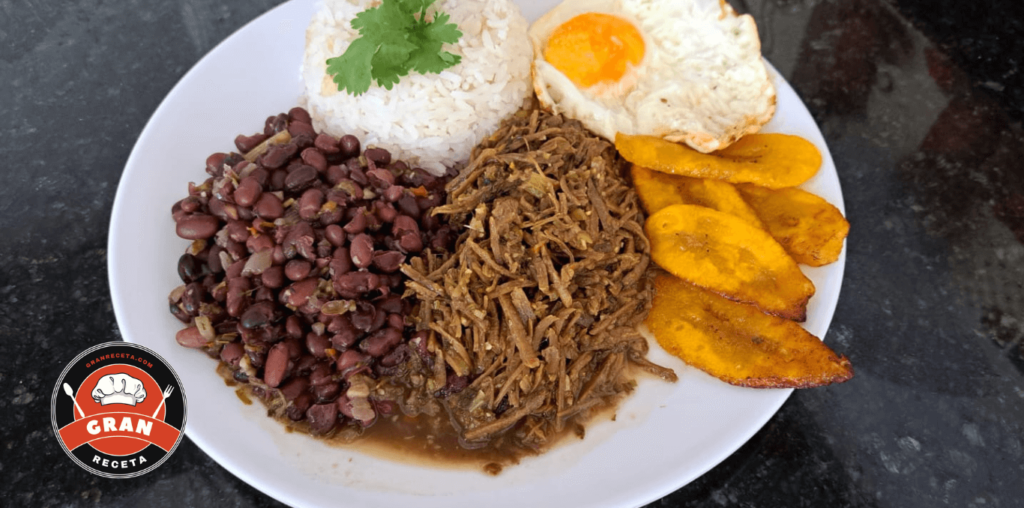
Pabellón criollo, Venezuela’s national plate, is 4 separate dishes served side by side and never stirred together: shredded flank steak, black beans, white rice and fried sweet plantain, laid out like the colors of a flag. None of the four is a garnish, and that’s why a plate runs 808 calories, split almost evenly across all four of them. It takes 3 hours start to finish but only about 60 minutes of actual work, because three pots run at once, and the piece that decides everything is the flank steak: it needs a full 2 hours before it will shred into threads.
How do you make pabellón criollo? Simmer 1½ lb of flank steak 2 hours and shred it with two forks, then stew it with a sofrito of onion, ají dulce and tomato. Separately cook 10 oz of black beans soaked overnight, a pot of white rice, and slices of very ripe plantain fried until golden. Plate each component apart. Three hours, 180 minutes, for 6 servings.
What pabellón criollo is, and what the 4 parts are
The Spanish Wikipedia describes the plate as resembling a flag, the colors of its four components set next to each other. The same entry runs through the origin theories, none of them firmly documented, and flags the popular reading that assigns each component to a culture (rice to the European, beef to the Indigenous, beans to the African) as “merely poetic”. So there’s little to say about the history and quite a lot about the technique.
What defines it is that the four preparations are cooked separately and served without touching. In a Caracas arepera you’ll get it with the plantain slices standing on end around the rim; that’s pabellón con barandas, with railings.
What to buy, and the two choices that matter
Everything here is in a US supermarket except the ají dulce. Two choices decide the plate. The first is the beef cut: it has to be full of collagen, so flank, brisket or skirt. Lean round or sirloin will cook but never shred, because there’s no collagen to turn into gelatin and release the fibers. The second is the plantains: they need to look past their prime, skins mostly black. Per USDA, a ripe plantain has 17.5 g of sugar per 100 g against 2.3 g in a green one, and that sugar is what caramelizes in the pan.
Ají dulce is the flavor you can’t buy here. It looks like a habanero and has no heat at all, with a sweet, almost floral aroma; mini sweet peppers with a pinch of sugar get you closest. And papelón is unrefined cane sugar, sold as piloncillo in the Latin aisle; dark brown sugar works.
The beef, 2 hours and not a minute less
Flank is a working muscle, dense with collagen, and that’s the whole point. Before the hour-and-a-half mark the fibers hold together and the meat fights the fork; by the two-hour mark the collagen has turned to gelatin, the fibers let go and the meat shreds itself. Past 3 hours it goes the other way, into limp mush that disappears into the stew. A pressure cooker reaches the same point about 45 minutes after coming to pressure.
Three details do most of the work:
Cook it whole, not cubed. Cubes lose juice from every side and give short shreds. The flank goes in whole and gets pulled apart afterward.
Shred it warm. Ten minutes out of the pot.
Keep the broth. A ladle of the cooking liquid goes back into the stew at the end, and it’s the difference between juicy and dry. Pouring it down the sink is the most common waste in this recipe.
Where the calories are
This is the part that surprises people: the four parts weigh in about the same, so there’s no “light” component to help yourself to twice. Calculated from the USDA database on this recipe’s ingredients, a plate lands at 808 kcal, with more protein than a chicken breast and most of its fiber coming from the beans.
If you need to bring it down, dropping the plantain leaves it near 650 kcal and dropping the rice takes off a little more. I’d rather serve less of everything than cut one out; a pabellón without plantain is a different plate.
The beans, soaked overnight and salted last
Black beans go into cold water the night before, covered by 2 inches. That soak hydrates the bean from the inside and gets them cooking in 90 minutes; without it they can take twice as long and cook unevenly, some done and some hard.
Salt goes in at the end, once they’re soft, because in salted water the skin firms up and the bean takes longer to soften. Salt, sofrito and papelón all go in during the last 15 minutes, which is also when the beans thicken. The tablespoon of papelón doesn’t make them sweet; it rounds off the acidity of the tomato in the sofrito. Some eastern Venezuelan families double it, and those beans are noticeably sweet.
Three pots at once
The 3 hours look worse than they are. The beef and the beans start within 10 minutes of each other and then cook unattended for an hour and a half, and that gap holds the two sofritos, the rice and the plantains. Actual hands-on time is about an hour.
The order I use: flank into the pot, drained beans into another, and walk away. At the 90-minute mark I make both sofritos, shred the beef and start the rice. Plantains are last, because cold ones lose everything.
Who this recipe is for
- If you’re short on time → pressure-cook the beef, 45 minutes at pressure, and use canned beans rinsed well; the plate comes down to about an hour
- If it’s your first time → cook the beef and beans the day before; both taste better reheated and you’re left with rice and plantains on the day
- If you can’t find ají dulce → half a red bell pepper finely chopped with a pinch of sugar
- If you want it “a caballo” → a fried egg on each plate, which adds about 90 calories
- If you’re cooking for a crowd → double everything except the rice water, which always stays at twice the volume of the rice
What goes wrong
Cubing the beef before cooking. It comes out dry and in short pieces. Whole in the pot, shredded after.
Salting the beans early. The skins firm up and the beans take twice as long. Salt in the last 15 minutes.
Frying under-ripe plantains. No sugar, no caramel: pale, firm slices that taste green. The skin should be mostly black.
Throwing out the beef broth. It’s what makes the stew juicy, and it costs nothing to keep.
Mixing it all in the pot. Pabellón is assembled on the plate. Stirred together it becomes a beef stew with rice.
Pabellón, ropa vieja and bandeja paisa
If you know Cuban ropa vieja, you know the beef: same cut, same shredding, different seasoning, and it’s usually served over the rice rather than beside it. The Colombian bandeja paisa is the maximalist cousin, a single platter with beans, chicharrón, chorizo, egg, avocado and an arepa that runs about three times the calories. Pabellón is the restrained one. Its parts also work on their own: the Colombian shredded beef is the same technique with a heavier sofrito, and leftover beef with rice is the filling for Colombian empanadas the next day.
Storage and what reheats well
Keep the components separate and they behave differently. The beef and the beans keep up to 4 days in the fridge, according to the USDA window for cooked dishes, and both are better the next day. Rice keeps the same but needs to be refrigerated within 2 hours. Plantains don’t keep: they go soft and lose the caramelized edge, so fry them to order.
Beef and beans freeze well for 3 months; rice, less happily; plantains, not at all. Reheat the beef with a spoonful of its broth and the beans with a splash of water, both covered.
Questions people ask
What cut of beef should I use? Flank is the classic; brisket and skirt work too. All are collagen-rich cuts that fall into threads with a long simmer. Lean cuts like round dry out before they ever shred.
How long does the beef need? Two hours at a gentle simmer, or about 45 minutes in a pressure cooker once it’s up to pressure. At 90 minutes it still breaks into chunks rather than threads.
Can I skip soaking the beans? You can, but they take twice as long and cook unevenly. The quick soak works: boil 2 minutes, turn off, cover and wait an hour.
Why is it called pabellón criollo? Per the Spanish Wikipedia, because the four components lined up look like a flag. The readings that assign each part to a culture are described by that same source as poetic rather than historical.
What is pabellón a caballo? The same plate with a fried egg on top, the version you order in an arepera. It adds about 90 calories.
How many calories is a plate? About 808, calculated from the USDA database on this recipe’s ingredients. Without the plantain, around 650.
Nutrition
Per serving, one sixth of the four preparations, from the USDA database: about 808 kcal, 114 g carbohydrate, 20 g fat of which 6 g saturated, 42 g protein, 12 g fiber, 20 g sugar from the ripe plantain and papelón, and 850 mg sodium.
It’s a complete, substantial plate, with the protein split between the beef and the beans and nearly all the fiber coming from the beans. The fat is lower than it looks, because trimmed flank carries 6.3 g per 100 g per USDA and nearly everything else is cooking oil.
The beans on the plate have their own recipe, with the panela and the sweet peppers: Venezuelan black beans.
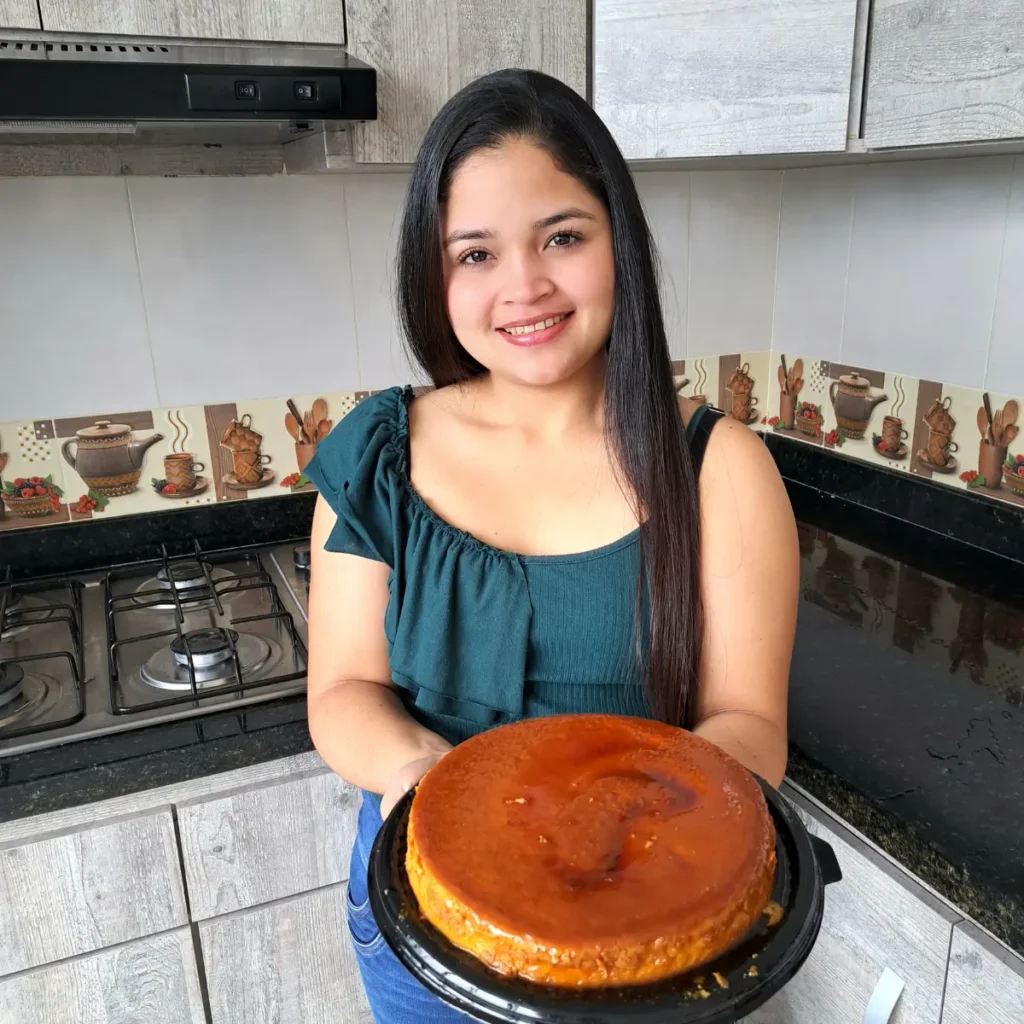
Pabellón is what I cook when someone asks me about Venezuela. Here in Colombia people look at the plate and compare it to the bandeja paisa, and they’re right about the size and the plantain and wrong about everything else: the bandeja piles six things on one platter, and the pabellón is four and that’s it. Dessert is Venezuelan quesillo and then the table is complete. Josnaisis.