
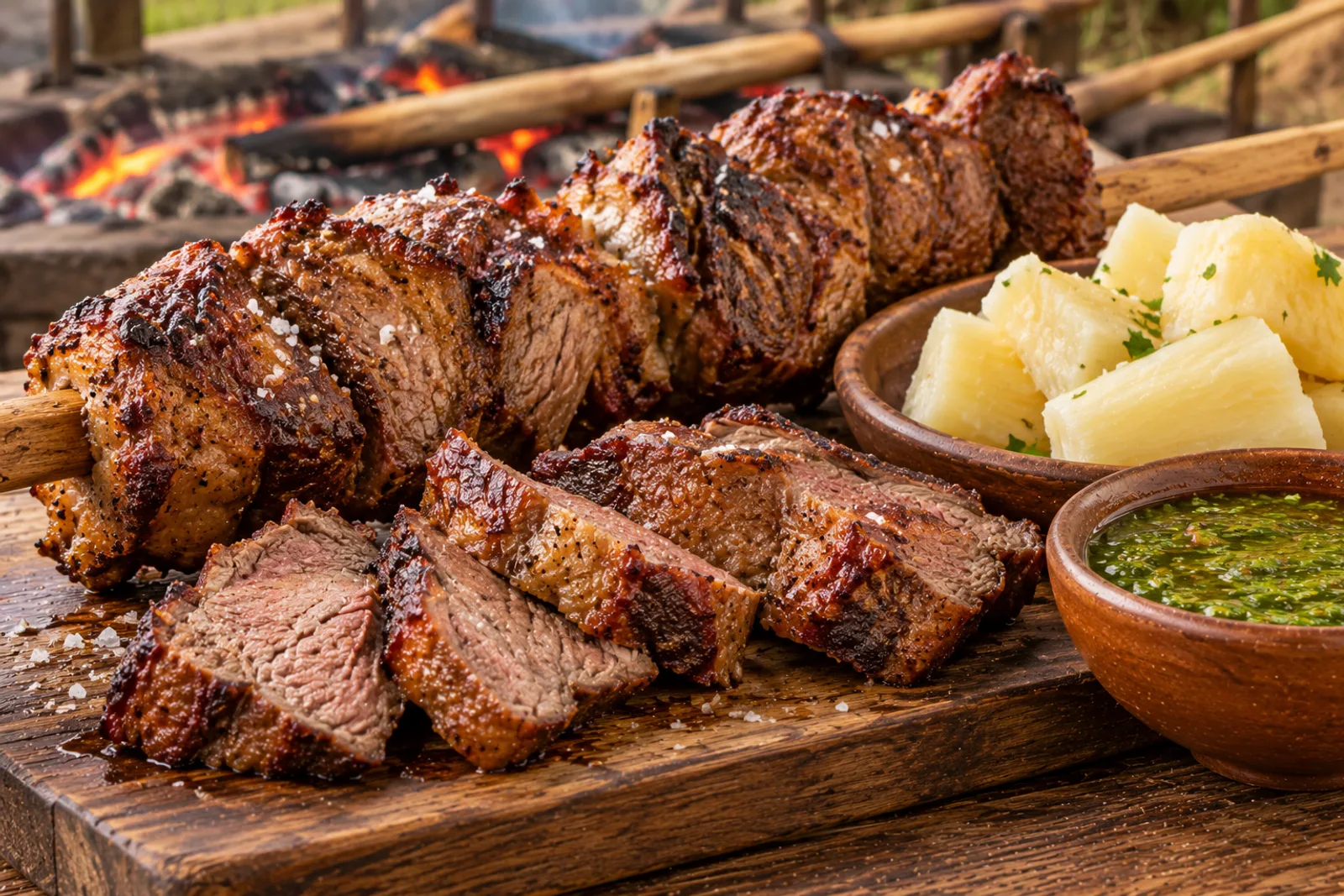

Carne en vara (CAR-neh en VAH-rah, “meat on a stake”) is the barbecue of Venezuela’s Llanos, the hot cattle plains that run into eastern Colombia. Big pieces of beef are salted, threaded onto stakes and planted in the ground beside a wood fire, where they cook from the side for hours. There’s no marinade, no rub, no sauce on the meat. This home version keeps all of that except the stakes: two butcher’s cuts, coarse salt the night before and 300°F (150°C) of indirect heat on a lidded grill or in the oven, for 8 people.
What carne en vara is and what to expect
How do you make carne en vara at home? Salt 3¼ lb (1.5 kg) of beef short ribs and a 2⅔ lb (1.2 kg) picanha with coarse salt the night before and leave them uncovered in the fridge. Cook them over indirect heat at 300°F (150°C) with the lid down: the ribs 3 to 4 hours until tender, the picanha to 131°F (55°C), then sear it over the coals and rest it 15 minutes. 995 minutes for 8 servings, counting the 12 hours of salting.
It comes out with a golden, salty crust, rib fat that has gone soft, and meat that tastes of beef and smoke rather than seasoning. The low, sideways heat is the point: it’s what turns a tough, fatty cut like short ribs tender without burning the outside.
If you’ve seen ternera a la llanera, the Colombian stake-roasted veal, it’s a close cousin: the same fire and the same salt, but young veal in big plains-style pieces, about 8 kg (18 lb) for a crowd of 20. Carne en vara at home is grown beef, two cuts from a good butcher, and a backyard grill.
Time and effort. About 16½ hours start to finish, but only 15 minutes of work the night before and about 30 on the day. Medium difficulty: nothing is technically hard, but the grill has to hold 300°F (150°C) for 4 hours and the picanha has to come off at the right temperature.
The two cuts, and what to ask for
Plan on 12 oz (340 g) of raw, bone-in meat per person, which gives about 7½ oz (215 g) of cooked meat on the plate.
| Cut | US name | UK name | What it brings |
|---|---|---|---|
| Punta trasera | Picanha, top sirloin cap, coulotte | Rump cap, picanha | Lean slices with a fat edge |
| Costilla de res | Beef short ribs | Short ribs, Jacob’s ladder | Fat, bone and meat that falls apart |
- Picanha. Ask for it whole, 2 to 3 lb (1 to 1.5 kg), with its ⅜ in (1 cm) fat cap left on. The fat protects the meat and is what browns; don’t let the butcher trim it. In the US, Brazilian and Latin butchers usually sell it whole; in the UK, ask for rump cap.
- Short ribs. Strips of 2 or 3 bones with plenty of meat on top. Thin flanken-cut ribs for fast grilling won’t work here; they dry out before they soften. Huge whole plates take twice as long.
- Only one cut? All short ribs, 6 lb (2.7 kg), is richer and juicier. All picanha, 4½ lb (2 kg), has no bone, cooks in about 1½ hours and slices more neatly.
How much salt, and why the night before
Only coarse salt, about 7.5 g per kg of meat: 20 g (0.7 oz) for the 6 lb (2.7 kg) in this recipe. Salted the night before, it has 12 hours to work its way in; salted at the last minute, it seasons the crust and leaves the middle bland. Leaving the meat uncovered dries the surface, and a dry surface is what browns.
Weigh it if you can. Kosher brands differ a lot by volume: a teaspoon of Morton weighs nearly twice what a teaspoon of Diamond Crystal does, and table salt is denser still. If you’re using a spoon, the 20 g in this recipe is about 4 tsp of Morton kosher salt.
How much meat for your crowd
Equipment. A charcoal or gas grill with a lid and room to keep the meat away from the fire, or your oven; an instant-read thermometer; long tongs and a big carving board. If your grill lid has no gauge, an oven thermometer on the cool side tells you whether you’re at 300°F (150°C).
Setting up the fire
On the plains, the stake leans beside the coals and never over them. At home, that’s indirect heat:
- Charcoal kettle. Light the coals; when they’re covered in white ash, about 30 minutes, bank them on one side. The meat goes on the other side, lid down, vents half open. Add a handful of coals every hour.
- Gas grill. Light the burners on one side only, at medium-low, and put the meat over the unlit side.
- Oven. 300°F (150°C), conventional rather than fan if you can choose, with the meat on a rack over a sheet pan. You lose the smoke, not the texture.
Either way, aim for 285 to 320°F (140 to 160°C) where the meat sits. Hotter, and the crust darkens before the ribs soften; cooler, and the cook drags on while the meat dries out.
The cooking day, minute by minute
The ribs go on first because they take twice as long. The picanha goes in when the ribs have had about 2 hours, so both finish within minutes of each other.
How to tell each cut is done
The clock is only a guide here. Push the thermometer in from the side to the center of the thickest part, away from the bone.
- Picanha. When it reads 131°F (55°C) on the cool side, move it over the hottest coals and sear 2 to 3 minutes per side, fat cap first, to 140°F (60°C). A 15-minute rest carries it to about 145°F (63°C): pink in the middle and at the safe minimum for a whole cut of beef. On the plains it’s eaten more done; for that, pull it at 158°F (70°C). The fat cap keeps it from tasting dry.
- Short ribs. Pink is no use here: the connective tissue that makes them tough only breaks down after hours of heat. They’re ready at 200 to 205°F (93 to 96°C), when a skewer slides between the bones like it’s going into butter and the meat has shrunk back from the bone ends. If they still resist at 3 hours, give them another 30 minutes and test again.
Resting and carving. The picanha rests 15 minutes on a board, loosely covered, so the juices settle and the crust stays crisp. Slice it ⅜ in (1 cm) thick across the grain: the grain shows as lines in the meat, and your knife should cut across them, not along them. The ribs rest 10 minutes and are cut between the bones. If you like a bright, juicy steak you can carve at the table, Mexican carne asada is the fast, marinated opposite of this one.
Cooking it on real stakes
With a yard, firewood and a safe spot for an open fire, the plains method works with these same quantities. Use dry hardwood such as oak (on the plains, local hardwoods like guamo or yopo) and never pine or other resinous wood, which leaves a bitter taste. Burn it down to ash-covered embers with no flames, which takes about 1 hour.
- Stakes. Green hardwood or iron rods. Thread the ribs between the bones and the picanha end to end.
- Angle. Lean them about 45° beside the embers, meat facing the fire.
- Distance. Hold your palm where the meat is. If you can keep it there 8 to 10 seconds before you have to pull away, the heat is right. Under 5 seconds, move the stake back.
- Turning. Turn the stakes every 30 to 40 minutes and feed the embers with small pieces of wood; a big log flares up.
Timings and internal temperatures are the same as on the grill: 3 to 4 hours for the ribs and the thermometer for the picanha.
What goes wrong, and how to fix it
- Flare-ups under the meat. Dripping fat catches, flames jump and the crust burns while the middle is still raw. Meat goes beside the fire, never above it.
- Lifting the lid all the time. Each look drops the temperature and stretches the cook. Open it only to turn, add fuel or take a reading.
- Pulling the ribs at 2 hours. They might read 160°F (70°C) and still be tough. The skewer test decides, not the clock.
- Stabbing with a fork. Every hole lets juice out. Use tongs.
- Carving the picanha straight away, or with the grain. The juice ends up on the board and the slices chew like rubber.
- Ribs still tough at the end. Wrap them in foil with 3 tbsp water, put them back on the cool side and test every 30 minutes.
What to serve with it
On the plains it comes with boiled cassava (yuca), the same cassava that gets crisped up for fried yuca; Venezuelan guasacaca, the tangy avocado and herb sauce spooned over the beef; corn bollitos; and a tomato and onion salad. Sweet, baked plantains with cheese, Venezuelan cachapas or arepas are just as common. Make the guasacaca while the ribs cook; it keeps 2 days in the fridge.
Scaling up. Use the per-person amounts in the chart above. Timings stay the same as long as all the meat fits in one layer on the cool side; if it doesn’t, run two grills, or the grill and the oven together.
Storing and reheating
- Fridge. Into a sealed container within 2 hours, then 3 to 4 days at 40°F (4°C) or below.
- Freezer. 2 to 3 months, sliced or shredded and wrapped well.
- Reheating. Covered skillet over medium heat with 2 to 3 tbsp water or stock, 4 to 6 minutes, until it reaches 165°F (74°C) in the middle. Leftover rib meat is good shredded into Venezuelan pisillo or stuffed into arepas.
Frequently asked questions
What does “en vara” mean? “On a stake.” The meat is skewered on a long wooden or iron rod and planted in the ground beside the fire.
Is it the same as Brazilian churrasco or Argentine asado? It’s related, since picanha is the star of churrasco and asado also cooks beside the fire, but carne en vara is cooked longer and lower, with salt alone and no chimichurri on the meat. In Venezuela the sauce is guasacaca, served at the table.
Can I do this on a grill without a lid? Only if you can keep the coals on one side and the meat on the other. Without a lid the heat escapes, so it takes longer and you’ll need to turn the meat every 20 to 30 minutes. An upside-down sheet pan over the meat holds in some heat.
Can I use beef back ribs instead of short ribs? Yes, but back ribs have much less meat between the bones, so you get more crust and less to eat. They’re thinner, so start testing earlier, around 2½ hours.
Nutrition
Per serving, one-eighth of the meat (about 7½ oz / 215 g cooked, no sides), worked out ingredient by ingredient from the quantities above:
- Calories: 732 kcal
- Protein: 52 g
- Carbohydrates: 1 g
- Fat: 57 g, of which 23 g saturated
- Fiber: 0 g
- Sugars: 0 g
- Sodium: 1120 mg
The short ribs supply 60% of the calories through their fat; all-picanha brings the number down a lot. Sodium assumes you eat every grain of salt in the recipe, and some stays on the pan and the crust you trim, so the real figure is lower.
I put the picanha on fat side up and leave it alone until the sear, because as it cooks the fat melts down over the meat and there’s nothing else to do. And I pull the ribs by the skewer, never the clock: I’ve had one strip ready at 3 hours while the one next to it needed another half hour. Josnaisis.