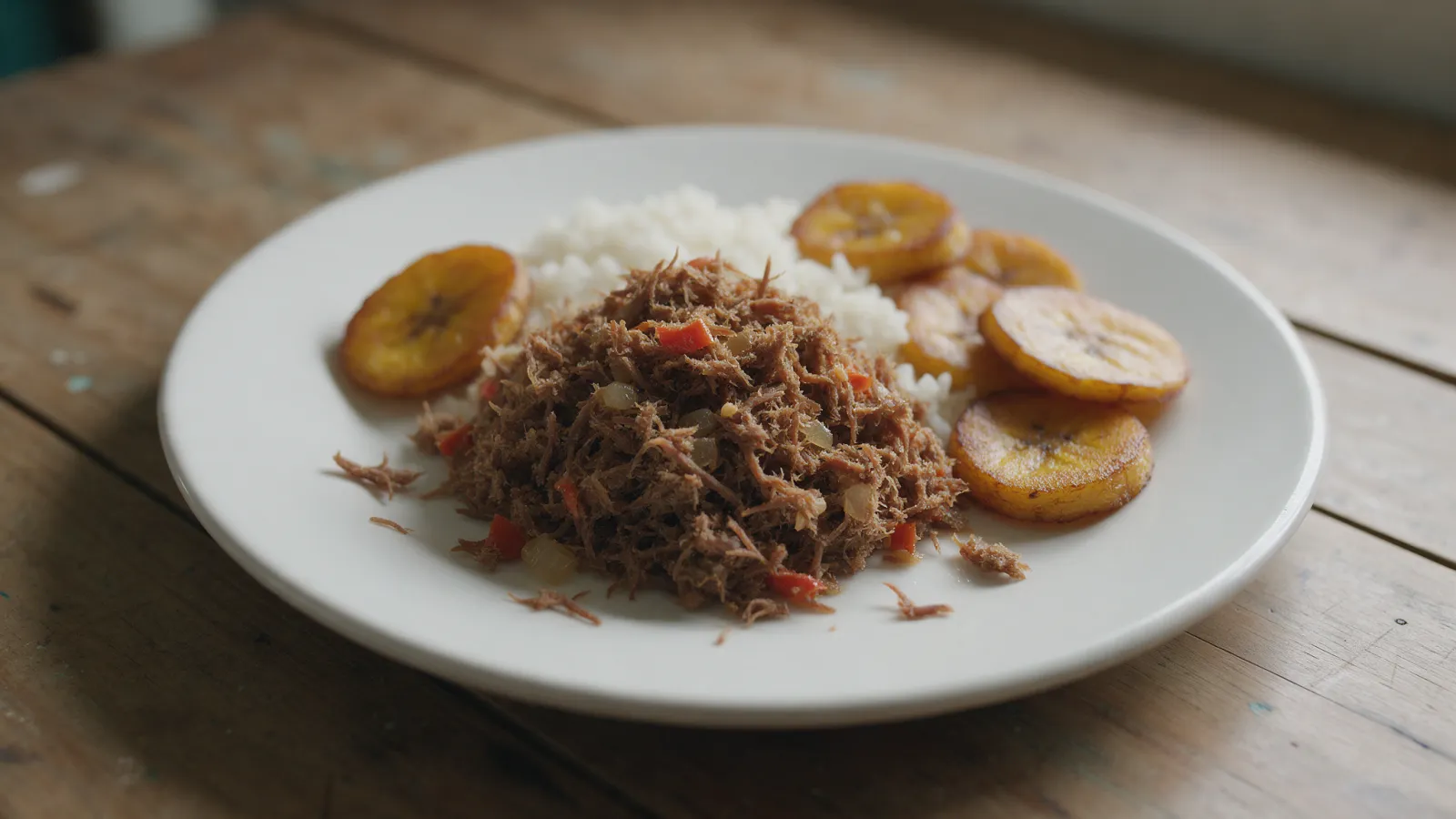

Most shredded beef recipes, from Cuban ropa vieja to Venezuelan carne mechada, stop while the meat is still sitting in sauce. Pisillo (pee-SEE-yoh) keeps going. It comes from the Llanos, the cattle plains shared by Venezuela and Colombia, where it was a way to use beef that had been salted and dried in the sun: the meat is simmered, pulled into threads so fine they look almost ground, then fried with onion, sweet peppers, cumin and annatto until every drop of liquid is gone. What you get is closer to a seasoning you eat by the spoonful than to a stew, and it keeps for days.
What is pisillo, and how is it different from ropa vieja?
How do you make Venezuelan pisillo? Simmer 2.2 lb (1 kg) of flank steak for 2 hours, let it cool slightly and pull it apart by hand into very fine threads. Fry onion, ají dulce, garlic, cumin and annatto in oil, add the beef and 1 cup (240 ml) of its broth, and cook over medium-low heat for 30-35 minutes, stirring, until it is dry, loose and glossy. 205 minutes for 6 servings.
If you know Cuban ropa vieja or Venezuelan carne mechada, the one on a pabellón criollo plate, you know where pisillo starts. Both of those finish juicy, in a tomato sauce, with medium-thick shreds. Pisillo has no tomato in my Venezuelan version, the threads are as thin as you can make them, and the last half hour or so in the skillet is spent drying the meat until it separates on its own. The result is salty, savory and a little sweet from the peppers, with crisp edges here and there, and it doesn’t wet the plate or the dough around it.
The same method is used for other meats. In the Llanos the classic is pisillo of chigüire, the capybara, which is sold salted around Easter in Venezuela; Atlas Obscura tells the story of how the animal came to be treated as fish for Lent. On the coast there is pisillo de pescado, made with salted fish, often as an empanada filling. In the east, the sea version everyone knows is cazón guisado, a shredded shark stew dried in the pan the same way. This recipe is the beef version you can make anywhere.
Ingredients, and what to buy in the US and UK
For 6 servings you need 2.2 lb (1 kg) of beef, 10½ oz (300 g) of onion, 2 oz (60 g) of ají dulce, a few garlic cloves, 1 tsp each of cumin and annatto, 3 tbsp of oil and 1 cup of the cooking broth. Full quantities are in the recipe card.
| Ingredient | What it is | US swap | UK swap | What changes |
|---|---|---|---|---|
| Falda (flank) | Long-grained beef cut that shreds into thin threads | Flank steak, or chuck roast | Bavette (flank), or chuck / braising steak | Chuck is fattier and a little coarser, still very good |
| Ají dulce | Small, aromatic pepper with no heat | Caribbean or Latin markets, sometimes as ají cachucha | Online or in Caribbean shops; hard to find | ½ red bell pepper gives color and sweetness, not the perfume |
| Onoto | Annatto seeds, ground or fried into oil for color | Ground annatto or achiote in the Hispanic aisle | Online or Latin shops | ½ tsp sweet paprika gives the color, slightly sweeter |
| Carne salada | Beef salted and dried in the sun | Cecina or tasajo in Latin markets | Rarely sold; use fresh beef | Fresh beef gives a milder, juicier pisillo |
Two warnings. Seasoning packets labelled “with annatto” usually contain salt and MSG, and the recipe already has its salt, so check the label. And corned beef or UK salt beef are brined and spiced, not dried; they turn pink and taste of pickling spice, so they are not a stand-in for carne salada.
Which cut of beef to buy
Flank is what I use: long, thin fibers, some fat and collagen, and it falls apart after 2 hours of simmering. Of the cuts the US Bureau of Labor Statistics tracks, chuck roast is the one that shreds finest. Round is leaner and cheaper, and after 35 minutes of drying it tastes like sawdust.
Equipment
A 4-5 quart (4-5 liter) pot, a meat mallet and, above all, a 12-inch (30 cm) skillet or wide Dutch oven. In a 9-10 inch pan the beef piles up, steams and never dries. No mallet? The base of a small saucepan works. No wide pan? Dry it in two batches.
How to make pisillo, step by step
The method is three stages: simmer, shred, dry. Only the last two need you.
Shredding it fine, by hand or by machine
Pound the cooked beef to about ¾ inch (2 cm) first. It opens the grain and halves the work. Then pull it apart with your fingers, like separating thread.
These times are from my own kitchen with 2.2 lb (1 kg) of warm flank. Forks are fine if you’ll do a second pass. The stand mixer paddle is what I use when I’m cooking for 15. The food processor only works with one-second pulses and a small handful at a time.
Drying it without burning it
This is the step that turns cooked beef into pisillo. Keep the heat at medium-low and stir every couple of minutes, scraping the bottom. Both llanero recipes I checked ask for the same thing, low heat and constant stirring until the meat is dry, golden and glossy, which takes roughly half an hour to forty minutes.
How to tell each stage is right.
- Simmered beef → after 2 hours a fork goes in with no push and the grain opens. If not, give it 20 more minutes.
- Sofrito → onion soft and translucent at 10 minutes, no dark edges; the oil looks red from the annatto.
- Minute 10 → still saucy, like ropa vieja.
- Minute 20 → the pan is dry, but the threads are soft and clumped.
- Minutes 30-35 → a spoon dragged through the pan leaves a dry line, the threads fall apart and shine. Done.
Who this recipe is for
- If you like intense, savory meat → this is it, and it keeps better than any saucy shredded beef.
- If you want a filling that won’t make dough soggy → empanadas and arepas are where pisillo beats mechada.
- If you want it juicy, with sauce → make Colombian shredded beef instead, which stews 15 minutes in hogao.
- If you can’t stand at the stove for 35 minutes → cook and shred the beef the day before and save the skillet for serving day.
Make-ahead plan, scaling and freezing
205 minutes start to finish, about 95 hands-on. The vegetables get chopped while the beef simmers, so what really adds up is the shredding and the skillet.
The day before. Simmer and shred the beef and keep it covered in the fridge, with the cup of broth in a separate jar. Serving day is then 45 minutes: 10 for the sofrito and 35 to dry.
Scaling. Plan on about 6 oz (170 g) of raw beef per person. For 4, 1½ lb (700 g) and two thirds of the sofrito; for 8, 2¾ lb (1.3 kg); for 12, 4½ lb (2 kg); for 20, about 7½ lb (3.5 kg). Simmering times don’t change if the beef goes in as 2-lb pieces. The skillet is the bottleneck: more than 2.2 lb (1 kg) in a 12-inch pan steams instead of drying, so for a crowd dry it in batches or in two pans at once.
Freezing. Pisillo is one of the best meats to freeze because it has so little water. Pack it flat in freezer bags of 10-14 oz (300-400 g); it keeps its quality for 2-3 months, according to USDA FSIS guidance for cooked meat. Thaw it in the fridge overnight.
Mistakes that ruin pisillo
- It stays wet, like ropa vieja → the pan was too small or the heat too low. Spread the beef 1 inch (2-3 cm) deep and give it 10 more minutes.
- It tastes like sawdust → too lean a cut, or more than 45 minutes in the pan. A tablespoon of oil and two of broth at the end half-rescue it.
- The bottom scorches → high heat to finish faster. Medium-low, and scrape every 2-3 minutes.
- Thick, tangled threads → shredded hot, or with forks. Pound first, shred warm, use your fingers.
- Too salty → salt added to salted beef, or to both the water and the pan. With fresh beef the simmering water stays unsalted and you taste before the last ½ tsp.
Heat level, 0 out of 5. Ají dulce has no heat; put hot sauce on the table if your family wants it. Kids usually like it, since it’s mild and the fine threads are easy to chew. Allergens: no gluten, dairy, egg, nuts or fish, unless a seasoning packet adds them.
Variations
- With salted beef, the old llanero way. Cut it into 1½-2 inch (4-5 cm) chunks, since thickness matters more than hours, and soak it 8-12 hours in the fridge, changing the water every 3-4 hours. Boil 10 minutes, throw that water away, then simmer in fresh water for 60-90 minutes until it falls apart. Boil a scrap for 5 minutes and taste it before adding any salt.
- Instant Pot or pressure cooker. 45 minutes at high pressure and a 10-minute natural release instead of the 2-hour simmer. The drying always happens in a skillet. Total time drops to about 140 minutes.
- Lighter. Use 1½ tbsp of oil instead of 3 and trim the flank well: about 30 kcal less per serving and fat down to about 14 g. It shines less, so stir more often.
- Vegetarian. There is no real meatless pisillo, but 1⅓ lb (600 g) of oyster mushrooms pulled apart by hand and dried 15 minutes with the same sofrito gets close in texture, with much less protein.
- Colombian Llanos style. In Arauca it is made with capybara, scallions, red bell pepper and cilantro, and served with beans, white rice, cassava bread or boiled cassava.
What it costs
With BLS average prices for August 2026, 2.2 lb (1 kg) of chuck roast at $9.45 a pound comes to about $20.83, or $3.47 a serving for the beef. Onions, peppers, garlic, oil and spices add little and have no current BLS series, so I left them out. Flank steak has no BLS series either; at most stores it costs more than chuck. In Bogotá, with the DANE SIPSA wholesale prices for September 12-18, 2026, the whole pot comes to 30,483 Colombian pesos, about 5,081 a serving, and the beef is 96% of it. I found no reliable source for prices in Venezuela.
Yield. 2.2 lb (1 kg) of raw flank gives about 1½ lb (650 g) shredded, and after drying, with the sofrito, I end up with roughly 1¼ lb (550 g): 6 servings of about 3 oz (90 g) with rice and plantains, or around 20 medium empanadas.
What to serve with pisillo, and how to store it
In the Llanos it goes with white rice or beans, cassava bread or boiled cassava, and fried plantains, ripe or green. At home I serve it with Colombian-style white rice, Venezuelan black beans and fried sweet plantains, with a spoonful of guasacaca, the Venezuelan avocado sauce, for anyone who wants something wet on the plate. It is also an excellent filling for Venezuelan cornmeal empanadas. For the other side of Llanos beef, cooked over open fire with nothing but salt, see Colombian llanero beef.
Fridge. According to USDA FSIS, no more than 2 hours at room temperature, then 3-4 days at 40°F (4°C) or below in a closed container.
Reheating. In a skillet over medium heat with 2-3 tbsp of water or broth per 2 cups, stirring 4-5 minutes until it reaches 165°F (74°C). In the microwave, cover it and add the water too, or it dries further.
Frequently asked questions
What is pisillo? Beef (or salted beef, capybara or fish) that is cooked, shredded very finely and fried with onion, sweet peppers and spices until dry. It comes from the Llanos of Venezuela and Colombia.
Is pisillo the same as carne mechada or ropa vieja? No. Mechada and ropa vieja have medium shreds and finish juicy in tomato sauce after about 15 minutes. Pisillo has nearly ground threads, no tomato in the Venezuelan version, and dries for about half an hour until loose.
What cut of beef is best for pisillo? Flank, or chuck if flank is expensive. Brisket works too. Lean round dries out like sawdust.
How long do you soak salted beef? I cut it into 1½-2 inch chunks and soak it 8-12 hours in the fridge, changing the water every 3-4 hours, then discard the water from a first 10-minute boil.
Can I make pisillo in an Instant Pot? The beef, yes: let it release naturally for 10 minutes after 45 at high pressure. The drying has to happen in a wide skillet.
What does pisillo taste like? Salty and savory, sweet from the onion and ají dulce, earthy from the cumin, with toasted edges. No sauce.
Can you freeze pisillo? Yes. In flat freezer bags it stays at its best for up to 3 months. Reheat in a skillet with a splash of water or broth.
What is capybara pisillo? The Llanos version made with chigüire, the capybara, eaten in Venezuela especially around Easter, when it is sold salted.
Nutrition
Per serving (about 3 oz / 90 g of pisillo, without sides), calculated ingredient by ingredient from USDA FoodData Central (SR Legacy) using this recipe’s quantities and lean raw flank:
- Calories: 335 kcal
- Protein: 37 g
- Carbohydrates: 6 g
- Fat: 17 g, of which 5 g saturated
- Fiber: 1 g
- Sugars: 3 g
- Sodium: 680 mg
Almost all of that sodium comes from the salt in the pan; without it a serving has about 100 mg. The oil adds about 60 kcal per serving. With salted beef the sodium goes up by an amount nobody can calculate, because it depends on how much salt the soak pulls out.
Pisillo is the dish that taught me patience at the stove. For years I turned the heat up in the last ten minutes to get it done, and for years it came out scorched at the bottom and damp on top; now I set a timer for 35 minutes, put on music and stir. A dry pan is the whole recipe. Josnaisis.