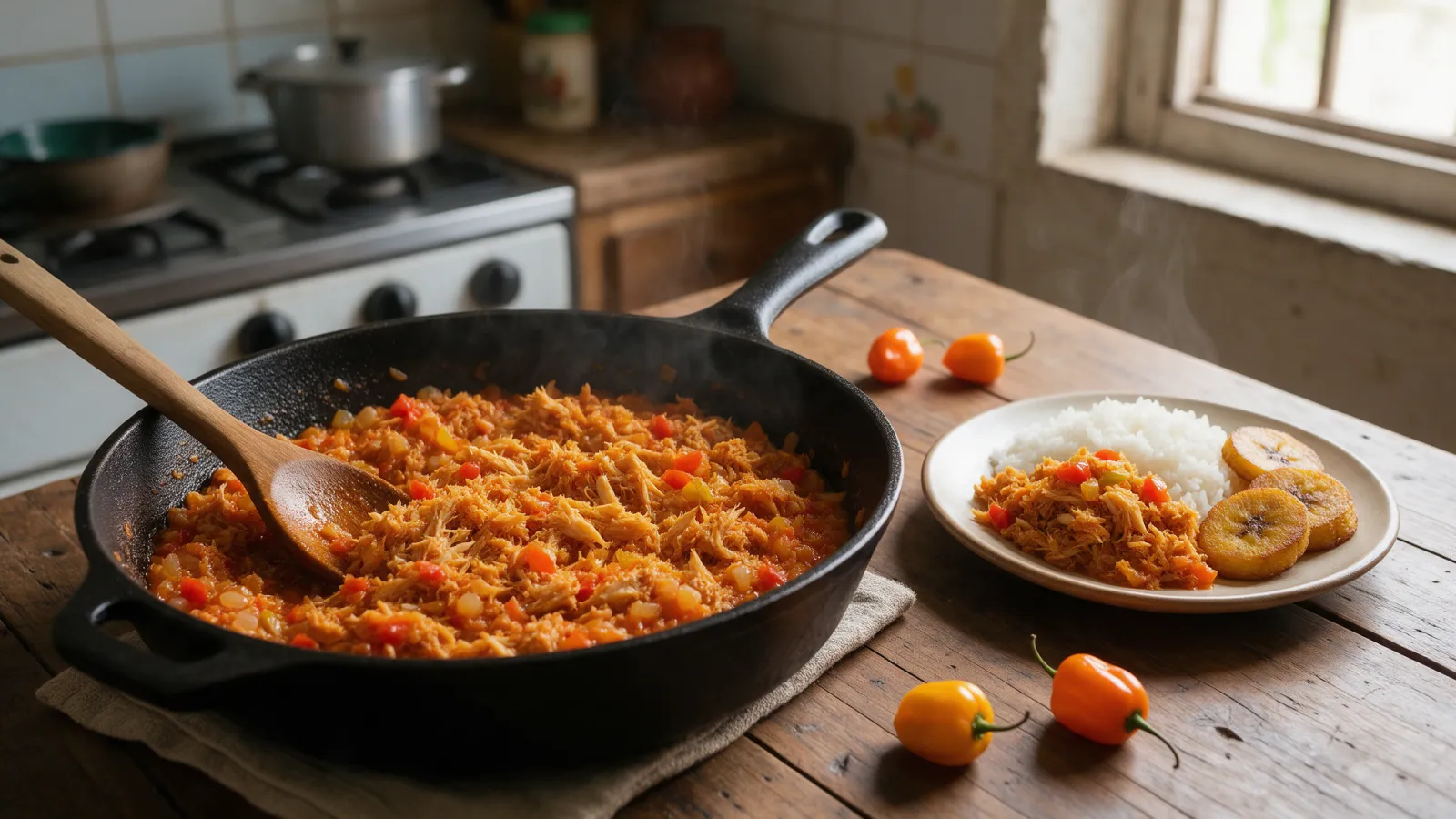

On Venezuela’s Margarita Island and along the eastern coast, the classic empanada filling isn’t beef or chicken but cazón (kah-SOHN), a small shark that’s poached, shredded and cooked down with sweet peppers, onion and annatto until it’s dry enough to fold into corn dough. The same stew is spooned into split arepas and served over rice. If you’ve never cooked shark, the thing nobody warns you about is the smell, and it has a simple chemical cause. I’ll walk you through that, plus what fish to use in a US or UK kitchen and why some people shouldn’t eat shark at all.
What is cazón guisado, and is it worth making?
How do you make Venezuelan cazón guisado? Soak small shark steaks 15 minutes in lime water, poach them 10 minutes, then shred the meat without skin or cartilage. Cook onion, red bell pepper, ají dulce, garlic and scallions in annatto oil, add the fish and a cup of the poaching water, and cook uncovered for 15-20 minutes until a spoon leaves a dry track in the pan. Ready in 80 minutes for 8 servings.
Cazón guisado means stewed cazón. In Venezuela, cazón isn’t a single species: it’s the market name for several small sharks. A University of Oriente study in the Revista de Biología Tropical looked at one of the most landed, the Brazilian sharpnose shark (Rhizoprionodon lalandii), under 5 feet (1.5 m) long, and called it one of the main ingredients of traditional dishes like cazón empanadas and arepas.
It’s worth making if you plan to make empanadas: one batch fills about 30 and freezes for months. The texture is the draw. Shark meat shreds into short, firm flakes that stay separate in the pan instead of collapsing into mush, and the ají dulce and annatto make it sweet, savory and bright orange.
Who it isn’t for. Anyone pregnant or breastfeeding, and young children, if you use real shark; I explain why under food safety. And it isn’t a quick weeknight dinner: 80 minutes, about 50 of them hands-on.
Honest difficulty, medium. Nothing is technical. What goes wrong is buying fish that already smells, leaving cartilage in, and stopping the pan too early, so the filling is wet and the empanadas burst in the oil.
What you need, with US and UK swaps
Exact amounts are in the recipe card: 2.2 lb (1 kg) of shark steaks, 2 onions, a red bell pepper, 10 ají dulce, 6 garlic cloves, a tomato and ¼ cup (60 ml) of annatto oil. The fish is the decision that matters.
Why shark smells like ammonia, and how to stop it
Sharks keep urea in their blood and tissues to balance the water in their bodies. After the animal dies, that urea breaks down into ammonia, which is where the sharp smell comes from. The FAO’s guide to shark fisheries says fishermen avoid it by bleeding the shark quickly, and that soaking the meat in a weak acid, citrus juice or vinegar, can remove up to 90% of the urea.
So my routine has three checkpoints:
- At the fish counter, smell it. Fresh shark smells like the ocean. If it smells of ammonia, the urea has already turned, and the soak only takes the edge off; the stew comes out with a bitter aftertaste.
- At home, 15 minutes in 1 liter (4 cups) cold water with the juice of 2 limes, then a rinse. Vinegar works too, ¼ cup (60 ml) per liter.
- While poaching, smell the water. If it’s strong, pour it out and cook the stew with fresh water instead.
The same FAO guide notes that the spiny dogfish, the small shark sold in the US as cape shark and in Britain under names like huss, has the lowest urea of the species measured.
Which fish to use outside Venezuela
Dogfish is the nearest thing to cazón, but in the US it’s rarely sold to home cooks, and it is shark, with the same mercury caution. Skate wings shred into longer strands and taste milder; figure about 2.9 lb (1.3 kg) of wings for 1¾ lb (800 g) of meat, the same ratio I use for the Venezuelan pastel de chucho, 1.6 kg of wings per 1 kg of meat. Cod, haddock or hake gives shorter flakes and a gentler flavor, and it’s what I’d cook for children. Tilapia or swai is the cheapest and releases the most water, so add 5 minutes in the pan. Salt cod makes a firm, very savory stew, but it needs a 24-36 hour soak in the fridge, and the salt in the sofrito drops to ½ tsp.
Ají dulce, annatto and the rest, translated
Ají dulce is a small, aromatic pepper with no heat, sold frozen in Latin grocery stores in the US and online; Puerto Ricans call it ajicitos dulces. The closest supermarket stand-in is a handful of mini sweet peppers: same color and sweetness, less perfume. Don’t use habaneros, which look alike and are fiercely hot.
Annatto (achiote, or onoto in Venezuela) comes as hard red seeds or ground, in the Latin or Mexican aisle; it colors the oil and adds a faint peppery note. No annatto? 1 tsp sweet paprika gives the color with a smokier taste. Scallions are spring onions in the UK. Cilantro is coriander leaf.
Equipment
A 3-4 quart (3-4 liter) pot, a tray for cooling the fish and a 12-inch (30 cm) skillet. The width matters more than anything else: in a 9-10 inch pan the stew piles up, steams in its own moisture and takes twice as long to dry. No wide pan? Dry it in two batches.
An 80-minute plan, and how to tell each stage is right
Soaking the fish and chopping the vegetables happen at the same time, and the poaching water goes on the stove at minute 0.
What you can do ahead. The poached, shredded fish keeps covered in the fridge until the next day, and so do the chopped vegetables. The whole stew made the day before tastes better and goes into the dough cold, which is how empanada dough wants it.
Signs each stage is right.
- Raw fish → smells of the sea, firm and glossy. Ammonia means walk away.
- Poached → after 10 minutes the flesh is white and opaque, flakes with a fork, and the skin slides off. On a thermometer, 145°F (63°C).
- Annatto oil → deep red-orange after 3-4 minutes. If the seeds go dark and smoke, start again.
- Sofrito → translucent onion, soft peppers, tomato melted into it, no loose liquid.
- Dry stew → a spoon leaves a dry track across the bottom of the pan, and a spoonful pressed against a plate releases no juice.
Drying the stew is the whole job for empanadas
Wet filling boils inside the dough when it hits oil at 350°F (175°C); the steam forces its way out and the empanada splits along the seam. That’s why the last 15-20 minutes uncovered can’t be shortened and why the filling goes in cold, after 30 minutes spread on a tray. The dough and frying are covered in my Venezuelan empanadas, which take about 1.4 oz (40 g) of filling each; at that size, this batch fills 28-30.
Scaling for 4, 8 or 20
- For 4 → 1.1 lb (500 g) of fish and half of everything else. Same times; drying drops to about 12 minutes.
- For 8, or 28-30 empanadas → the recipe as written.
- For 20, or about 70 empanadas → 5.5 lb (2.5 kg) of fish. Poach in two batches in the same water, and dry the stew in two skillets or a 6-quart Dutch oven for 25-30 minutes. Make it the day before.
Mercury, food safety, mistakes and allergens
Mercury first. Shark is one of the fish highest in mercury. The FDA puts it on its “Choices to Avoid” list for anyone who is or might become pregnant, who is breastfeeding, and for children aged 1 to 11. Spain’s food safety agency, AESAN, says the same for children under 10 and adds a limit of 120 g (about 4 oz) a month for ages 10 to 14. A serving of this stew holds about 3.5 oz (100 g) of fish. For those groups, make it with cod, haddock, hake or tilapia, all on the FDA’s “Best Choices” list.
Cooking temperatures. Fish is done at 145°F (63°C) per the USDA and FDA, or when it’s opaque and flakes. Raw lean fish keeps only 1-2 days in the fridge, so buy it the day you cook or the day before.
Mistakes that ruin it.
- It smells and tastes of ammonia → the fish arrived that way. The soak and fresh water help; next time, smell before buying.
- The filling soaks the dough → not enough time in the pan. Another 5 minutes uncovered, until the dry track, and fill it cold.
- Hard, crunchy bits → cartilage. Shred with your fingers, not a fork, and go over it again on the tray.
- Bitter → burnt annatto oil or old fish. Keep the annatto on low and strain it as soon as the oil turns red.
- Dry as sawdust → too long over high heat. Medium heat; if it’s gone too far, add 3-4 tbsp water and stir for 2 minutes.
Spice level, 0 out of 5. Ají dulce isn’t hot. If your family likes heat, keep it on the side; I put a jar of hot peppers in vinegar on the table for the empanadas.
Allergens. Fish. No gluten, dairy, egg or nuts; if you use achiote paste instead of seeds, check the label.
Which version should you make?
- Short on time → 1¾ lb (800 g) of cod or tilapia fillets, no soak or skin: poach 6 minutes and save about 20 minutes.
- For a party → 5.5 lb (2.5 kg) for about 70 empanadas, made the day before.
- For kids or pregnancy → the same recipe with cod, haddock or hake.
- The Margarita plate → the stew, juicier, with white rice, black beans and fried sweet plantain is the island’s take on the pabellón criollo, with shark instead of shredded beef.
- Saltier and firmer → salt cod, soaked 24-36 hours.
What it costs, and what makes it expensive
With frozen tilapia from Walmart at about $4.44 a pound and vegetables at the prices US grocers advertised in the USDA’s retail report for early October, the batch comes to roughly $14.75, or $1.84 a serving. The fish is 53% of that: 1¾ lb of tilapia is $7.82, onions $1.08, a red bell pepper $1.19, mini sweet peppers $0.81, garlic $0.24, scallions $0.99, a tomato $0.65 at the BLS average of $1.977 a pound, cilantro $0.97 and 2 limes $1.00. Oil, annatto and cumin aren’t included.
Shark itself is the hard number. Dogfish sells for very little at the dock in New England, but I couldn’t find a reliable retail price per pound, so I won’t guess one. In Colombia, where I live, the same pot made with tilapia costs about 2,212 pesos a serving at Bogotá wholesale prices.
Yield. In my kitchen, 2.2 lb (1 kg) of skin-on steaks gives about 1¾ lb (800 g) of meat and roughly 2.4 lb (1.1 kg) of finished stew: 8 plates of 4.5 oz (130 g) over rice, or 28-30 empanadas.
Serving, storing and freezing
How it tastes. Short, firm, separate flakes, orange from the annatto, sweet from the ají dulce and onion, with a fish flavor stronger than cod’s. Dry, not oily.
How it’s served. Fried into empanadas, hot, with guasacaca or hot sauce on the side. Warm, inside a split arepa. Or on a plate with white rice, Venezuelan black beans and fried ripe plantain. If you like this dry, shredded style, Venezuelan pisillo does the same thing with beef.
Fridge. Cooked fish keeps 3-4 days at 40°F (4°C) or below, per the FDA’s storage chart, as long as it goes in within 2 hours of cooking. Shallow containers cool it faster.
Freezer. Cooked fish keeps its quality 4-6 months frozen (FDA). I freeze it flat in 14 oz (400 g) bags, enough for 10 empanadas, and thaw it overnight in the fridge.
Reheating. In a skillet over medium heat with 2 tbsp water, stirring, to 165°F (74°C). In the microwave, covered, in 1-minute bursts. If it’s going into empanadas, don’t reheat it: fill cold and let the frying do the work.
Frequently asked questions
What is cazón? The Venezuelan market name for several small sharks, such as the Brazilian sharpnose shark. In Spain, cazón is the trade name of the tope shark, Galeorhinus galeus.
Is cazón the same as dogfish? Not exactly, but dogfish is a small shark of the same kind and the closest thing you’ll find in the US or UK. Both are shark, with the same mercury caution.
Why does shark meat smell like ammonia? Sharks store urea in their flesh, and after death it breaks down into ammonia. A 15-minute soak in water with lime juice or vinegar removes much of it; fish that smells strongly before cooking is past its best.
What can I use instead of cazón? Skate for the closest texture, or cod, haddock, hake or tilapia. Tilapia needs about 5 more minutes in the pan.
Can pregnant women or children eat cazón? No. The FDA lists shark among the fish to avoid during pregnancy and breastfeeding and for children aged 1 to 11. Make it with cod or hake instead.
How do I know the filling is dry enough for empanadas? When a spoon dragged across the bottom of the pan leaves a dry track that doesn’t fill back in. Then cool it 30 minutes before filling.
Can you freeze cazón guisado? Yes, 4-6 months according to the FDA. Freeze it flat and thaw it in the fridge.
Nutrition per serving
Per serving (about 4.5 oz / 130 g of stew, without rice or dough), calculated ingredient by ingredient from USDA FoodData Central (SR Legacy) using 1¾ lb (800 g) of shark meat, the vegetables, ¼ cup (60 ml) of oil and the salt in the stew; the salt in the poaching water is discarded and not counted.
- Calories: 230 kcal
- Protein: 22 g
- Carbohydrates: 9 g
- Fat: 12 g, of which 2 g saturated
- Fiber: 2 g
- Sugars: 4 g
- Sodium: 380 mg
High in protein. Nearly half the calories come from fat, and about a quarter of the total from the annatto oil. Inside an empanada, 1.4 oz (40 g) of filling is about 70 kcal; the dough and the frying bring the rest.
The first batch I ever made was in Colombia, with tilapia, because shark is hard to come by here, and tilapia taught me the drying better than shark could have: it weeps water, so you learn to wait for that dry track in the pan. When I finally cooked real cazón again, the lesson was a different one. Smell it before you pay for it. Josnaisis.