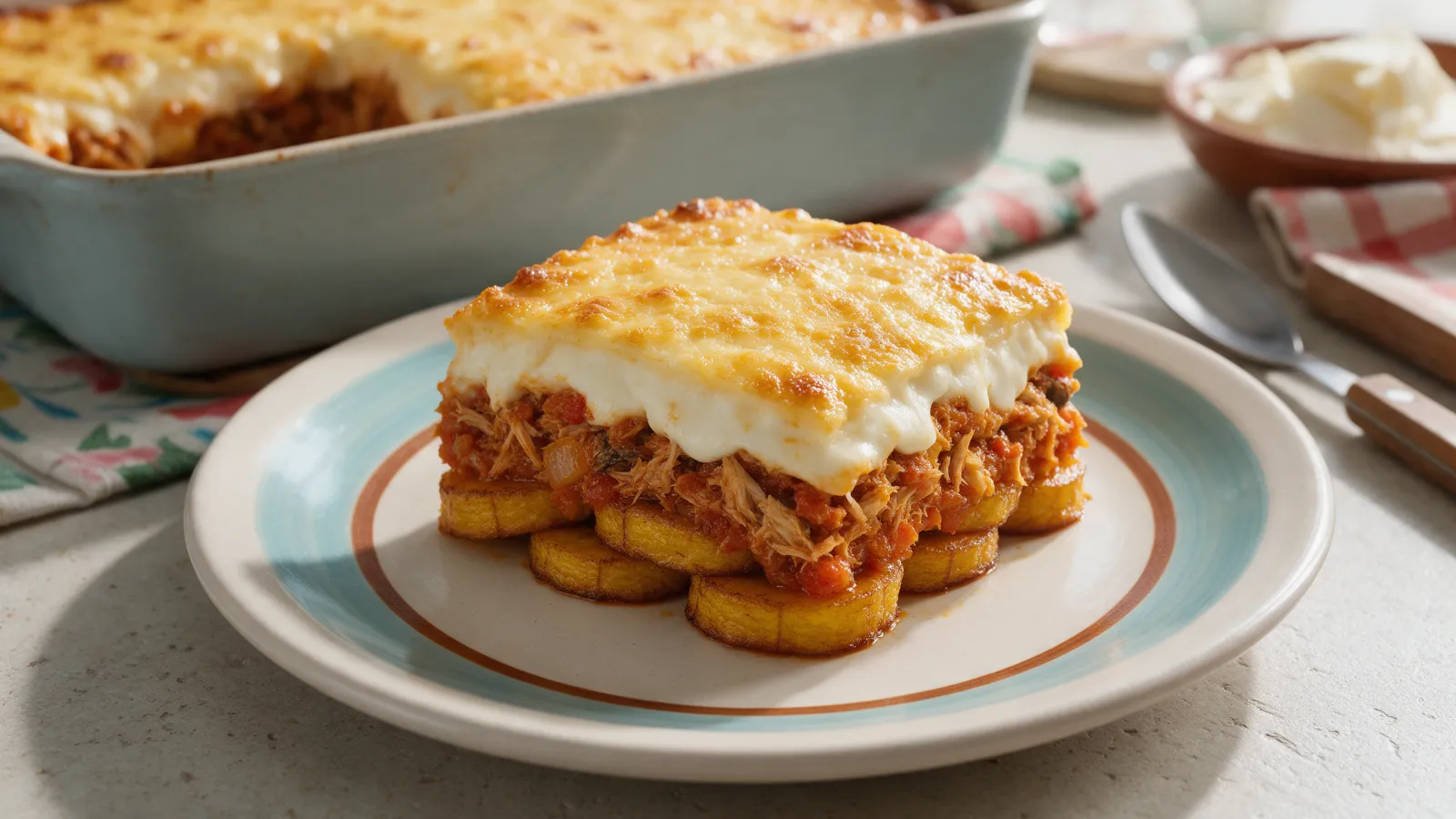

On Margarita Island, off Venezuela’s Caribbean coast, the fish that gives this dish its name is the chucho, the spotted eagle ray. Pastel de chucho (pahs-TEL deh CHOO-choh) layers that ray, poached, shredded and cooked down with sweet peppers and cumin, between slices of fried ripe plantain and salty white cheese, then bakes it like a lasagna with plantain where the pasta would be. It’s sweet and savory in the same forkful. Below is how to make it with fish you can actually buy in the US or UK, how to keep it from going soggy, and how to plan it over two days for a crowd of 10.
What is pastel de chucho, and is it worth making?
How do you make pastel de chucho? Poach ray or a firm white fish, shred it, squeeze out the water and cook it with onion, bell pepper, ají dulce, tomato and cumin until the pan is dry. Layer fried ripe plantain, the fish stew, grated white cheese and egg beaten with milk in a 9 x 13 in dish, top with mozzarella and bake 35 minutes at 350°F (180°C). 120 minutes for 10 servings.
It’s a Lent and Easter dish in Venezuela, a fish main for the weeks when many Catholic families skip meat, though on Margarita it’s eaten year-round. The Venezuelan cook Rubén Santiago, of the restaurant La Casa de Rubén on Margarita, is credited with creating it, according to the Colombian news channel NTN24’s report on his death in December 2021; English Wikipedia dates the dish to the 1980s.
Worth it when you’re feeding 8 to 12, you want something you can assemble the day before and simply bake, or you like the sweet-salty thing that ripe plantain and cheese do together. One square is a full meal.
Skip it when it’s a weeknight (it’s two hours on the clock), when you’re cooking for two (same work as for ten, though squares freeze), or when someone at the table dislikes sweet with fish, because the sweetness is the point.
Real time. 120 minutes, about 65 of them hands-on, including a 20-minute rest you can’t skip. Make the fish stew the day before and serving day drops to 75 minutes.
Honest difficulty, medium. Nothing is technically hard. You’re juggling three pans at once, and two moments decide the result: the stew has to be dry, and the pie has to rest.
What you need, with US and UK substitutes
Exact amounts are in the recipe card: 1 kg (2.2 lb) of clean fish, 1 kg (2.2 lb) of peeled ripe plantain, 450 g (1 lb) of cheese and 3 eggs for one 9 x 13 in (23 x 33 cm) dish.
The fish, since you won’t find chucho
Spotted eagle ray isn’t sold outside the Caribbean, and the IUCN lists it as endangered, so I don’t go looking for it. What matters for the pie is how the fish shreds and how much water it lets go.
Skate wings are the real match: same long, boneless strands and the same mild taste. They’re a fishmonger staple in the UK and turn up at some US fish counters. Buy about 1.6 kg (3.5 lb) of wings for 1 kg (2.2 lb) of meat.
Cod or haddock flake into shorter pieces and hold more water; squeeze them hard. Tilapia and swai (pangasius, sold as basa in the UK) are the cheapest and the wettest. They work, as long as the squeezing isn’t optional.
Dogfish, sold as huss or rock salmon in British chip shops, is the closest cousin to cazón, the small shark eastern Venezuela also uses for this pie. It’s a shark, and the FDA puts shark on its “choices to avoid” list for pregnant women and young children because of mercury. Fine for adults; not what I’d serve a toddler.
Salt cod, if you’d rather
Desalted salt cod gives the most flavor and the driest stew, because curing has already pulled water out of the flesh. Look for it in Latin, Italian, Portuguese or Caribbean shops. Soak it in the fridge 24 to 36 hours in plenty of cold water, changing the water every 8 hours, then poach a small piece for 2 minutes and taste. Still salty? One more change. With salt cod, start the stew with ½ tsp salt and add more only at the end.
Plantains, and how ripe is ripe
You want plantains that are yellow with lots of black patches, giving a little when pressed, like a ripe avocado. At that stage they’re sweet, and their sugar browns quickly in the pan. Plain yellow plantains fry up starchy and bland; fully black, soft ones tear when you slice them and burn before they brown. US supermarkets usually sell them green, so buy them about a week ahead and leave them on the counter, or in a paper bag to speed things up. Don’t swap in bananas: they turn to mush in the oven.
Everything else, translated
| In Venezuela | US | UK | What changes |
|---|---|---|---|
| Queso llanero or queso de año, 300 g (10.5 oz) | queso blanco or cotija (Latin brands) | 200 g (7 oz) Wensleydale + 100 g (3.5 oz) feta | nothing you’d notice; check the salt |
| Ají dulce, 80 g (3 oz) | fresh or frozen at Caribbean and Latin grocers, also sold as ají cachucha | rarely sold; use red bell pepper | without it, less perfume, same dish |
| Papelón, 1 tbsp | piloncillo or dark brown sugar | dark muscovado | nothing |
| Onoto | annatto (achiote) | 1 tsp sweet paprika for color | color only |
| Mozzarella, 150 g (5 oz) | low-moisture mozzarella | mozzarella | nothing |
Equipment, and workarounds
A 9 x 13 in (23 x 33 cm) baking dish at least 2 in (5 cm) deep, a saucepan, a large deep skillet for the stew, a second pan for frying, a colander and a wide spatula. With one skillet, fry the plantains first and make the stew in the same pan without washing it. A 10 x 12 in (25 x 30 cm) dish or an 11 in (28 cm) round one works with the same timing.
A two-day plan, and how to tell each stage is right
Two hours from a cold kitchen, about 65 minutes of real work. It stays at two hours only if things overlap: the fish poaches while you chop, the sofrito softens while you shred, and the plantains fry while the stew dries.
Make ahead. Day one, make the stew and refrigerate it covered, up to 2 days ahead. Or go further and assemble the whole pie the evening before: cover it and keep it raw in the fridge up to 24 hours, then bake it straight from the fridge, covered with foil for the first 20 minutes, for 10-15 minutes longer than usual. Fry the plantains on the day you assemble; fried a day early, they soften and soak up moisture from the stew.
| Stage | What you should see |
|---|---|
| Poaching, 6-15 min | flesh opaque, separates with a fork |
| Shredding | a squeezed handful no longer drips |
| Sofrito, 18 min | onion translucent, tomato no longer in pieces |
| Stew, 15-20 min | a spoon leaves a dry track; stew pulls away from the sides |
| Plantains, 2-3 min a side | golden with dark, glossy edges; if they darken in under a minute, the oil is too hot |
| Oven, 35 min | edges bubbling; pressing the center with a spoon brings up no clear liquid |
Drying the stew is the whole trick
Once the fish is in, the pan stays uncovered over medium heat for a good quarter of an hour or more, and you stir often so nothing catches. It feels too long for fish that’s already cooked, but you’re cooking off water, not cooking fish. A stew that still glistens on the bottom of the pan becomes a pie that weeps in the dish. Let it cool 15 minutes before layering, or it softens the plantains and starts setting the egg too soon.
Layering, and why there’s egg in it
Three layers of plantain, two of stew. The bottom plantain layer has no gaps, slices laid lengthwise and slightly overlapping, because it’s what holds each square up. Press the stew down with the back of a spoon. Beat the eggs with the milk and pour half over each cheese layer; as the custard sets, it glues the layers together. It’s the same idea as the béchamel in a Venezuelan pasticho, Venezuela’s lasagna.
Baking, and the 20-minute rest
Bake 35 minutes at 350°F (180°C) on the middle rack. Because the bind is raw egg, the center needs to hit 160°F (71°C), the USDA’s number for egg dishes and casseroles. Then rest it 20 minutes on the counter. Cut it straight from the oven and you’ll be serving it with a spoon.
Scaling for 4, 12 or 20
- 4 to 6 people → halve everything into an 8 x 8 in (20 x 20 cm) dish; 30 minutes in the oven, same rest.
- 10 to 12 → the recipe as written; cut 12 squares if there’s rice or salad alongside.
- 20 → double it in two 9 x 13 in dishes, both in the oven at once on racks at mid height, swapping them at 20 minutes; 40-45 minutes total. A 2 kg (4.4 lb) batch of fish stew needs 25-30 minutes to dry out, so split it between two skillets or make it the day before.
Food safety, mistakes, spice and allergens
Two temperatures matter here, and they’re different: one for the fish, one for the egg.
The fish is done at 145°F (63°C), or when it’s opaque and flakes, per the FDA and USDA. The finished pie needs 160°F (71°C) in the center because of the raw egg in the bind. Leftovers are reheated to 165°F (74°C).
Mistakes that ruin it.
- Soggy pie → the fish wasn’t squeezed, or the stew wasn’t dried. There’s no fixing it in the dish; next time, the dry-track test.
- Squares collapse → cut without resting, or the egg was left out. Give it 20 minutes.
- Plantains burnt outside, raw inside → oil too hot, or plantains too black. Medium heat, 340-350°F (170-175°C).
- Starchy, unsweet plantain → they were just yellow. Wait for the black spots.
- Too salty → under-soaked salt cod, or salty cheese plus full salt in the stew. Taste the stew before layering; it should be just seasoned, because the cheese adds more.
- Bones → with cod, haddock or hake fillets, run your fingers through every handful as you shred.
Spice level, 0 out of 5. Ají dulce has the perfume of a hot pepper with none of the heat. Hot sauce goes on the side.
Kids? Usually yes, thanks to the sweet plantain and cheese. Check carefully for bones if you use fillets, and skip dogfish or any shark for young children.
Allergens. Fish, egg and milk (cheese, butter, milk in the bind). It’s gluten-free as written; the béchamel version is not.
Which version should you make?
- Short on time → make the stew the day before; on the day it’s 75 minutes. In a pinch, 4 cans of water-packed tuna (about 480 g / 1 lb drained) replace the poached fish and need only 8 minutes in the sofrito to dry. Not the same pie, but a good one.
- Not frying → brush the plantain slices with 2 tbsp oil, roast on a lined sheet at 400°F (200°C) for 20 minutes, flipping halfway. Paler, softer, about 30 kcal less per square.
- Béchamel instead of egg → 50 g (6 tbsp) flour, 60 g (4 tbsp) butter and 500 ml (2 cups) milk, mozzarella and Parmesan on top, 30 minutes at 350°F (180°C). This is how one Margarita home cook, @florelis, published it on Steemit. Creamier, harder to slice, and it has gluten.
- Sweeter → scatter 2 tbsp grated papelón or dark brown sugar over the middle plantain layer. Some families do it; I find the ripe plantain sweet enough. Leave out the fish, sweeten every layer with papelón syrup and bind it with egg, and you have the meatless side dish, Venezuelan plantain cake.
- For a party → two dishes for 20, assembled the night before, baked as the guests arrive.
- Vegetarian → there isn’t one that’s still pastel de chucho. The same layers with shredded beef make a plantain pie, which is a different dish.
The real regional variant. In eastern Venezuela the same stew is made with cazón (small shark) and goes into empanadas and into the Margarita-style version of the national plate, the pabellón criollo.
What it costs, and what makes it expensive
The US Bureau of Labor Statistics tracks part of this shopping list. At its August 2026 city-average prices, the 450 g (1 lb) of cheese costs about $5.94 (priced as Cheddar, $5.983/lb, the only cheese in the series), 3 eggs $0.57 ($2.272 a dozen), 250 g (9 oz) of tomatoes $1.09 ($1.977/lb) and ½ cup of milk $0.13 ($4.229 a gallon): $7.73 for those four items.
What drives the price is the fish, and the BLS doesn’t track fish fillets or plantains. Take the per-pound price on the label and multiply by 2.2 for the 1 kg of fillet; for skate wings, by 3.5. Whatever you pick, the fish will cost more than everything else combined. In Bogotá’s wholesale markets, where I shop, fish is 45 % of the pie’s cost with tilapia and close to 75 % with domestic hake.
Yield. 10 squares of about 300 g (10.5 oz), each a full main. With rice or salad on the side, 12.
Cheapest way to make it well. Tilapia or swai, squeezed hard. Once it’s stewed with peppers and cumin and buried under plantain and cheese, the difference between budget fish and premium fish is much smaller than on a plate of grilled fillets. Save the good white fish for fish Veracruz-style, where it’s on show.
Serving, storing and reheating
Taste and texture. Soft, caramelized plantain top and bottom, a shredded fish stew in the middle with the floral note of ají dulce and cumin, and salty cheese tying it together. Sweet first, then savory. A rested square stands up and cuts with a fork.
How it’s served. Hot or warm, in squares, with a lettuce and tomato salad or a mound of white rice. A spoonful of Venezuelan guasacaca, the avocado and herb sauce, is very good next to the fish, and on an Easter table it shares space with Venezuelan empanadas. For the same tray-bake format with chicken, Venezuelan polvorosa de pollo, the crumbly chicken pie, is cut into squares the same way, with a sweet short crust instead of plantain.
Fridge. USDA FSIS numbers: no more than 2 hours out of the fridge, then 3 to 4 days at 40°F (4°C) or below, covered, in the dish or in squares. It cuts even better on day two.
Freezer. Baked, cooled squares wrapped individually keep their quality 2 to 6 months (FSIS). I stop at 2 months; the plantain gets softer as it thaws. Thaw overnight in the fridge.
Reheating. Oven at 350°F (180°C), covered with foil, 15-20 minutes for a square or 30 for the whole dish, to 165°F (74°C) in the center. The microwave works in 1-minute bursts, at the cost of the browned top.
Frequently asked questions
What kind of fish is chucho? The spotted eagle ray, Aetobatus narinari. It’s a ray, with white, boneless flesh that pulls into long strands. Cazón, often confused with it, is a small shark.
What can I use instead of stingray? Skate wings are the closest. Otherwise any firm white fish, cod, haddock, hake, tilapia or swai, squeezed well after shredding. Desalted salt cod also works and gives a drier, tastier stew.
Is pastel de chucho sweet? Sweet and savory. The sweetness comes from very ripe fried plantains, the savory from the fish stew and salty white cheese.
Can I use bananas instead of plantains? No. Bananas collapse in the oven and are much sweeter. Use plantains with black-spotted yellow skins.
Why is my pastel de chucho watery? The fish wasn’t squeezed or the stew wasn’t cooked dry. Once the fish is in, keep cooking uncovered until a spoon dragged across the pan leaves a dry track, usually a good quarter of an hour.
Can I make it ahead? Yes. Assemble it up to a day ahead and keep it raw in the fridge. Bake it under foil at first and allow 10-15 extra minutes.
Can I freeze pastel de chucho? Yes. Freeze baked, cooled squares individually wrapped; FSIS gives leftovers 2 to 6 months for quality. Reheat to 165°F (74°C).
How many people does one pan feed? A 9 x 13 in (23 x 33 cm) dish gives 10 main-course squares, or 12 with sides. Make two for 20.
Nutrition per serving
Per square of about 300 g (10.5 oz), one tenth of the dish, calculated ingredient by ingredient from USDA FoodData Central (SR Legacy) using the quantities above. The database has no entry for ray, so Atlantic cod stands in for the fish, and I count about ¼ cup of frying oil absorbed by the plantains:
- Calories: 506 kcal
- Protein: 32 g
- Carbohydrates: 42 g
- Fat: 25 g, of which 9 g saturated
- Fiber: 3 g
- Sugars: 23 g, nearly all from the ripe plantain
- Sodium: 734 mg
The two cheeses supply over 40 % of the fat and the frying oil about a quarter; oven-roasted plantains bring a square down to about 478 kcal. The salt in the stew accounts for 349 mg of the sodium per square and the white cheese for another 211 mg.
My rule for this pie is that it’s decided before the oven goes on. I squeeze the fish like I’m wringing out a towel, I don’t layer until the spoon leaves the pan dry, and I wait the full 20 minutes even when people are hovering. Here in Colombia I make it with tilapia or basa, the fish I can find at a fair price, and nobody at the table has ever asked where the ray went. Josnaisis.