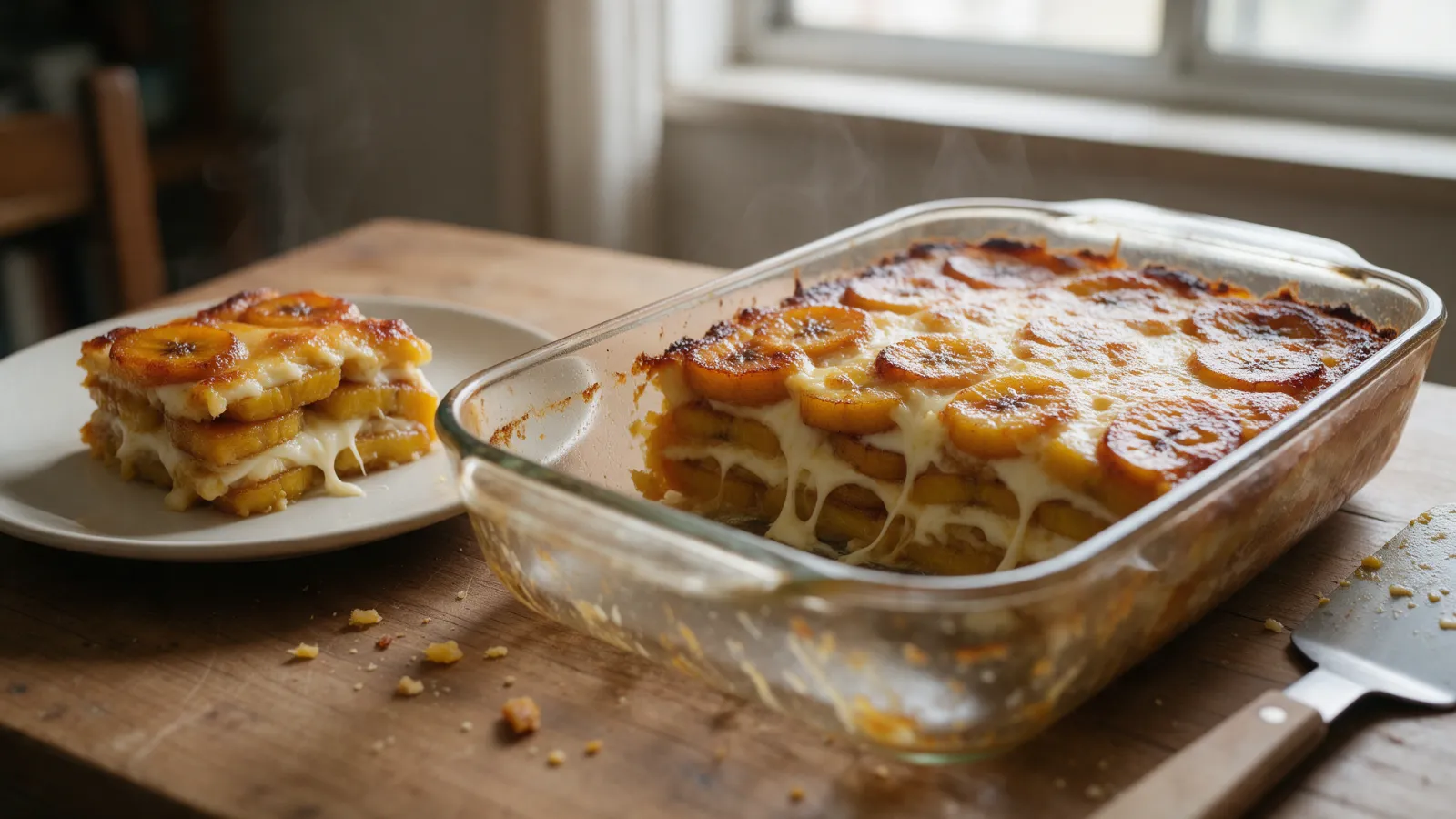

Torta de plátano (TOR-tah deh PLAH-tah-no) is what a Venezuelan Sunday lunch puts next to the braised beef: slices of black-ripe plantain, fried until the edges turn to caramel, layered with salty grated white cheese and a little cane sugar syrup, then baked under a few beaten eggs until it sets enough to cut in squares. It is sweet and salty in the same bite, and despite the word cake there is no flour and no batter. Think of it as a sweet plantain casserole. The version here fits an 8x12-inch dish, feeds 12 as a side, and comes with cheese swaps for a US or UK supermarket.
What is Venezuelan plantain cake, and is it worth making?
How do you make Venezuelan plantain cake? Fry 1 cm (⅜ inch) slices of very ripe plantain, layer them three deep in an 8x12-inch (20x30 cm) dish with spoonfuls of papelón syrup and grated salty white cheese, then pour over 4 eggs whisked with more syrup and cinnamon. Bake 35-40 minutes at 350°F (180°C) until the centre is set. Ready in 120 minutes for 12 servings.
It is worth it if you have plantains going black on the counter and a crowd to feed. In Venezuela it is mostly a side dish. Enri Lemoine serves hers with shredded beef, asado negro and pabellón criollo; chef Víctor Moreno, writing for the Venezuelan site El Estímulo, calls it a side or a starter; and the Time-Life recipe shared on Food.com says it goes with meat, hot or cold. A cold square also makes a decent afternoon snack.
Who it suits. Anyone who likes sweet plantains with savoury food, people cooking ahead for a group, and gluten-free tables, since this version has no flour.
Who it may not suit. Anyone avoiding eggs or dairy, because they are the structure. And if you want a sponge-like plantain loaf, this is not it; the mashed version further down is closer, or try a Colombian banana cake, which is a proper cake with flour.
Time and effort. Two hours on the clock, about 65 minutes of it hands-on, mostly standing at the skillet. Easy, as long as you fry gently and resist cutting it hot.
How ripe should plantains be?
Black, or nearly black, and still firm when you press them. That is the plantain both Enri Lemoine and Víctor Moreno ask for. Inside it is deep yellow, sweet, and still holds a clean slice. Ripe raw plantain has 17.5 g of sugar per 100 g according to the USDA, and that sugar is what browns at the edge of each slice.
| Skin | What you get | Use it? |
|---|---|---|
| Green | starchy, not sweet | No, that is the plantain for tostones |
| Yellow with black spots | firmer slices, less sweet | Yes, add 1-2 tablespoons more syrup |
| Black and firm | sweet, slices hold | Best |
| Black and very soft | sweet, falls apart in the pan | Only for the mashed version |
| Mould, leaking, fermented smell | spoiled | No |
In my kitchen a yellow plantain takes about 4-6 days on the counter to turn black, a little less in a paper bag. The fridge darkens the skin without ripening the fruit properly. Frozen sweet plantains from the Latin freezer aisle work in a pinch, though Enri Lemoine finds them greasy with an off aftertaste, and I agree.
Can you use bananas? Not for the sliced version. A banana has less starch and turns to mush in hot oil. Slightly underripe bananas work in the mashed version, which then tastes more like banana bread.
Where to buy plantains. In the US, most large supermarkets stock them near the bananas, and Latin and Asian grocers always do; the USDA’s weekly retail report had them advertised at an average of $0.88 a pound in early October 2026. In the UK, Tesco lists them at £0.75 each, and Caribbean and African grocers carry them. Buy them yellow a week ahead if you cannot find black ones.
Ingredients and what to buy in the US and UK
The quantities are in the recipe card: 1.1 kg (2.4 lb) peeled plantain, 300 g (10.5 oz) cheese, 150 g (5.3 oz) papelón, 4 eggs, 30 g (2 tablespoons) butter and a teaspoon of cinnamon.
The cheese
The cheese has two jobs. It salts the dish against the sweet plantain and syrup, and it must not weep water in the oven. A soft, wet cheese is the number one reason this dish ends up soggy.
- Venezuelan queso blanco duro or llanero, grated, is the original. Latin grocers in the US often carry it, along with Colombian queso costeño, which works the same way.
- Feta is the easiest supermarket swap in both the US and the UK: salty, crumbly, barely melts.
- Cotija with shredded low-moisture mozzarella, roughly half and half, is what the Tasting Table version uses. Enri Lemoine also accepts bagged pizza mozzarella and warns against fresh mozzarella, which releases too much liquid.
- Halloumi, grated, is a good UK option: salty and softens without running.
If your cheese is mild, whisk ¼ teaspoon of salt into the eggs.
Papelón and its stand-ins
Papelón is unrefined cane sugar sold in hard cones or blocks; panela (Colombia) and piloncillo (Mexico) are the same product. In the US, piloncillo cones are in the Latin aisle, usually 8 oz (225 g) each. In the UK, look for panela or jaggery in Latin or South Asian shops, or use dark muscovado sugar, which dissolves straight away. Ordinary light brown sugar works but gives a paler, flatter syrup.
Equipment
An 8x12-inch (20x30 cm) baking dish, or any 2-quart (2-litre) dish. A 9x13-inch (23x33 cm) pan works with the same quantities but the cake is thinner, so start checking at 30 minutes. You also need a wide, deep skillet, a small saucepan, paper towels and a sharp knife. An instant-read thermometer helps but is not essential.
Make-ahead plan and baking day
The full recipe takes 120 minutes: syrup first so it can cool, plantains peeled and sliced while it does, 30 minutes of frying in four batches, 10 minutes of layering, 40 minutes in the oven and 15 of rest. Splitting it over two days is easier.
The day before, fry the plantains and make the syrup. Cool the slices, cover and refrigerate; keep the syrup in a jar at room temperature.
What not to do ahead. Don’t assemble the whole dish with the raw eggs and leave it overnight. The custard sinks to the bottom and the base turns soggy. If you want everything done in advance, bake the cake fully, refrigerate it once cool and reheat it the next day. It slices beautifully cold.
Scaling for 4-6, 12 or a party
| Servings | Dish | Plantains, peeled | Cheese | Papelón + water | Eggs | Bake at 350°F (180°C) |
|---|---|---|---|---|---|---|
| 4-6 | 8x8 in (20x20 cm) | 3, 550 g (1.2 lb) | 150 g (5.3 oz) | 75 g (2.6 oz) + 50 ml (3½ tbsp) | 2 | 30-35 min |
| 12 | 8x12 in (20x30 cm) | 6, 1.1 kg (2.4 lb) | 300 g (10.5 oz) | 150 g (5.3 oz) + 100 ml (⅓ cup + 1 tbsp) | 4 | 35-40 min |
| 20-24 | two 8x12 in dishes | 12, 2.2 kg (4.9 lb) | 600 g (1.3 lb) | 300 g (10.6 oz) + 200 ml (¾ cup + 1 tbsp) | 8 | 40-45 min, swap racks at 20 |
For a party, use two dishes rather than one deep pan, which takes far longer to set in the centre. Frying 12 plantains is an hour at the stove, so for that size I bake the slices instead: two parchment-lined sheets, 350°F (180°C), 20-25 minutes without flipping, as Enri Lemoine does.
Fried, baked or mashed plantains, which to choose
Fried slices give the caramelized edges that define the dish, and that is what this recipe uses. Baked slices lose some of that edge but save the frying: by my USDA-based numbers they cut about 60 calories and 5 g of fat per serving, to roughly 276 calories and 10 g of fat. Mashed plantain mixed with eggs, sugar, butter, cheese and a little flour or breadcrumbs, baked 45 minutes at 350°F (175°C), is the version Comidas Venezolanas publishes; it is a moist cake with no layers and leans dessert. And if you have no oven, a recipe on Petitchef builds the same layers in a heavy 10-inch (26 cm) skillet, covered over the lowest heat, flipped with the lid.
A few real variations: a layer of guava paste between the plantains (Comidas Venezolanas says some regions do this), 4 tablespoons of dark rum in the syrup and a 320°F (160°C) oven for about 40 minutes (Víctor Moreno’s version), or the richer torta bejarana, with breadcrumbs, sesame seeds and spices, which SBS soaks in a sherry syrup.
Why plantain cake turns out soggy, and how to tell it’s set
The eggs are the only thing holding the layers together, so the cake is done when the custard in the middle is set. The USDA Food Safety and Inspection Service puts egg dishes at 160°F (71°C), and that is also the point where the knife comes out clean.
Causes of a soggy or loose cake.
- Wet cheese. Fresh mozzarella, queso fresco alone or ricotta release whey. Swap for a firm, salty one.
- Undrained plantains. Oil from stacked slices pools at the bottom. Drain in a single layer.
- Too much or too thin syrup. Three tablespoons per layer, no more; if the syrup is watery, simmer it 3 minutes longer.
- Too few eggs. Two or three eggs will not bind this much fruit in an 8x12-inch dish. The recipes I compared use 3 to 5 eggs in the same size or smaller.
- Cutting it hot. The custard firms up during the 15-minute rest.
Other things to watch. Black, bitter slices mean the oil was above 350°F (175°C). A burnt top over a raw middle means the rack was too high; use the middle and foil if needed. To turn the whole cake out onto a platter, line the base with parchment and run a knife round the sides.
Spice, kids and allergens. No heat at all. Children usually love it. It contains milk and eggs; it is gluten-free as written, but check your cheese and papelón labels if cooking for someone with coeliac disease.
Torta de plátano vs pastelón, pastel de chucho and bollo de maduro
All four are ripe plantain with cheese, which is why they get mixed up.
- Puerto Rican pastelón layers fried sweet plantain like lasagna sheets, but with seasoned ground beef between them; the Dominican version boils and mashes the plantain instead. Torta de plátano has no meat and is sweetened with papelón: it goes next to the meat, not around it.
- Venezuelan pastel de chucho, from Margarita Island, uses the same plantain and cheese layers with a fish stew in the middle. It is a main course, baked about 35 minutes at 350°F (180°C).
- Bollo de maduro is cooked, mashed ripe plantain with cheese or butter, wrapped in a leaf and steamed or boiled, from Ecuador and Colombia’s Caribbean coast. No layers, no oven.
- Venezuelan mandocas use the same trio of ripe plantain, papelón and salty cheese, kneaded with cornmeal and fried into rings for breakfast.
Green plantain is another world entirely: it is the starchy shell of the patacón maracucho.
What it costs in the US
With plantains at the USDA advertised average of $0.88 a pound (week of October 9, 2026), BLS August 2026 averages for eggs ($2.272 a dozen) and butter ($4.021 a pound), cheddar’s BLS price ($5.983 a pound) standing in for the cheese because there is no BLS series for queso blanco, and an 8 oz piloncillo cone at $1.28 from H-E-B, the dish comes to $8.85, about 74 cents a serving, before frying oil. A Latin-grocer queso duro or a block of feta may cost more than cheddar, so treat the cheese line as a floor.
Serving, storing, freezing and reheating
Serving. Warm squares beside Venezuelan asado negro with white rice, or in place of the loose fried plantains on a pabellón criollo plate with Venezuelan black beans. Colombian tables serve ripe plantain loose instead, as on the bandeja paisa. As a dessert, a spoonful of whipped cream is what Comidas Venezolanas suggests.
Fridge. Once cool, covered, 3-4 days, which is the FDA’s window for leftover cooked egg dishes. Don’t leave it out longer than 2 hours.
Freezer. At 0°F (-18°C) it stays safe, but quality drops over time. I stop at 2 months, because the custard weeps a little after thawing. Freeze individual squares wrapped in plastic, and thaw overnight in the fridge.
Reheating. Covered with foil at 320°F (160°C) for 15-20 minutes, until the centre reaches 165°F (74°C), the FSIS temperature for reheated leftovers. A single square takes 1-1½ minutes in the microwave, covered. In an air fryer, 5-6 minutes at 320°F (160°C) crisps the edges again.
Venezuelan plantain cake FAQ
Is torta de plátano a side dish or a dessert? In Venezuela it is mostly a side, served with meat at lunch. The mashed version is sweeter and more often eaten as dessert.
How ripe should the plantains be? Black or nearly black skins, still firm. Yellow ones give a less sweet cake; black, very soft ones are best mashed.
What cheese can I use instead of queso blanco? Feta in the US or UK, Colombian queso costeño, cotija mixed with low-moisture mozzarella, or grated halloumi. Avoid fresh mozzarella.
Why is my plantain casserole watery? Usually a wet cheese, undrained plantains, too much syrup or cutting it hot. Use 4 eggs for an 8x12-inch dish, bake to 160°F (71°C) in the centre and rest it 15 minutes.
What temperature do you bake it at? 350°F (180°C) for 35-40 minutes. Published recipes range from 320°F (160°C) for 40 minutes to 350°F for up to 45, depending on pan and eggs.
Can I use regular sugar instead of papelón? Dark muscovado or dark brown sugar, same weight. White sugar works, as in the Time-Life recipe, but you lose the molasses flavour.
Can I make it ahead or freeze it? Yes. Fry the plantains and make the syrup the day before, or bake it completely and reheat. Frozen in squares it keeps well for 2 months.
Is it the same as pastelón? No. Pastelón has ground beef between the plantain layers; torta de plátano has no meat and is sweetened with cane sugar.
Nutrition per serving
Per square (1/12 of the dish, about 145 g / 5 oz), calculated from USDA FoodData Central (SR Legacy) with this recipe’s quantities. The fried plantain uses USDA’s entry for fried ripe plantain, which already includes the absorbed oil; papelón is counted as brown sugar and the cheese as queso blanco.
- Calories: 336
- Protein: 8 g
- Carbohydrates: 42 g
- Sugars: 28 g
- Fat: 15 g, of which 7 g saturated
- Fibre: 2 g
- Sodium: 208 mg
Real sodium is likely higher, since Venezuelan queso duro and Colombian costeño are saltier than USDA’s queso blanco.
At home in Venezuela, torta de plátano came out on the Sundays there was asado negro, and the crusty corners never made it to the table because I ate them first. In Colombia my first one was a puddle, made with a mild farmer’s cheese and cut straight from the oven. Salty cheese and fifteen minutes of patience fixed it, and now Dylan asks for it cold from the fridge the next day, which is honestly when it cuts best. Josnaisis.