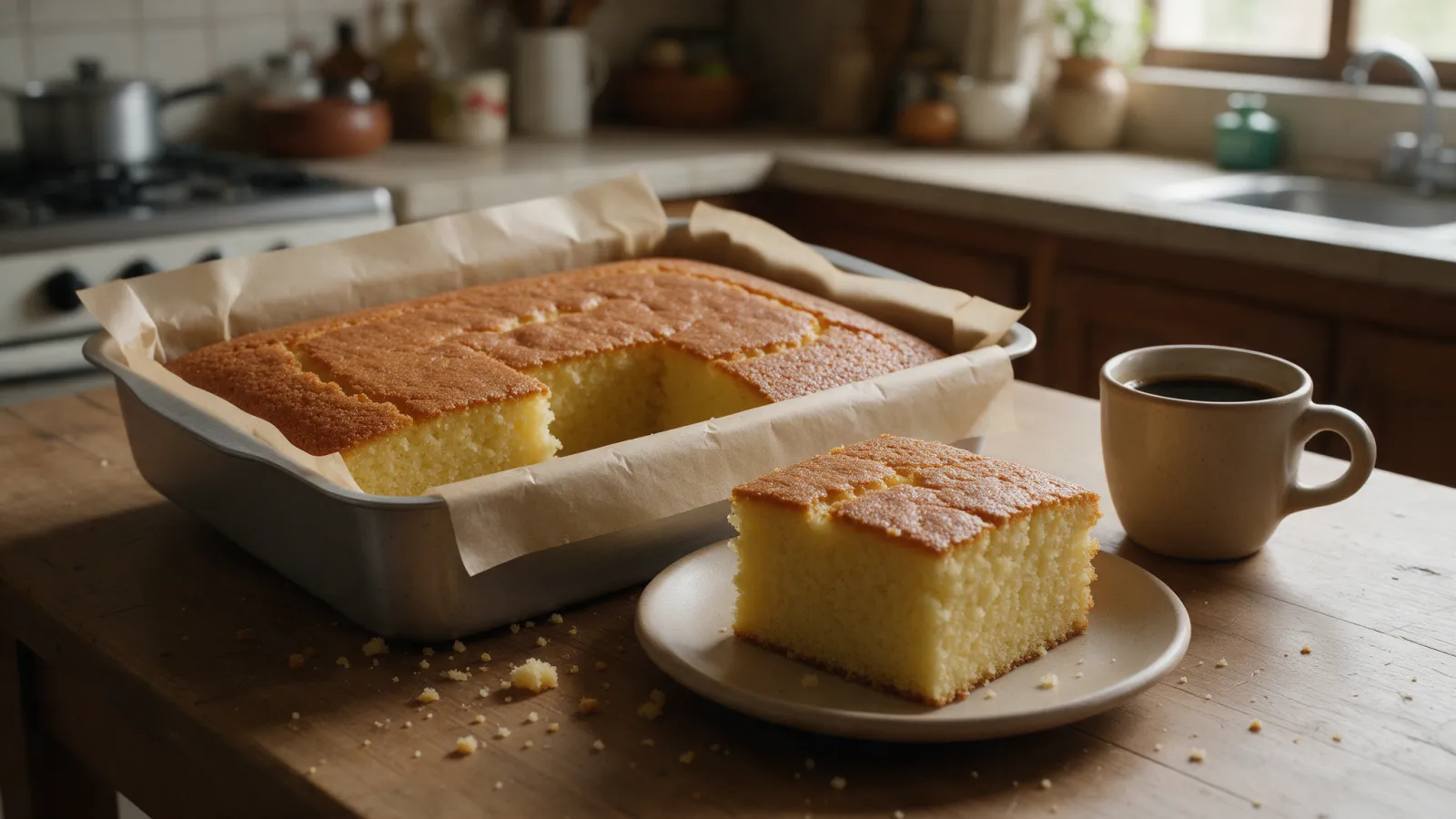

Ask for mantecada in a Mexican bakery and you’ll get a single cupcake-like cake in a fluted paper liner. Ask for it in Bogotá and you’ll get a square cut from a sheet of yellow butter cake that gets part of its body from cornmeal. That second one is this recipe: denser than a sponge, moister than cornbread, sweet enough to eat with coffee and plain enough for breakfast. Below is whether it’s worth the hour of planning, which corn product to buy in a US or UK store, how to tell when it’s done without guessing, and what it costs.
Is Colombian mantecada worth baking?
How do you make Colombian mantecada? Cream 250 g (2 sticks plus 2 tbsp) of butter at 65-67°F with 220 g (1 cup plus 2 tbsp) of sugar for 3 minutes, beat in 5 room-temperature eggs one at a time, then fold in 200 g of flour and 130 g of fine cornmeal with baking powder, alternating with ½ cup of milk. Bake in a 9x13-inch pan at 350°F (180°C) until the center reads 200-205°F. 55 minutes for 15 servings.
Yes, if you own a 9x13 pan and can remember to take the butter out an hour early. It’s a one-bowl-plus-one cake with no frosting, no syrup and no layers, and it holds up in a lunchbox or on a picnic table. What makes it worth it over a plain yellow cake is the cornmeal: a deeper color, a toasted-corn flavor and a soft grain you notice when you bite.
It’s a good fit for an afternoon snack, a brunch spread, a bake sale or a potluck, since you can carry it in the pan and it doesn’t need the fridge on day one. In Colombia it’s eaten at breakfast or as an afternoon snack, as Jenny is Baking notes.
It’s not the cake for a birthday centerpiece (it’s low and plain), for anyone without an oven, or for a light dessert: each square carries 16 g of fat.
Time. 55 minutes of recipe, 20 of them hands-on. Add the hour the butter and eggs spend warming up on the counter and 35 minutes of resting and cooling, and you’re looking at 2 hours 25 minutes from fridge to plate.
Difficulty: easy. It fails for two reasons only: cold ingredients, or an impatient baker who opens the oven early or pulls the cake before the center sets.
Not the Mexican mantecada, and not the Spanish one
Three countries use the same word for three different bakes. In Mexico, mantecadas are individual cakes in paper liners, somewhere between a muffin and a pound cake, often dunked in coffee or hot chocolate, as Tasting Table describes them. In Spain, the best known come from Astorga: small butter sponges baked in paper boxes. In Colombia and Venezuela, according to Wikipedia, mantecada is a cake that’s cut into pieces after baking. If you came for the Mexican kind, the batter below bakes well in liners too (see the versions).
What you need, and the cornmeal question
Exact amounts are in the recipe card. Two ingredients decide how it turns out: the corn and the butter.
Fine cornmeal, cornstarch or masarepa
Mantecada uses raw, fine yellow cornmeal, the same thing sold as fine polenta. Colombian recipes disagree wildly on the ratio. My Colombian Recipes uses three times as much cornmeal as flour by volume; El Heraldo in Barranquilla goes to five parts corn for one of wheat; Sweet y Salado uses 75 g of cornmeal to 210 g of flour. I settled on 200 g of flour to 130 g of cornmeal, roughly three to two, which tastes clearly of corn and still slices without crumbling.
- The UK trap. In Britain, cornflour means cornstarch. It works in the batter at the same weight, but you get a finer, paler, more crumbly cake with no corn flavor. For the real thing, buy fine polenta or fine cornmeal.
- Masarepa (P.A.N. and similar arepa flours) is precooked. It soaks up the milk and bakes dense and dry. The author of Sweet y Salado says the same in her comments: dry cornmeal, not precooked.
- Masa harina (for tortillas) is nixtamalized and tastes of tortilla. I don’t use it here.
- Coarse cornmeal or grits stay gritty after baking. If that’s all you have, pulse it in a blender first.
- Self-rising cornmeal mix already contains leavening and salt; skip it, or you’ll be guessing at the baking powder.
US and UK shopping list
| In the recipe | United States | United Kingdom |
|---|---|---|
| Fine cornmeal (harina de maíz) | fine yellow cornmeal or fine polenta | fine polenta or fine cornmeal, not cornflour |
| All-purpose flour | all-purpose flour | plain flour |
| Unsalted butter | unsalted butter (if salted, drop the ½ tsp salt) | unsalted butter |
| Aguardiente (anise liqueur) | rum, a drop of anise extract, or nothing | rum, or nothing |
| 9x13-inch pan | standard 9x13 metal pan | 23x33 cm traybake tin |
Equipment
A 9x13-inch (23x33 cm) pan, a hand or stand mixer, a spatula, a big bowl and parchment paper. No mixer? Cream by hand with a wooden spoon for about 10 minutes; El Heraldo does it that way, and the cake comes out a little more compact. An instant-read thermometer isn’t required, but it settles the doneness question and tells you when the butter is ready.
How to plan it, and how to know it’s done
The only thing that needs thinking ahead is the hour of softening. The rest is 20 minutes of work and the oven.
Make-ahead. Bake the whole cake the day before; covered, it’s as moist the next day and slices cleaner. Don’t refrigerate the raw batter overnight: the butter firms up and the baking powder loses some punch.
Butter temperature is the whole game
Mantecada rises on baking powder and on the air you beat into the butter and sugar. That air only stays put in softened butter at 65-67°F (18-19°C), the range America’s Test Kitchen gives for cakes. Colder, it won’t aerate. Warmer, the bubbles collapse and, as King Arthur Baking puts it, you get a greasy mix and a heavy cake.
The eggs matter as much. King Arthur Baking explains that even slightly cold eggs make soft butter seize and break the emulsion, and its fix is the one in the recipe card: a couple of tablespoons of the flour beaten in with the eggs. Forgot to take them out? Set them in a bowl of warm (not hot) water for 10 minutes or so, as Sally’s Baking Addiction suggests.
Signs that the creaming worked: the mix goes from yellow to cream-colored, gains volume and stops clinging to the bowl. King Arthur describes it as light and fluffy, pale but not white.
Doneness, toothpick or thermometer
A toothpick in the center should come out clean or with a few moist crumbs, never wet batter. The top should be golden and spring back, and the edges should pull away from the pan. With a thermometer it’s simpler: Milk Street gives 200-205°F (93-96°C) for most cakes, measured in the center without touching the bottom of the pan, and reminds you that carryover heat keeps cooking it after it leaves the oven. In my oven, the 9x13 pan gets there at 33-35 minutes.
Pan sizes and baking for a crowd
| Pan | Batter | Pieces | Bake at 350°F (180°C) |
|---|---|---|---|
| 9x13 in (23x33 cm) | full recipe | 15, or 20 smaller | 33-35 min |
| 8x8 in (20x20 cm) | half recipe | 9 | 30-33 min |
| two 9x5 in (23x13 cm) loaf pans | full recipe | 2 loaves | 45-55 min |
| 24 muffin cups with liners | full recipe | 24 | 18-22 min |
| two 9x13 in pans | double recipe | 30 | 35-38 min |
Times outside the 9x13 are my own, and in every case the center temperature beats the clock. For 4-6 people, bake a half batch in the 8x8 (for the half egg, beat 3 eggs and use 125 g / 4.4 oz). For 12-20, the full batch cut 4 x 5. For thirty, double it in two pans on the middle rack; if they don’t fit side by side, the second batter waits fine for 20 minutes on the counter.
Before you bake, mistakes, kids and allergens
Why it sank in the middle. Most often the center was underbaked: the edges set and the middle didn’t. Opening the oven before the cake sets drops the temperature and can collapse it, and too much baking powder makes it rise fast and fall. Fix: 200-205°F in the center, door shut until minute 25, level teaspoons.
Other common problems.
- Dense and heavy → cold butter or eggs, or too little creaming. Overdoing it hurts too: King Arthur warns that over-creaming leaves dense, gummy streaks.
- Curdled batter → cold eggs or eggs added too fast. Two tablespoons of the dry mix and 20 seconds of beating bring it back.
- Dry → overbaked, or made with masarepa. Pull it at 200-205°F.
- Greasy top → the butter was close to melted.
- Stuck to the pan → no parchment. Grease and flour instead, and unmold at 10 minutes.
Kids. Most love it: sweet, soft and finger food. For children, leave out the aguardiente or rum; baking doesn’t drive off all the alcohol.
Allergens. Contains wheat (gluten), egg and milk. No nuts. I haven’t tested a gluten-free version, so I won’t give you amounts for one.
Raw batter. Don’t lick the bowl: the FDA advises against eating raw cake batter because of the raw eggs and uncooked flour.
Which version should you make?
- Short on time → cube the butter into ½-inch (1 cm) pieces; in my kitchen it softens in 20-30 minutes instead of an hour. Eggs go in warm water.
- No mixer → wooden spoon, 8-10 minutes of creaming; a bit less rise.
- Lighter and spongier → the El Heraldo method: separate the eggs, cream the butter with the yolks, whip the whites to soft peaks and fold them in last.
- More corn → up to 250 g (about 1½ cups) cornmeal and 80 g (⅔ cup) flour. Sandier, yellower and denser.
- With cornstarch → 130 g (1 cup) cornstarch instead of cornmeal: a fine, pale cake without corn flavor.
- Individual, Mexican-style → 24 lined muffin cups, 18-22 minutes.
- The flavoring → aguardiente, rum, a drop of anise, or nothing at all. My Colombian Recipes lists all three as normal in Colombian homes.
What it costs in the US
Using Bureau of Labor Statistics average retail prices (US city average, August 2026), the five ingredients with a price series add up to $4.04 for the pan, about 27 cents a square, and butter is 55% of that.
The math: butter at $4.021/lb (250 g = 0.55 lb, $2.22); eggs at $2.272 a dozen (5 eggs, $0.95); sugar at $1.024/lb (220 g, $0.50); flour at $0.548/lb (200 g, $0.24); whole milk at $4.229/gallon (½ cup, $0.13). Cornmeal, baking powder and vanilla have no BLS series and aren’t counted. A bag of fine cornmeal is a pantry item, and you’ll use well under half of it.
What makes it expensive. Butter, everywhere. In Colombia, with wholesale Bogotá prices and retail butter, the pan comes to about 19,067 pesos, and butter is 80% of it.
Yield. 15 squares of about 3 x 2½ inches (7.7 x 6.6 cm), around 80 g (2.8 oz) of raw batter each; or 20 snack-size squares.
What to expect, how to serve it and how to store it
Taste and texture. A golden, moist, close-crumbed cake with crisp corners, tasting of butter and toasted corn, with a faint grain from the cornmeal. It’s compact rather than airy, and it cuts in clean squares.
How it’s served in Colombia. Plain, in squares, at room temperature. My Colombian Recipes serves it with blackberry or strawberry jam on the side; Sweet y Salado with milk, coffee or hot chocolate. At home I pour a glass of Colombian kumis, the drinkable fermented milk, or a cup of Colombian hot chocolate. On the same table, savory almojábanas or pandebono balance the sweet.
Counter. Covered or in an airtight box, 2-3 days in my kitchen. In a hot, humid climate, move it to the fridge from day two.
Fridge. Well wrapped, up to 5 days. The butter firms up in the cold: 15 minutes on the counter or 10 seconds in the microwave per square brings it back.
Freezer. USDA FSIS says food kept at 0°F (-18°C) stays safe indefinitely; what drops is quality. I wrap squares individually, bag them and use them within 2-3 months. Thaw wrapped on the counter for 1-2 hours, or warm for 5 minutes at 300°F (150°C).
For another Colombian sheet cake, the Colombian banana cake is made with oil and very ripe bananas and stays moister; for a spoon dessert, Colombian natilla is the one that’s set with cornstarch.
Frequently asked questions
Is Colombian mantecada the same as Mexican mantecadas? No. The Colombian one is a sheet cake of butter, flour and cornmeal cut into squares. Mexican mantecadas are individual muffin-like cakes in paper liners.
Can I use cornstarch instead of cornmeal? Yes, at the same weight, but you get a finer, paler cake with no corn flavor. In the UK, remember that cornflour is cornstarch.
Can I use masarepa or P.A.N.? No. It’s precooked, absorbs the milk and makes the cake dense and dry.
Why did my mantecada sink? Usually an underbaked center, an oven door opened too early, or too much baking powder. Bake to 200-205°F (93-96°C) in the center.
What temperature and how long? 350°F (180°C) for 33-35 minutes in a 9x13-inch pan; 45-55 minutes in loaf pans.
How long does it keep? 2-3 days covered on the counter, up to 5 days in the fridge, and 2-3 months frozen in wrapped squares.
Can I make it a day ahead? Yes. Bake it the day before and keep it covered; it slices cleaner on day two.
Nutrition
Per square (1/15 of the pan, without alcohol), calculated ingredient by ingredient from USDA FoodData Central (SR Legacy) with the amounts in this recipe, using degermed yellow cornmeal for the polenta:
- Calories: 287 kcal
- Protein: 5 g
- Carbohydrates: 32 g
- Fat: 16 g, of which 9 g saturated
- Fiber: 1 g
- Sugars: 15 g
- Sodium: 155 mg
Butter supplies 203 g of the 236 g of fat in the pan. Cut into twenty squares, each comes to about 215 kcal.
My first mantecada was a failure I still remember: I used arepa flour because it was the only corn flour in my cupboard, and it came out as dry as a sweet arepa. Raw cornmeal and butter left out for an hour fixed it, and now it’s the cake I bake on Sunday so Dylan has squares for the week’s lunchboxes. Josnaisis.