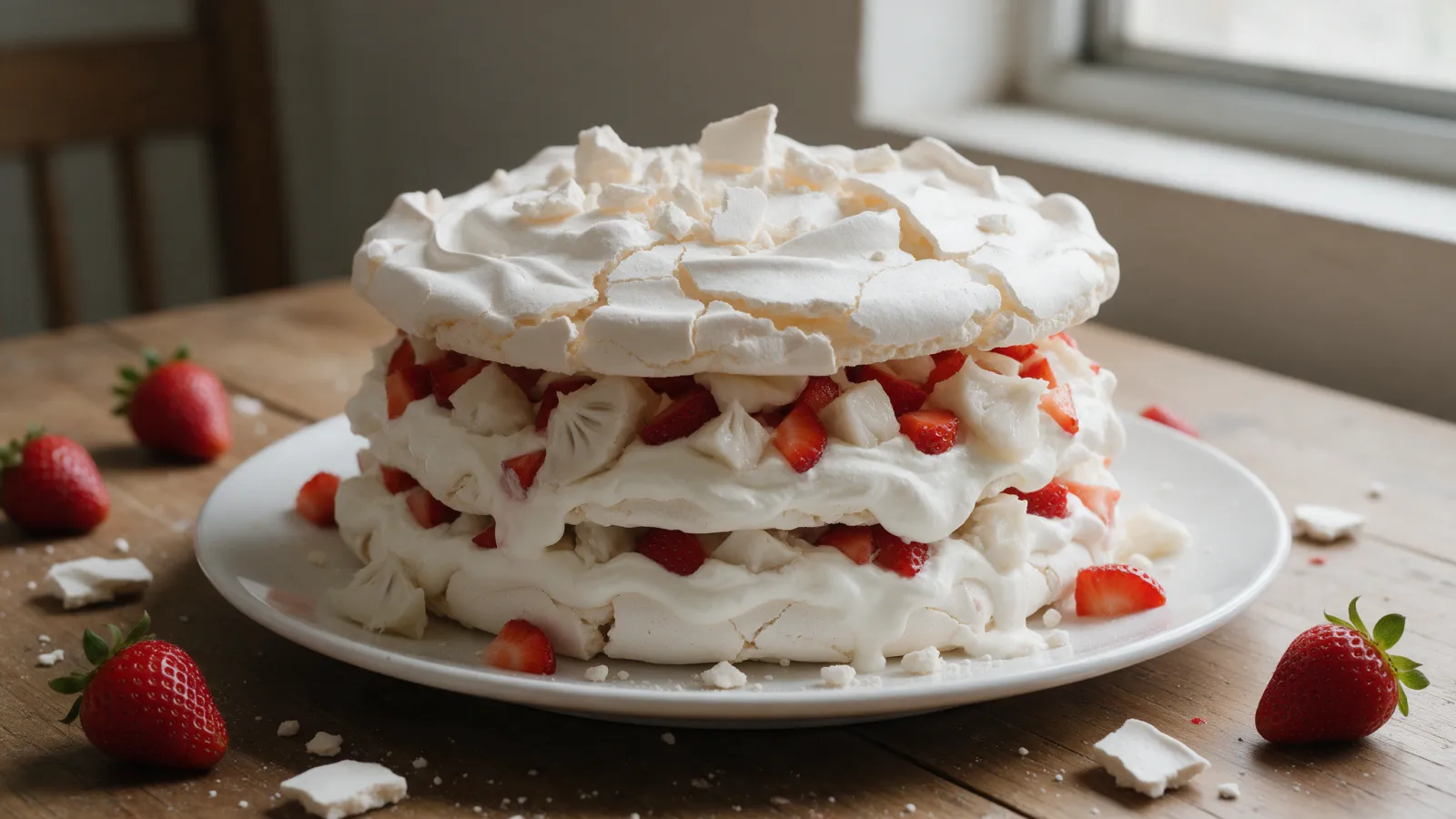

Merengón (meh-ren-GOHN) is what you get when a pavlova moves to the Andes and loses its soft middle. It’s a Colombian bakery dessert: discs of meringue dried until they crunch all the way through, stacked with sweetened whipped cream and fruit, classically soursop, strawberries, Andean blackberries and canned peaches. In Bogotá I’ve mostly eaten it with soursop and strawberries, cut in wedges from a big round on the counter. Below are the gram-and-cup amounts for 10 servings, the low oven that keeps it from weeping, what changes at altitude, and how to get the fruit right in a US or UK supermarket.
Is Colombian merengón worth making?
How do you make Colombian merengón? Whip 6 egg whites with 1½ cups (300 g) of sugar added a spoonful at a time until stiff and glossy, fold in ¾ cup (100 g) of powdered sugar, spread two 8½-inch (22 cm) discs and dry them 2½ hours at 212°F (100°C), then 1 hour in the turned-off oven. Layer with 2 cups (500 ml) of whipped cream and fruit just before serving. Ready in 240 minutes for 10 servings.
Yes, if you have a morning at home and want a centerpiece dessert that’s half fruit. The work is about 55 minutes; the oven does the rest. It’s a good birthday or Sunday-lunch dessert for 8 to 12, and it’s naturally gluten-free.
Skip it if you need to assemble dessert the night before, because a built merengón doesn’t wait, or if you want something low in sugar: each serving carries about 56 g. Honest difficulty is medium, and it comes down to patience more than skill.
Merengón, pavlova and Eton mess
All three are meringue, cream and fruit, and that’s where the resemblance ends. A pavlova gets cornstarch and vinegar or lemon juice in the meringue and is baked to keep a marshmallowy center under a crisp shell; it’s one disc with everything piled on top. Eton mess, the English dessert served at Eton College’s cricket match against Harrow, is broken meringue folded through strawberries and cream in a glass. Merengón wants the meringue dry from crust to core and builds it in layers. Not every Colombian version is the same, though: SBS describes some baked hotter and shorter, with a softer middle.
What you need, with US and UK swaps
Everything is in the recipe card: 6 egg whites and about 2 cups (400 g) of sugar for the meringue, 2 cups of cream and a little over 2 pounds (1 kg) of fruit.
Why twice as much sugar as egg white
7 oz (200 g) of whites to 14 oz (400 g) of sugar. The recipes I compared run from 1.5 to 2 grams of sugar per gram of white. America’s Test Kitchen uses 1 cup (198 g) for 4 large whites; My Colombian Recipes uses 1½ cups for 5 whites; Vanguardia, a Colombian newspaper, gives its chef’s recipe as 80 g of whites to 120 g of sugar. For a merengón I use the classic 2:1 of dry meringues, because sugar is what holds on to the water in the whites. With less, the discs dry slower and bead syrup once the cream goes on.
The 6 leftover yolks have a job too: Colombian natas dessert takes 4 of them.
Keep the bowl glass or metal and spotless. A speck of yolk or grease and the whites won’t whip, and plastic bowls hold on to fat even when they look clean.
The cream, and how to keep it from deflating
Use heavy cream, which by FDA standard has at least 36 % milkfat; light whipping cream (30 to under 36 %) whips but slumps sooner. In the UK, whipping cream is the one to buy; double cream whips too but turns heavy and buttery fast. Keep it fridge-cold, sweeten it with powdered sugar so there’s no grit, and stop the moment it holds a firm peak.
Making it hours ahead? Bloom 2 tsp (6 g) unflavored gelatin in 2 tbsp (30 ml) cold water, melt it, let it cool to barely warm and stream it in at the end of whipping. That’s the 1 tsp per cup of cream ratio from Live Well Bake Often, and it holds 2 to 3 days in the fridge.
The fruit, and what to buy outside Colombia
Soursop (guanábana) is the one fruit you probably can’t buy fresh. Goya sells the frozen pulp in 14-oz (400 g) packs in the freezer aisle of Latin grocers; thaw it in a sieve and let it drip before you build. Mango is the fallback if you can’t find it: sweeter, less tart. Colombian mora de Castilla is a sour Andean blackberry, so regular blackberries are a touch sweeter. Don’t macerate the fruit in sugar for more than 15 minutes; the juice it releases is what turns crisp meringue soggy on the plate.
Equipment, and what to use instead
An electric mixer (stand or hand), a glass or metal bowl, two baking sheets, parchment, a spatula and a serrated knife. Whipping by hand is possible, but 6 whites with 1½ cups of sugar is 20-25 minutes of nonstop whisking. An oven thermometer is worth it here: many home ovens run hot at low settings, and at 250°F (120°C) the meringue starts to brown and weep.
Make-ahead plan and serving day
The full timeline is 240 minutes: 15 to whip, 5 to shape, 150 in the oven, 60 drying in the turned-off oven, then cream, fruit and 10 minutes of assembly. Almost all of it can happen days before.
- Up to 3 days ahead → bake the discs. Once cold, store them airtight at room temperature, away from a steamy kitchen. America’s Test Kitchen keeps its meringue cookies up to 2 weeks in an airtight container; in a humid climate I don’t push past 3 days.
- The day before → whip a stabilized cream if you want it ready.
- The morning of → cut the fruit and keep it in the fridge on paper towels.
- At the table → assemble. Nothing else waits on the last 10 minutes.
Feeding 4-6 or a crowd of 20
| Servings | Whites | Granulated + powdered | Cream | Fruit | Discs |
|---|---|---|---|---|---|
| 4-6 | 3 (100 g) | ¾ cup (150 g) + ⅓ cup + 1 tbsp (50 g) | 1 cup + 1 tbsp (250 ml) | 1.1 lb (500 g) | two 6-inch (16 cm) |
| 10 | 6 (200 g) | 1½ cups (300 g) + ¾ cup (100 g) | 2 cups + 2 tbsp (500 ml) | 2.3 lb (1 kg) | two 8½-inch (22 cm) |
| 20 | 12 (400 g) | 3 cups (600 g) + 1⅔ cups (200 g) | 4¼ cups (1 L) | 4.4 lb (2 kg) | two merengones |
For 20, whip in two batches of 6 whites (my hand mixer won’t handle 12 at once) and bake in two rounds if your oven only fits two sheets. The 6-inch discs I bake for 2 hours. For a party, individual 3-inch (8 cm) rounds are easier to serve: I give them 1 hour 45 minutes, and the base recipe makes about 20, stacked in pairs.
Whipping and drying the meringue
Stages to watch for.
- Foam → whites, salt and lemon on medium for 2 minutes, until white and opaque with soft, floppy peaks.
- Sugar → on high, a spoonful at a time, about three a minute. Dumping it in leaves grains, and grains bake into beads of syrup.
- Stiff and glossy → firm peaks that curl at the tip. Rub a dab between your fingers; if it feels gritty, keep the mixer going a little longer.
- Powdered sugar → sifted and folded with a spatula, not beaten.
212°F (100°C) for 2½ hours, plus 1 hour in the turned-off oven with the door propped open. Vanguardia dries its meringue 2 hours at 194°F (90°C) and America’s Test Kitchen 1½ hours at 200°F (93°C), both for thinner shapes; My Colombian Recipes and Sweet y Salado go to 250°F (120°C) for a shorter bake. For 1-inch-tall discs, 212°F is where they dry through without coloring. The discs are done when they’re dry to the touch, lift off the parchment by themselves and sound hollow when you knock the underside.
Baking merengón at altitude
Bogotá sits at about 8,660 ft (2,640 m), where Colorado State University’s altitude table puts boiling water near 196°F (91°C); in Denver, at 5,000 ft, it’s about 203°F (95°C). The same CSU guide says liquids evaporate faster at altitude and, for cakes that rise only on egg whites, advises beating them to shiny peaks that droop slightly, not stiff and dry. I treat merengón meringue the same way above 5,000 ft: stop as soon as it’s glossy and holds a peak. Overbeaten meringue looks dull and grainy and cracks in the oven. The oven setting doesn’t need to change; at 212°F you’re already above the boiling point up there.
Mistakes that ruin merengón, and what to know first
- Beads of syrup on top → undissolved sugar, or an oven so hot that the whites set before the water can leave. Beat until smooth and stay at 212°F (100°C).
- Making it on a rainy day → sugar pulls water out of the air. America’s Test Kitchen says meringues made on humid days will never crisp. If it has to be today, Saveur suggests adding 1 tsp cornstarch to the sugar, and I leave the discs in the turned-off oven for 2 hours instead of 1.
- Chewy center → underbaked or too thick. If the base doesn’t sound hollow, give it 20-30 minutes more.
- Whites won’t whip → fat in the bowl or a trace of yolk. There’s no rescue; start over.
- Cracks → overbeating or a sudden temperature change, which is why the discs cool inside the oven.
- Soggy on the plate → assembled too early, or wet fruit. Drain the fruit and build at the table.
Egg safety. These discs spend 2½ hours at 212°F (100°C), far above the 160°F (71°C) the FDA asks of egg dishes. If you ever top a dessert with unbaked meringue, the FDA’s advice is pasteurized eggs or whites, especially for young children, pregnant women and older adults. Because of the cream, don’t leave an assembled merengón out of the fridge for more than 2 hours, or 1 hour above 90°F (32°C).
Heat, kids and allergens. No chile, 0 out of 5. Kids love the crunch; make a strawberry-only slice for anyone who finds soursop or blackberries too sour. It contains egg and milk, no flour and no nuts; check that your powdered sugar and vanilla are labeled gluten-free if that matters.
Which version should you make?
- Short on time → store-bought meringue, below.
- Bakery-style → this recipe: two 8½-inch discs with soursop, strawberries and peaches.
- For a party → 3-inch individual merengones, or a double batch as two cakes.
- Strawberry only → 2.2 lb (1 kg) strawberries instead of the mix. The easiest version outside Colombia.
- Soursop only → 1.3 lb (600 g) well-drained pulp. The tartest, and the best balance for the sweet meringue.
- With dulce de leche → a thin layer of Colombian dulce de leche on the first disc, under the cream. That’s how I do birthdays at home; it’s much sweeter, so cut the sugar in the cream.
- Lighter → there isn’t an honest one. Less sugar and the meringue won’t dry. Cut 12 slices instead of 10, with more fruit and less cream.
Using store-bought meringue
It works and takes 20 minutes. Break about 14 oz (400 g) of crisp store-bought meringue cookies or nests into large pieces and layer them in a dish or glasses with the cream and fruit. It ends up closer to Eton mess than to a layered merengón, but it tastes the same. Bite one first: if they’re soft, they’ve already absorbed moisture.
If you want a fruit-and-cream dessert that actually improves overnight, the no-bake passion fruit dessert is the one to make the day before.
What merengón costs in the US
With the BLS average price for August 2026 for strawberries ($2.578 per 12-oz pint), eggs ($2.272 a dozen) and sugar ($1.024 a pound), Goya frozen soursop pulp at $5.29 for 14 oz at ShopRite and Walmart Great Value heavy cream at $2.96 for 16 oz, the merengón comes to about $11.65, or $1.17 a serving, before blackberries and canned peaches. The BLS doesn’t track those two, so I left them out rather than guess. The powdered sugar is costed at the granulated price for the same reason.
In the UK I found no official average prices for these items, so there’s no pound figure here.
What it yields. 10 generous slices of about 7 oz (200 g) each from two 8½-inch discs, or 12 after a heavy meal. What drives the cost is the soursop and the cream, more than half the bill together; the whole meringue is about $2.
Serving, storing and the one-hour rule
Taste and texture. Sweet meringue that shatters, cold cream and tart fruit. Soursop and blackberries are there to cut the sugar. For the first hour it crunches; after that the meringue touching the cream turns chewy, like soft nougat.
Serving. Cold, on the platter you built it on, cut with a serrated knife in one firm stroke; sawing back and forth crumbles the disc. After a Colombian fruit salad it’s too much fruit; serve it after something savory.
How long it holds once assembled. About an hour at its best. My Colombian Recipes says to assemble right before serving and eat it at once. For safety, the USDA’s 2-hour limit for perishable food at room temperature applies because of the cream.
Storing.
- Unassembled discs → up to 3 days airtight at room temperature.
- Whipped cream → plain, same day; stabilized, 2-3 days in the fridge.
- Leftover slices → covered in the fridge, and in my house they don’t last past the next day. They’re fine to eat, but by then it’s a soft, spoonable dessert closer to tres leches cake than to merengón.
- Freezer → I don’t freeze it, assembled or not: the cream weeps when thawed and the meringue goes damp.
Reviving soft discs. If stored discs lose their crunch, 15-20 minutes at 212°F (100°C) and cooling in the turned-off oven dries them out again.
Colombian merengón FAQ
What is merengón? A Colombian dessert of crisp baked meringue layered with whipped cream and fruit, usually soursop, strawberries, blackberries and canned peaches.
Is merengón the same as pavlova? No. Pavlova has cornstarch and vinegar and a soft, marshmallowy center; merengón is dry meringue all the way through, built in layers.
What temperature do you bake merengón meringue at? 212°F (100°C) for 2½ hours for two 8½-inch (22 cm) discs 1 inch tall, plus 1 hour in the turned-off oven. Published recipes range from 194°F to 250°F (90-121°C).
Why is my meringue weeping or sticky? Undissolved sugar, an oven that’s too hot, or a humid day. Beat until it feels smooth between your fingers, bake low, and dry it longer in the turned-off oven.
Can I make merengón ahead? The discs, yes, up to 3 days in an airtight container. The assembly, no: build it right before serving.
What can I use instead of soursop? Frozen soursop pulp from a Latin grocer, thawed and drained. If you can’t find it, ripe mango, which is sweeter and less tart.
Can I use store-bought meringue? Yes. About 14 oz (400 g) of crisp meringue cookies, broken and layered with the cream and fruit. It ends up closer to Eton mess.
Is the egg in merengón raw? No. The meringue bakes 2½ hours at 212°F (100°C). Unbaked meringue toppings are the ones that call for pasteurized eggs.
Nutrition per serving
Per serving (one tenth of the batch with strawberries, soursop, blackberries and canned peaches), calculated from USDA FoodData Central (SR Legacy) using this recipe’s amounts:
- Calories: 409 kcal
- Protein: 4 g
- Carbohydrates: 60 g
- Sugars: 56 g
- Fat: 18 g, of which 11 g saturated
- Fiber: 3 g
- Sodium: 72 mg
The meringue sugar and the cream supply close to four fifths of the calories in roughly equal shares; the fruit adds under 15 %. Cut twelve slices and each drops to about 340 kcal.
Growing up in Venezuela, meringue meant the soft, just-whipped topping on a Venezuelan bienmesabe, so the first merengón I ate in Colombia surprised me by crunching. My first one at home came out chewy because I turned the oven up to finish sooner. Now I start the oven early, leave it at 212°F, forget about it and only build the thing once everyone is sitting down. A merengón is mostly waiting, and the waiting is the recipe. Josnaisis.