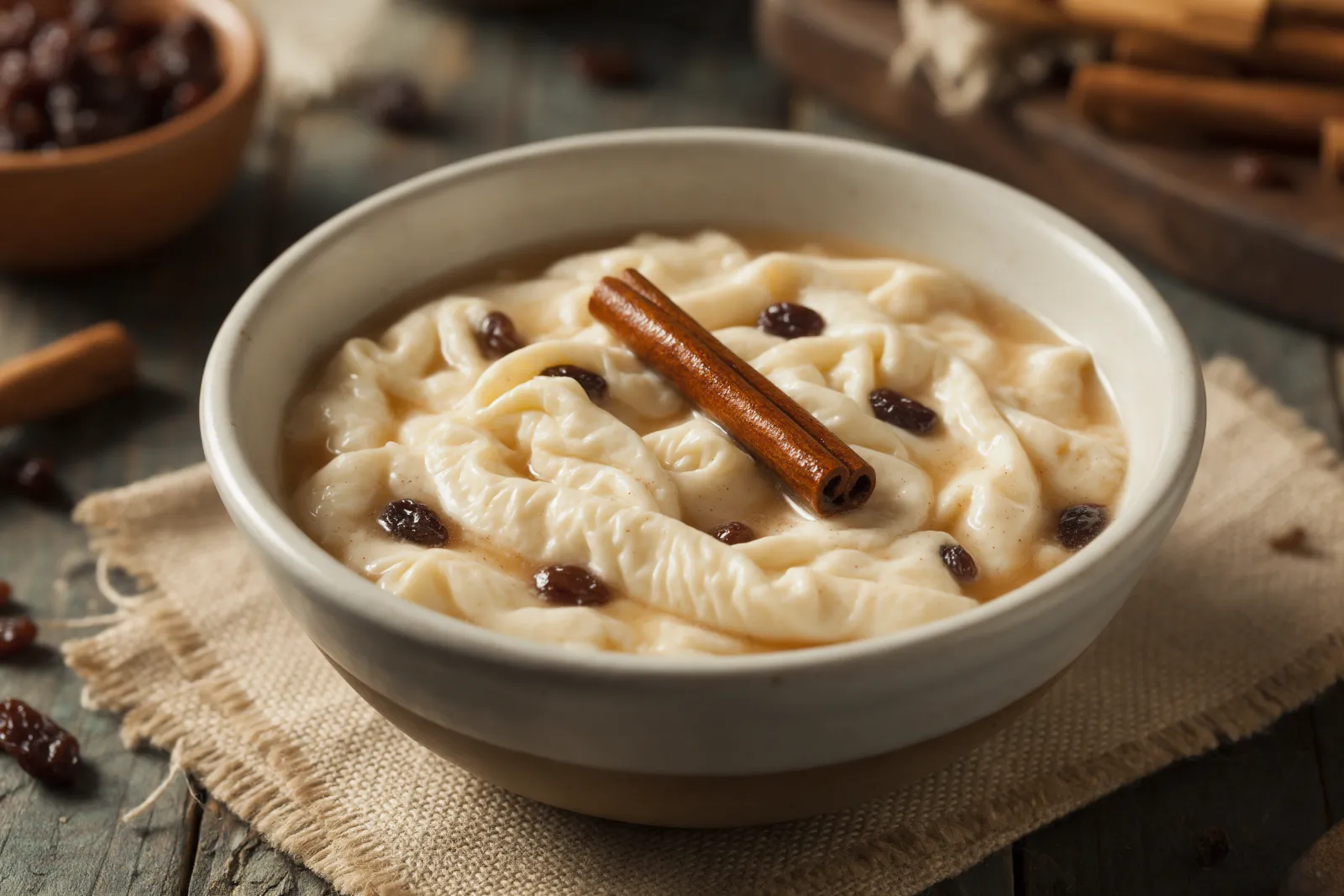

Postre de natas (POHS-treh deh NAH-tahs) is a Colombian dessert made from the skin that forms on boiled milk, the thing most people fish out of their hot chocolate and throw away. In the Andean highlands around Bogotá, cooks save it instead, day after day, until there’s enough to simmer in cinnamon syrup with egg yolks and raisins. The result is soft, chewy layers of milk in a thick syrup, served cold. Making it is mostly a matter of buying the right milk and starting three days early.
What is postre de natas, and is it worth three days?
How do you make Colombian postre de natas? Boil 6 liters (1.6 gallons) of fresh whole milk in wide pots, chill it overnight and lift off the firm skin; repeat three times over three days. Simmer the skins in a cinnamon sugar syrup at thread stage, stir in tempered egg yolks until the mixture reaches 160°F (71°C), and finish with rum-soaked raisins. 110 minutes of work spread over three days for 8 servings.
It’s worth it if you like milk desserts and plan ahead, and the work is light: three short boils, three skimmings of 5 minutes, and 26 minutes at the stove on the last day. It isn’t worth it if you need dessert tonight, or if the only milk you can buy is ultra-pasteurized.
When it shines. Christmas Eve or New Year’s Eve, because it’s done the night before and served straight from the fridge. Also a Sunday lunch with a soup like Colombian ajiaco before it.
Honest difficulty, medium. The steps are simple. The three ways to fail are the wrong milk, milk boiling over while you look away, and yolks that curdle because the pan boiled.
What it is not. Not Colombian natilla, which is a firm, sliceable custard thickened with cornstarch and panela. And “natas” here doesn’t mean the cream you buy: in Spain, nata is cream; in Venezuela, where I grew up, nata is the tangy cream we spread on arepas. Here it’s the skin.
The milk decides everything
A liter of whole milk holds about 33 g of fat (USDA), roughly 1.2 oz per quart, and the skin can’t take out more than that. What determines how much you actually get is whether the milk is homogenized. Homogenizing pushes milk through a tiny gap at high pressure until the fat globules are less than a micron across (Tetra Pak’s Dairy Processing Handbook), and globules that small stay suspended instead of rising.
- Cream-top or non-homogenized whole milk is the one to hunt for. In the US it’s sold at natural food stores and some supermarkets as “cream-top” or “non-homogenized”; in the UK, look for “non-homogenised” on the label, which some Channel Island (Jersey and Guernsey) milks carry. Raw milk works too, but the FDA warns it can carry Salmonella, E. coli and Listeria, so it has to be boiled, which this recipe does three times.
- Regular pasteurized whole milk works, with a thinner skin. In my kitchen it gives about half as much as cream-top. Buy 9-10 liters (2½ gallons) instead of 6, or boil it 4 or 5 times.
- Ultra-pasteurized and UHT milk barely form a skin. They’re homogenized and have already been heated to 275-300°F (135-150°C), so much of the protein that builds the skin is already set. In the US, much organic milk is ultra-pasteurized; check the carton. With 6 liters I don’t reach 100 g (3½ oz).
- Lactose-free, 2 % or skim: no. Most lactose-free milk is ultra-pasteurized, and lower-fat milk has less to give.
Ingredients, with US and UK equivalents
| What | Amount | US | UK | Notes |
|---|---|---|---|---|
| Whole milk | 6 L | 1.6 gallons | 10½ pints | non-homogenized if possible |
| Sugar | 200 g | 1 cup granulated | caster or granulated | white, not brown |
| Water | 125 ml | ½ cup | ½ cup | for the syrup |
| Egg yolks | 4 large | large eggs | medium-large eggs | about 68 g / 2.4 oz |
| Raisins | 60 g | scant ½ cup | 2 oz | golden ones usually contain sulfites |
| Cinnamon | 1 stick | 3 in | 8 cm | Ceylon or cassia both work |
| Rum or brandy | 30 ml | 2 tbsp | 2 tbsp | optional |
Equipment. Two wide pots of about 5 quarts (5 liters), a slotted spoon, a sieve, a heavy saucepan, an 8 × 8 in (20 × 20 cm) glass dish and an instant-read thermometer, which is the only way to know the yolks are safe.
The three-day plan for Christmas Eve
The skins can’t be rushed, so work backwards from the day you serve.
- December 21, evening. First boil. Cool, cover, refrigerate.
- December 22, morning. Lift the first skin, the thickest of the three. Second boil.
- December 23, morning. Lift the second skin. Third boil.
- December 23, evening. Lift the third skin and make the dessert. Chill overnight.
- December 24. Nothing left to do.
For New Year’s Eve, slide everything a week: boil on the 28th, assemble on the 30th. A fourth boil gives so little skin it isn’t worth the extra day.
Collecting the skin. Bring the milk up over medium heat and stay with it; in 15-20 minutes it foams up the sides all at once. Turn it off then. Cool it uncovered on the stove for no more than 1 hour, since the USDA FSIS limit for dairy at room temperature is 2 hours, then cover and refrigerate overnight. Cold, the skin is firm and pale yellow and lifts in one piece. Drain it in a sieve over the pot and keep all the skins together, covered, in the fridge.
The milk left behind. About 5 liters (5 quarts) of boiled, lower-fat milk. Keep it cold and use it within 3 days, in coffee, in a Colombian rice pudding, or in a pot of Colombian hot chocolate.
Making the dessert, syrup and yolks
Thread stage, and why altitude changes it
The syrup of 200 g (1 cup) sugar, 125 ml (½ cup) water and the cinnamon boils about 10 minutes over medium heat without stirring, until it reaches thread stage. The Exploratorium in San Francisco puts that at 230-235°F (110-113°C) at sea level and says to subtract 1°F for every 500 feet of altitude. In Denver that’s about 10°F lower; in Bogotá, at 8,600 feet, it’s closer to 17°F. Follow a sea-level number at altitude and the syrup goes past thread to caramel. Without a thermometer, pull a cooled drop between thumb and finger: it should form a short thread.
Yolks to 160°F (71°C)
The FDA says dishes containing eggs should reach 160°F (71°C), checked with a thermometer. The yolks go in raw, so warm isn’t enough. Whisk them with the ¼ cup milk, temper with 2 ladles of the hot skins and syrup, return everything to low heat and stir for 4-6 minutes until the thermometer reads 160°F. The upper limit is about 180°F (82°C), when the yolks start to scramble. No thermometer? Take it off when the mixture steams and the first small bubble breaks at the edge.
Who this recipe is for
- If you’ve never seen milk skin used for anything → start with cream-top milk; it makes the method obvious.
- If you only have regular supermarket whole milk → buy 2½ gallons and plan 4 boils.
- If you’re cooking for kids or someone pregnant → soak the raisins in hot water and use the thermometer; the FDA counts both groups as higher risk with eggs.
- If you have one afternoon → use the heavy cream shortcut below.
Mistakes that ruin it
- No skin at all → ultra-pasteurized, UHT, lactose-free or low-fat milk. There’s no fix but different milk or the cream shortcut.
- Very little skin → a tall, narrow pot, or skin lifted while warm. Wide pots, half full, and skim cold.
- Milk boiled over → high heat and nobody watching. Medium heat, and off the moment it rises.
- Curdled yolks → the pan boiled. If it’s only a few threads, blitz the mixture (without raisins) for 5 seconds in a blender; you lose some texture and save the batch.
- Syrup turned to caramel → it went past thread stage, often from using a sea-level temperature at altitude. Stir in 3-4 tablespoons of hot water and boil 1 minute.
- Runny dessert → not enough time in the fridge, or the syrup never reached thread. Give it the whole night.
Allergens. Milk and egg. No gluten, no nuts. Golden raisins usually contain sulfites.
Other versions, from a shortcut to a crowd
The heavy cream shortcut. Replace the 300 g of skins with 400 ml (1⅔ cups) heavy cream (double cream in the UK), reduce it in the syrup for 10 minutes, then add the yolks as written. Done in an afternoon. What changes is texture: smooth, like a cinnamon cream, with none of the chewy layers, because cream is emulsified fat without the set protein a milk skin has. It’s also richer, about 320 kcal a serving instead of 260.
For 20. 15 liters (4 gallons) of milk in 3 wide 8-quart pots, 500 g (2½ cups) sugar, 310 ml (1¼ cups) water, 10 yolks and 150 g (1 cup) raisins. The same three days: what grows is the number of pots.
Alcohol-free. Raisins soaked in hot water or orange juice.
Less sweet. 150 g (¾ cup) sugar; a little looser.
Milk syrup. Swap the water for 250 ml (1 cup) of the leftover milk and boil 15-18 minutes. It turns cream-colored and tastes like Colombian dulce de leche.
What it costs in the US
At the US city average retail prices the Bureau of Labor Statistics published for August 2026, 6 liters of whole milk (1.59 gallons at $4.229) cost $6.70, four eggs from a $2.272 dozen cost $0.76, and 200 g of sugar at $1.024 a pound cost $0.45.
That’s $7.91 for 8 servings, about $0.99 each, and the milk is 85 % of it. Raisins, a cinnamon stick and a splash of rum aren’t tracked by the BLS.
Serving, storing and gifting
Taste and texture. Thick cinnamon syrup, soft milk layers you actually chew, golden curds of yolk and plump raisins. Sweet, milky and rich, nearer to curdled dulce de leche than to any custard.
How it’s served. Cold, about 95 g (½ cup) a serving, in small glasses or straight from the dish. At Christmas it sits on the table next to Colombian buñuelos and natilla.
Fridge. The FDA says leftover cooked egg dishes keep 3 to 4 days refrigerated at 40°F (4°C) or below, and no more than 2 hours out. Cover it well; milk skin picks up fridge smells.
Freezer. I don’t freeze it: the syrup separates and the skins turn grainy. There’s no official figure for this dessert; that’s my kitchen’s rule.
As a gift. In 8 oz (250 ml) glass jars, made the day before and cold, labelled “keep refrigerated, 3 days”. No more than 2 hours out of the fridge on the way.
Frequently asked questions
What is postre de natas made of? Milk skins collected from boiled whole milk, a cinnamon sugar syrup, egg yolks and raisins, often with a little rum.
Can I make it with store-bought milk? Regular pasteurized whole milk, yes, with more milk or more boils. Ultra-pasteurized or UHT milk, no: it barely forms a skin.
How much milk do I need? For 8 servings, 6 liters (1.6 gallons) of non-homogenized milk for about 300 g (10½ oz) of skins, or 9-10 liters (2½ gallons) of regular whole milk.
Are the egg yolks cooked? Yes, if the mixture reaches 160°F (71°C), the FDA target for egg dishes. Use a thermometer.
Can I make it with heavy cream instead of milk skin? Yes. 400 ml (1⅔ cups) heavy cream reduced in the syrup gives a smooth, richer dessert in an afternoon, without the layered texture.
How long does it keep? Up to 4 days, covered and cold, which is the FDA’s window for cooked egg dishes. Don’t freeze it.
Is postre de natas the same as natilla? No. Natilla is a firm cornstarch and panela custard; postre de natas is milk skin in syrup, eaten with a spoon.
Nutrition
Per serving (about 95 g / ½ cup), calculated from the USDA FoodData Central database (SR Legacy) with the quantities above. Milk skin isn’t listed there, so light whipping cream stands in for it as the closest match:
- Calories: 260 kcal
- Protein: 3 g
- Carbohydrates: 33 g
- Fat: 14 g, of which 8 g saturated
- Sugars: 31 g
- Sodium: 22 mg
The sugar alone is 774 of the dessert’s 2,086 kcal, and nearly all the fat comes from the skins. The rum adds about 8 kcal a serving. Small portions are the point.
In Venezuela I’d only ever met nata in a tub, salty and sour, for arepas, so the first time someone in Bogotá offered me postre de natas I expected something savory. What I got was milk I’d been throwing away for years, turned into the best spoonful on the Christmas table. These days the milk goes on the stove three nights before Christmas Eve, and the day itself is mine. Josnaisis.