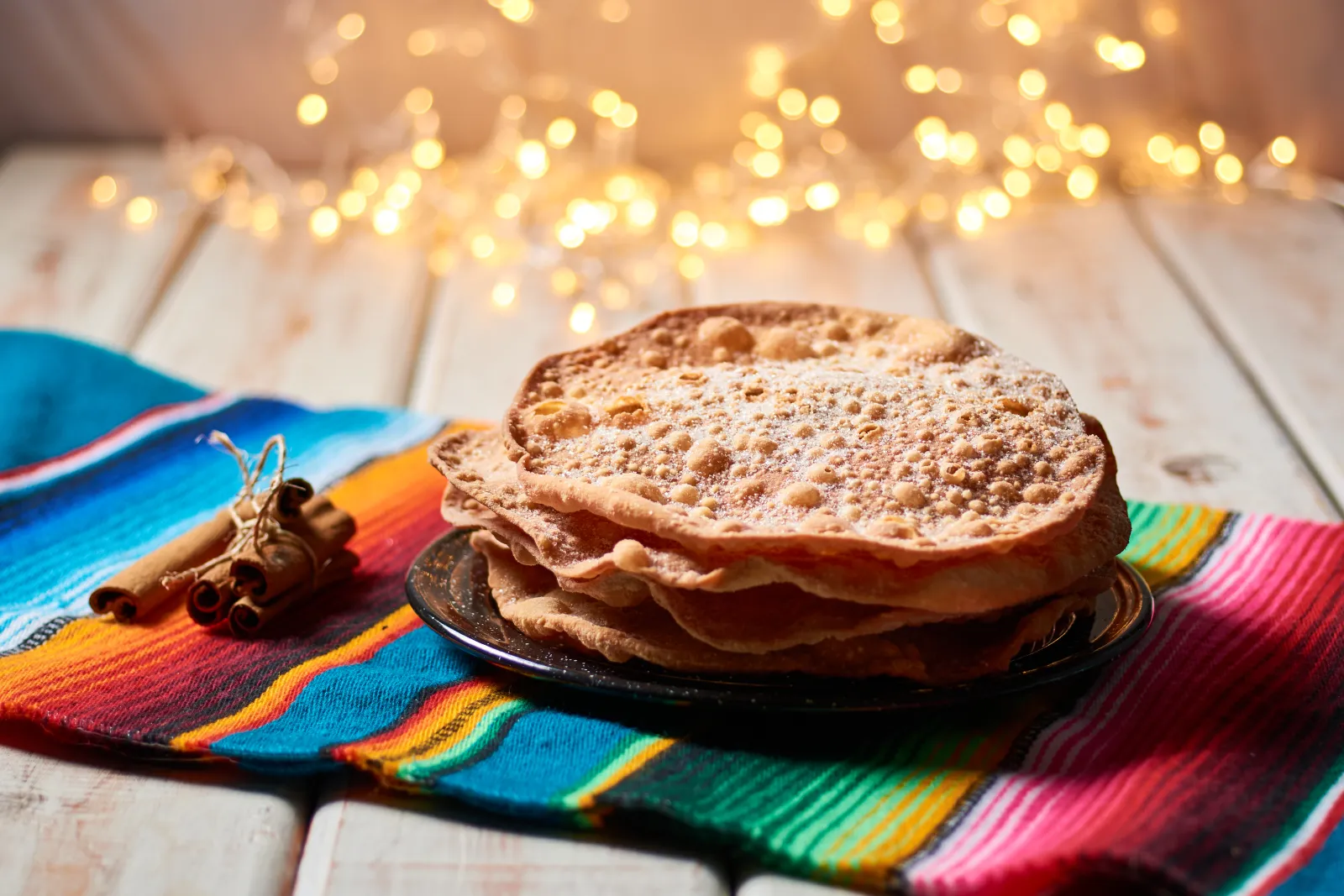

Picture an 8 in (20 cm) disc of wheat dough rolled so thin you can read through it, fried until it blisters and goes glassy, then tossed in cinnamon sugar. That’s a Mexican buñuelo (boo-NYWEH-loh), the fried dough disc that shows up on Christmas Eve, Christmas Day and at the posadas, the neighborhood parties of the nine nights before Christmas. Some families serve them in a dark syrup of piloncillo, Mexico’s unrefined cane sugar, simmered with guava and cinnamon. One batch of dough, 500 g (about 4 cups) of flour, makes 16 discs the size of a dinner plate.
What are Mexican buñuelos, and are they worth 110 minutes?
How do you make Mexican buñuelos? Knead 500 g (4 cups) of flour with baking powder, 2 eggs, 60 g (4 tbsp) of butter and 200 ml (¾ cup) of warm milk, rest the dough 30 minutes and cut it into 16 balls. Roll and hand-stretch each into a paper-thin 8 in (20 cm) disc, fry it at 350°F (175°C) for 30 to 45 seconds a side, and toss it in cinnamon sugar or spoon piloncillo syrup over it. 110 minutes for 16 buñuelos.
Worth it if you’re feeding a crowd in December. The ingredients cost about $2 in the US, and the cinnamon-sugar version stays crisp in a cookie tin for days, so you can fry on Thursday for a Saturday party.
Who they’re for. A holiday party, a dessert table, a gift tin, or anyone who likes churros and wants something crispier and less doughy.
Who might skip them. Gluten-free households, since wheat gluten is what lets the dough stretch this thin. Anyone short on patience: stretching 16 discs takes about 25 minutes, and the first two or three will tear. And if you want a 20-minute dessert, see the flour-tortilla shortcut below.
Real time. 110 minutes, about 75 hands-on. With the dough made the night before, the day itself is 95 minutes.
Honest difficulty, medium. The kneading is easy. The two skills are stretching evenly and holding the oil temperature. A disc with a hole still fries fine.
Not the same as Colombian buñuelos or sopapillas
The word buñuelo covers three different things in Latin America. This recipe is the Mexican buñuelo de rodilla, or “knee buñuelo,” a flat wheat disc; The name refers to stretching the dough over the knee, according to the Mexico City newspaper Excélsior. Colombian buñuelos are something else: salty, puffy balls of cheese and corn starch, gluten-free, fried at a lower temperature for 8 minutes. And buñuelos de viento are rosettes made with a thin batter and a steel mold.
Buñuelos vs sopapillas. Sopapillas are thicker squares that puff into pillows and are eaten soft with honey. Buñuelos are rolled thin and fried flat, so they shatter. Closest relatives? The flat, crisp fried-dough sweets of other cuisines, including Colombia’s hojuelas.
Ingredients, with US and UK swaps
Nothing here is hard to find except the piloncillo, and that’s only for the syrup. The card above has exact amounts for 16.
| Ingredient | In the US | In the UK | What changes if you swap |
|---|---|---|---|
| All-purpose flour | any brand, not bread flour | plain flour | bread flour makes the dough spring back and the buñuelo tougher |
| Butter | unsalted | unsalted | lard is flakier; vegetable shortening is plainest and dairy-free |
| Piloncillo | Hispanic aisle, cones or bags | Latin grocers online | dark brown sugar or dark muscovado gives a lighter, less smoky syrup |
| Guava | Latin markets, sometimes frozen pulp | some large supermarkets | 2 apples, quartered, or leave it out |
| Self-rising flour | works | self-raising works | leave out the baking powder |
About piloncillo. It’s unrefined cane sugar pressed into cones, the same thing Colombians call panela. At H-E-B, an 8 oz (227 g) bag of its Mi Tienda piloncillo was $1.28 in October. Hard cones are easiest to break by simmering them whole in the water; no need to grate.
Equipment. A wide 10 to 11 in (26 to 28 cm) skillet with 2 in (5 cm) sides, a rolling pin, a wide slotted spatula, an instant-read or deep-fry thermometer, and a clean tablecloth or towels for drying the discs. Only have a smaller pan? Stretch 6 in (15 cm) discs and you’ll get 20.
Make-ahead plan for the holidays
The dough keeps overnight in the fridge, the syrup keeps a week, and fried buñuelos with cinnamon sugar keep several days in a tin. So nothing has to happen on party day except, at most, warming the syrup.
Three days to one week ahead. Make the syrup and refrigerate it in a jar.
Up to three days ahead. Fry and coat the buñuelos, cool them completely and store them in a tin.
The night before (if you’d rather fry on the day). Make the dough, wrap it tightly and refrigerate. Take it out 30 minutes before you divide it, or it fights the rolling pin.
On the day. Roll every disc before you heat the oil, so frying runs without interruption.
How to roll buñuelo dough paper-thin without tearing
Rest is what lets it stretch, not strength. Kneading tightens the gluten into something like a rubber band. 30 minutes under a cover, then 10 more as oiled balls, and the dough relaxes enough to open without snapping back. If a disc shrinks while you work it, cover it and move on to the next; in 5 minutes it will cooperate.
- Roll to 5 in (12 cm) with the pin, using as little flour as possible. Extra flour burns in the oil and leaves black specks.
- Stretch to 8 in (20 cm) over your knuckles, or over your knee or an upturned bowl draped with a towel, pulling the edges outward and turning it as you go. The center thins on its own; the edges are what stay thick, and thick edges are what turn hard.
- Check it against the light. You should see the shadow of your hand through the dough, about 1/32 in (1 mm) thick.
- Air-dry 10 to 15 minutes on a tablecloth, until dry to the touch but still bendable. A dried surface absorbs less oil.
Oil temperature for buñuelos, and why one at a time
350°F (175°C), 30 to 45 seconds per side. A disc this thin needs hot oil to set and brown before it has time to soak up fat. At 320°F (160°C) it takes twice as long, drinks oil and turns leathery. Above about 365°F (185°C) the blisters go dark brown before the rest colors. Colombian cheese buñuelos are the opposite case: a thick ball fried cooler, around 300 to 330°F (150 to 165°C), so the inside cooks.
Fry one at a time. The disc fills the pan, and every cold piece of dough drops the oil temperature; give it 15 to 20 seconds to recover between buñuelos. When the dough hits the oil it puffs into big bubbles. Press them flat with the spatula for the first 10 seconds so it fries evenly.
No thermometer? Drop in a scrap of dough. It should rise immediately in a ring of bubbles and turn golden in about 30 seconds.
Cinnamon sugar or piloncillo syrup
Cinnamon sugar is the one to make ahead. Toss each buñuelo while still warm so the sugar sticks, and they’ll stay crisp for days. Piloncillo syrup turns the buñuelo into a plated dessert: within 10 to 15 minutes it softens from shattering to tender, tasting of dark caramel and guava. Spoon it on at the table, never before. Honey works the same way, with less depth.
For the syrup, simmer 250 g (8.8 oz) piloncillo in 500 ml (2 cups) water with cinnamon, orange peel and star anise; once it boils, add 2 quartered guavas and cook uncovered 20 to 25 minutes until it coats a spoon. That’s enough for 16, about 2 tablespoons each.
Troubleshooting, kids and allergens
- Hard, like a stale cracker → the dough was too thick, usually at the edges, or skipped its rest. Stretch until you can see light through it.
- Greasy and chewy → the oil was below 340°F (170°C), or the disc went in damp. Air-dry the discs and let the oil recover between each one.
- Tears while stretching → dough too dry or too tense. Add 1 tablespoon of milk while kneading and give it 10 more minutes.
- Shrinks back → gluten still tight. Cover it for 5 minutes.
- Black specks → too much flour on the counter, or oil over 365°F (185°C).
- Soft the next day → stored while warm, or with syrup. Cool completely and keep them dry.
Spice level, none. It’s a cinnamon sweet.
Kids. A favorite: crunchy, sweet, eaten with your hands. Let them toss the discs in cinnamon sugar and keep them away from the pan; oil at 350°F (175°C) burns on contact.
Allergens. Wheat (gluten), egg and milk (butter and milk). No nuts. The egg-free, dairy-free version is below.
Other ways to make buñuelos
- Quick, with flour tortillas → fry store-bought 8 in (20 cm) flour tortillas at 350°F (175°C) for about 30 seconds a side and toss in cinnamon sugar. 10 in 15 minutes. Flatter and less blistered, but crisp.
- Egg-free and dairy-free → the same 500 g (4 cups) flour with 60 g (⅓ cup) vegetable shortening and about 250 ml (1 cup) warm water. Whiter, very flaky, a little less golden.
- Lighter → skip the syrup and use half the cinnamon sugar, about 15 kcal less per buñuelo. Frying at the right temperature is the only thing that reduces the oil.
- Smaller → 6 in (15 cm) discs, 20 per batch, easier for kids and for small skillets.
How many buñuelos for a party of 20 to 30
I count one large buñuelo per person when there are other desserts, and one and a half when it’s the main sweet. With one skillet you fry about 30 an hour.
| Guests | Flour | Eggs | Butter | Milk | 8 in (20 cm) buñuelos | Frying, 1 pan |
|---|---|---|---|---|---|---|
| 4-6 | 250 g (2 cups) | 1 | 30 g (2 tbsp) | 100 ml (scant ½ cup) | 8 | 15 min |
| 12-16 | 500 g (4 cups) | 2 | 60 g (4 tbsp) | 200 ml (¾ cup + 1 tbsp) | 16 | 30 min |
| 20-30 | 1 kg (8 cups) | 4 | 120 g (1 stick) | 400 ml (1⅔ cups) | 32 | 60 min |
| 40-50 | 1.5 kg (12 cups) | 6 | 180 g (1½ sticks) | 600 ml (2½ cups) | 48 | 90 min |
Scale the syrup at 250 g (8.8 oz) piloncillo per 16. Above 30 guests, knead in two batches; 1.5 kg (3.3 lb) of dough is too much to knead well by hand.
What Mexican buñuelos cost in the US
At August 2026 average prices, according to the US Bureau of Labor Statistics or BLS (flour $0.548/lb, eggs $2.272 a dozen, butter $4.021/lb, whole milk $4.229 a gallon, sugar $1.024/lb), the dough and cinnamon sugar for 16 come to about $2.03, roughly 13 cents a buñuelo. Piloncillo for the syrup adds about $1.41. The BLS doesn’t track frying oil or guava, so they’re not in the total.
The oil is the real expense, and most of it isn’t eaten: by my estimate each buñuelo keeps about 6 g (1½ teaspoons), and the rest can be strained and reused two or three times. Fry homemade churros in it the next day.
How to store buñuelos and keep them crispy
At room temperature. Cinnamon-sugar buñuelos, completely cooled, keep crisp up to 1 week in an airtight tin lined with paper towel. I stop at 5 days because the cinnamon fades. Don’t refrigerate them; fridge humidity softens them. With syrup, eat the same day.
The syrup. In a closed jar, up to 1 week in the fridge. It thickens when cold; warm it 2 minutes with 1 tablespoon of water.
The dough. Up to 24 hours in the fridge, tightly wrapped. I don’t freeze fried buñuelos: they turn damp as they thaw and don’t recover their snap.
To re-crisp. 5 minutes in a 300°F (150°C) oven on a rack, cool, then re-dust with cinnamon sugar. The microwave makes them chewy.
What to serve with them. Something hot and December: Mexican Christmas punch with tejocotes and guava, thick chocolate champurrado, cinnamon atole or spiced café de olla. In January they keep company with a rosca de reyes.
Frequently asked questions
Why are my buñuelos hard instead of crispy? The dough was too thick, especially at the edges. A crispy buñuelo is 1 mm (1/32 in) or thinner and shatters; a thick one dries out in the oil. Rest the dough 30 minutes and stretch until light shows through.
What temperature do you fry buñuelos at? 350°F (175°C), 30 to 45 seconds per side, one at a time.
How do you keep buñuelos crispy? Cinnamon sugar instead of syrup, cool them completely, and store them in an airtight tin at room temperature, not in the fridge. They keep up to a week.
What’s the difference between buñuelos and sopapillas? Buñuelos are rolled paper-thin and fried flat until they shatter, then coated in cinnamon sugar or syrup. Sopapillas are thicker, puff into soft pillows and are usually eaten with honey.
Can you make buñuelos with flour tortillas? Yes, as a shortcut: fry 8 in (20 cm) flour tortillas at 350°F (175°C) about 30 seconds a side and toss in cinnamon sugar. They’re flatter and less blistered than homemade.
What can I use instead of piloncillo? Dark brown sugar or dark muscovado, in the same weight. The syrup comes out a little lighter and less smoky.
Are Mexican and Colombian buñuelos the same? No. Mexican buñuelos are thin, sweet wheat discs. Colombian buñuelos are salty balls of cheese, corn starch and cassava starch, with no wheat.
How many buñuelos do I need for 30 people? 32, from a double batch with 1 kg (8 cups) of flour, if there are other desserts. Make 48 if buñuelos are the main sweet.
Nutrition
Per buñuelo (about 55 g / 2 oz raw dough, with cinnamon sugar, no syrup), calculated ingredient by ingredient from USDA FoodData Central (SR Legacy) with this recipe’s amounts, counting 6 g of absorbed oil per buñuelo, which is my estimate at 350°F (175°C):
- Calories: 243 kcal
- Protein: 5 g
- Carbohydrates: 33 g
- Fat: 10 g (3 g saturated)
- Fiber: 1 g
- Sugars: 9 g, mostly from the cinnamon sugar
- Sodium: 160 mg
The absorbed oil is about 53 kcal of each buñuelo. Two tablespoons of piloncillo syrup add about 66 kcal and 16 g of sugars.
I didn’t grow up with these; Venezuelan Christmas had its own sweets. What won me over was the dough itself, which asks you to wait and then rewards you by stretching until it’s almost transparent. Now December in my house starts the day the first tin is full. Josnaisis.