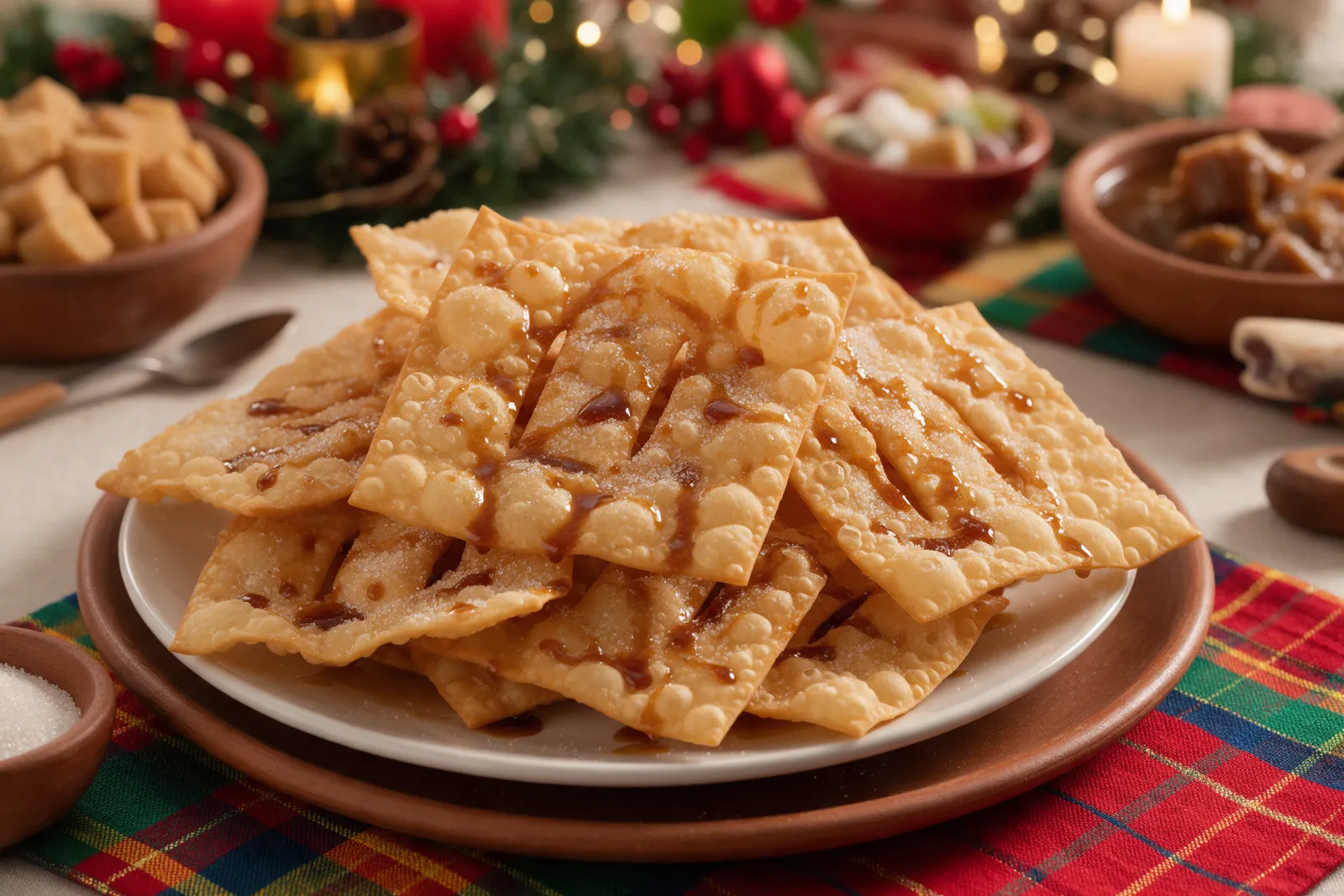

If you’ve had Mexican buñuelos, Italian chiacchiere or Polish chruściki, you already know the family: a thin sheet of sweet wheat dough that hits hot oil, blisters, and comes out so crisp it shatters. Hojuelas (oh-HWEH-lahs) are Colombia’s version, flavored with fresh orange juice and zest, and in Antioquia and the Valle del Cauca they’re also called hojaldras. They turn up every December next to custard and cheese fritters, and they have one advantage over almost every other Christmas sweet: made a few days ahead, they keep.
How do you make Colombian hojuelas?
How do you make Colombian hojuelas? Knead 500 g (4 cups) of flour with an egg, 40 g (3 tbsp) of butter, a little sugar and salt, and 180 ml (¾ cup) of orange juice, then rest the dough 30 minutes. Roll it to 2 mm (1/16 in), cut rectangles, and fry at 350-355°F (175-180°C) for 60 to 90 seconds a side until blistered. Dust with powdered sugar or serve with panela syrup. 85 minutes for 15 servings.
Fifteen servings means about 75 pieces, five each. The whole method hangs on two numbers, and both are about steam. The orange juice and egg put water into the dough; at 350°F (175°C) that water flashes into steam and lifts the surface into blisters before the crust sets. Roll thicker than 2 mm, or let the oil drop, and the steam escapes slowly, the dough soaks up fat, and you get a hard, greasy cracker.
Where they come from. Wikipedia’s entry on hojuelas describes them as a holiday sweet in Colombia, eaten with natilla, buñuelos and manjar blanco, and El Espectador’s food section places the hojaldras name in Antioquia and the Valle del Cauca. In Colombia they belong to the Novena de Aguinaldos, nine evenings of prayers and carols from December 16 to 24, when each night ends with something sweet on the table.
Is it worth it? If you’re feeding a crowd, yes. One batch costs a few dollars and fills a tin. If you don’t want a pot of hot oil in your kitchen for half an hour, skip to the oven and air fryer section first, and decide with the trade-offs in front of you.
What you need, with US and UK swaps
The full amounts are in the recipe card: 500 g (1.1 lb) of flour, 1 egg, 40 g (3 tbsp) of butter, 180 ml (¾ cup) of orange juice and 1 liter (1 quart) of oil. Everything except the syrup’s panela is a supermarket staple.
Panela, explained. Panela is unrefined cane sugar boiled down and set in blocks, darker and more molasses-like than brown sugar. In the US the same product is sold as piloncillo, in cones, in the Mexican aisle of most supermarkets and at any Latin grocery. In the UK, Latin American online grocers stock panela; dark muscovado is the closest thing on a regular supermarket shelf. Dark brown sugar works too, with a thinner, less caramel note. You only need it for the syrup.
Flour. All-purpose in the US, plain in the UK. Cake flour makes hojuelas so fragile they snap when you flip them; bread flour makes them tougher.
Orange juice. Fresh is best, but a not-from-concentrate carton works with a bit less aroma. Don’t skip the zest, which carries most of the orange smell.
Equipment. A rolling pin, a knife or pizza wheel, a heavy pot 8-9 inches (20-24 cm) wide, a slotted spoon or spider, a rack or paper towels, and ideally a clip-on thermometer. A smooth, chilled wine bottle stands in for a rolling pin.
Getting the oil right
Temperature is where most batches go wrong, so it gets its own section. Clip a thermometer to the side of the pot and aim for 350-355°F (175-180°C), letting the oil recover between batches.
No thermometer? Drop in a scrap of dough. It should float and sizzle within 2 to 3 seconds. If it sits on the bottom, the oil is too cold; if it browns instantly, it’s too hot.
Batch size. Eight pieces in an 8-9 inch pot. More than that and the oil temperature falls toward 300°F (150°C), which is exactly the greasy zone.
Frying safely with kids around
Kids love helping with hojuelas, and the jobs are easy to split. The NFPA (National Fire Protection Association) recommends a kid-free zone of at least 3 feet (1 meter) around the stove. In my kitchen:
- Kids cut and dust. The pizza wheel and the powdered-sugar sieve live on a separate table.
- Back burner, handle turned in, and oil no more than a third of the way up the pot.
- No water near the oil, ever. If the oil catches fire, per the NFPA, slide a lid over the pot and turn off the burner, then leave it covered until it cools.
- Let the oil cool in the pot before straining or moving it. It takes over an hour.
Mistakes that make hojuelas hard or greasy
- Hard and dense → rolled thicker than 3 mm (⅛ in), too much flour on the counter, or the dough skipped its rest and shrank back. Roll to 2 mm and rest 30 minutes.
- Pale and oily → oil below 330°F (165°C), or too many pieces at once. Smaller batches, and wait for the thermometer.
- No blisters → dough too dry. Add a tablespoon more juice next time.
- Brown outside, raw in the middle → oil at 375°F (190°C) or hotter. Turn the heat down and test with a scrap.
- Sugar won’t stick → it went on cold. Dust within 30 seconds of lifting them out.
- Re-rolled scraps come out tougher → the gluten got worked twice. Rest the scraps 10 minutes before rolling.
How many to make, and a make-ahead plan
Plan on 3 or 4 hojuelas per person when they share the table with other desserts, and 6 when they’re the only sweet. A 500 g (1.1 lb) batch of flour gives about 75; each kilo (2.2 lb) of flour gives about 150.
| Crowd | Flour | Eggs | Orange juice | Hojuelas |
|---|---|---|---|---|
| 6 people | 250 g (2 cups) | 1 small | 90 ml (⅓ cup + 1 tbsp) | about 37 |
| 15-20 people | 500 g (4 cups) | 1 large | 180 ml (¾ cup) | about 75 |
| 15-20 people, 3 evenings | 1.5 kg (3.3 lb) | 3 | 540 ml (2¼ cups) | about 225 |
| 15-20 people, all 9 Novena evenings | 4.5 kg (10 lb) | 9 | 1.6 liters (6¾ cups) | about 675 |
Day before. Make the dough, wrap it, and refrigerate up to 24 hours. The syrup keeps in a jar in the fridge; warm it in a water bath before serving.
Two or three days before. Fry. Sugared hojuelas without syrup stay crisp in a tin, so the party day is free. For a nine-night Novena I fry three times, on the 16th, 19th and 22nd, with 1.5 kg (3.3 lb) of flour each time.
Fried, baked or air fryer
You can bake or air-fry hojuelas, but go in knowing what you’ll get.
| Method | Temperature and time | What you get | Fat per serving |
|---|---|---|---|
| Deep-fried | 350°F (175°C), 60-90 s a side | big blisters, shatters | about 13 g |
| Oven | 400°F (200°C), 7-9 min, brushed with 1 tbsp oil in total | flat, no blisters, like an orange cookie | about 4 g |
| Air fryer | 375°F (190°C), 5-6 min, single layer | a few blisters, crisp and dry | about 4 g |
In my air fryer the pieces are so light that the fan lifts them; a small rack set on top keeps them flat. Both versions taste good. Neither is a hojuela as Colombians know it.
Powdered sugar or panela syrup
- For tins and make-ahead → powdered sugar while hot, 40 g (⅓ cup) for the whole batch. Mix in 1 teaspoon of ground cinnamon if you like.
- For serving right away → panela syrup on the side. The ratio is 250 g (9 oz) panela to 150 ml (⅔ cup) water, simmered to thread stage, 223-230°F (106-110°C). It makes about 300 g (1 cup) of syrup, enough for 15 people. Past 240°F (115°C) it sets sticky like caramel as it cools; loosen it with a spoonful of hot water.
- With dulce de leche → a teaspoon of Colombian dulce de leche on top, at the table, is another December way to eat them.
- With cinnamon sugar → rolled while hot instead of drizzled, the way homemade churros are coated.
What it costs
At the US city average retail prices the Bureau of Labor Statistics published for August 2026, the ingredients it tracks add up to about $3.08 for 75 hojuelas, roughly 21 cents a serving of five.
The surprise is the oranges: at $1.709 a pound, the fruit for the juice and zest costs three times the flour at $0.548 a pound. Butter was $4.021 a pound, eggs $2.272 a dozen and sugar $1.024 a pound. The BLS doesn’t track frying oil, powdered sugar or piloncillo. Of the quart of oil in the pot, only about 150 g (5 oz) ends up in the hojuelas; strain the rest and reuse it once or twice, unless it smokes before reaching temperature or smells stale.
How to serve and store them
Taste and texture. Light gold, blistered, crisp enough to break into shards, and clearly orange. Syrup soaks into the blisters, so they go from shattering to chewy-centered within the hour.
Serving. In Colombia, on a big platter beside Colombian natilla and buñuelos, with a cup of Colombian hot chocolate or hot aguapanela. For the grown-ups on Christmas Eve, a glass of ponche crema and, if the main course was lechona, they’re the light thing to end with.
Keeping them crisp. Once completely cool, store the sugared ones in an airtight tin or jar lined with a paper towel, at room temperature and away from the stove. Mine stay crisp for 5 days; after that they soften and the oil starts tasting old. Don’t refrigerate them, because fridge humidity softens them. With syrup on, eat them the same day.
Reviving soft ones. 300°F (150°C) oven, 3 to 4 minutes on a tray, then cool on a rack.
Allergens. Wheat (gluten), egg and dairy (butter). For egg-free, replace the egg with 3½ tablespoons (50 ml) more orange juice; the dough is a little more crumbly and still blisters. With plant-based butter they’re dairy-free. I can’t recommend a gluten-free version: gluten-free flour blends tear when rolled to 2 mm and don’t blister.
Frequently asked questions
What are Colombian hojuelas? Thin sheets of orange-flavored wheat dough, fried until blistered and dusted with sugar or served with panela syrup. They’re a Christmas sweet in Colombia, eaten with natilla and buñuelos.
Why are my hojuelas hard? Almost always thickness. Above 3 mm (⅛ in) they don’t blister and set hard as they cool. Too much flour on the counter, or unrested dough, also make them tough.
What oil temperature do I need? 350-355°F (175-180°C). At 300°F (150°C) they soak up oil; at 375°F (190°C) they brown before they puff.
How long do hojuelas stay crisp? About 5 days in an airtight tin at room temperature, without syrup.
Can I make hojuelas in an air fryer? Yes, at 375°F (190°C) for 5 to 6 minutes in a single layer. They come out flatter and drier, closer to a cookie, with about 4 g of fat per serving instead of 13 g.
Are hojuelas the same as Mexican buñuelos? They’re close relatives: both are thin fried wheat dough with sugar, and Mexican buñuelos with piloncillo syrup are simply rolled into bigger discs. Colombian buñuelos are something else entirely, round cheese fritters.
What can I use instead of panela? Piloncillo in the US, dark muscovado in the UK, or dark brown sugar, which gives a lighter syrup.
Nutrition
Per serving of 5 hojuelas (about 50 g / 1.8 oz) with powdered sugar and no syrup, calculated from the USDA FoodData Central database (SR Legacy) with the quantities above and about 150 g (5 oz) of oil absorbed across the batch:
- Calories: 256 kcal
- Protein: 4 g
- Carbohydrates: 31 g
- Fat: 13 g, of which 3 g saturated
- Fiber: 1 g
- Sugars: 5 g
- Sodium: 74 mg
More than half the fat is frying oil, which is why oil temperature matters for nutrition too: cooler oil means greasier hojuelas. The panela syrup adds about 63 kcal per serving.
Nobody made hojuelas in my Venezuelan childhood; December at home meant hallacas. I met them at my first Novena in Colombia, piled next to the natilla, and my first batch came out thick and hard. These days my son Dylan runs the pizza wheel at the far end of the table and I stay by the pot, and the rule we never break is rolling until you can see the counter through the dough. Josnaisis.