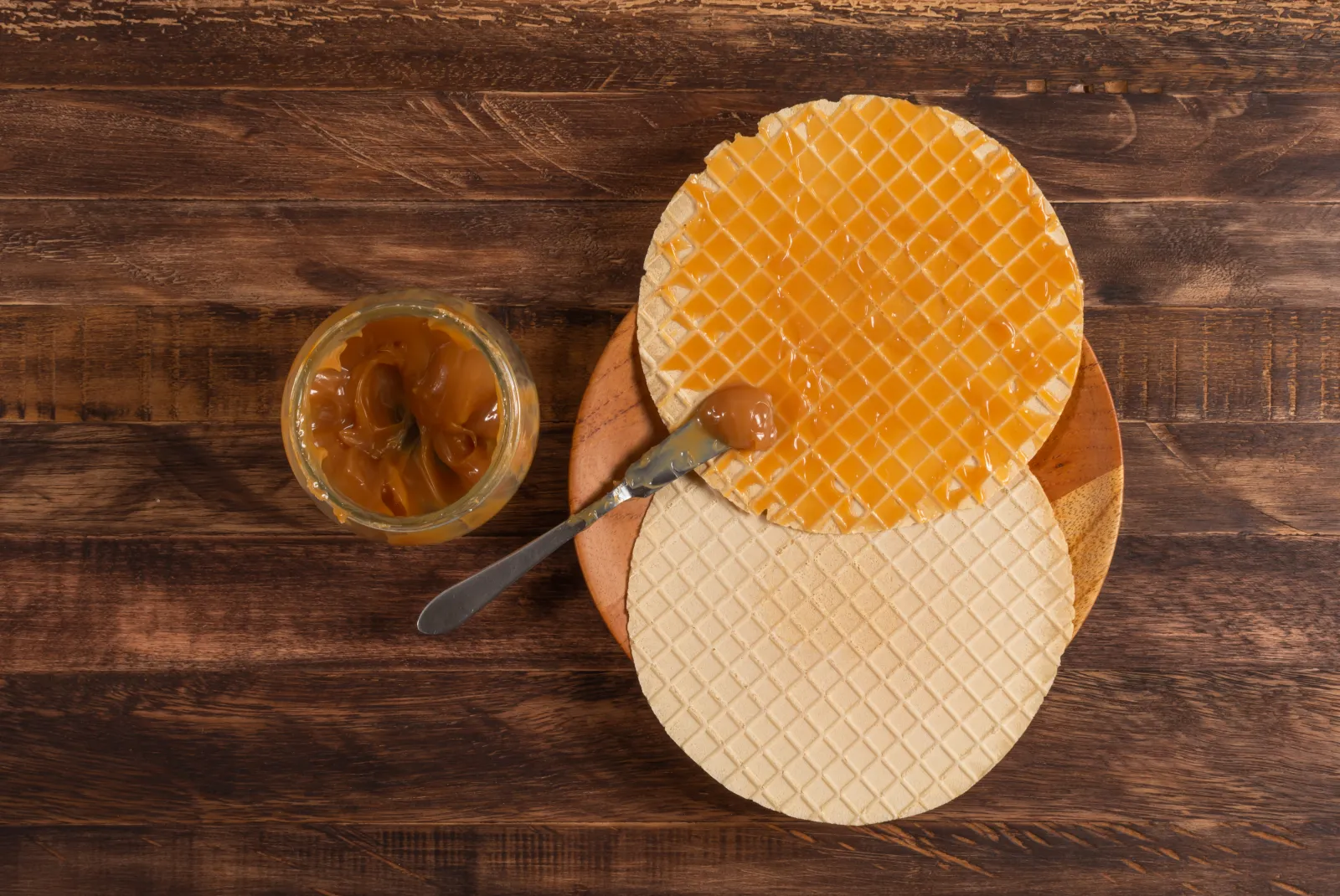

A Colombian oblea is two 7 g wafers, crisp as a cake cone and so thin you can see light through them, pressed around a thick layer of arequipe. Nobody in Colombia bakes the wafers at home: they come in packs from the supermarket, and the cook’s job is the filling and the timing. This guide covers both, plus where to find the wafers in the US and UK, what to use when you can’t, and how to run an oblea bar for a crowd.
Are obleas worth making, and who are they for?
How do you make Colombian obleas? Buy a pack of oblea wafers, spread one with 30 g (1½ tbsp) of arequipe or thick dulce de leche, leaving a 1 cm (⅜ in) border, add blackberry compote, cream and grated cheese on top, and close it with a second wafer pressed only in the center. The only cooking is a quick berry compote, 15 minutes on the stove and 15 to cool. 40 minutes for 12 servings.
What they are. Obleas are a street sweet from Bogotá and especially from Floridablanca, a town next to Bucaramanga in northeast Colombia. According to the Santander newspaper Vanguardia, they arrived there from Bogotá about a hundred years ago, and local makers later began adding toppings and naming the combinations. Every Floridablanca oblea still starts with arequipe, Colombia’s thick dulce de leche.
Why bother. No oven, no dough, and the result is a contrast you don’t get from many desserts: a wafer with almost no flavor of its own, crisp like a cake cone, against dense caramel, tart blackberry and salty cheese. Cheese on a sweet sandwich sounds odd until you taste it; it is what keeps the caramel from being cloying.
Who it suits. Kids, who can build their own. Casual dinners. Birthday parties of 10 to 20, where a topping bar replaces cake and nobody has to slice anything.
Who it doesn’t. Anyone who needs dessert assembled hours ahead: filled obleas don’t wait. Anyone avoiding gluten, since the wafers are wheat. And if you want something barely sweet, one fully loaded oblea carries about 26 g of sugar.
Time and difficulty. 40 minutes in total, 25 hands-on, and 18 if the compote is made the day before. Easy: the only ways to fail are cold dulce de leche that cracks the wafer and warm compote that soaks it.
What you need, and where to find oblea wafers in the US and UK
The recipe card has the exact amounts for 12: 24 wafers, 360 g (12.7 oz) dulce de leche, 250 g (8.8 oz) blackberries, 120 g (4.2 oz) cheese and 120 ml (½ cup) cream. The wafer is the hard part outside Latin America.
Buying the wafers
- US. The Colombian brand La Fe sells obleas in 12-packs of 84 g (2.96 oz), carried by Publix through Instacart and by online Latin grocers. Mexican supermarkets such as Northgate in Southern California, and Mexican candy shops (dulcerías), stock Mexican obleas: thinner, smaller, often tinted pink or green, sold for eating with cajeta.
- UK. I haven’t found a UK supplier with reliable stock of Colombian obleas, so check Latin American online grocers and order two packs: shipping breaks a few.
- In Colombia, for reference, a 24-pack of Clauss obleas (160 g) cost 25,050 pesos at Éxito’s online store on October 11, 2026, and each wafer weighs about 6.7 g.
What each swap changes. Mexican obleas are the closest in texture but smaller and more fragile, so keep them to dulce de leche alone or with cheese. Pizzelle, the Italian waffle cookies found in most US supermarkets, are thicker and already sweet with anise or vanilla; they take every topping and taste like pizzelle. Cream-filled wafer cookies split into layers when you bite. Edible wafer paper from baking suppliers dissolves under the caramel in seconds.
Baking wafers at home takes a dedicated two-plate iron (sold in Colombia as an obleario). I don’t make them and won’t hand you a batter I haven’t tested.
Arequipe, dulce de leche or cajeta
The filling has to be thick enough to stay on an upturned spoon. Colombian arequipe, Argentine dulce de leche repostero and Mexican cajeta all work; canned dulce de leche from US supermarkets is softer, so chill it 30 minutes and use it slightly cool, not cold. If you want to make your own, my arequipe, Colombian dulce de leche cooks to the right thickness. Firmer Colombian manjar blanco, set with ground rice, also spreads at room temperature and makes a heavier oblea. Sweetened condensed milk won’t work as the base: it is runny and soaks the wafer within minutes. In Floridablanca it is a drizzle on top of the arequipe.
The toppings, with supermarket swaps
- Cheese → Colombian queso campesino or costeño. In the US, Mexican-style queso fresco or queso blanco; in the UK, a well-drained feta, which is saltier, or a mild Wensleydale. It must be salty and dry, and grated fine.
- Blackberries → Colombian mora de Castilla is tart; ordinary blackberries, fresh or frozen, do the job in the compote.
- Cream → heavy cream in the US, double cream in the UK, spooned on liquid, not whipped.
- Coconut and chocolate chips → standard baking-aisle bags.
Equipment. A small saucepan, a fine grater, a flat plate and a spoon per bowl. A flat offset spatula or the back of a tablespoon spreads the caramel without cracking the wafer.
How to plan it, and the layer order that keeps obleas crisp
40 minutes on the clock, 25 of them working. The compote simmers for 15 minutes and needs 15 more to cool; the cheese and the topping bowls fit inside that wait.
Make ahead. The compote keeps in a sealed jar in the fridge, and the grated cheese in a covered tub, both made the day before. Bring them out 20 minutes before serving. The wafers stay in their unopened pack: humidity is what softens them.
How to tell each stage is right.
- Compote → after 15 minutes the fruit has collapsed and a spoon drawn across the pan leaves a trail that closes after 2 seconds. Closes instantly? 3 more minutes.
- Cooled compote → no warmth when you touch it. Warm compote soaks a wafer on contact.
- Dulce de leche → spreads without dragging the wafer. If the wafer slides or cracks, it is too cold: 10 seconds in the microwave.
- Closing → pressure in the center pushes the filling to the edge, not out of the sides.
Seal first, wet on top
Dulce de leche, dense and low in free water, always goes straight onto the wafer and seals it. Compote, cream and any condensed milk go on top of the caramel, never on bare wafer. Cheese goes last, because it is the driest. Leave a 1 cm (⅜ in) border so pressing spreads the filling instead of squeezing it out.
My own numbers, from making these many times: dulce de leche alone stays crisp for an hour or two; with berries and cream, about 15 minutes. After that they’re still edible, but the wafer bends instead of snapping.
An oblea bar for a party
Allow 1.5 obleas per guest: kids go back for seconds, adults usually stop at one.
Put the wafers in the middle, in the open pack or under a dry cloth, and the bowls around them in the order they’re used: dulce de leche, berries, cream, condensed milk, cheese, coconut, chips. Set the cream bowl inside a bowl of ice.
Before you start, mistakes, kids and allergens
One critical point. Nothing wet or warm touches the bare wafer.
Common mistakes.
- Wafer cracks while spreading → caramel straight from the fridge. Leave it out 30 minutes or microwave 10 seconds, and spread from the center with a flat spatula.
- Soggy within minutes → berries or cream placed on bare wafer, or warm compote. Caramel first, wet on top.
- Filling squirts out → overfilled. 30 g (1½ tbsp) of caramel and a teaspoon of each topping is the limit.
- Top wafer breaks → you pressed at the edge. Flat palm, center only.
- Opened pack has gone soft → close it with a clip as soon as you take what you need.
- Runny compote → undercooked. Back on the heat until the spoon leaves a trail.
Heat level. None, 0 out of 5.
Kids. A favorite, and one of the few desserts they can assemble themselves. Offer the plain caramel version before the cheese one. Very young children need watching: the wafer shatters into thin shards.
Allergens. Wheat (the wafers) and milk (caramel, cheese, cream). Some wafer brands may contain egg or soy, so read the label. Chocolate chips can carry tree-nut traces.
Which oblea to make
Floridablanca makers sell around 30 named combinations. These are the ones the recipe card covers, plainest first.
- Plain → caramel only, 30 g (1½ tbsp). The crispest and the longest-lasting once filled.
- Caramel and cheese → the sweet-salty pairing that converts first-timers.
- The full Floridablanca → caramel, blackberry, cream and cheese, as on the card.
- “Amor coqueto” → caramel, cheese, cream and chocolate, as Vanguardia described it.
- Short on time → store-bought blackberry jam instead of the compote: sweeter, less tart.
- Lighter → skip the cream and coconut; caramel, berries and cheese come to 213 kcal.
What obleas cost
In Colombia, the 12 full obleas came to 47,964 pesos, about 4,000 per oblea, at supermarket prices on October 11, 2026 and wholesale Bogotá prices for the berries and cheese from the DANE SIPSA bulletin for September 12-18, 2026. The wafers were 52% of that.
In the US the imported wafers are the expensive part. One online Latin grocer listed the La Fe 12-pack at $18.41, about $1.53 a wafer, so 24 wafers run close to $37. The rest is cheap: at BLS August 2026 average prices, 120 g (4.2 oz) of cheese costs about $1.58 at the cheddar rate and 70 g (⅓ cup) of sugar about $0.16, and USDA retail reports put a 6 oz box of blackberries at around $2.36, so the 250 g (8.8 oz) here cost about $3.50. Dulce de leche and wafers have no official price series. Mexican obleas from a Mexican market, where available, cut the wafer cost sharply.
Yield. 12 obleas of about 95 g (3.4 oz) each: one per person after a meal, one and a half at a kids’ party.
What to expect, how to serve and how to store them
Flavor and texture. The wafer tastes of almost nothing: dry, faintly toasty, crisp as a cake cone. All the flavor is the filling, toffee-like caramel, sharp berries, mellow cream, salty cheese. You eat it with your hands and it breaks as you bite, so bring napkins.
How to serve. On the street, wrapped in a paper napkin the moment it’s made. At home, on a board, built one by one. They work after a bowl of Colombian ajiaco, with a mug of Colombian hot chocolate, or on a Colombian dessert table beside natas dessert and figs in syrup. On a hot day, cholado is the other street dessert built to order.
Storage. Filled obleas don’t keep. The components do. Opened dulce de leche goes in the fridge, as the label says; homemade compote in a sealed jar, which I use within 5 days; cream and cheese in the fridge. Perishable dairy shouldn’t sit at room temperature for more than 2 hours, or 1 hour above 90°F (32°C), according to the USDA FSIS, so at a party the cream sits on ice and goes back in the fridge.
Freezing. Don’t freeze filled obleas or the wafers. The compote freezes well in portions; thaw it in the fridge.
Reviving soft wafers. Nothing gets reheated, but if an open pack has softened, 3 to 4 minutes on a tray in a 300°F (150°C) oven brings most of the snap back for me. Cool them before spreading.
Frequently asked questions
What are Colombian obleas? Two very thin round wheat wafers, about 7 g each, sandwiched with arequipe and optional toppings such as blackberry, grated cheese, cream, coconut or chocolate. A street sweet from Bogotá and Floridablanca, Santander.
Do you make the wafers or buy them? Buy them. Baking them takes a special two-plate iron, and even in Colombia home cooks buy the packs.
Where can I buy oblea wafers? In the US, La Fe obleas at stores with a Latin aisle and online Latin grocers, or Mexican obleas at Mexican supermarkets such as Northgate. In the UK, Latin American online grocers.
What can I use instead of oblea wafers? Mexican obleas are closest. Pizzelle hold every topping but taste of anise or vanilla. Edible wafer paper and cream-filled wafer cookies don’t work.
How do I keep obleas from getting soggy? Dulce de leche straight on the wafer, everything wet on top of it, compote at room temperature and assembly right before eating.
Why is there cheese on obleas? Salt against sweet. A dry, salty white cheese, grated fine, cuts the caramel’s sweetness. Try a caramel-only one first if you’re unsure.
How many calories are in an oblea? About 150 kcal for a caramel-only oblea with 30 g (1½ tbsp) of dulce de leche; about 271 for the loaded version on this card.
Can I use condensed milk instead of dulce de leche? Not as the base: it’s runny and soaks the wafer. Drizzled over the caramel, yes.
Nutrition
Per oblea, about 95 g (3.4 oz), calculated ingredient by ingredient from USDA FoodData Central (SR Legacy) with the card’s quantities divided by 12, using cake-type ice cream cone as the wafer equivalent and queso blanco for the cheese:
- Calories: 271 kcal
- Protein: 6 g
- Carbohydrates: 38 g
- Fat: 11 g, of which 6 g saturated
- Fiber: 2 g
- Sugars: 26 g
- Sodium: 153 mg
Of the 271 kcal, the dulce de leche brings 94 and the two wafers 56. A caramel-only oblea is 150 kcal, 27 g of carbohydrates and 3 g of fat.
The cheese was the part I resisted longest when I moved to Colombia, because where I come from caramel and cheese never shared a plate. These days a pack of wafers lives in my cupboard next to a jar of arequipe, and when Dylan’s friends come over, the bowls go on the table and the kids take care of dessert themselves. Josnaisis.