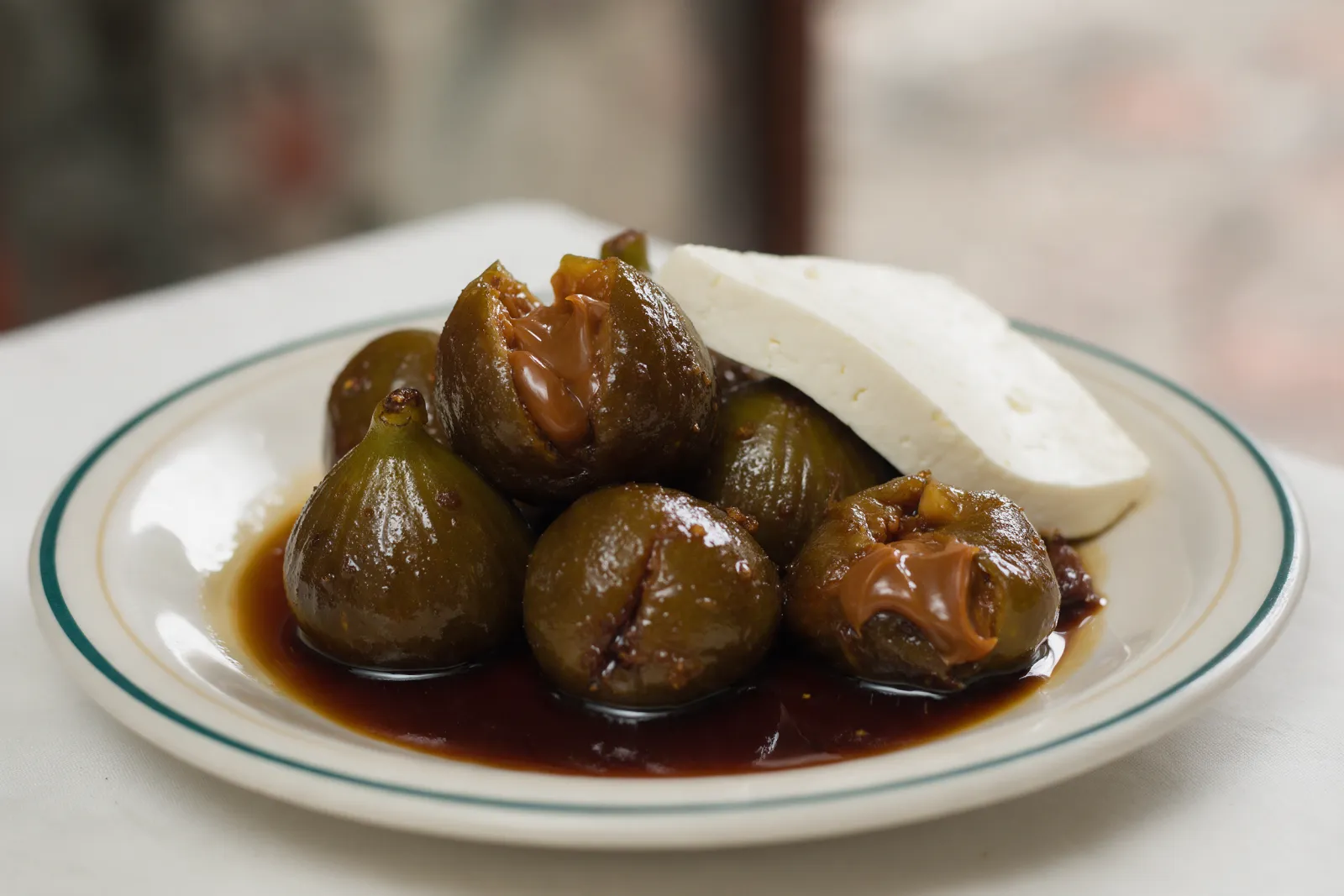

In Colombian homes at Christmas, figs come to the table almost black, glossy with syrup, split open at the base and filled with dulce de leche, with a slab of fresh white cheese on the side. The dish is brevas con arequipe (BREH-vahs kon ah-reh-KEE-peh): green, unripe figs simmered for close to two hours in a syrup of panela, the unrefined cane sugar of Colombia, and stuffed with arequipe, the local dulce de leche. The figs are picked hard and green on purpose, because a ripe fig would collapse long before the syrup was done.
What are brevas, and are they worth making at home?
How do you make Colombian figs in syrup? Cut a cross into the base of each green fig, then boil them three times for 10 minutes in fresh water, discarding it each time, to remove the bitter latex. Simmer them uncovered for about 105 minutes in a syrup of 500 g (1.1 lb) panela with cinnamon and cloves until it reaches 220°F (104°C). Fill the cold figs with dulce de leche. Ready in 170 minutes for 8 servings.
Breva is simply the fruit of the common fig tree, Ficus carica. In Spain the word means something precise, the breba crop: the first of the tree’s two harvests, which grows on the previous year’s wood and ripens in early summer, while the main crop that follows is called higo. Spanish Wikipedia describes brevas as larger and less sweet than the main-crop figs. In Colombia the tree has no real winter and the word just means fig, and for this dessert you buy them green.
It’s worth making if you can get green figs and have an afternoon. You get about 24 figs from 1 kg (2.2 lb), three each for 8 people, in 170 minutes with about 25 of them hands-on. It keeps in the fridge for a couple of weeks, so it’s a natural make-ahead dessert for Christmas Eve or New Year’s Eve.
It’s not for you if you want something light: a serving with its syrup and the filling carries over 90 g of sugars. And if no green figs or jarred brevas are within reach, the ripe-fig version below is good, but it’s a softer, different dessert.
The fig problem outside Colombia, and what each option gives you
Green, unripe figs almost never reach a supermarket. Foodwise, the San Francisco farmers’ market organization, explains why: unripe figs don’t ripen off the tree and taste acrid, so growers have no reason to pick them early. In the US, fresh figs (mostly ripe Black Mission and Brown Turkey) run from June through roughly October; in the UK, fresh figs are a summer and autumn import. For a December table, plan around that.
- Green figs. The real thing. Ask a fig grower at a summer farmers’ market, or pick from a backyard tree before the fruit softens or colors. Cook them in season and freeze the finished figs in their syrup for December.
- Jarred Colombian brevas. Already cooked in syrup; just drain, fill and serve. In the US they’re sold in Latin grocers and online, for example the La Fe brand in 28 oz (794 g) jars. This is my December answer abroad.
- Ripe fresh figs. No boils needed, since ripe figs have little latex. Reduce the syrup first for 30 minutes, then slip the figs in for only 20 minutes over the lowest heat, or they split. They stay pink inside instead of turning dark.
- Dried figs. Soak 30 minutes in hot water, then 40 minutes in the syrup. Chewy, seedy and good with cheese, but the dulce de leche won’t sit inside a dried fig.
Ingredients, and the US and UK swaps
Everything is in the recipe card above, in metric and imperial. Three ingredients need a word for a non-Latin kitchen.
| Ingredient | What it is | US swap | UK swap | What changes |
|---|---|---|---|---|
| Panela | Unrefined cane sugar block, molasses intact | Piloncillo (Mexican aisle) | Dark muscovado | Muscovado is a little lighter in color; flavor is close |
| Arequipe | Colombian dulce de leche, firm | Jarred dulce de leche or cajeta | Jarred dulce de leche | Cajeta is goat’s milk, tangier; loose versions run out of the cut |
| Queso campesino | Mild, fresh, slightly salty white cheese | Queso fresco or farmer’s cheese | Paneer | Paneer is firmer and less salty; I add a pinch of salt on top |
Why not white sugar. Panela is what turns the figs dark brown and gives the syrup its caramel and molasses depth. With white sugar the figs stay olive green and the syrup tastes flat. Light brown sugar is a workable middle ground.
Equipment. Two 4-5 liter (4-5 quart) pots, one for the boils and a wide one for the syrup so the figs sit in a single layer, a large colander and ideally a candy or instant-read thermometer.
A make-ahead plan for Christmas Eve
170 minutes start to finish, about 25 of them hands-on, plus 2 hours of cooling. Keep the kettle going for the second and third boils, and build the syrup in the other pot while they run.
- December 21 or 22 (28 or 29 for New Year’s Eve): cook the figs start to finish, cool them in the pot and refrigerate.
- December 23 (or 30): move them into jars with their syrup. If you’re giving some away, label them now.
- December 24 (or 31): fill with dulce de leche just before serving, cheese on the side.
Scaling. The figs set everything else: panela is always half their weight, the syrup water about 1.25 liters per kg (2½ cups per lb), and dulce de leche 10 g (2 tsp) per fig.
For 20 people, split 2.5 kg (5.5 lb) of figs across two pots with 1.25 kg (2¾ lb) panela and 3.1 liters (13 cups) water in total. In one pot they crowd, cook unevenly and break when you swirl them. Allow about 20 minutes extra for the larger volume of syrup to reach temperature.
Cooking the figs, step by step
The card has the full method. These are the three places where the result is decided.
Why the figs get a cross cut and three boils
When you trim a green fig, a bead of white, sticky latex appears at the stem. That latex contains ficin, a protein-digesting enzyme, plus furocoumarins such as psoralen, which can cause blistering burns on skin exposed to sunlight; case reports of fig phytophotodermatitis in Cutis and the Dermatology Online Journal describe it. Wear gloves for trimming and wash your hands before going outside.
The cross cut, 1 cm (½ in) deep in the base, opens the skin so water gets in and latex gets out during the boils, and it’s the pocket for the filling later. The three boils of 10 minutes each, always in fresh water, take away the latex and the acrid taste of unripe fruit: the first water comes out cloudy and green, the third almost clear. That water never goes into the syrup. My check before moving on is to bite a small piece of skin; if it still catches at the back of the throat, I do a fourth boil.
Some cooks add a pinch of baking soda to the first boil. I leave it out: alkaline water softens fruit skins when hot, and these figs still have nearly two hours in the pot ahead of them.
The syrup comes off at 220°F (104°C)
The syrup is done at 220°F (104°C) at sea level, the jelly point that the USDA’s National Center for Home Food Preservation uses for jams, 8°F (about 4°C) above boiling. It looks too thin when you turn off the heat, but it sets to thin honey in the fridge, which is what you want for spooning over cheese.
At altitude, every stage drops by the same amount as the boiling point of water; the Exploratorium’s rule is about 1°F for every 500 feet. The reliable method anywhere is to check what temperature your water boils at and add 8°F (4°C).
No thermometer. Put a plate in the freezer when you add the lemon. Turn the heat off, drop a little syrup onto the plate and wait 30 seconds. If it runs slowly, it’s ready; if it runs like water, give it 5 more minutes. If it holds still and wrinkles, add ½ cup (120 ml) hot water and boil 2 minutes.
Who this recipe is for
- If it’s your first time → don’t skip or shorten the boils, and keep the heat low: those are the two steps that decide whether the figs come out bitter or split.
- If you only have ripe figs → no boils, 20 minutes in reduced syrup over the lowest heat, and accept a softer, lighter dessert.
- If you’re short on time → after the first boil, pressure-cook the figs in fresh water for 15 minutes, then finish uncovered in the syrup. It saves about 30 minutes; the figs end up softer.
- If you’re feeding a crowd → two pots, cooked two or three days ahead, and a platter of filled figs with cubed cheese.
Mistakes that ruin Colombian figs in syrup
- Bitter figs. Too few boils, or the boiling water reused for the syrup. Three 10-minute boils, all discarded.
- Figs that split or fall apart. Fruit that was already ripening, heat too high, or stirring with a spoon. Hard green figs, lazy bubbles, swirl the pot.
- Pale, olive-green figs. Not enough time in the syrup, or white sugar instead of panela. They need about 105 minutes.
- Hard figs in taffy-like syrup. The syrup went past 230°F (110°C). Add ½ cup (120 ml) hot water and boil 2 minutes.
- Crystals in the jar. Sugar crust on the pot walls falling back in. Don’t stir once the panela dissolves, and brush the walls with a wet pastry brush. The lemon juice helps by splitting some sucrose into glucose and fructose.
- Filling sliding out. Filled while warm, or with loose dulce de leche. Cold figs, firm filling, at the last minute.
Storage, freezing, gifting and canning
Fridge. There’s no official USDA figure for this dessert. USDA FSIS guidance is to refrigerate cooked food within 2 hours and keep the fridge at 40°F (4°C) or below. In clean, covered jars with the figs submerged in syrup, I eat them within 2 weeks, always using a clean spoon. Once filled with dulce de leche, they keep less: My Colombian Recipes gives up to 4 days in a glass jar, and I stop at 3. Mold, bubbles or a fermented smell mean the whole jar goes.
Freezer. I freeze unfilled figs in their syrup for up to 3 months in an airtight container; FSIS notes that food held at 0°F (−18°C) stays safe indefinitely and it’s quality that fades. Thaw overnight in the fridge.
Gifting. Give them refrigerated, labeled with the date and “keep refrigerated”, with the dulce de leche in a separate jar.
Can I water-bath can them for the pantry? Not this recipe. Canned figs measure pH 4.92-5.00 in Clemson University’s acidity table, above the 4.6 line for water-bath canning, which is why the USDA-tested method for whole figs, as published by Oregon State University Extension, adds 2 tablespoons of bottled lemon juice per quart and processes pints for 45 minutes and quarts for 50 at sea level. That method is for ripe figs in sugar syrup. I found no tested process for green figs in panela syrup at the NCHFP, so mine stay in the fridge.
What it costs
In the US, the BLS doesn’t track fig prices, so there’s no honest total for the fruit. What it does track: white sugar averaged $1.024 per lb in August 2026, which puts the 1.1 lb of syrup sugar at about $1.13 if you use it in place of panela, and whole milk averaged $4.229 per gallon, so the half liter (2 cups) of milk for a homemade batch of dulce de leche costs about $0.56. The figs, or a jar of imported brevas, are the real expense.
In Colombia, at Medellín’s Central Mayorista wholesale market in mid-September 2026 (DANE’s SIPSA bulletin), 1 kg of brevas cost 4,336 pesos and 500 g of panela 2,145, about 834 pesos a serving with the lemon. The cheese on the side costs more than the whole dessert.
What to serve with Colombian figs in syrup
Cold, three figs per small plate, each opened at the cross with dulce de leche showing, a slice of fresh cheese alongside and a spoonful of syrup over the top. The filling is Colombian dulce de leche (arequipe), and a homemade batch from 1 liter (1 quart) of milk gives about 500 g, twice what you need; the rest is ideal for Colombian obleas with dulce de leche.
On a Colombian Christmas table it sits with natilla, the set custard of December, and cheese buñuelos, with a mug of Colombian hot chocolate or aguapanela alongside. After something as rich as Colombian lechona, a cold fig with cheese is the right weight. And if you like fruit cooked in dark cane syrup, Venezuelan green papaya dessert uses the same syrup logic with a different fruit.
Frequently asked questions
What is the difference between a breva and a fig? Botanically they’re the same fruit. In Spain, breva means the early-summer first crop on old wood and higo the later main crop. In Colombia breva just means fig, and for this dessert it’s bought green.
Why do you boil green figs three times? To remove the latex and the acrid taste of unripe fruit. Three 10-minute boils in fresh water each time, and a fourth if a nibble of skin still tastes harsh.
Can I use ripe figs? Yes, with no boils and only 20 minutes in syrup that has already reduced for 30 minutes. They’ll be softer and lighter in color than green figs.
Can I make this with dried figs? Yes, after a half-hour soak in hot water and about 40 minutes in the syrup. Tasty and chewy, but they won’t hold a dulce de leche filling.
Where can I buy brevas in the US or UK? Fresh green figs only in summer, from growers. Jarred Colombian brevas in syrup are sold in Latin grocers and online in the US; in the UK, look online or in Latin American shops.
How long do figs in syrup keep? I keep them 2 weeks in the fridge, submerged in syrup, and 3 days once filled. Frozen, up to 3 months.
Is it safe to can them? Not this recipe. Figs are a borderline low-acid fruit, and the tested USDA method covers ripe figs with added bottled lemon juice, not green figs in panela. Keep these refrigerated.
Nutrition
Per serving of three figs, all their syrup and about 1 oz (30 g) of dulce de leche, with no cheese, calculated ingredient by ingredient from USDA FoodData Central (SR Legacy) using this recipe’s amounts. USDA has no entry for green figs or panela, so I used raw figs and brown sugar as the closest matches.
- Calories: 425 kcal
- Carbohydrates: 102 g
- Sugars: 96 g
- Fiber: 4 g
- Protein: 3 g
- Fat: 3 g, of which 1 g saturated
- Sodium: 58 mg
Most of those calories are panela. If you leave half the syrup behind in the jar, each serving drops by roughly 120 kcal. The dulce de leche adds around 95 kcal.
I grew up in Venezuela knowing only dried figs, and the first time I made brevas in Colombia I did one boil to save time and served something bitter to people who knew exactly how it should taste. Three boils since then, and I always bite the skin before the figs go into the syrup. The figs go dark, the cheese stays white. Josnaisis.