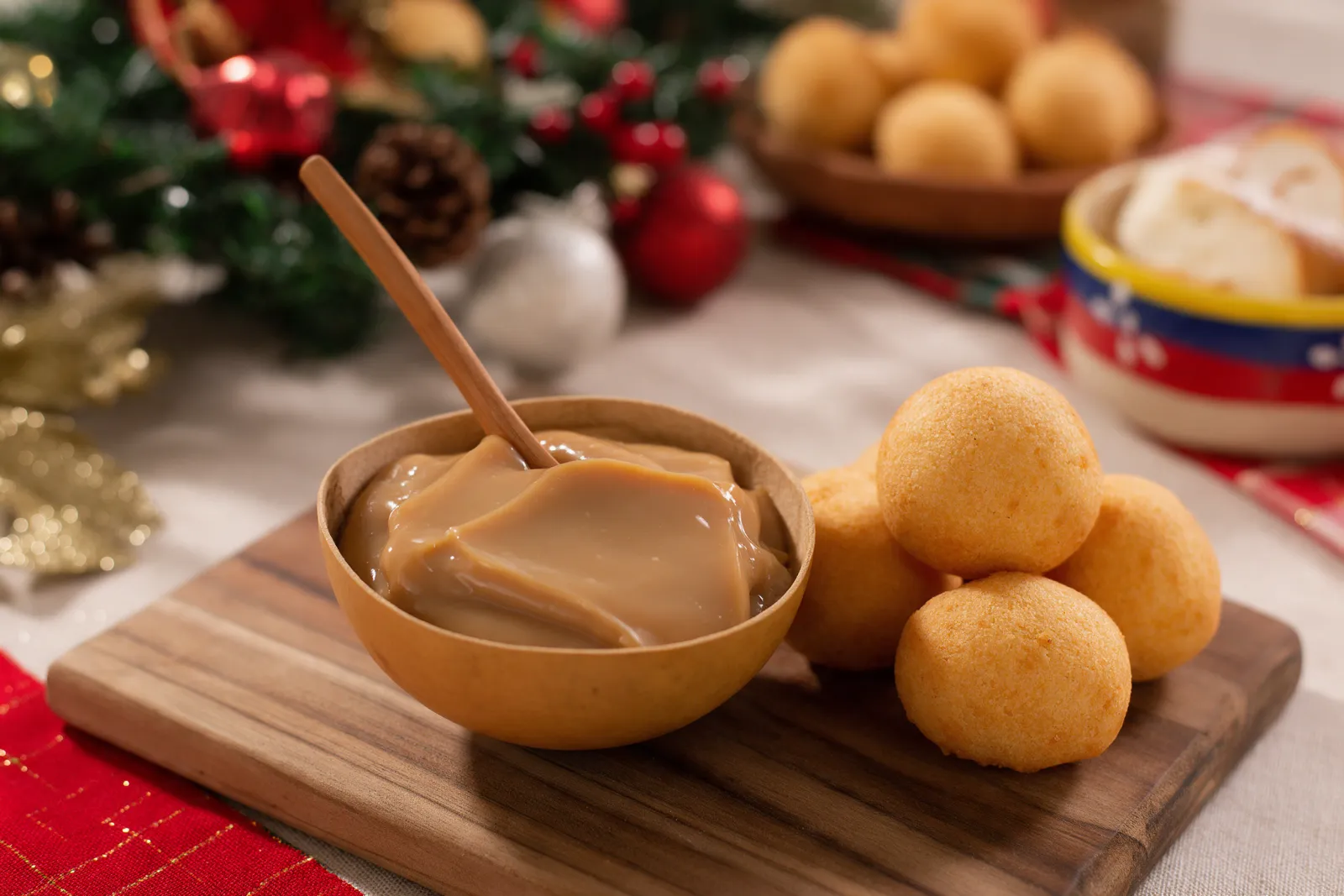

What separates manjar blanco (mahn-HAR BLAHN-koh) from dulce de leche is 50 g (¼ cup) of rice. The sweet comes from the Valle del Cauca, the sugar-cane valley around Cali in southwest Colombia, and it is the milk sweet that shows up in December beside fritters and custard. Soaked, ground and stirred into two liters of milk with 500 g of sugar, that rice helps the pot reduce for about 3 hours into a sweet that sets firm when cold, firm enough to cut with a spoon, and paler than the dulce de leche most people know. This is the version I make for Christmas Eve, with the swaps that work in a US or UK kitchen.
What is manjar blanco, and is it worth the afternoon?
How do you make Colombian manjar blanco? Soak 50 g (¼ cup) of rice for 12 hours, blend it with a cup of milk and strain it. Cook that rice milk with 2 liters of whole milk, 500 g of sugar and ¼ tsp of baking soda in a wide pan for about 3 hours, stirring constantly for the last hour, until it pulls from the bottom and a drop on a cold plate holds. Counting the overnight soak, 915 minutes for 20 servings.
It is worth it if you have one free afternoon in December and like milk caramel. The shopping list is three supermarket staples, and the yield is generous: about 1.1 kg (2.4 lb), which is 20 servings of 55 g (2 oz), or four 250 g gift jars. In Cali it is served in totumas, small bowls made from dried gourds; a ramekin does the same job.
Hands-on time is the honest catch. Of the 195 minutes on the stove, roughly 70 are spent stirring without a break, almost all of them at the end. The 12-hour soak happens while you sleep.
It is not the right project for one or two people. Below 1 liter (1 quart) of milk the pan catches before the rice has time to set anything.
Manjar blanco vs dulce de leche
The difference is starch, and it has been measured. Diego Fabián Novoa and Juan Sebastián Ramírez-Navas, in a study published in Biotecnología en el Sector Agropecuario y Agroindustrial, describe manjar blanco as a dulce de leche “with added starch”, made from cow’s milk, cane sugar and flour, mainly rice flour. Testing four traditional brands from the region, they found it lighter in color than Argentine dulce de leche (an average lightness score, L*, of 43.6 against 26 to 41) and concentrated to between 65 and 76.5 °Brix, the percentage of dissolved solids.
In practical terms, four things change compared with my Colombian dulce de leche, which is called arequipe in Colombia:
- Texture → manjar blanco sets into a firm, spoonable block; arequipe stays spreadable.
- Color → beige to pale caramel, not brown.
- Baking soda → ¼ tsp for 2 liters, a quarter of arequipe’s dose per liter.
- Time → arequipe needs 115 minutes for a single liter; this needs around three hours for twice the milk.
Per liter of milk I use 25 g of rice and 250 g of sugar, roughly a tenth as much rice as sugar. More rice sets it faster but it starts to taste floury; less, and it slumps out of the bowl.
Ingredients, and what to buy in the US or UK
Nothing here needs a specialty store, though one swap matters a lot.
Whole milk, 2 liters (8½ cups). Fat gives body. Skim milk browns faster and sets thin. Lactose-free milk has its lactose already split into glucose and galactose, which brown much sooner, so it turns dark before it reaches the set.
Granulated sugar, 500 g (2½ cups). Caster sugar is fine in the UK. Light brown sugar or panela (Latin unrefined cane sugar, sold as piloncillo in Mexican shops) gives a darker, molasses-edged version that some cooks in the Valle make on purpose.
Rice, 50 g (¼ cup heaped). Any plain long-grain white rice. Parboiled or converted rice releases less starch.
Rice flour instead of soaked rice. Use 40 g (¼ cup) of plain white rice flour, whisked into 250 ml (1 cup) of cold milk, and skip the soak and the straining. It comes out a shade smoother. Do not use glutinous or sweet rice flour, the kind sold as mochiko: it sets gummy.
Baking soda, ¼ tsp (1 g). It neutralizes some of the milk’s natural acidity, which keeps the milk from curdling over 3 hours at a simmer, and by raising the pH it speeds up Maillard browning. Since manjar blanco is meant to stay pale, the dose is small. Double it and you get a darker sweet with a faint soapy edge. With very fresh milk you can leave it out; the result is whiter and takes a little longer.
Equipment. A wide, heavy pan 28-30 cm (11-12 in) across, holding about 5 liters (5 quarts): enameled cast iron or heavy stainless steel. In the Valle it is cooked in copper cauldrons for the same reason, even heat. A tall narrow pot evaporates slowly and adds an hour. You also need a flat-ended wooden spoon, a blender and cheesecloth or a thin clean tea towel.
A Christmas Eve plan, and how to tell it is done
Day by day. Soak the rice on the evening of the 21st or 22nd. Cook on the 22nd or 23rd. Serve on the 24th, out of the fridge 30 minutes ahead so a spoon goes in easily. It keeps for the week, so the same batch covers New Year’s Eve.
The set. There are three ways to read it, and the first two are the ones to use:
- The pan test → drag the spoon across the bottom; when the pan stays visible for a few seconds before the mass closes over, you are there. Valle cooks watch for the same sign with a long wooden paddle.
- The cold-plate test → a teaspoon on a cold plate, 1 minute, then tilt. If it holds and cuts cleanly, turn off the heat.
- The back-of-the-hand test → a drop that does not stick, which is how one Buga cook described it to El País of Cali. At over 212°F (100°C), I would skip this one.
Take it off too early and you have a lovely sauce that never sets in the bowl. Fifteen minutes too long and it turns hard once cold. When in doubt, stop and do the plate test.
Who this recipe is for
- If it is your first time → use rice flour; it removes the straining, which is where grit gets in.
- If you are cooking for 20 → 3 liters (3 quarts) of milk, 750 g (3¾ cups) sugar and 75 g (⅓ cup, heaped) rice, in a pan of at least 32 cm (12½ in), for about 3½ to 4 hours.
- If you want it as a gift → fill 250 g (9 oz) jars while hot; one batch fills four.
- If you have no time on the day → this is not a last-minute dessert. Make it two days ahead.
Mistakes that ruin manjar blanco
High heat to speed it up. With rice starch in the pan, the bottom thickens faster than in plain dulce de leche and catches in about 30 seconds. Medium-low from the first boil.
Adding the starch to hot milk. Rice milk or rice flour goes in while everything is cold, or it lumps on contact.
Scraping the sides. The crust on the pan walls falls back as lumps. Sweep the bottom in figure eights and leave the sides alone.
Skipping the second strain. If a drop of rice milk feels gritty between your fingers, strain it again. Grit does not cook out.
Rescuing a scorched pan. If it catches, pour it into a clean pan at once without scraping. If it already smells burnt, the whole batch tastes of it.
Stiff or runny? Stiff: warm it with 50-100 ml (¼-½ cup) of milk, stirring. Runny in the bowl: back in the pan for 10-15 minutes and another plate test.
Which version should you make?
- Classic → soaked rice, as written, with no cinnamon and a pinch of baking soda for the palest result.
- Easier → rice flour, no soak. Same 3 hours on the stove.
- Pressure cooker → no. This sweet is made by boiling off about 1.5 kg (3.3 lb) of water, and a sealed pot evaporates nothing. A can of condensed milk under pressure gives a different sweet.
- Darker → panela or light brown sugar instead of white.
- With raisins → 35 g (¼ cup), stirred in off the heat.
- For filling citrus shells → in the Valle, manjar blanco fills the candied lime shells called desamargado. For that I stop about 10 minutes earlier, with a softer set.
What it costs
At US city average prices from the Bureau of Labor Statistics for August 2026, the whole batch costs about $3.48, or 17 cents a serving.
Milk is two thirds of the bill. Baking soda and cinnamon are pantry items and are not counted. In Colombia, with wholesale prices from the DANE’s SIPSA bulletin for Cali, it comes to about 13,656 pesos, using powdered milk as the reference because liquid milk is not quoted.
Serving, storing and gifting
How it is eaten. Cold or at room temperature, by the spoonful, from a small bowl. In December it goes alongside Colombian buñuelos, cheese fritters, and Colombian natilla, a cinnamon custard set with cornstarch, with a cup of Colombian hot chocolate. If you are making a valluno tamale for Christmas Eve, this is the dessert to finish on. Leftovers are good spooned over Colombian rice pudding or eaten the next morning with a hot cheese arepa, sweet against salty.
Fridge. USDA FSIS guidance for milk-based dishes applies: no more than 2 hours out of the fridge, and stored at 40°F (4°C) or below. Covered, I eat it within a week. Commercial manjar blanco carries a 60-day shelf life under Colombia’s NTC 3757 standard, but that is factory-made; a home batch has no preservatives.
Freezer. Skip it. Rice starch weeps water as it thaws and the texture turns grainy.
Softening. If it is too firm straight from the fridge, give it 30 minutes on the counter, or microwave in 10-second bursts, stirring between each.
Frequently asked questions
Is manjar blanco the same as dulce de leche? No. Manjar blanco from the Valle del Cauca has rice or rice flour cooked into it, about 25 g per liter of milk, so it sets firm and stays paler. Dulce de leche, or arequipe, has no added starch and stays spreadable.
Can I use rice flour instead of rice? Yes, 40 g (¼ cup) of plain white rice flour for 2 liters, whisked into cold milk. Avoid glutinous or sweet rice flour, which turns gummy.
Why add baking soda? It stops the milk curdling during the long simmer and speeds browning. A quarter teaspoon for 2 liters is plenty; more darkens it and tastes soapy.
How long does it take to make? Count on an overnight soak, then about three hours of stove time for this batch and an hour to cool.
How long does manjar blanco keep? About a week covered in the fridge at 40°F (4°C) or below. It does not freeze well.
Is manjar blanco gluten-free? The recipe has no wheat. If you cook for someone with celiac disease, use rice flour certified gluten-free to avoid cross-contact.
Nutrition
Per 55 g (2 oz) serving, one of 20, calculated ingredient by ingredient from USDA FoodData Central (SR Legacy) with the quantities above, without cinnamon:
- Calories: 169 kcal
- Protein: 3 g
- Carbohydrates: 32 g
- Fat: 3 g, of which 2 g saturated
- Fiber: 0 g
- Sugars: 30 g
- Sodium: 60 mg
Twenty-five of those 30 g of sugar are added sugar. About a quarter of the sodium comes from the baking soda, the rest from the milk. Three spoonfuls in a small bowl is the right amount.
I grew up in Venezuela knowing dulce de leche, and I assumed manjar blanco was the same thing under a Colombian name until I made it the first time with unstrained rice and had to blend the whole grainy batch. Now I strain twice, cook on the 22nd and trust the cold plate over my eyes. Josnaisis.