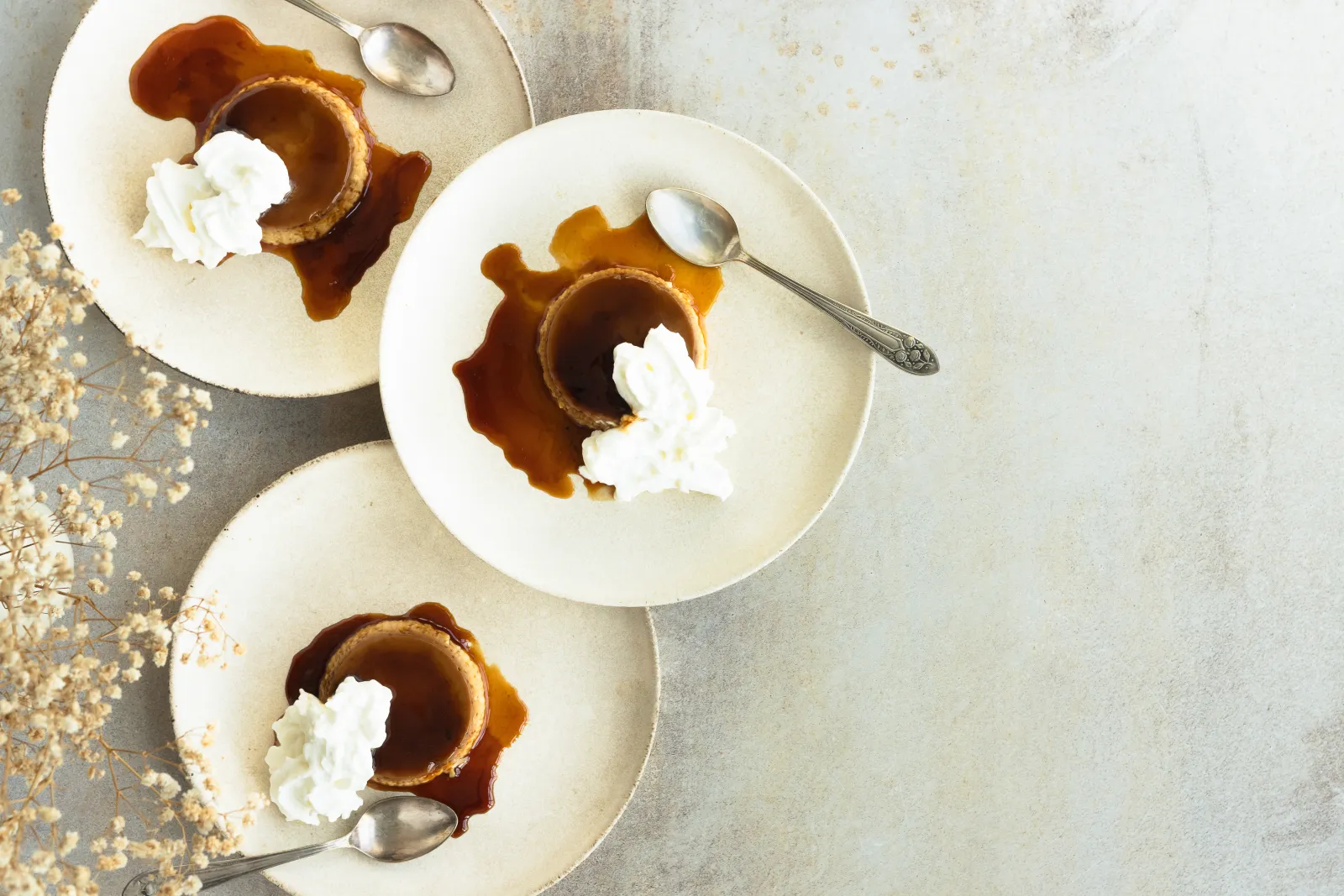

Flan napolitano (flahn nah-poh-lee-TAH-noh) is Mexico’s party flan: a baked caramel custard made with both canned milks, sweetened condensed and evaporated, plus a block of cream cheese blended into the batter. That cheese is the whole difference. It makes the custard denser and silkier than the wobbly flan most people picture, closer to a cheesecake in body but still sliding out of the pan under a pool of caramel. It’s the dessert I reach for when I need something made the day before that feeds ten.
What is flan napolitano, and is it worth making?
How do you make flan napolitano? Cook 150 g (¾ cup) sugar to an amber caramel in a 9-inch pan. Blend 6.7 oz (190 g) cream cheese with a can of evaporated milk, a can of sweetened condensed milk, 5 eggs and vanilla for under a minute, strain, rest 15 minutes, and bake covered in a water bath at 325°F (160°C) for about 75 minutes, until the center wobbles as one piece. Chill 6 hours. 525 minutes for 10 servings.
Yes, if you can plan a day ahead. The active work is about 20 minutes; the rest is oven and fridge, and it tastes better on day two than on day one because the caramel has fully dissolved into sauce. It’s not the dessert for tonight, and at 341 kcal a slice it isn’t a light one.
How it compares to other flans. All of these are egg custards baked over caramel. What changes is the dairy, and that changes the texture.
| Flan napolitano | Classic flan / crème caramel | Venezuelan quesillo | |
|---|---|---|---|
| Dairy | condensed + evaporated milk | whole milk + sugar | condensed + whole milk |
| Cream cheese | 6.7 oz (190 g) | none | none |
| Water in the batter | 56 % | 67 % | 62 % |
| Fat in the batter | 12.5 % | 4.2 % | 6.8 % |
| Texture | dense, silky, no holes | soft, trembling | fine holes on purpose |
The water and fat figures are calculated from USDA data for the batters of this recipe and of two others on this site: the Colombian flan, a classic milk custard cooked on the stovetop, and the Venezuelan quesillo, which is baked hotter to get its signature little holes. Less water and twice the fat is why flan napolitano sets firmer, slices cleanly and survives a car ride.
As for the name, nobody has documented where “napolitano” came from, and there’s no proven link to Naples. What is clear is that the version with two canned milks and cream cheese is Mexican.
Ingredients, with US and UK shopping notes
Everything is in the recipe card: a 14 oz (397 g) can of sweetened condensed milk, a 12 fl oz (354 ml) can of evaporated milk, 6.7 oz (190 g) of cream cheese, 5 large eggs and ¾ cup (150 g) sugar for the caramel.
Cream cheese. Use full-fat block cream cheese, the cheesecake kind. In the US that’s three quarters of an 8 oz (226 g) block. In the UK it’s sold in tubs as soft cheese; weigh out 190 g of the full-fat one. In Mexico it comes in a 190 g bar, which is exactly what this recipe uses. Cream cheese is 34 % fat and 53 % water according to USDA FoodData Central, against 74 % water in evaporated milk, so it’s what gives the flan its body.
The two cans. Sweetened condensed milk is milk with sugar, 54 g of sugar per 100 g; evaporated milk is concentrated milk with none. They sit side by side on the shelf, and mixing them up ruins the flan. In the UK the standard condensed milk tin is 397 g, the same as here; evaporated milk often comes in a larger tin, so measure 360 ml (1½ cups).
| If you don’t have | Use | What changes |
|---|---|---|
| Block cream cheese | full-fat tub cream cheese | slightly softer flan |
| Full-fat cream cheese | reduced-fat (Neufchâtel in the US) | about 27 kcal less per slice, less dense |
| Cream cheese at all | leave it out | you get a condensed-milk flan, close to quesillo, softer |
| Evaporated milk | 360 ml (1½ cups) whole milk | more water (88 % vs 74 %), softer set |
| Sweetened condensed milk | no good swap | it’s the sugar and half the body |
Equipment. A 9-inch (22-23 cm) round pan at least 2.5 inches (6 cm) deep, a blender, a fine sieve, a roasting pan bigger than the flan pan, foil, and ideally an instant-read thermometer. A glass pan works but heats more slowly, so allow 10 more minutes and check the temperature; don’t pour hot caramel into a cold glass dish, which can crack.
The make-ahead plan
About 20 minutes of work over roughly 9 hours. Caramel first, blend while it sets, rest the batter while the oven reaches 325°F (160°C), then bake.
Make it one or two days ahead. At 24 hours the caramel has melted completely and the texture is at its best. The caramel can also go into the pan in the morning and sit at room temperature until you’re ready.
How to make flan napolitano
The caramel, strong-tea amber
Sugar and 3 tablespoons of water over medium heat, and no spoon. The water melts the sugar evenly and buys you a minute or two before it burns, which matters the first time. Stirring is what makes caramel seize into white sand.
Candy charts don’t agree on exact numbers; most put amber somewhere around 340-355°F (170-180°C). I go by eye and nose: the color of strong tea or dark honey, usually a little past the 8-minute mark. Pull it off the heat one shade lighter than you want, because the hot pan keeps cooking it, and pour immediately. If it smokes or smells burnt, start over. Bitter caramel spoils all ten slices; another ¾ cup of sugar costs very little.
Blend briefly, then let it rest
Blend the cream cheese with the evaporated milk for 20 seconds first, so it dissolves. Then everything else, on low, for under 20 seconds. Strain, and give the batter 15 minutes in the jug. The bubbles the blender added float up into the foam on top, which you skim off. Pour slowly down the side of the pan.
Water bath at 325°F (160°C), covered
Foil on tight, hot water halfway up the pan. Water can’t go above 212°F (100°C), so it cushions the custard and keeps the edges from cooking ahead of the middle. The foil keeps the top from drying and cracking. Use water from the kettle, not the tap, or the first 20 minutes go into heating it.
How to tell it’s done
From 60 minutes, nudge the roasting pan with an oven mitt. A circle about 2 inches (5 cm) across in the middle should wobble as one piece, not ripple. With a thermometer it’s simpler: 170-175°F (77-79°C) in the center, the doneness range America’s Test Kitchen gives for flan, and safely past the 160°F (71°C) the USDA Food Safety and Inspection Service sets for egg dishes.
It will look underdone. That’s right; it firms as it cools.
Unmolding
One hour on the counter, then at least 6 hours in the fridge. Any sooner and the caramel is still hard on the bottom and the custard is too soft to flip. Run a thin knife around the edge, put a rimmed plate on top (the caramel is runny), flip in one motion and wait 30 seconds. If it won’t drop, sit the pan in hot water for a minute or two to loosen the caramel, and try again.
Oven, stovetop or Instant Pot
The same batter works three ways. The oven gives the most even result.
- Stovetop → a large lidded pot with a folded kitchen towel on the bottom, the foil-covered pan on top, hot water halfway up, lid on, 80 to 90 minutes with the water barely trembling. Heat comes from below, so the bottom sets a little firmer.
- Instant Pot → the official Instant Pot flan recipe uses a 7 to 8 inch (18-20 cm) pan on the trivet with 1 cup of water, LOW pressure for 10 minutes and a 10-minute natural release. This batter is denser, so I check the center with a thermometer after release and, if it’s under 170°F (77°C), seal it again for a few more minutes on low.
- Stovetop pressure cooker → pan on the rack with 1 to 1¼ inches (2.5-3 cm) of water, high heat until it hisses, then 25 minutes on medium-low and a natural release.
Why flan napolitano goes wrong
Almost always too much of something: blending, heat or time. Past 185°F (85°C) egg proteins tighten, squeeze out their water and leave holes.
- Holes and a spongy texture → air from the blender or too much heat. Under a minute of blending, 15 minutes of rest, 325°F (160°C) not 350°F (175°C). If the water bath is boiling hard, your oven runs hot.
- A cracked top → baked uncovered or too long. Seal the foil, pull it while the center wobbles.
- Watery liquid on the plate → overbaked. The amber syrup that runs off is caramel and is supposed to be there; a thin, cloudy whey is not.
- White specks → cold cream cheese. Room temperature, blended first with the evaporated milk.
- Raw center → a pan narrower or deeper than 9 inches. Check with a thermometer.
- Bitter caramel → too dark. There’s no fix; make it again.
Allergens. Eggs and milk throughout. No flour or nuts; for coeliac guests, check the vanilla and cream cheese labels. Kids generally love it; the 10 ml of vanilla extract carries a trace of alcohol, spread across 10 slices and 75 minutes of baking.
Scaling it, from ramekins to a crowd of 20
- Individual flans → 10 ramekins of about 4 oz (120 ml), a spoonful of caramel in each. Pati Jinich bakes hers at 350°F (175°C) for 45 to 50 minutes; at 325°F (160°C) I start taking the temperature at 35 minutes.
- For 20 → a double batch in a 9x13-inch (23x33 cm) pan, which has about twice the area of a 9-inch round, so the custard sits at roughly the same depth. Start checking at 70 minutes. Or two 9-inch pans side by side. Avoid one big deep round pan: the edge overcooks before the middle sets.
- Lighter → reduced-fat cream cheese and fat-free evaporated milk bring it to about 293 kcal and 9 g of fat a slice, with a softer set.
What it costs
At the US city average prices the Bureau of Labor Statistics published for August 2026, a dozen large eggs cost $2.27 and sugar $1.02 a pound, so the 5 eggs and ¾ cup of sugar here come to $1.29. The BLS doesn’t track canned milks or cream cheese, so I can’t give you a verified total; those three are most of the bill. For a comparison with real numbers: in Spain, with Mercadona’s online prices in October 2026, the whole flan came to €5.59, about €0.56 a slice, and the dairy was 75 % of that.
Yield. 10 slices of about 4.75 oz (135 g) with caramel, or 12 thinner ones on a dessert table with other sweets.
Serving and storing flan napolitano
Taste and texture. Dense, smooth and creamy, firmer than a milk flan, with no holes if it went right. Dairy and vanilla, and just enough bitterness from the caramel.
Serving. Cold, in wedges, with caramel spooned over. Take it out 15 minutes before serving so the caramel flows. It closes a Mexican feast well, after mole poblano or cochinita pibil, with a mug of Mexican café de olla. On Three Kings’ Day it shares the table with a rosca de reyes, and if you want a second, lighter dessert, tres leches cake is the other make-ahead classic.
Fridge. Covered, 3 to 4 days at 40°F (4°C) or below. That’s the figure the US government’s foodsafety.gov storage chart gives for custard pies, the closest listed egg-and-milk custard. Like any perishable, no more than 2 hours out of the fridge (USDA FSIS). Transport it in its pan and flip it at the destination.
Freezer. No. The same chart says custards don’t freeze, and they don’t: thawed flan weeps and turns grainy.
Flan napolitano FAQ
What makes flan napolitano different from regular flan? Cream cheese and two canned milks. That drops the water in the batter to 56 % (a classic milk flan is about 67 %) and roughly triples the fat, so it’s denser and silkier.
Is flan napolitano Mexican? Yes. The version with condensed milk, evaporated milk and cream cheese is Mexican; the origin of the name isn’t documented.
Why does my flan have holes? Too much air or too much heat. Blend under a minute, rest the batter 15 minutes, and bake covered in a water bath at 325°F (160°C). Above 185°F (85°C) in the center the custard curdles and leaves holes.
What internal temperature is flan done? 170-175°F (77-79°C) in the center. It will still wobble and firms up in the fridge.
Can I make flan without a water bath? Not well. Without water around it the edges overcook before the center sets. If your oven won’t fit a roasting pan, use the stovetop method in a covered pot.
Can I make flan napolitano in an Instant Pot? Yes. Use a 7 to 8 inch pan, LOW pressure 10 minutes and a 10-minute natural release, then check that the center reached 170°F (77°C).
How long does flan last in the fridge, and can I freeze it? 3 to 4 days covered at 40°F (4°C) or below. Don’t freeze it.
Nutrition
Per slice, one tenth of the flan (about 135 g / 4.75 oz with caramel), calculated ingredient by ingredient from USDA FoodData Central (SR Legacy) with the quantities above:
- Calories: 341 kcal
- Protein: 10 g
- Carbohydrates: 42 g
- Fat: 15 g, of which 9 g saturated
- Fiber: 0 g
- Sugars: 41 g
- Sodium: 201 mg
Growing up in Venezuela, flan meant quesillo, and the first flan napolitano I made I baked like one, hot, expecting the same result. It came out full of holes and sitting in a puddle. Turning the oven down and trusting the wobble fixed it: a quesillo wants bubbles, this one wants none, and patience in the fridge. Josnaisis.