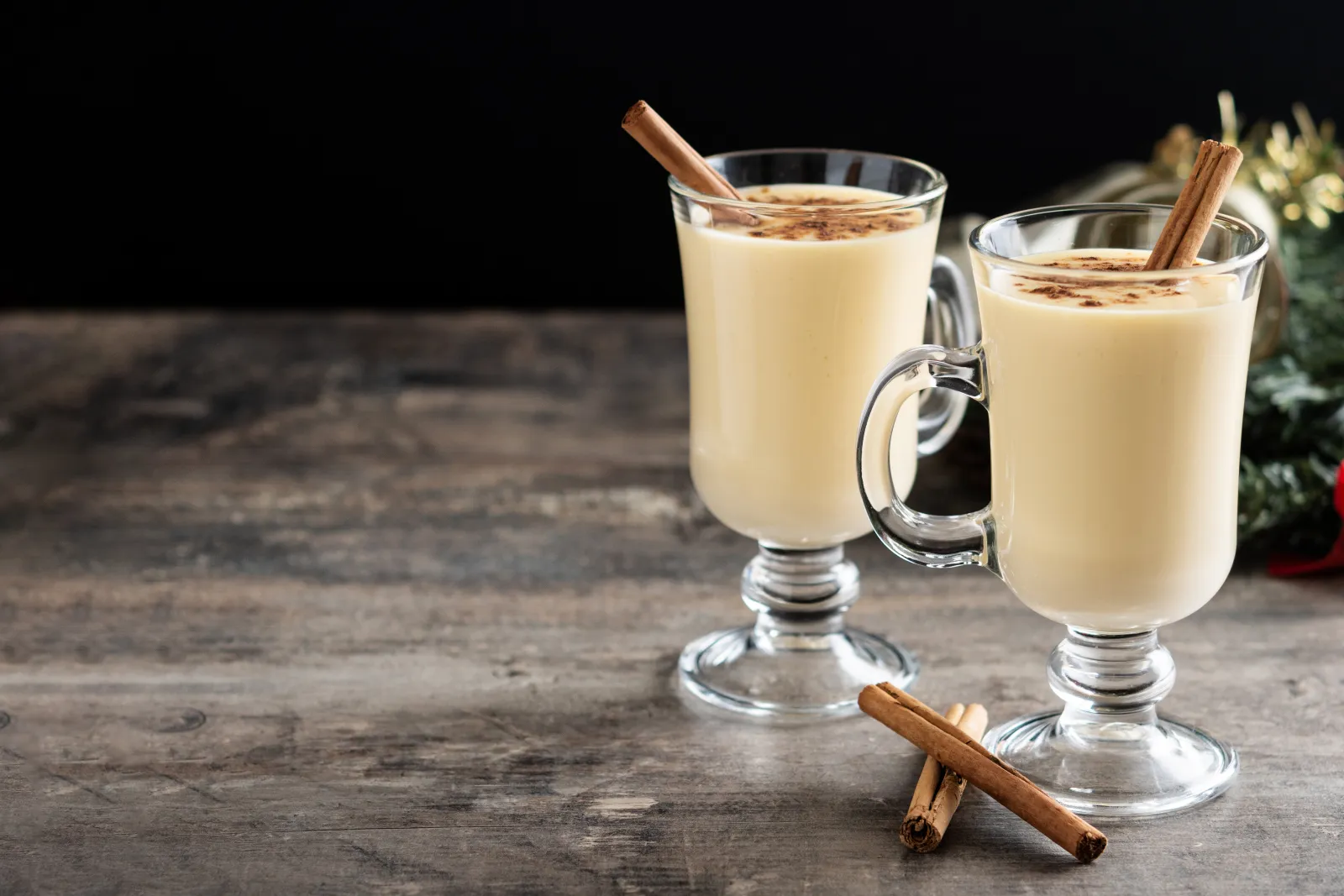

Ponche crema (PON-cheh KREH-mah) is what Venezuelans pour at Christmas instead of eggnog: a bottled, thick, cold rum drink built on canned milk rather than fresh cream. If you know American eggnog, you know the family. The difference is in the can, because sweetened condensed milk and evaporated milk give it a dulce de leche note and a body that pours like a thin custard. Below is how to make a batch safely (the base is cooked to a measured 160°F), how strong it ends up, a version the kids can drink, and how long a bottle keeps in the fridge.
What is ponche crema, and how is it different from eggnog?
How do you make ponche crema at home? Whisk 8 egg yolks with a 14 oz (397 g) can of sweetened condensed milk and 3 cups (710 ml) of evaporated milk, then stir over medium-low heat until a thermometer reads 160°F (71°C). Strain, cool in an ice bath and stir in 1½ cups (350 ml) of aged rum and vanilla. 40 minutes for 20 servings.
It’s a cooked egg-and-milk liqueur, served chilled in small glasses through December in Venezuela. The bottle most Venezuelans grew up with is a commercial one, which its maker says the Caracas chemist Eliodoro González P. created in 1900. Homemade, it takes five supermarket ingredients and 40 minutes.
Three practical differences matter if you’ve made eggnog before. Ponche crema needs no cream and no sugar of its own; the condensed milk is about 54% sugar per the USDA’s food composition data, and it does both jobs. It’s thicker because evaporated milk has had some of its water cooked off. And it’s bottled: you make it a day ahead, chill it and pour it in 2.5 fl oz (75 ml) glasses, not cups.
Is it worth making, and who is it for?
Yes, if you’re hosting in December and own (or will buy) an instant-read thermometer. One batch gives 1.5 liters (about 6⅓ cups), exactly two 750 ml bottles, around 20 small glasses. You choose the rum, you control the sweetness, and the same pot makes a rum bottle for the adults and a milk-only bottle for the kids.
Who should skip the rum version. Pregnant guests, older adults and anyone with a weak immune system: give them the no-rum batch made with pasteurized eggs, still cooked to 160°F (71°C), which is what the FDA advises for higher-risk people.
When it’s the wrong project. If you want something that keeps for weeks. Store-bought ponche crema is shelf-stable because it’s made industrially; homemade lasts 3 to 4 days in the fridge.
Time and difficulty. 40 minutes, of which 15 are stirring without walking away, then 4 hours of chilling. I rate it medium: nothing is hard, but the last few minutes before 160°F, when the base thickens fast, need your full attention.
Ingredients, and what to buy in a US or UK store
Exact amounts are in the recipe card. Everything is on a normal supermarket shelf, usually the baking aisle in the US and the tinned-milk shelf in the UK.
- Sweetened condensed milk. Sweetens and thickens. Don’t swap it for sugar and milk; you’d have to cook the base far longer to get the same body, and the cooked-milk flavor disappears.
- Evaporated milk. Unsweetened, concentrated milk for creaminess. Swap 3 cups (710 ml) of whole milk if you can’t find it: thinner, still good.
- Rum. An aged or gold 80-proof (40%) rum is classic. Venezuelan brands such as Santa Teresa and Diplomático are sold in the US and UK, but any decent aged rum works; white rum gives the same strength with less oaky flavor.
- Lemon peel and nutmeg. The peel cuts the sweetness and covers any eggy smell; use a vegetable peeler so you leave the bitter white pith behind.
Equipment. A heavy 2 to 3 quart (2 to 3 liter) saucepan, a silicone spatula, an instant-read thermometer, a fine-mesh sieve, a big bowl of ice water, a funnel and two 750 ml (25 fl oz) bottles with caps. No heavy pan? Use a double boiler; it takes about twice as long but won’t scorch. No fine sieve? Line a regular one with cheesecloth. There’s no substitute for the thermometer.
Why the base goes to 160°F (71°C)
Raw eggs can carry Salmonella, sometimes inside the shell. The FDA’s holiday eggnog recipe tells you to cook until the thermometer reads 160°F (71°C), the same point it sets for custards and cream-pie fillings, and the agency has warned that you can’t count on the alcohol in eggnog to kill all the bacteria. That’s why the rum here goes in last, into a cooled base, for flavor rather than as a preservative.
Make-ahead plan for Christmas Eve and New Year’s
40 minutes on the clock, then at least 4 hours cold. Sterilize the bottles before the stove goes on, and have the ice bath ready before you get close to 160°F.
- December 22. Shop, and check your thermometer in boiling water (about 212°F / 100°C at sea level).
- December 23, evening. Make the batch, bottle and refrigerate. By the 24th it has had 12+ hours to chill and thicken.
- December 24. Shake and pour. Leftovers are good until the 26th or 27th.
- New Year’s Eve. Make a fresh batch on the 29th or 30th; a bottle from the 23rd is past its window.
Scaling. For 6 adults, one batch is about 3 small glasses each. For 12 to 20 guests, double everything in a 4 quart (4 liter) pot: 16 yolks, 2 cans of condensed milk, 6 cups (1.42 liters) of evaporated milk and 3 cups (700 ml) of rum, for four bottles. It takes a few extra minutes to reach temperature. If kids are coming, make one of the two batches with milk instead of rum.
Signs it’s going right.
| Stage | What you should see |
|---|---|
| Yolks and condensed milk, 1 min | smooth, pale yellow, no strands of white |
| 8 to 10 min on the heat | steaming, a little thicker than milk, not yet coating a spoon |
| Near 160°F (71°C) | coats the back of a spoon; a finger line through it holds |
| In the sieve | only the peel and maybe a teaspoon of yolk threads |
| After 4 hours cold | thick, like drinkable yogurt; pours in a steady ribbon |
How strong is it, and the version for kids
Using 1½ cups (350 ml) of 40% rum with about 4¾ cups (1.15 liters) of base, the finished ponche crema is around 9.3% ABV. The math: milliliters of rum × 0.40 ÷ total volume.
For kids, make the same recipe and replace the rum with 1½ cups (350 ml) of whole milk, stirred in cold: zero alcohol, same body, same vanilla and lemon. Bottle and label it separately, because the two bottles look identical.
Allergens. Egg and milk, in quantity. No gluten or nuts; check the label if you use a spiced or flavored rum for someone with celiac disease. Spice level, 0 out of 5: nutmeg perfumes, it doesn’t burn.
Mistakes and fixes.
- Lumpy → it overshot or the corners went unstirred. Strain and blend 30 seconds. Next time, lower heat and scrape the corners.
- Thin → it never reached 160°F (71°C), or whole milk replaced the evaporated. The first one is a safety issue: back on the heat.
- Tastes eggy → bits of white stayed with the yolks. Separate carefully and keep the lemon peel.
- Can’t taste the rum → it went into a hot base. Always cool first.
- Separates in the bottle → normal after a day. Shake before serving.
Variations
- Milder → 1 cup (250 ml) of rum, about 7% ABV. Stronger → 2 cups (500 ml), about 12%, and noticeably thinner.
- Coffee ponche crema → one of the variants listed on its Wikipedia entry: 1 tbsp instant coffee dissolved in the evaporated milk before heating.
- Pumpkin → Venezuelan cook Enri Lemoine publishes a version with pumpkin purée and spices; denser and less sweet.
- For gifting → the standard batch in four 375 ml (12.7 fl oz) bottles to spread across more homes.
What it costs to make
The BLS tracks only two of these ingredients. At the US city average for August 2026, a dozen large Grade A eggs was $2.272, so the 8 yolks cost about $1.51, and whole milk was $4.229 a gallon, so the 1½ cups for the kids’ batch cost about $0.39. Condensed milk, evaporated milk and rum aren’t in that data. Of the five ingredients, the rum is the biggest line on the receipt, and the one where spending more shows.
Yield. 1.5 liters (about 6⅓ cups), two 750 ml bottles, 20 glasses of 2.5 fl oz (75 ml), or 10 if you pour 5 fl oz (150 ml).
How to serve it, and how long it keeps
Flavor and texture. Sweet, cooked-milk and vanilla up front, lemon peel keeping it from cloying, rum at the finish. Cold, it’s thick enough to leave a film on the glass.
Serving. Very cold, in 2 to 2.5 fl oz (60 to 75 ml) glasses, sometimes with a grating of nutmeg. On a Venezuelan Christmas table it sits next to Venezuelan hallacas and a loaf of Venezuelan ham bread. For dessert, Venezuelan quesillo uses the same can of condensed milk; before dinner, a tray of homemade Venezuelan tequeños goes out with the first glass, and Colombian homes pair the season with Colombian natilla. Kids who skip the ponche will take a mug of Colombian hot chocolate instead, or a spoonful of Colombian dulce de leche.
Fridge life. 3 to 4 days at 40°F (4°C) or below, according to the FDA’s guidance for leftover cooked egg dishes. There’s no official figure for homemade eggnog with rum, and the alcohol isn’t a reliable preservative, so I hold the rum bottle to the same 3 to 4 days.
Out of the fridge. 2 hours at most, or 1 hour above 90°F (32°C), per the USDA FSIS rule for perishable food. At a long party, pour a round and put the bottle back.
Freezing. There’s no official guidance for this mix and I don’t freeze it: the milk fat separates on thawing and it turns grainy.
Can you give it as a gift? Yes, if it goes from your fridge to theirs within 2 hours, and the label says the date you made it, “drink within 3 to 4 days, keep refrigerated” and “contains egg and alcohol”. For a Christmas Eve gift, make it on the 22nd or 23rd.
Ponche crema FAQ
Is ponche crema the same as eggnog? It’s a close cousin. Both are egg, milk and spirit; ponche crema uses canned condensed and evaporated milk, aged rum and lemon peel, and is bottled and served cold in small glasses.
Do you have to cook the eggs in ponche crema? Yes. Cook the base to 160°F (71°C) on a thermometer, as the FDA advises for homemade eggnog. Rum doesn’t replace that step.
How long does homemade ponche crema last? 3 to 4 days in the fridge at 40°F (4°C) or below. Alcohol doesn’t reliably extend that.
How much alcohol is in it? About 9% ABV with 1½ cups (350 ml) of 80-proof rum per batch; roughly 7% with 1 cup and 12% with 2 cups.
Can I make it without alcohol? Yes. Replace the rum with the same amount of whole milk, added cold. It’s then fine for kids.
Why did my ponche crema curdle? It went past 160°F (71°C) or the bottom heated without stirring. Strain it and blend for 30 seconds.
Nutrition per 2.5 fl oz (75 ml) glass
Calculated ingredient by ingredient from USDA FoodData Central (SR Legacy) with the amounts above, divided into 20 glasses:
- Calories: 175 kcal
- Protein: 5 g
- Carbohydrates: 15 g, all of it sugars
- Fat: 6 g, of which 3 g saturated
- Fiber: 0 g
- Sodium: 69 mg
About 38 kcal per glass comes from the rum. The kids’ version with whole milk lands near 148 kcal, with 6 g of protein and 7 g of fat.
In Venezuela we bought our ponche crema; I only started making it in Colombia, when the familiar bottle wasn’t on every shelf. Cooking it to a thermometer felt fussy at first, since I’d only ever seen it judged by eye. Now Dylan’s bottle, the one with milk instead of rum, is the first one I make every December. Josnaisis.