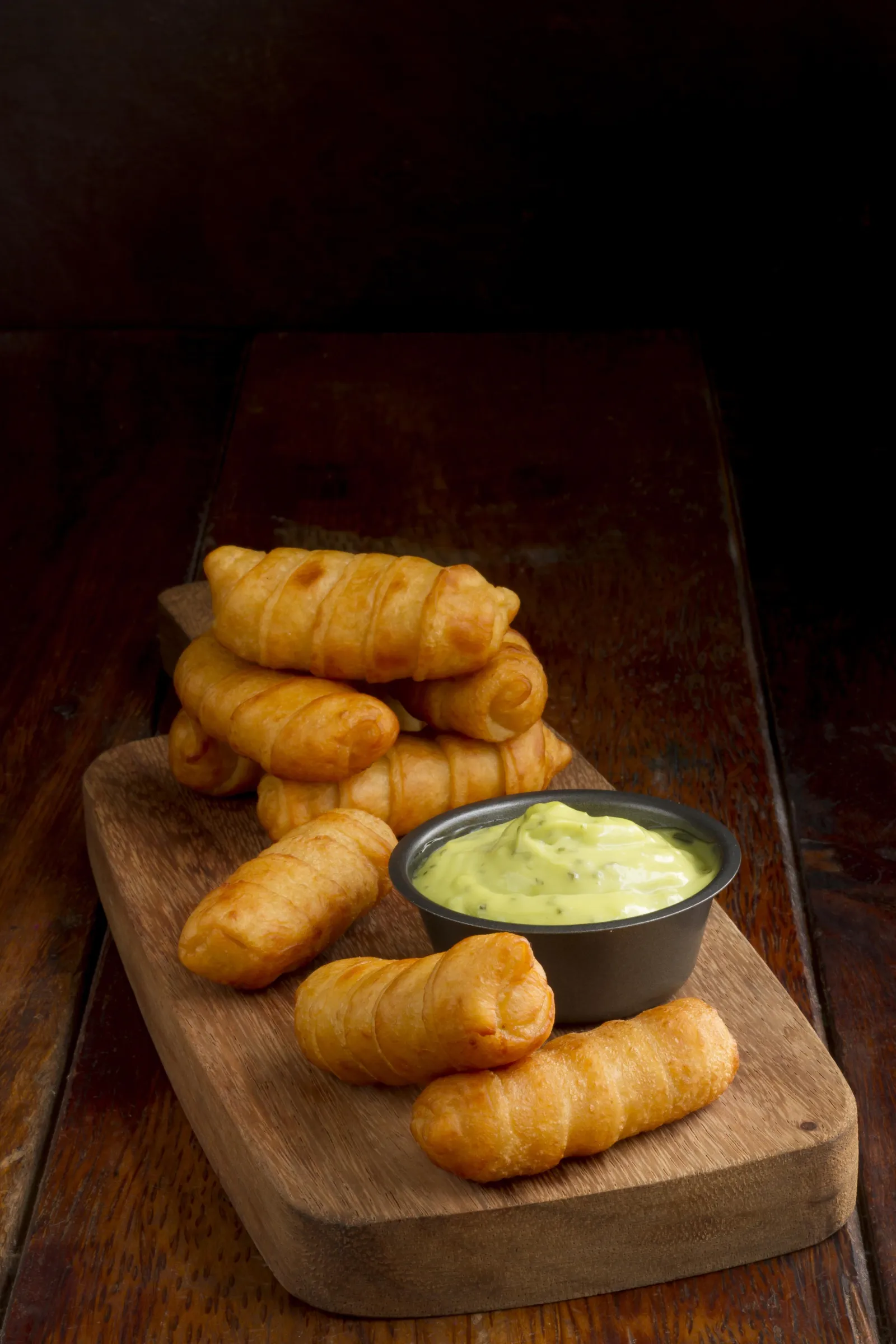

Picture a mozzarella stick that went to Caracas and came back better: a finger of salty white cheese wrapped in a spiral of thin, buttery wheat dough and fried until the crust blisters. That’s a tequeño (teh-KEH-nyo), and in Venezuela no birthday, wedding or office party happens without a tray of them. The name points to Los Teques, a city just outside Caracas. The hard part outside Venezuela is the cheese, so this recipe starts there, then shows you how to wrap them so nothing leaks, how to freeze 100 of them a week before a party, and what to dip them in.
What are tequeños, and are they worth making from scratch?
How do you make Venezuelan tequeños? Make a firm dough from all-purpose flour, cold butter, an egg, a little sugar, salt and water, rest it 30 minutes, and roll it 2 mm (1/12 in) thin. Wrap ⅝-inch strips in a tight spiral around sticks of a non-melting white cheese, covering both ends, then fry 8 at a time at 350°F (175°C) for 3-4 minutes. 130 minutes for 10 servings of 4.
Yes, if you’re feeding a crowd. Frozen tequeños exist in Latin freezers in the US and in some UK online shops, but homemade dough is thinner and crisper, and you choose the cheese. Making 40 takes 130 minutes on the clock and about 85 of them hands-on, most of it wrapping. If you only want a snack for two tonight, buy them; homemade starts paying off around 30.
Difficulty is medium, and the medium part is your hands, not technique. My first five always look clumsy. By the tenth they’re even.
Start with the cheese, because it decides everything
The cheese has one job: soften in hot oil without turning liquid. Venezuelans use queso llanero, a pressed, salty white cheese from the plains; in Colombia, where I live, I use queso costeño, its close cousin. Neither is easy to find in a US or UK supermarket, but three things are.
- Queso para freír (“frying cheese”) and queso blanco are sold in the Latin dairy case of most US supermarkets. They’re made to be seared without melting, which is exactly the job.
- Halloumi is in nearly every UK supermarket and many US ones. It holds perfectly and is salty, so cut the salt in the dough to 4 g (¾ tsp).
- Paneer from an Indian grocer won’t melt either, but it’s unsalted, so the tequeño tastes mostly of dough. Pair it with a punchy dip.
What doesn’t work: mozzarella and cheddar. They melt, the liquid cheese boils against the dough, finds the weakest seam and bursts through, and you pull out a crisp, hollow tube. Mexican queso fresco sits in between: it softens and weeps whey, so dry the sticks well and fry straight from the fridge.
Ingredients, with US and UK swaps
The full list with weights and cups is in the recipe card. For 40 tequeños you need 500 g (4 cups) flour, 100 g (7 tbsp) butter, one egg and 500 g (1.1 lb) cheese, plus a liter of oil.
| Ingredient | Why it’s there | Swap | What changes |
|---|---|---|---|
| All-purpose / plain flour | stretchy enough to wrap, tender enough to crisp | bread flour | shrinks when rolled, tougher crust |
| Cold butter | tenderness and blisters | margarine, or 60 ml (¼ cup) oil | margarine is near-identical; oil makes a stretchier, less flaky dough |
| Egg | color and strength | 30 ml (2 tbsp) more water | slightly paler, still works |
| Sugar, 2 tsp | browning | leave it out | paler crust |
| Frying cheese | holds its shape | halloumi or paneer | halloumi saltier, paneer blander |
Equipment. A rolling pin, a knife or pizza wheel, a deep pot and a probe or clip-on thermometer. No thermometer? Dip the tip of a wooden chopstick in the oil: a steady stream of fine bubbles means you’re near 350°F (175°C). No deep pot? A skillet with 3 cm (1¼ in) of oil works if you turn them more often.
How to wrap tequeños so they don’t burst
This is the step that matters, and I do it the same way every time.
- Cap the first tip. Lay the end of a strip diagonally across the end of the cheese stick and fold it down, so no cheese shows.
- Spiral with a ¼-inch overlap. Each turn rides about 5 mm (¼ in) over the last. Don’t pull the dough tight: stretched dough shrinks in the oil and opens a crack.
- Cap the second tip and seal dough on dough. The final end of the strip goes against dough, never against cheese, because it won’t stick to cheese.
No water needed. If the dough has dried out, the lightest brush of water; too much makes it slide. Then 15 minutes in the fridge before frying, so the cheese starts cold and the seams set.
Who this recipe is for
- If you’re hosting → make and freeze them days ahead; frying is the only job on the day.
- If it’s your first time → make a half batch and practice the wrap on 20.
- If you don’t deep-fry → the air fryer gives the closest result (times below).
- If you can’t find Latin cheese → halloumi, with half the salt in the dough.
The oil temperature, in °F and °C
At 350°F (175°C) the dough seals in the first seconds, so the crust is done before the cheese has time to get runny. Below 320°F (160°C) it’s the other way round: the dough drinks oil, browns slowly, and the cheese softens first and looks for a way out. That’s also why you fry 6 to 8 at a time; a crowded pot drops the temperature and doesn’t recover fast enough.
A fresh tequeño bubbles hard the moment it goes in and floats within about 30 seconds. It’s done when it’s evenly golden with small blisters, usually just under 4 minutes. If you see cheese poking out, take it out right away.
Make ahead, freeze and feed a crowd
The dough keeps 24 hours in the fridge, well wrapped; let it sit out 15 minutes before rolling. Wrapped, uncooked tequeños keep in the fridge until the next day on parchment, but no longer, because the cheese moisture softens the dough.
To freeze them raw, which is the best party trick there is: spread them on a tray without touching, freeze for 2 hours until hard, then bag them with the air pressed out. Per the USDA Food Safety and Inspection Service, food held at 0°F (−18°C) stays safe indefinitely; it’s quality that slips, and I use mine within 3 months, before the tips dry out. Cook them straight from frozen. Thawed dough goes soggy and the cheese leaks.
How many tequeños per person. My rule: 4 each when there’s other food on the table, 8 each when tequeños are the main event.
| Guests | With other snacks | Tequeños as the star |
|---|---|---|
| 4-6 | 20-25 (half batch) | 40 (1 batch) |
| 10 | 40 (1 batch) | 80 (2 batches) |
| 20 | 80 (2 batches) | 160 (4 batches) |
To scale up, I make separate batches of 500 g (4 cups) flour rather than one giant dough; that’s as much as kneads comfortably by hand.
Mistakes that ruin tequeños
- The cheese leaks → melting cheese, an open tip, or oil below 340°F (170°C).
- They unroll in the oil → the strip was stretched, or the end was pressed onto cheese.
- Raw dough inside → rolled thicker than 3 mm (⅛ in), or oil above 375°F (190°C) browning the outside too fast.
- Greasy → oil too cool or the pot too crowded.
- Dough shrinks back when rolled → it skipped the 30-minute rest. Cover it and give it 10 more minutes.
- Frozen ones burst → they were thawed first.
Spice level, 0 out of 5. Any heat comes from the dip. Kids love them; just wait 2-3 minutes, because the cheese is far hotter than the crust. Allergens: wheat (gluten), egg and dairy. Skip the egg with 30 ml (2 tbsp) more water. There’s no gluten-free version that tastes like a tequeño.
What tequeños cost in the US
At the US city average prices from the Bureau of Labor Statistics for August 2026, the ingredients for 40 come to about $8.27, or 21 cents a tequeño, before frying oil. The BLS doesn’t track queso blanco, halloumi or paneer, so the chart uses its cheddar price, $5.983 per pound, as a floor.
What drives the price. Cheese, at 80 % of the total even at the cheddar price. Latin frying cheese and halloumi usually cost more per pound, so expect the real figure to be higher. The oil goes back in a jar after straining; each tequeño only takes a few grams of it.
Yield. 40 tequeños of 8 cm (3 in), about 33 g each raw, or 10 servings of 4.
Dips, and what to serve with them
- Guasacaca → Venezuela’s avocado sauce, looser and more vinegary than guacamole: blend 1 avocado (about 150 g of flesh), ½ green bell pepper, ½ onion, 1 garlic clove, 15 g (½ oz) cilantro and parsley, 3 tbsp vinegar, 3 tbsp oil and salt (the full Venezuelan guasacaca recipe covers swaps and storage). If you know authentic Mexican guacamole, this is its smoother, tangier relative.
- Pink sauce (salsa rosada) → 4 tbsp mayonnaise, 2 tbsp ketchup and a few drops of lime. The children’s-party classic.
- Garlic sauce → 1 crushed garlic clove per 4 tbsp mayonnaise.
At a Venezuelan party, tequeños share the table with small reina pepiada arepas and, in December, slices of Venezuelan ham bread. I’ve served them as the starter before Venezuelan hallacas on Christmas Eve, with Venezuelan quesillo to finish. For a hot-weather party, a platter of shrimp aguachile is the cold, sharp counterpoint to anything fried. And if you like a fried snack with a surprise inside, Colombia’s cassava carimañolas fry at the same temperature.
Leftovers. Cooked tequeños are safe, according to the USDA FSIS, for 2 hours out of the fridge and 3 to 4 days in it at 40°F (4°C) or below. Reheat in an air fryer at 350°F (175°C) for 4-5 minutes or the oven at 350°F (175°C) for 8, to 165°F (74°C) in the center. The microwave makes the crust rubbery.
Frequently asked questions
What cheese is best for tequeños? A white cheese that softens without melting: queso llanero in Venezuela, queso para freír or queso blanco in the US, halloumi in the UK. Paneer works too.
Can I use mozzarella in tequeños? It’s the most common mistake. Mozzarella melts, bursts through the dough and leaves the stick hollow.
Can you make tequeños in an air fryer? Yes. Brush with oil and cook at 375°F (190°C), 8-10 minutes fresh or 12-14 frozen, turning halfway. The crust is crisp but smoother than fried.
Can you freeze tequeños before frying? Yes, and it’s the best way to make them for a party. Freeze on a tray for 2 hours, bag them, and fry from frozen at 355°F (180°C) for 5-6 minutes.
How many tequeños per person? Plan on 4 each alongside other food and double that when they’re the main snack, so 20 guests need between 80 and 160.
Can I use puff pastry or store-bought dough? Puff pastry works in 30 minutes, but it’s flakier and greasier. Empanada discs are closer to the real dough.
What do you dip tequeños in? Guasacaca, the Venezuelan avocado sauce, or pink sauce made with mayonnaise and ketchup.
Nutrition
Per serving of 4 tequeños (about 140 g / 5 oz), worked out ingredient by ingredient from USDA FoodData Central (SR Legacy) with the amounts in this recipe, using its queso blanco entry and counting about 3 g of oil absorbed per tequeño, which is my own estimate for frying at 350°F (175°C) and draining well:
- Calories: 526 kcal
- Protein: 16 g
- Carbohydrates: 41 g
- Fat: 33 g, of which 13 g saturated
- Fiber: 1 g
- Sugars: 2 g
- Sodium: 671 mg
About 106 kcal per serving is frying oil, so baked or air-fried tequeños land around 425-430 kcal. Halloumi and queso llanero are saltier than the USDA queso blanco, so sodium goes up with them unless you cut the salt in the dough. Two tablespoons of pink sauce add roughly 130 kcal.
Back home in Venezuela we bought tequeños by the hundred for birthdays, and I’d never wrapped one. I learned in Colombia with queso costeño, and my first batch opened up in the pot like flowers. Now I cap both tips, wait for the thermometer, and Dylan still eats twice what I plan per person. Josnaisis.