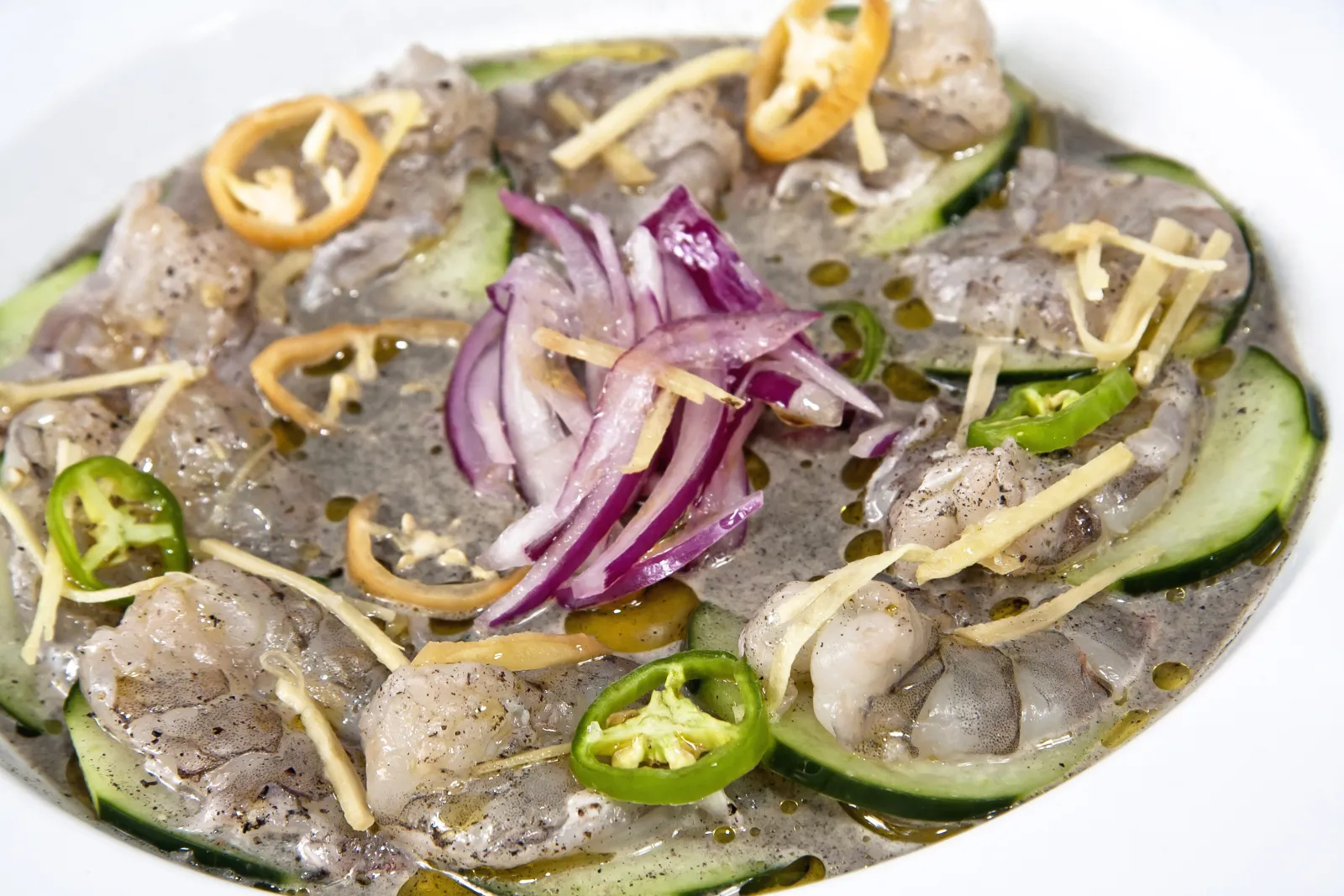

Aguachile (ah-gwah-CHEE-leh), from Sinaloa and Nayarit on Mexico’s Pacific coast, means more or less chile water, and that is what you pour over the shrimp: lime juice blended with green serrano chiles and cilantro until it turns the color of a lawn. There it is a snack, eaten with cold beer and crisp corn tostadas. The raw shrimp sits in that sauce for about a quarter of an hour, just long enough to turn white on the outside. Whether that makes it “cooked” is the question most people actually have, and it gets a straight answer below, along with a blanched version for anyone who should not eat raw seafood.
What shrimp aguachile is and whether it’s worth 40 minutes
How do you make shrimp aguachile? Peel and butterfly raw shrimp, salt them, and blend lime juice with serrano chiles, cilantro, cold water and salt. Pour that over the shrimp with sliced cucumber and red onion and chill 10-15 minutes, until the outside is white and the center still pearly. Serve right away with tostadas and avocado. Ready in 40 minutes for 4 servings.
If you can get good shrimp, yes. There is no stove involved, 25 of the 40 minutes are hands-on, and it lands on the table looking far more impressive than the effort. The flavor is loud: sour, hot, herbal, with cool crunch from the cucumber. If you want the gentler, cooked cousin in a tomato sauce, that is a Mexican shrimp cocktail.
It is the wrong pick for a make-ahead buffet (it does not wait), for a crowd that does not handle heat, and, raw, for anyone in the at-risk groups covered next.
Is raw shrimp in lime juice safe? What 15 minutes of acid does
Lime juice does not cook shrimp the way heat does. The acid changes the proteins on the surface, which is why the shrimp turns opaque, and it does reduce some bacteria. A 2013 study in the Journal of Food Protection on ceviche-style fish found lime juice pushed Vibrio parahaemolyticus below detectable levels within 30 minutes. Salmonella on the same fish, though, dropped by only 1 to 2 log units, meaning most of it survived. The FDA’s position is that cooking seafood is the safest route, and the CDC estimates about 80,000 Vibrio infections a year in the US, 52,000 of them from food.
Freezing is not a fix either. The FDA notes that freezing kills parasites that may be present, but does not kill all harmful germs. That is still a good reason to buy frozen, as long as you know it is not the same thing as cooked.
Who should not eat it raw. The FDA lists pregnant women, young children, older adults and people with weakened immune systems (transplant patients, people with HIV, cancer or diabetes) as the groups who should skip raw or undercooked seafood, ceviche included. The CDC adds liver disease and stomach-acid-reducing medicines as risk factors for Vibrio. For a healthy adult eating cold, well-sourced shrimp straight away, the risk is the one you take with any ceviche. For everyone else, blanch it (below): it keeps nearly all of the dish.
Ingredients, US and UK swaps, and which lime to buy
The recipe card has exact amounts. Here is what each ingredient does and what to buy if your store is not a Mexican market.
| Ingredient | What it is | US swap | UK swap | What changes |
|---|---|---|---|---|
| Raw shrimp 26/30 | Medium-large, about 30 per 1.1 lb (500 g) peeled | Frozen raw, peeled and deveined bag | Frozen raw king prawns | Nothing, if well frozen |
| Persian lime | The standard supermarket lime | Regular limes | Limes | Nothing |
| Mexican lime | Smaller, seedy, more aromatic | Key limes in mesh bags | Rarely sold | You need twice as many or more |
| Serrano chile | Slim green chile, 5,000-15,000 Scoville units | Jalapeño, 2 per serrano | Green finger chillies | Jalapeño is milder, 2,500-5,000 |
| Cilantro | Leaves and tender stems | Cilantro | Fresh coriander | Same herb, different name |
| Red onion | Thin slivers for bite | Red onion | Red onion | Soak 5 minutes in ice water if harsh |
The Scoville ranges come from North Dakota State University Extension. Skip bottled lime juice: it tastes cooked and flattens the sauce.
Fresh or frozen shrimp for eating raw
I buy frozen raw shrimp from a brand I trust over “fresh” shrimp from a counter when I cannot tell how long it has been sitting there; some of that counter shrimp arrives frozen and is thawed in store, so ask. When you pick up a frozen bag, the FDA’s checklist is short: no tears or crushed edges, no frost or ice crystals inside (a sign it thawed and refroze), and shrimp that are frozen solid, not bendable. Thaw overnight in the fridge at 40°F (4°C) or below, or in the sealed bag under cold water if you are short on time. Never on the counter.
Tools
A small sharp knife, a blender and a shallow glass or ceramic dish that holds the shrimp in one layer. No blender? Mince the chiles and cilantro very fine and mash them with the salt in a mortar before adding the lime. Avoid aluminum dishes; lime reacts with them.
How to butterfly shrimp and time the lime, 10 to 15 minutes
Butterflying halves the thickness of each shrimp and doubles the surface the lime can reach, so the outside does not toughen while the middle stays raw.
- Peel, leaving the tail on if you like.
- Slice along the curved back, about two-thirds of the way through, without cutting it in two.
- Lift out the vein with the knife tip or a toothpick.
- Open it flat like a book and press gently.
- Pat dry, since water dilutes the sauce.
Then watch the clock, not the color alone.
In my kitchen, with medium butterflied shrimp and fridge-cold sauce, the surface is white by 5 minutes, the sweet spot is 10 to 15 minutes, at 30 minutes it is firm and opaque all through like ceviche (fine if you prefer it), and past an hour it goes rubbery and chalky and leaks liquid. The acid keeps working, so a longer soak only makes it tougher. Larger shrimp, go to 15; whole unbutterflied shrimp cure unevenly.
How to tell it’s right. Outside opaque white-pink with no glassy gray patches, center still pearly when you cut one, firm bite without chewiness, and sauce that is still bright green rather than olive.
Make-ahead plan for a 40-minute aguachile
The night before. Move the frozen shrimp to the fridge.
Up to about 4 hours ahead. Peel and butterfly; keep covered in a single layer in the fridge, over ice if it will be a while. Slice the cucumber and onion into a separate container.
Up to 2-3 hours ahead. Blend the sauce and keep it in a sealed jar in the fridge. Longer than that and the cilantro dulls.
Never ahead. The shrimp goes into the lime only when people are ready to eat. That is the rule that keeps the texture, and it is the one most likely to be broken at a party.
Green, red or black aguachile, plus the blanched version for 4
All three use the same 1.1 lb (500 g) of shrimp, cucumber and onion; only the sauce changes.
- Green (aguachile verde) → the recipe card. Fresh and herbal, and the easiest place to start.
- Red (aguachile rojo) → blend 2 tablespoons dried chiltepín (sold in the US as chile pequín) with the lime and salt, no cilantro. Hotter and drier-tasting. 4-5 dried chiles de árbol, toasted 30 seconds, get you close with a little less fire.
- Black (aguachile negro) → char 3 serranos, 1 habanero and 1 corn tortilla in a dry skillet until blistered black in spots, then blend with lime, 1 tablespoon soy sauce and 1 tablespoon Worcestershire sauce. Smoky, salty and dark; about 10 extra minutes.
- Blanched, for pregnancy, kids or older guests → bring 2 quarts (2 liters) of water to a boil with 1 tablespoon salt. Drop in the butterflied shrimp for 60-90 seconds, until opaque all the way through and firm, or 145°F (63°C) in the thickest part on an instant-read thermometer, which is the FDA target for most seafood. Move them to ice water for 2 minutes, pat dry and give them just 5 minutes in the sauce. Slightly firmer, same flavor.
- Precooked frozen shrimp → already cooked, so thaw in the fridge, pat dry and sauce for 5 minutes. Drier than home-blanched, but the fastest option that suits everyone.
Aguachile vs ceviche. Ceviche usually means chopped seafood left longer in citrus, often with tomato, until it is firm and fully opaque. Aguachile keeps the shrimp whole and butterflied, uses a blended chile-lime sauce, and is eaten after 10-15 minutes. If you want tomato and onion to lead, a pico de gallo with chopped cooked shrimp is closer to what you are after, or try a Mexican fish ceviche on tostadas.
Scaling for 4 or for 10
I plan 4.5 oz (125 g) peeled shrimp per person as a snack with other food around, and about 7 oz (200 g) if it is the main event.
| Ingredient | 4 people | 10 people |
|---|---|---|
| Peeled shrimp 26/30 | 1.1 lb (500 g), about 30 | 2.75 lb (1.25 kg), about 75 |
| Lime juice | ¾ cup (180 ml), 5 limes | scant 2 cups (450 ml), 12-13 limes |
| Serrano chiles | 3 | 7-8 |
| Cilantro | 0.7 oz (20 g) | 1.8 oz (50 g) |
| Ice-cold water | ¼ cup (60 ml) | ⅔ cup (150 ml) |
| Fine salt | 1 tsp | 2½ tsp |
| Cucumber | 1 (10.5 oz / 300 g) | 2½ (1.7 lb / 750 g) |
| Red onion | ½ (2.8 oz / 80 g) | 1 large (7 oz / 200 g) |
| Avocado | 1 | 2-3 |
| Tostadas | 8-12 | 20-30 |
For 10, blend the sauce in two batches and dress the shrimp in two platters, the second one going into the lime once the first is on the table.
What shrimp aguachile costs in the US, about $15 for 4
Using the $9.65 per pound average retail shrimp price for early 2026 reported by Expana’s US shrimp market insights, and the USDA’s advertised supermarket prices for the week of October 9, 2026 for the rest, aguachile for 4 comes to about $15.26, or $3.82 a serving.
Shrimp is 70% of the bill, so that is where the savings are: a bag of frozen raw shrimp on promotion beats fresh counter shrimp on price and, often, on condition. The serrano price uses the USDA jalapeño figure ($1.45 per pound), since three chiles weigh well under an ounce.
Serving, leftovers and storage, the 2-hour rule
How it’s served. On a flat platter or in a molcajete, sauce pooled underneath, shrimp on top, cucumber and onion scattered over, sliced avocado and a few serrano rounds for anyone who wants more heat. Everyone builds their own on a tostada. In my house it also goes on crisp tostones, which hold up to the sauce.
Alongside. A bowl of guacamole and a milder tomatillo salsa verde for guests who want less heat, ice-cold agua de jamaica to drink, and the cooked, sweeter Mexican shrimp cocktail if you are setting up a seafood table. For something hot and crunchy next to all that lime, add a round of Baja fish tacos with beer batter.
Out of the fridge. 2 hours at most; set the platter on ice if it will sit out longer (FDA).
Leftovers. Raw aguachile does not keep: the lime keeps working and in a few hours the shrimp is rubbery. Peeled raw shrimp without sauce lasts 1-2 days in the fridge per the FoodSafety.gov cold storage chart. If some is left, drain the sauce, cover it, refrigerate, and finish it the same day; the blanched version holds until the next day.
Freezer. Raw shrimp keeps good quality 3-6 months frozen. Finished aguachile does not freeze: the cucumber collapses and the shrimp turns mealy.
Shrimp aguachile FAQ
Does lime juice cook shrimp? It turns shrimp opaque and firm, like heat does, but it does not make it as safe as cooking. It reduces some bacteria, such as Vibrio parahaemolyticus, and barely affects others, such as Salmonella.
How long should shrimp marinate in lime juice for aguachile? No more than a quarter of an hour in the fridge if butterflied; I pull mine at 12 minutes. Left for an hour or more, it turns rubbery.
Is aguachile safe to eat while pregnant? Not raw; the FDA advises against raw seafood in pregnancy. Blanched 60-90 seconds to 145°F (63°C) and then sauced, yes.
Can I make aguachile with frozen shrimp? Yes, and a good frozen bag is often the better buy. Thaw overnight in the fridge or sealed in cold water, and pat dry. Freezing kills parasites but not all bacteria.
Can I use cooked shrimp? Yes. Precooked shrimp or home-blanched shrimp needs only 5 minutes in the sauce. The texture is firmer and less silky.
What’s the difference between aguachile and ceviche? Aguachile uses whole butterflied shrimp in a blended lime-chile sauce and is eaten within minutes. Ceviche uses chopped seafood cured longer in citrus, often with tomato.
Is aguachile very spicy? With 3 serranos for 1.1 lb (500 g) of shrimp, yes, about 4 out of 5. One seeded serrano brings it to a mild 2.
Nutrition per serving
Per serving (about 10 oz / 290 g, without avocado or tostadas), calculated ingredient by ingredient from USDA FoodData Central (SR Legacy) using this recipe’s amounts and counting all the sauce:
- Calories: 139 kcal
- Protein: 26 g
- Carbohydrates: 9 g
- Fat: 1 g (0 g saturated)
- Fiber: 1 g
- Sugars: 3 g
- Sodium: 736 mg
Raw shrimp brings 85 kcal and 20.1 g of protein per 100 g (3.5 oz), which is why this is such a lean plate. Some of the sauce stays behind, so the sodium you actually eat is lower. Half a Hass avocado (68 g / 2.4 oz) adds about 114 kcal and 10 g of fat.
The first time I made aguachile I left the shrimp in the lime for an hour, sure that longer meant safer, and served something that squeaked. Now I butterfly, set a timer for 12 minutes, and blanch a separate plate for anyone who should not eat it raw. Lime is seasoning, not a stove. Josnaisis.