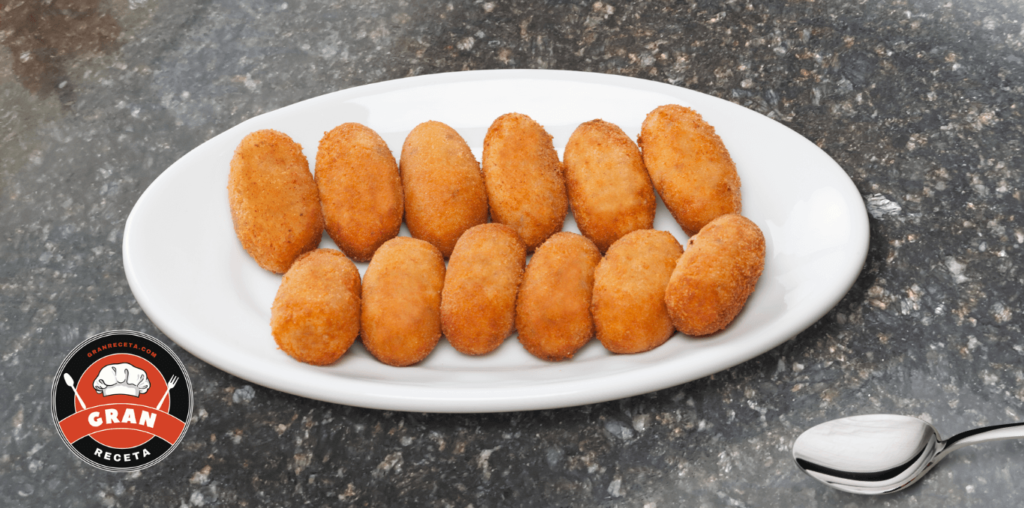
On Colombia’s Caribbean coast a carimañola is a 4 oz torpedo of boiled cassava stuffed with beef and fried, and the whole recipe turns on one instruction that is rarely written down: mash the cassava while it is still too hot to touch comfortably. Cool it first and the dough cracks, and every crack is a place for the oil to get in and the filling to get out. This is the Caribbean coast’s breakfast fritter, sold from trays in Cartagena and Montería from six in the morning. Twelve of them in 70 minutes, about 285 calories each.
How do you make carimañolas? Boil cassava 30 minutes until it falls apart, pull out the woody core and mash it hot. Fill 3 oz portions of dough with cold seasoned ground beef, close them into sealed torpedoes and fry at 350 °F for 4 minutes. 70 minutes for 12 fritters.
What cassava is, and why it is never eaten raw
Cassava, sold as yuca in Latin markets and sometimes as manioc, is a starchy root about the length of a forearm with a waxed brown skin and dense white flesh. It is the same plant that tapioca comes from, and it behaves in the kitchen like a denser, less forgiving potato: more starch, less water, and no possibility of eating it raw.
That last part is not a preference. Cassava must be cooked through, which is why every traditional preparation of it starts with a long boil, and why the 30 minutes here are not negotiable even if the pieces look done at 20.
Boiling it to the right point
Cassava for this dough is not boiled until tender but until it collapses, about 10 minutes past what you would do for a side dish. At 20 minutes it still slices cleanly and the dough will be grainy; at 30 it falls apart on a fork; past 45 it drinks water and the dough turns too wet to seal.
Older or thicker roots want 5 to 10 minutes more, so the fork is the judge and the clock is only a guide. Salt the water from the start, since the dough takes salt poorly afterwards.
The woody core, and pulling it out hot
Every 2-inch piece has a thin woody string running down the middle that never softens no matter how long it boils. Leave it in and you get a hard thread in the middle of the fritter, plus a weak line where the dough tears as you fold it.
Pull it out as you drain, with your fingers or the tip of a knife. Frozen cassava chunks usually arrive already cored, which is one of the reasons they are worth buying.
Which cassava to buy
Frozen peeled chunks are the practical default outside the tropics. They are picked and frozen at source, arrive cored, boil in about 20 minutes from frozen and cost less than fresh. Fresh root is better when it is genuinely fresh, which means white flesh with no grey or blue streaks when you cut it.
What will not work is anything further down the processing chain. Cassava flour and tapioca starch are different products with different jobs, and frozen yuca fries come par-fried in oil that ruins the dough. If the bag says anything other than plain cassava, it is not this recipe.
Why the dough must be mashed hot
This is the point the whole thing hangs on. Cassava starch gelatinizes as it boils, and while it is hot the dough is stretchy and folds without breaking. As it cools, that starch retrogrades, the chains reorganizing into crystals, and the dough turns brittle: it cracks as you close it and it splits in the oil.
So you mash it straight from the colander, working fast, with a towel over your hand or a wooden mallet. If it cools before you finish, 40 seconds in the microwave restores it. No egg is needed unless the dough still cracks when folded, and then one egg is enough for the whole batch.
Cold filling, and the shape that holds
The filling is cooked while the cassava boils so that it has time to cool. Warm filling softens the dough from the inside, and dough that is soft inside and sealed outside bursts the moment it meets hot oil.
The torpedo shape matters too. Both ends get pinched inward and smoothed with a wet finger, and loose ends are exactly where carimañolas open. Three ounces of dough with a heaped spoonful of filling gives enough wall without leaving a mouthful of plain cassava at each tip.
Who this recipe is for
- If the dough cracks → it has cooled; 40 seconds in the microwave and mash again
- If the dough sticks to your hands → a little tapioca starch on your palms, never wheat flour, which changes the taste
- If you use frozen cassava → boil it about 10 minutes less, since it arrives partly cooked, and skip the coring
- If you want them meatless → 9 oz of grated firm white cheese instead of the beef, the other classic filling on the coast
- If you want to get ahead → freeze them shaped and raw up to 2 months and fry them straight from frozen, 6 minutes
Make ahead, storage and reheating
Shaped and uncooked, carimañolas freeze better than almost anything else in Colombian cooking. Lay them on a tray until solid, bag them, and they keep 2 months. They go into the oil frozen, 6 minutes at 350 °F, with no thawing at all.
Cooked ones keep 3 days in the fridge, within the 3 to 4 day window the USDA gives cooked dishes. Reheat in a 400 °F oven or air fryer for 6 minutes; the microwave turns the crust to leather. The dough itself does not freeze well once fried, which is why the freezer step belongs before the oil, not after.
Carimañola, papa rellena and croquette
All three are a starchy dough wrapped around a filling and fried, and the carimañola is the only one that goes into the oil bare. A croquette relies on breadcrumbs for its crust and a papa rellena is usually dusted, while the cassava here forms its own shell as the surface starch dehydrates.
That is also why sealing matters more here than in the other two. There is no coating to hold a leak, so a badly closed end empties itself into the pot within a minute.
What goes wrong
Cold dough. The root cause of most failures: it cracks, opens and spills the filling into the oil.
The core left in. A hard thread in the middle and a weak seam where the dough tears.
Warm filling. Softens the dough from inside and bursts the fritter.
Oil under 320 °F. The dough absorbs oil before it can seal, and the result is heavy and greasy rather than crisp.
Loose ends. Pinch them hard and smooth the seam with a wet finger.
Variations
With cheese. 9 oz of grated queso costeño or firm feta instead of the beef, the version most bakeries in Barranquilla sell.
With shredded chicken. Cooked and stewed in hogao, milder than beef and about 30 calories lighter each.
With a quail egg. Half a hard-boiled egg inside the filling, a street-cart habit in Montería.
Baked. 25 minutes at 400 °F brushed with oil. Not the same fritter, but about 190 calories each.
What to serve with them
On the coast these are breakfast, served with suero costeño, a tart cultured cream that sour cream stands in for, or with a fresh chili sauce. On a tray of fried things they sit next to the Colombian egg arepa and Colombian fried calamari, all fried in the same oil one after another at 350 °F.
For a longer table, Colombian peanut empanadas bring the Cauca to the tray, while Colombian patacones with hogao and Colombian cheese arepas cover the griddle side, and the drink is Colombian hot chocolate or cold juice, which is what actually gets drunk with fried food at seven in the morning.
Frequently asked questions
Why do they open when frying? Almost always because the dough was mashed cold and cracked as it was sealed, or because the ends were left loose.
Does the dough need egg? Only if it still cracks when folded. Cassava boiled to the right point and mashed hot does not need it.
Can I use frozen cassava? Yes, and it saves the coring step. Boil it about 10 minutes less than fresh.
Can they be air-fried? They can, 15 minutes at 400 °F, and they come out closer to baked than fried, at about 190 calories.
What is the difference from a yuca empanada? Shape and dough: a carimañola is a sealed torpedo of plain cassava dough, an empanada is a half-moon with starch added to the dough.
Nutrition
Per carimañola of about 4 oz (110 g), calculated with the USDA database for the cassava, the ground beef and the oil absorbed in frying:
- Calories: 285 kcal
- Protein: 6 g
- Carbohydrates: 32 g
- Fat: 14 g, of which 3 g saturated
- Fiber: 2 g
- Sodium: 380 mg
Nearly all the carbohydrate is the cassava, which according to the USDA carries 38.06 g per 100 g raw, noticeably more than potato. The fat splits between the beef and the oil the dough takes on, and that second part is entirely under your control: every 25 °F below 350 shows up as absorbed oil.
We did not have carimañolas in Venezuela, we had bollos and corn empanadas, so the first time I watched someone mash boiling-hot cassava with bare hands it looked like pointless suffering. The woman at the cart in Montería explained it without any theory at all: cold, it is no good. Years later I learned why the starch does that, but her hands already knew. Josnaisis.