
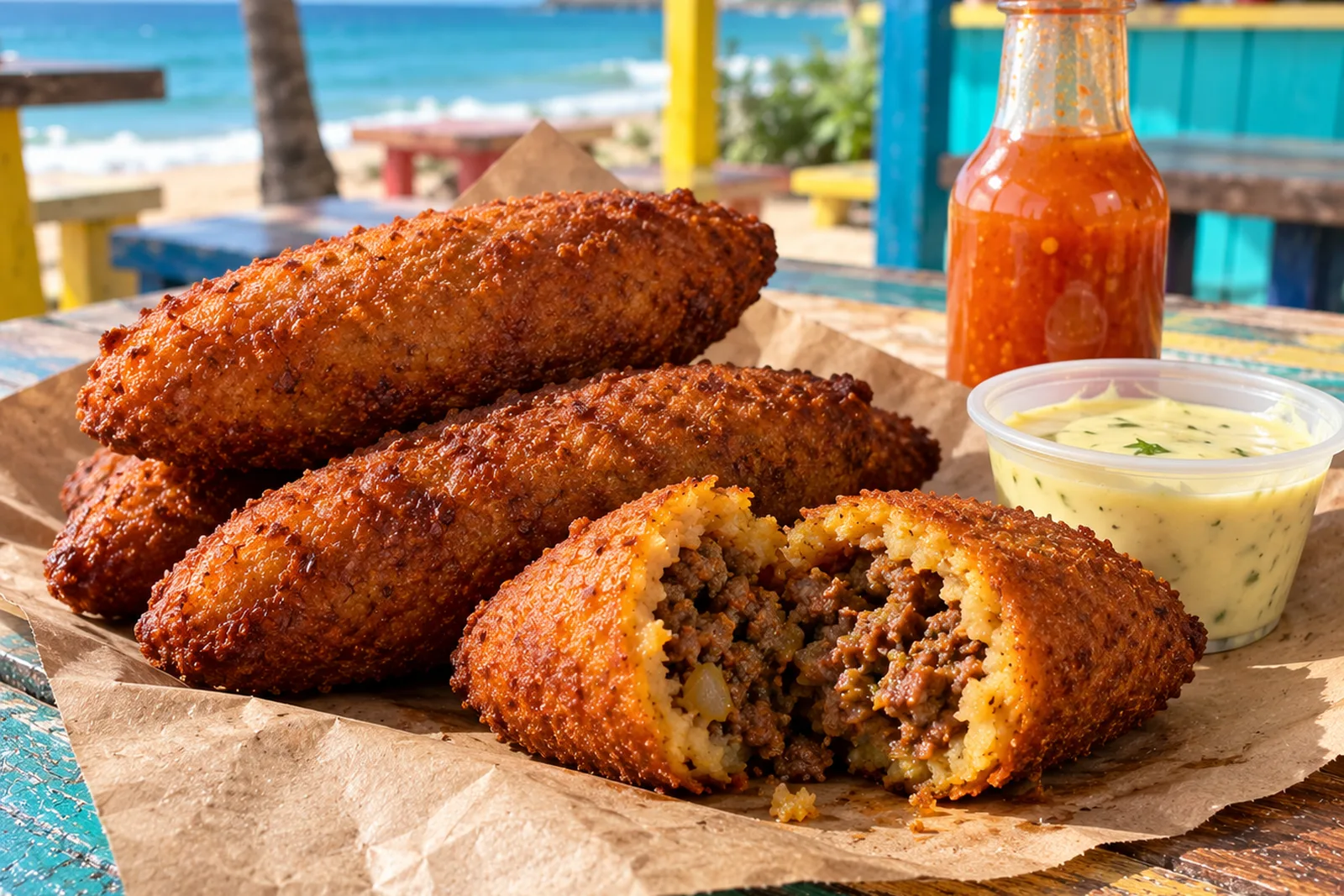

Alcapurrias (ahl-kah-POO-ree-ahs) are Puerto Rico’s best-known fritter: a torpedo of raw, grated green banana and yautía dough, stained orange with annatto oil, wrapped around seasoned ground beef and deep-fried until the shell crackles. The dough is unlike anything made with flour. It’s sticky, soft and a little alarming the first time, and it only behaves once it’s cold. Get that right, keep the filling dry and the oil at 350°F (175°C), and they hold together. Here’s the batch of 16, how to tell if the dough is right and rescue it if it isn’t, what yautía is and why taro isn’t the same, and how to freeze them raw.
What alcapurrias are, and how long they take, 175 minutes
How do you make Puerto Rican alcapurrias? Finely grate 2 lb (900 g) of peeled yautía with 5 green bananas, season with annatto oil and salt and chill for at least 1 hour. Spread ⅓ cup of dough on an oiled banana leaf, add cold beef picadillo down the middle, fold it closed into a torpedo and fry at 350°F (175°C) for 5 to 7 minutes. 175 minutes for 16 alcapurrias.
On the island they’re beach-shack food, fried to order at the kiosks of Piñones and Loíza, east of San Juan. Ground beef is the everyday filling; on that coast they’re also stuffed with land crab (jueyes), shrimp or lobster. The island’s other classic fritter is bacalaitos, crispy salt cod fritters, flat and made from a flour batter.
The dough belongs to the same family as Puerto Rican pasteles, but without the milk and stock, so it’s firm enough to hit hot oil with no wrapper. If you’ve had Colombian carimañolas, they’re the closest cousin: also a meat-filled root-vegetable fritter, but made from boiled yuca, while alcapurria dough goes in raw.
Time. Just under 3 hours start to finish, but only about 2 of them are hands-on: the dough needs an hour in the fridge, and the filling cooks while you peel and grate. Medium difficulty. Nothing is hard, but the dough is sticky and your first two or three will look rough until you get the motion.
Ingredients for 16 alcapurrias
Each alcapurria takes about 3 oz (90 g) of dough, roughly ⅓ cup, and 1½ tbsp of filling.
Annatto oil
- 2 tsp annatto seeds warmed in ⅓ cup (80 ml) vegetable oil. Enough for the dough, the filling and brushing the leaves. Annatto is a mild, earthy seed used mostly for its color; look for it as achiote in the Latin aisle.
Beef filling
- 340 g (¾ lb) 85% lean ground beef. With 95% lean the filling turns dry and crumbly.
- ½ onion (75 g / 2½ oz) and 2 garlic cloves, finely chopped
- 60 g (¼ cup) Puerto Rican sofrito or recaíto, a green purée of cubanelle pepper, sweet ají peppers, onion, garlic and culantro. Jarred is fine but already salted, so taste before you salt.
- 60 ml (¼ cup) canned tomato sauce, the thin unseasoned American kind (in the UK, passata)
- ½ tsp dried oregano, ½ tsp ground cumin, ½ tsp salt and ¼ tsp pepper
- 8 pimento-stuffed green olives, chopped
Dough
- 900 g (2 lb) white yautía, weighed after peeling
- 5 green bananas, about 500 g (1 lb 2 oz) peeled
- 3 tbsp (40 g) annatto oil
- 2 tsp (12 g) fine salt
To shape and fry
- 16 pieces of banana leaf or wax paper about 8 × 6 in (20 × 15 cm). Parchment (UK baking paper) also works.
- 2 liters (2 quarts) vegetable oil
Yautía, malanga and taro, what to buy
Yautía is the same root sold in the US as malanga: brown, hairy skin and white to cream, crisp flesh. It’s sometimes labeled tannia or tannier, especially in the UK. For alcapurrias you want the white one.
Taro is a different plant. It comes from Asia, and some Latin shops sell it as malanga isleña or dasheen. Plenty of English-language recipes write “taro” when they mean yautía, which is where the confusion starts. Taro changes the dough, and I can’t promise the same result with it.
- US. Look for “malanga” or “yautía” in the root-vegetable bins of Latin and Caribbean supermarkets and bodegas. It’s easy to find in South Florida and the Northeast.
- UK. Caribbean and African grocers stock it, often labeled tannia or malanga. Eddoes and dasheen, sold in the same shops, are taro, so ask for tannia or yautía by name.
- Green bananas. Ordinary bananas picked hard and fully green, not plantains. In the US they’re in the Latin or Caribbean produce section; in the UK, Caribbean and African grocers sell them. They must be green all over: a banana starting to turn yellow makes a sweet, soft dough that falls apart in the oil.
Swaps, and what they change
- Green plantains instead of green bananas. It works, and some cooks make the dough from plantain alone. It’s firmer and easier to shape, but less tender inside and tastes more like tostones.
- Yuca (cassava). Yuca alcapurrias exist, rounder and with a harder crust. It’s a different dough; to try it, swap a third of the yautía first.
- No annatto seeds. 1 tsp ground annatto stirred into the oil gives the same color. Without either, they come out pale but taste almost the same.
- No sofrito. Another ½ onion, ½ green bell pepper and a small handful of cilantro (UK coriander), finely chopped.
Equipment. A box grater or a food processor with a shredding disc and blade, a deep 9½ in (24 cm) pot, a deep-fry thermometer, a spider or slotted spoon, and a wire rack set over a tray. No thermometer? Use the test in the frying step.
A make-ahead plan, the night before and the day
- The night before, 45 minutes. Annatto oil and filling, cooled and covered in the fridge. The dough too, if you like: grated, seasoned and with plastic wrap pressed onto the surface so it doesn’t darken.
- On the day, about an hour. Half an hour to shape the whole batch, then four rounds in the oil.
- Doing it all in one day? Start with the filling, grate while it cools, and don’t cut the dough’s hour in the fridge.
How to make alcapurrias step by step
The beef filling, dry and cold
Give the beef a proper browning in a spoonful of annatto oil, 6 to 8 minutes without crowding it, then add the onion, garlic and sofrito, then the tomato and spices. Leave the lid off at the end, since that last stretch of simmering is there to dry it out: it’s ready when the sauce clings to the meat and the line you drag with a spoon across the pan stays dry. Spread it on a plate to cool fast and get it into the fridge within 2 hours.
Cold filling portions neatly and doesn’t soften the dough. Hot or saucy filling turns to steam and bursts the fritter in the oil.
The alcapurria dough, finely grated and cold
Green bananas don’t peel like ripe ones. Cut off both ends, run a knife lengthwise through the skin only and pry it off with your thumb. Wear gloves: the sap stains skin and towels. If the peel won’t budge, soak the bananas in hot water for 5 minutes. As you peel, drop banana and yautía into salted water to stop them browning.
Grate everything on the finest side of the grater or through the processor’s shredding disc. With a processor, then blitz half of it with the blade into a thick purée and stir it back into the shredded half: the purée makes the dough sticky, which is what keeps it sealed, and the shreds give it some body. Mix in the annatto oil and salt until it’s an even orange.
What it should look like. Freshly made it’s sticky and soft, like thick mashed potato that sits on a spoon without dripping. After 1 hour in the fridge it’s noticeably firmer and spreads without sliding. Don’t skip that rest; 3 hours or overnight is even better.
If the dough is too wet
It happens most with very watery yautía or when all of it went through the blade.
- Squeeze it. Tip it into a clean dish towel or cheesecloth, twist over the sink and wring out some of the liquid. Don’t wring it dry; it should stay sticky.
- Add more root. Grate another 7 oz (200 g) yautía and mix it in. That beats flour, which changes the texture and dulls the flavor.
- Chill it. Another hour in the fridge firms it a lot.
Fry a test one before you shape the whole batch. If it splits in the oil, the dough needs more chilling or less water.
Shaping on a banana leaf or wax paper
- Pass the banana leaf over a flame or dip it in hot water for a few seconds so it bends without tearing, then dry it. Lay it on your palm or the counter and brush it with ½ tsp annatto oil. Wax paper works the same way.
- Add ⅓ cup of dough and spread it with the back of an oiled spoon into an oval about 5 × 3 in (12 × 8 cm) and ⅜ in (1 cm) thick.
- Spoon 1½ tbsp of filling in a strip down the center, keeping a ¾ in border of bare dough at each end.
- Lift one side of the leaf to fold the dough over the filling, like closing a book, and press through the leaf so the edges stick.
- Open the leaf and smooth the seam with the oiled spoon until no filling shows. Round off the ends into a torpedo about 5 in (12 cm) long.
At the kiosks they’re fried straight off the leaf: tip it over the oil and the alcapurria slides in. With paper, do the same but keep hold of the paper; if the alcapurria won’t let go, ease it off with the oiled spoon first, never with the paper in the oil. At home it’s easier to shape them all, leave them on a tray on their leaves or paper, and fry afterwards. If the dough sticks to your hands, oil them.
Frying at 350°F (175°C)
Pour 2 quarts (2 liters) of oil into a 9½ in (24 cm) pot: that’s about 1½ in (4 cm) deep, enough for them to float. Heat it to 350°F (175°C). With no thermometer, drop in a teaspoon of dough: it should bubble at once and rise to the surface within a few seconds without darkening fast.
Fry 4 at a time. More drops the temperature and the dough soaks up oil. After 30 seconds, nudge them with the spider so they don’t stick to the bottom. Turn them now and then. They’re done after 5 to 7 minutes of frying, when the crust is deep golden, sounds hollow when tapped and the big bubbles have died down. Drain on the rack and let the oil return to 350°F before the next batch.
Common mistakes and how to avoid them
- They split open in the oil. Unchilled or wet dough, a poorly sealed seam, warm filling or oil that’s too cool. Chill the dough, smooth the seam and check the temperature before every batch.
- Greasy and soft. Oil below 350°F (175°C) or too many in the pot. Batches of 4 and a thermometer.
- Very dark outside, cold inside. Oil too hot or dough thicker than ⅜ in (1 cm). Turn the heat down and get back to 350°F.
- Stuck to the bottom of the pot. They went in and were left alone. Nudge them at 30 seconds.
- Sweet or crumbly dough. Bananas that had started to ripen. Fully green only.
- Gray dough. Peeled root oxidizes in air. Peel into salted water and mix in the annatto oil straight away.
Allergens and heat. No gluten, egg or dairy; check the labels on jarred sofrito and tomato sauce. They aren’t spicy: heat comes from pique, Puerto Rican hot sauce, at the table. Kids usually like them; leave the olives out of their filling if needed.
Variations, crab, yuca or a batch of 32
- Crab (jueyes). On the Loíza coast they’re filled with land crab. Away from the island, about 10 oz (300 g) of pasteurized or canned crab meat, sautéed for 3 minutes with the same sofrito, tomato and olives and well drained, replaces the beef. Fry them the same way.
- Corned beef. One 12 oz (340 g) can of corned beef, broken up and sautéed with the sofrito and tomato, no added salt. A common kiosk filling and very quick. In the UK, tinned corned beef is the same idea.
- Plantain dough. Two large green plantains can stand in for the bananas, about 1 lb (500 g) peeled. Firmer and easier to shape.
- Baked or air-fried. You can, brushed with oil, but they don’t come out the same: the crust stays pale and dry, without the crackle. I prefer them fried.
- For 32. Double everything and split the work: one person grates, one shapes, one fries. Use two pots if you have them, always 4 at a time.
What drives the cost is the beef and the frying oil; crab or lobster push it up a lot. Corned beef makes the cheapest batch.
Serving, freezing and reheating
Serving. Fresh from the oil, but give them 5 minutes: the filling comes out very hot. Pique or ketchup on the side. For a meal, 2 per person with Puerto Rican arroz con gandules or alongside crisp Caribbean tostones. If you like the green-plantain side of the island’s cooking, Puerto Rican mofongo with garlic and chicharrón is the other classic.
Freezing raw. The best way to keep them. Set the shaped alcapurrias on a lined tray, not touching, and freeze. Once hard, move them to freezer bags with the date. They keep up to 3 months, though they’re best in the first month. Don’t thaw them: straight into 350°F (175°C) oil, 3 at a time, for about 10 minutes, until golden and hot in the center. Thawed, they soften and lose their shape.
Already fried. Refrigerate leftovers within 2 hours, covered, and eat them within 3 to 4 days. Reheat in the oven or air fryer, uncovered, until crisp again and 165°F (74°C) in the middle; in my oven at 400°F (200°C) that’s about 10 minutes. The microwave makes them soggy.
Alcapurria questions people ask
Can I make the dough with only yautía, no banana? You can, but it’s very soft and hard to shape. Green banana brings the starch that firms it up; if you can’t find green bananas, use green plantain.
Why does my dough turn gray or black? That’s oxidation of the peeled root. Peel into salted water, grate right before mixing and add the annatto oil straight away. Plastic wrap pressed onto the dough in the fridge stops the surface darkening.
How are alcapurrias different from pasteles? Pasteles dough has milk and stock, stays softer and is boiled in its leaf for 1 hour. Alcapurria dough has no liquid, is chilled until firm and is fried with no wrapper.
Can I make the dough a day ahead? Yes. Covered with plastic wrap touching the surface, it keeps overnight in the fridge and is easier to shape than fresh.
Alcapurrias nutrition facts
Per alcapurria (about 3 oz / 90 g of dough plus 1½ tbsp filling, fried), worked out ingredient by ingredient from the recipe amounts, including the oil absorbed in frying:
- Calories: 236 kcal
- Protein: 5 g
- Carbohydrates: 22 g
- Fat: 15 g, of which 2 g saturated
- Fiber: 2 g
- Sodium: 437 mg
A little over half the fat is frying oil, about 8 g per fritter. Jarred sofrito pushes the sodium up, so taste the filling before salting.
If you’re used to empanadas, the instinct is to shape these in your hand. It doesn’t work: a raw root-vegetable dough is sticky and soft and only cooperates when it’s cold and sitting on an oiled leaf. The batch runs best when the dough is made the night before, all 16 are shaped the next day, half are fried and the rest go to the freezer on their tray. Josnaisis.