
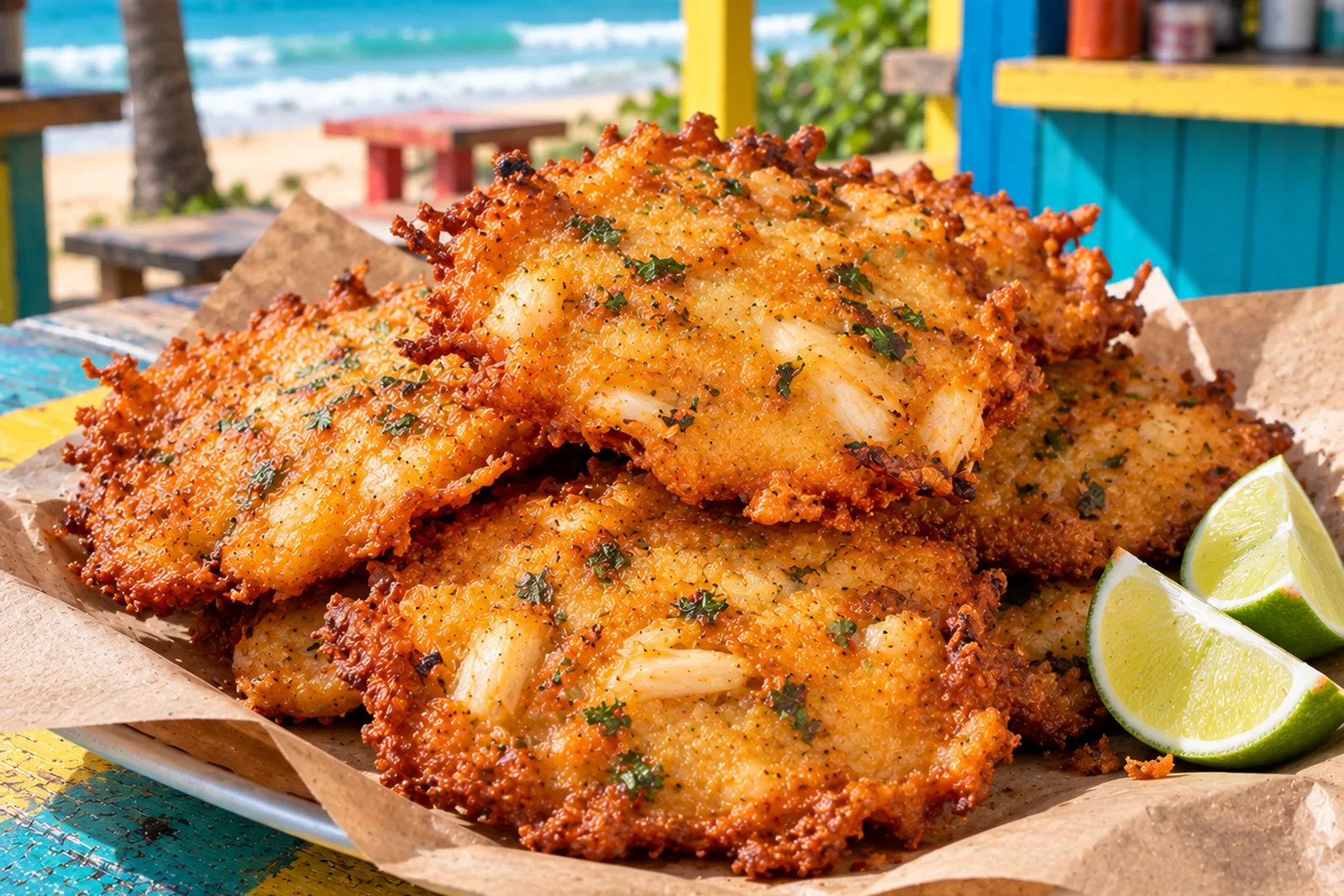

Bacalaítos (bah-kah-lah-EE-tohs) are Puerto Rico’s salt cod fritters: a runny batter of flour, water, garlic and culantro with flakes of salt cod stirred through, poured into hot oil where it spreads into a thin, flat, golden round with lacy edges. They’re beach and roadside-stand food on the island, eaten hot with a squeeze of lime or a garlicky dip. This recipe makes 12, and the parts that decide whether yours come out right are the soak, the thin batter and the oil temperature.
What bacalaitos are, and how long they take
How do you make bacalaitos? Soak 225 g (½ lb) of salt cod overnight in the fridge, simmer it for 15 minutes and shred it finely. Whisk 190 g (1½ cups) of flour with 1 tsp baking powder and 360 ml (1½ cups) of cold water into a runny batter, stir in garlic, culantro and the cod, and fry ¼ cup portions spread into thin rounds in oil at 350 to 360°F (175 to 180°C) for 2 to 3 minutes per side. 60 minutes for 4 servings, plus the overnight soak.
Think of a cross between a crisp, thin pancake and a fish cake. The edges are brittle and full of holes, the middle has a little chew, and every bite has a strand of cod. They taste salty, garlicky and herby, with no chile heat at all.
Time. 60 minutes on the day: 20 of prep and 40 at the stove for the simmer and the frying. The 8 to 12 hour soak happens the night before. Easy, as long as you keep an eye on the oil.
They’re not the same as the round, puffy salt cod fritters of Spain and Portugal, which are bound with egg or potato. A bacalaíto has no egg, and the batter is loose enough to flatten out on its own.
Shopping list, and what to buy in the US and UK
Salt cod. Look for a thin, boneless, skinless fillet, ⅜ in (1 cm) thick or less. It soaks overnight and shreds in minutes.
- US: the 1 lb boxes in the Latin aisle labeled bacalao. Many are actually salted pollock, so read the label. Pollock is fine here: it’s shredded anyway, and the flakes are just a bit softer.
- UK: big supermarkets sell skinless, boneless saltfish in 200 to 250 g packs, often with the Caribbean ingredients. That’s the right amount for this recipe. Some packs are pollock too.
- Thick salt cod loins are better saved for stews. If that’s all you have, see the soaking section below.
Culantro (recao). A long, serrated leaf (Eryngium foetidum) that tastes like cilantro turned up loud, which is why 2 tablespoons is plenty. Find it in Caribbean and Latin grocers, or in Vietnamese shops as ngò gai. Cilantro (UK coriander) is the stand-in: use 3 tablespoons and expect a milder, less herbal fritter.
Sazón. The little packets of seasoning with culantro and achiote give bacalaítos their orange tint. Optional. Without it they’re paler; a pinch of sweet paprika adds color but not the same taste.
Baking powder. Don’t skip it. Without it the fritters come out flat and hard rather than flat and crisp.
Oil. Any neutral frying oil: vegetable, canola, corn or sunflower.
How to desalt salt cod for fritters
Whatever method you use, the soaking fish stays in the fridge, never on the counter.
- Overnight (best). Thin fillet in 1.5 liters (6 cups) of cold water, 8 to 12 hours in the fridge, changing the water twice. Then simmer for 15 minutes in fresh water. It comes out desalted and already cooked for shredding.
- Same day, no soak. Cover the cod with water, simmer 15 minutes, drain, add fresh water and repeat. Expect 3 rounds in total, tasting after each. The fish ends up a little drier, which a fritter forgives.
- Thick loin. Allow about 1 day of soaking per ⅜ in (1 cm) of thickness, changing the water every 8 hours. Simpler: cut it into ⅜ in (1 cm) pieces before soaking and treat it like a fillet.
The taste test. Always taste a cooked flake, never a raw one. You want well-seasoned fish. If it makes you reach for water, give it another 10-minute simmer. If it’s bland, don’t worry: you’ll add salt to the batter after the test fritter.
Fresh cod instead? It works, poached and shredded, with ½ tsp salt in the batter. It’s milder and misses the cured flavor that makes a bacalaíto taste like one.
Why the batter is so thin
The ratio is 1 cup of water to 1 cup of flour: 360 ml to 190 g. It pours off a spoon in a steady stream, thinner than pancake batter. That’s deliberate. In hot oil, a thin batter spreads itself into a wide, shallow round, the water flashes off fast, and nearly the whole fritter turns to crust. A thick batter gives you a small, puffy fritter with a doughy middle that soaks up more oil.
- Thinner still. For extra-lacy, stand-style fritters, add up to 120 ml (½ cup) more water, 2 tablespoons at a time. They get more fragile, so spread them gently.
- Don’t overmix. Whisk until smooth and stop. Overworked batter fries up tough.
- Shred the cod finely. Chunks stop the batter from spreading evenly and leave raw spots around them.
- Rest it 10 minutes while the oil heats, so the flour hydrates and the baking powder starts to bubble.
Frying them big, flat and crisp
Oil depth. ⅝ in (1.5 cm) in a wide 10 to 11 in (26 to 28 cm) skillet, about 800 ml (3½ cups). You don’t need a deep fryer: the fritter floats flat and gets flipped once.
Temperature. 350 to 360°F (175 to 180°C). Below 340°F (170°C) the batter sets slowly, drinks oil and stays pale and limp. Above 375°F (190°C) the edges scorch before the middle cooks. No thermometer? Drop in a bit of batter: it should sizzle immediately and float up without browning in seconds.
The pour. Stir the batter before every fritter, since the cod sinks. Pour ¼ cup (60 ml) into the middle of the pan from just above the oil and spread it right away with the back of the ladle, in circles, to about 5 in (12 to 14 cm) across. Ragged edges are good; they’re the crunchiest part.
Doneness. 2 to 3 minutes per side. Flip when the edges are golden and the top looks dry and bubbly. They’re done when both sides are deep golden, the edges are lacy, and the fritter stays rigid when you lift it with a spider or slotted spoon.
Batches. 2 or 3 at a time, not touching. Wait 1 minute between batches for the oil to come back up. A wire rack keeps the bottoms crisper than paper towels.
Troubleshooting
- Greasy and soft. Oil too cool, or too many in the pan. Turn up the heat and fry 2 at a time.
- Thick and doughy. Batter too thick, or not spread out. Add water and flatten each one as soon as it hits the oil.
- Too salty. The cod needed more soaking. Stretch the batter with a half batch made without fish (95 g / ¾ cup flour, ½ tsp baking powder, 180 ml / ¾ cup water).
- Bland. Over-soaked cod. Add ¼ tsp salt at a time and fry another test.
- Dark outside, raw inside. Oil too hot or fritter too thick. Ease the heat down a notch.
- Hard, like a cracker. No baking powder, or the batter was overmixed.
Allergens. Fish and wheat gluten. No egg, no dairy, no chile heat, so kids usually like them. For gluten-free, a 1:1 gluten-free flour blend works.
Making them for a crowd
- For 12 people. Triple it: 675 g (1½ lb) salt cod, 570 g (4½ cups) flour, 3 tsp baking powder and 1.08 liters (4½ cups) water. Makes about 36.
- Day-ahead plan. Soak, simmer and shred the cod the day before; it keeps covered in the fridge for up to 3 days. On the day, the batter takes 5 minutes.
- Bite-size. Use 2 tablespoons of batter each and you’ll get about 24 smaller fritters from one batch.
- Batter ahead. You can make it a few hours early and keep it covered in the fridge. It thickens as it sits, so stir and fry a test one; it may need a splash of water.
Serving, storing and reheating
Serve within 5 to 10 minutes of frying, while they still crackle. The usual dip is mayo-ketchup with garlic, close to this 2-to-1 salsa rosada, or just lime and hot sauce. Count 2 per person as a snack, 3 as part of a meal. If you want a second Puerto Rican fritter from the same pot of oil, alcapurrias, green banana and yautía fritters stuffed with beef, also fry at 350°F (175°C). For a Puerto Rican spread, serve them alongside twice-fried tostones, garlicky mofongo, arroz con gandules and Puerto Rican stewed beans.
Fridge. Refrigerate within 2 hours in a closed container: 3 to 4 days. They lose their crunch but get it back when reheated.
Freezer. Freeze cooled fritters in a single layer on a tray, then bag them: up to 2 months.
Reheat in the oven or air fryer at 400°F (200°C) for 5 to 7 minutes, until the edges crisp again and they’re hot through, 165°F (74°C). A few minutes more from frozen. The microwave makes them soggy.
Bacalaitos FAQ
Can I make bacalaitos in an air fryer? Not from raw. The batter is liquid and runs straight through the basket. The air fryer is great for reheating them, though.
What’s the difference between salt cod and saltfish? In UK and Caribbean shops “saltfish” is a general name for dried salted white fish, which may be cod or pollock. Either works in this recipe; check the label if you specifically want cod.
Why do my fritters go soft after a few minutes? Steam from the middle keeps escaping into the crust, especially if they’re stacked or sitting on paper. Drain them on a rack, don’t cover them, and fry close to serving time.
Can I use the fish’s cooking water in the batter? Yes, if the cod tastes properly desalted: swap up to 240 ml (1 cup) of the water for it to add flavor. If you cooked the fish the day before, cool that water and keep it covered in the fridge along with the fish. Skip it if the fish is on the salty side.
Nutrition per serving
Per serving of 3 fritters (12 in the batch), calculated from the recipe quantities and counting about 7 g of absorbed oil per fritter, which is an estimate that depends on how hot your oil is:
- Calories: 411 kcal
- Protein: 19 g
- Carbohydrates: 37 g
- Fat: 21 g, of which 2 g saturated
- Fiber: 1 g
- Sugars: 0 g
- Sodium: 1,300 mg
Nearly half the calories come from the frying oil; without it a serving would be about 234 kcal. The sodium comes from the soaked cod, the baking powder and the Sazón, and leaving out the Sazón takes off about 100 mg per serving.
I do the first three steps the day before, and on frying day the first fritter is always the test one, eaten standing at the stove while I fix the salt. After that they go straight from the pan to the table, 3 at a time. Josnaisis.