
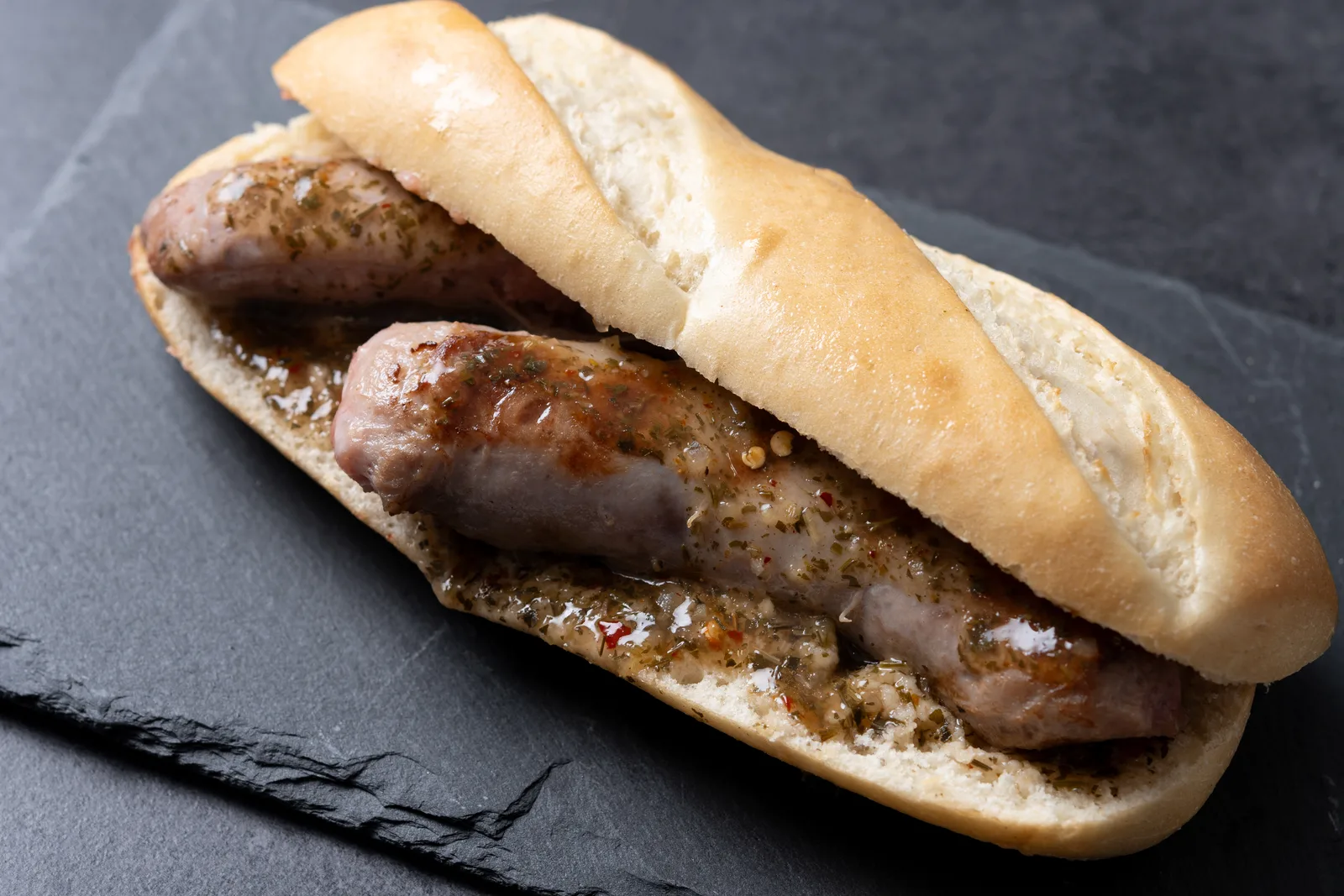

Choripán (choh-ree-PAHN) is what Argentinians eat standing next to the grill while the steaks finish: a fresh chorizo sausage cooked over the coals, split open, and stuffed into a crusty roll with chimichurri. The name is just chori plus pan, bread. It takes 45 minutes and almost no technique. The one thing that trips people up outside Argentina is the sausage itself, because the word “chorizo” on a US or UK label usually means something that won’t work here.
What choripan tastes like, and how long it takes
How do you make choripan? Grill 4 fresh Argentine-style chorizo links whole over medium heat, without pricking them, for 20 to 30 minutes, turning every 5, until they reach 160°F (71°C) inside. Butterfly them, sear the cut side for 2 minutes and serve in toasted French rolls with chimichurri and salsa criolla. 45 minutes for 4 servings, with the sauces made ahead.
Think of a very good grilled sausage sandwich with a crisp roll instead of a soft bun. The sausage is juicy and mildly seasoned with garlic and spices, the cut face is caramelized from the grill, and the chimichurri adds raw garlic, oregano, vinegar and a little chili heat. The salsa criolla, a chopped tomato, onion and pepper relish, cuts through the fat.
Time: 45 minutes once the sauces are made (15 of prep, 30 at the grill), plus however long your charcoal takes to light. Difficulty: easy. The only skill is keeping the fire at medium.
The sausage to buy, and the two “chorizos” to skip
Argentine chorizo, sold as chorizo parrillero or chorizo criollo, is a raw, fresh sausage in a natural casing: pork, or pork and beef, coarsely ground, not cured, not smoked and not hot. Links usually weigh 3½ to 4½ oz (100 to 125 g).
| What the label says | Will it work? | What changes |
|---|---|---|
| Argentine-style chorizo, chorizo parrillero, chorizo criollo (Latin butchers, online meat shops) | Yes | Nothing: this is the real thing |
| Mild fresh Italian sausage, natural casing, light on fennel | Yes, the closest supermarket option | Same juicy, coarse texture; fennel and a different spice profile |
| Coarse fresh pork sausage, unsmoked (in the UK, a Toulouse-style sausage) | Yes | Milder, more of a British banger flavor |
| Colombian fresh chorizo | Yes | Thinner links, so they cook faster |
| Spanish chorizo (dry-cured, the sliceable kind) | No | Already cured: it toughens, leaks orange fat and tastes of smoked paprika |
| Mexican chorizo (raw, loose, red) | No | Usually too soft and heavily spiced; it tends to crumble and can’t be butterflied |
| Pre-cooked or smoked sausages (kielbasa, hot links) | Not really | They only need reheating, so you lose the juicy, just-grilled texture |
Mexican chorizo is the one people try most often, because it’s raw and in the same aisle. It’s made for crumbling into eggs, like Mexican chorizo and eggs, not for grilling whole. If you’re near a Colombian bakery or butcher, Colombian chorizo is a fresh pork link that holds up on the grill.
The bread
A crusty French roll or baguette with a firm crust and a chewy crumb, cut in 7 to 8 in (18 to 20 cm) lengths to match an opened sausage. Mexican bolillos from a Latin bakery are a good US option. Soft hot dog buns and sandwich bread turn to mush under the juices.
The sauces
- Chimichurri. Parsley, garlic, dried oregano, chili flakes, vinegar and oil. This hand-chopped Argentinian chimichurri makes 12 servings, enough for these sandwiches plus the table, and it’s better made the day before.
- Salsa criolla. It’s in the recipe card above. Optional, but it makes the sandwich feel lighter.
Equipment. A charcoal or gas grill, tongs, a sharp knife and an instant-read thermometer. The thermometer is the only way to know a fresh sausage is done without cutting it open too early.
How to grill choripan, step by step
Medium heat, not high
Spread the coals so one side is hotter than the other. Hold your palm at grate level: 5 to 7 seconds is right; if you can only manage 3 or 4, it’s too hot and the casing will char before the center is cooked. Use the cooler side whenever the sausages flare up.
Cook the links whole, and don’t prick them
Pricking lets the juice escape, so the sausage dries out, and the fat that drips onto the coals causes flare-ups that blacken the skin. Lay them on whole and turn them every 5 minutes for 20 to 30 minutes. They’re ready when:
- the casing is evenly browned and tight;
- they feel firm, not squishy, when pressed with tongs;
- an instant-read thermometer pushed in through the end, to the center of the thickest link, reads 160°F (71°C).
That’s the minimum safe temperature for any fresh sausage made from ground pork or beef, because grinding spreads surface bacteria all through the meat. No rest time is needed. Don’t go by color: a sausage can look done inside, with clear juices, before it’s actually reached a safe temperature, which is why the thermometer is the only reliable check.
Butterfly and sear
On a board, slice each sausage lengthwise down the middle, stopping before you cut through so the halves stay joined by the casing. Open it flat and put it back on the grill cut side down for 2 minutes. It browns, sits flat in the roll and doesn’t roll out.
You can also butterfly them raw and grill them flat, 7 to 8 minutes in all, starting casing side down and flipping halfway, with a light weight on top (a small skillet works) so they don’t curl. It’s faster but they lose more juice. Check for 160°F (71°C) either way.
Toast and build
Split each roll lengthwise, leaving a hinge, and toast the cut side on the cooler part of the grill for a minute or two. Add the sausage, a tablespoon of chimichurri and a few spoonfuls of salsa criolla (about 3 tbsp, 45 ml), drained with a slotted spoon so the liquid doesn’t soak the bread. Eat it within a few minutes, before the roll softens.
No grill? Stovetop and oven choripan
Skillet or griddle pan. Brown the whole links in 1 tbsp oil over medium heat for 5 minutes, turning. Pour in ½ cup (125 ml) water, cover and cook 12 minutes. Uncover, let the water cook off and check for 160°F (71°C); if they’re not there yet, cover again for 2 to 3 minutes and check again. Then butterfly and sear the cut side for 2 minutes. Toast the rolls in the same pan.
Oven. Heat to 400°F (200°C), or 350°F (180°C) fan. Set the links on a rack over a sheet pan and roast 20 to 25 minutes, turning halfway, until 160°F (71°C); if they’re short, give them 5 more minutes and check again. Butterfly and finish under the broiler (UK: grill) for 2 to 3 minutes. Warm the rolls on the top rack at the end.
Feeding a crowd
- How many. As the main event, 2 sandwiches per adult. As a starter before steaks, 1 each. For 12 people as a meal: about 24 links (6 lb / 2.7 kg), 24 rolls, one and a half batches of chimichurri and three times the salsa criolla in the recipe card.
- The day before. Make both sauces and refrigerate them. Buy the bread and keep it in a paper bag.
- On the day. Sausages go from the fridge straight to the grill, in batches with space between them. Butterfly them as they come off.
- Holding. Keep cooked sausages above 140°F (60°C) in a pan on the cooler side of the grill. Anything that has sat at room temperature for 2 hours (1 hour above 90°F / 32°C outdoors) gets thrown out or refrigerated.
Keep the chimichurri cold until you serve it, in a bowl with its own spoon: it’s raw garlic in oil, so like everything else on the table it shouldn’t sit out for more than 2 hours (1 hour above 90°F / 32°C). Throw out what’s left after that. If you want something to go with it, Argentinian beef empanadas can be baked before you light the grill and served warm, and alfajores made the day before make an easy dessert.
Mistakes that ruin choripan
- Burst casings. Heat too high. Move the sausages to the cooler side and turn them more often.
- Charred outside, raw inside. Also too much heat. Finish them on the cool side, or cover them with foil for a few minutes, until they hit 160°F (71°C).
- Dry sausage. Pricked, or left on long after reaching temperature. Take them off as soon as they’re there.
- Soggy roll. Wet relish or soft bread. Drain the salsa criolla and use a roll with a real crust.
- Tastes like paprika. A cured or heavily seasoned chorizo was used. Go back to the table above.
Allergens. The bread contains gluten. Check the sausage label too if anyone has allergies or celiac disease, since some brands add binders. Kids usually prefer it without the salsa criolla and with chimichurri made without chili flakes.
Variations
- Morcipán. Morcilla, Argentine blood sausage, in place of the chorizo. It’s softer and splits easily, so cook it gently and turn it with care.
- With cheese. A slice of provolone on the opened sausage for the last 2 minutes, grill lid closed.
- With grilled onions and peppers. Instead of the raw salsa criolla.
- Chicken or plant-based. Fresh chicken sausage must reach 165°F (74°C). Plant-based links just need browning, following the package.
Cost. The sausage is where the money goes: imported or butcher-made Argentine chorizo costs well over supermarket fresh sausage. For a big crowd, a good mild Italian sausage keeps the bill down without hurting the result.
Storing and reheating
- Raw links. 1 to 2 days in the fridge; otherwise freeze them for 1 to 2 months and thaw overnight in the fridge.
- Cooked sausage. Refrigerate within 2 hours in a covered container, 3 to 4 days; frozen, 1 to 2 months. Don’t store the sandwiches assembled.
- Salsa criolla. 3 to 4 days, covered, in the fridge. The onion softens and it gets more watery.
- Reheating. Butterflied, in a covered skillet over medium heat for 4 to 5 minutes, until 165°F (74°C) in the center. The microwave works but softens the casing.
Choripan FAQ
Is choripan the same as a chorizo hot dog? Close, but the bread and the sauce make the difference: a crusty roll that’s toasted on the grill, and chimichurri instead of ketchup and mustard. In Argentina it’s eaten with chimichurri and sometimes salsa criolla, nothing else.
Can I grill the sausages ahead? Yes. Grill them to 160°F (71°C), cool, cover and refrigerate. The next day, butterfly them and sear them on the grill or in a skillet until they reach 165°F (74°C). They’re a little less juicy than fresh off the coals.
Should I boil the sausages first? Not over medium heat. If your fire is very hot or you’re short on time, use the skillet method above: cooked covered in a little water to 160°F (71°C), then browned.
Nutrition per choripan
Per sandwich (one 4 oz / 115 g raw link, 2½ oz / 70 g bread, 1 tbsp chimichurri and a quarter of the salsa criolla), calculated ingredient by ingredient from the recipe card:
- Calories: 701 kcal
- Protein: 24 g
- Carbohydrates: 46 g
- Fat: 47 g, of which 13 g saturated
- Fiber: 4 g
- Sugar: 8 g
- Sodium: 1318 mg
The numbers use raw sausage. Some of the fat drips off on the grill, so what reaches your plate is a bit lower. Roughly half the calories come from the sausage (about 333 kcal), then 190 from the bread and 63 from the chimichurri.
If you can’t find true chorizo parrillero, a thinner fresh chorizo makes a good choripan too: it cooks faster and needs more watching, and the crusty bread and the chimichurri carry the rest. What I’d never skip is the thermometer. And make the salsa criolla the night before, so you’re not chopping onions with the fire already going. Josnaisis.