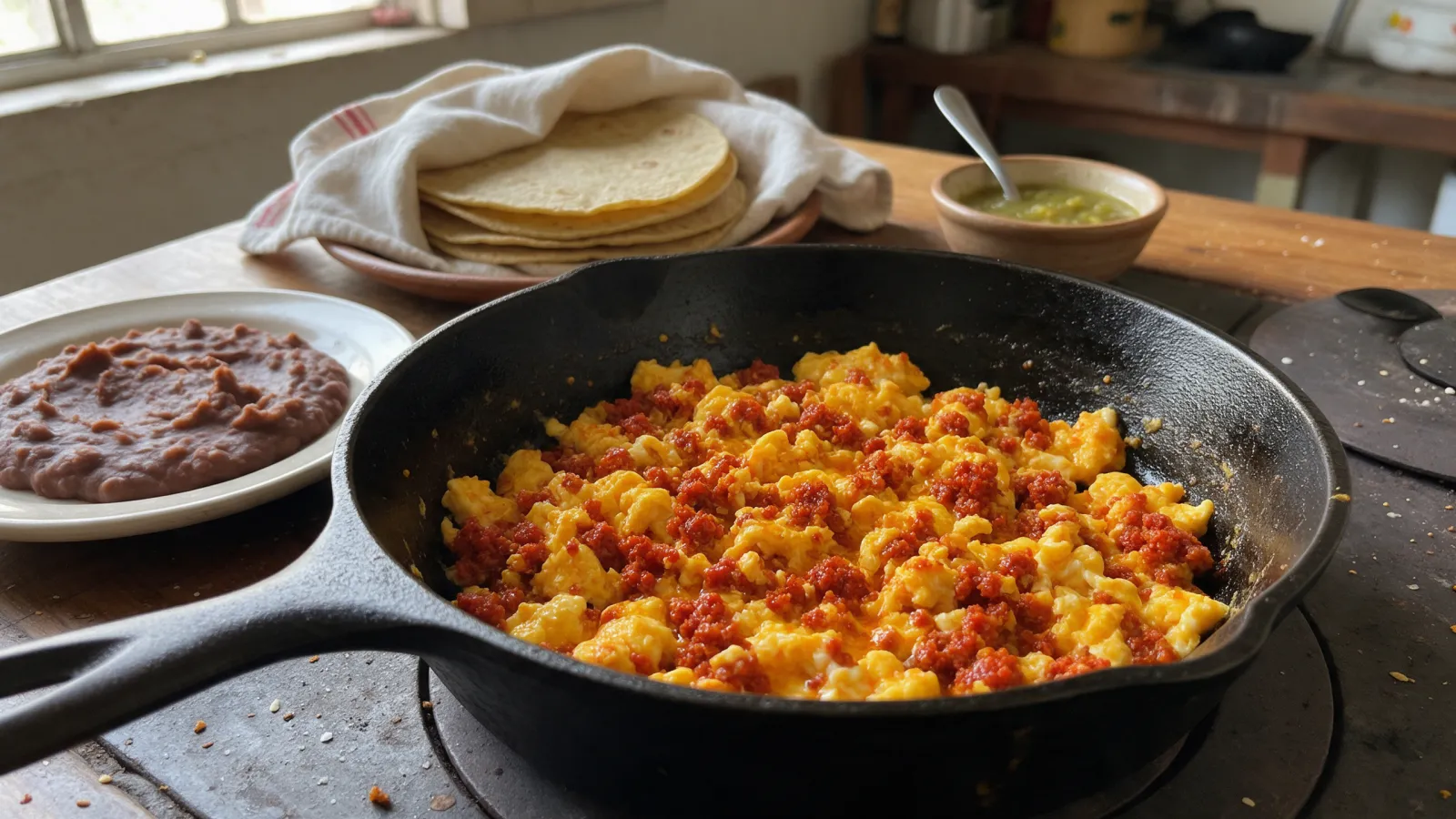

Huevos con chorizo (WAY-vohs kohn choh-REE-soh) is an everyday Mexican breakfast: fresh chorizo fried until it crumbles and crisps, eggs scrambled into the red fat it leaves behind, refried beans on the side and a stack of warm tortillas. It’s fast and it isn’t complicated. The one thing that goes wrong is the grease: a 12 oz (340 g) pack of Mexican chorizo renders several tablespoons of it, and how much you leave in the pan decides whether the eggs come out rich or oily. The other trap, if you’re in the UK, is buying the wrong chorizo altogether.
What is chorizo and eggs, and who is it for?
How do you make chorizo and eggs? Crumble 12 oz (340 g) of raw Mexican chorizo into a cold skillet and cook it over medium heat for 10 minutes, until it darkens and reaches 160°F (71°C). Spoon off the fat, leaving 2 tablespoons, soften some onion for 3 minutes, then scramble in 8 eggs over medium-low heat for 1½ to 2 minutes. Serve with beans and tortillas. Ready in 20 minutes for 4 servings.
It’s a breakfast plate, a taco filling and a sandwich filling, all from one skillet. On a plate it comes with beans and tortillas so everyone can build their own tacos; wrapped in a flour tortilla it’s a classic Texas breakfast taco filling.
Make it if you want a filling breakfast on the table in 20 minutes, or you’re feeding a crowd and want something you can half-make the night before.
Skip it if you’re after something light. A full plate with beans and tortillas is about 590 calories, and the chorizo is the fattiest part. If you don’t eat pork, use beef or soy chorizo (more on those below).
Time and effort. 20 minutes, about 10 of them hands-on, because the chorizo cooks by itself while you chop and warm the beans. Easy, with two things to watch: knowing when red meat is cooked, and not overdoing the eggs.
Mexican chorizo is not Spanish chorizo
This is the decision that matters most, and the labels don’t always help.
Mexican chorizo is sold raw. It’s ground pork seasoned with chile, spices and vinegar, in a plastic or natural casing or loose in a tray, and it has to be cooked like any ground meat. In the pan it crumbles and releases red fat. Raw, it has about 25 g of fat per 100 g (3½ oz). In the US it’s in the meat case of most supermarkets. Heat varies a lot by brand, from barely warm to properly spicy.
Spanish chorizo is usually cured: firm, sliceable, ready to eat, flavored with smoked paprika. It won’t crumble and doesn’t release fat the same way. Spain also makes a fresh, raw cooking chorizo, and that’s the one to look for in the UK, where Mexican chorizo is a specialist buy. Squeeze it out of its casing, cook it exactly like Mexican chorizo, and stir in 1 tablespoon of cider vinegar at the end to bring back the tang.
Only cured chorizo? Dice 150 g (5 oz) into 5 mm (¼ in) cubes, fry them over medium-low heat for 3 or 4 minutes until the fat runs red, and scramble the eggs straight in without draining. It’s a good breakfast, smokier and chunkier, but it’s a different dish.
Soy chorizo is sold raw too, usually near the tofu. The labels I’ve checked come to about 14 g of fat per 100 g, a little over half of pork chorizo, and it renders almost nothing, so start it in 1 tablespoon of oil and don’t drain. It cooks into softer crumbs and tends to be salty. Beef chorizo cooks just like pork, to the same 160°F (71°C); how much fat it gives off depends on the brand.
Ingredients and equipment
Everything for 4 plates, each with 2 eggs, about 3 oz (85 g) of chorizo, beans and 2 tortillas:
| Ingredient | Metric | US | Notes and UK swaps |
|---|---|---|---|
| Raw Mexican chorizo | 340 g | 12 oz | UK: raw Spanish cooking chorizo + 1 tbsp cider vinegar |
| Large eggs | 8 | 8 | UK large and US large are close enough |
| White onion, chopped | 60 g | ⅓ cup | Any mild onion |
| Serrano chile | 6 g | 1 | Optional; a small green chile or ½ jalapeño |
| Fine salt | 1.5 g | ¼ tsp | Taste the chorizo first |
| Refried beans | 360 g | 1½ cups | Canned is fine; UK: canned pinto beans mashed with a little of their liquid |
| Corn tortillas, 15 cm (6 in) | 200 g | 8 | Or flour tortillas for breakfast tacos |
Homemade refried beans are worth it if you have time. For tortillas, homemade corn tortillas are the everyday choice in central Mexico; for Texas-style breakfast tacos, use flour tortillas.
Equipment. A 26 to 28 cm (10 to 11 in) nonstick skillet with sides, a wooden spoon to break up the chorizo, a flexible spatula for the eggs, a small pan for the beans and a griddle or second skillet for tortillas. An instant-read thermometer is the easiest way to know the chorizo is done.
How much grease to pour off
Leave about 2 tablespoons in the pan for 8 eggs and spoon off the rest. That’s my rule, and here’s why it works. Two tablespoons is enough to keep the eggs from sticking and to stain them orange with the chorizo’s chile. Anything beyond that just sits on the eggs and makes them oily.
The easy way: tilt the skillet, push the chorizo up the high side with your spoon, and spoon the pooled fat into a heatproof cup. Let it set before you throw it out, never down the sink. Rendered pork fat is about 115 calories a tablespoon, so every spoonful you take out is roughly 29 calories off each of the four plates.
If your chorizo releases almost no fat (some leaner brands, and soy chorizo), don’t remove anything, and add a little oil if the pan looks dry.
Soft or firm eggs, and is raw chorizo safe?
Cook the chorizo to 160°F (71°C), the safe temperature for ground pork and beef. Because Mexican chorizo is red from the start, color tells you nothing. Look for meat that has darkened from bright red to brick, no raw-looking bits and edges starting to crisp, about 10 minutes over medium heat. Raw chorizo keeps only 1 to 2 days in the fridge, so buy it close to when you’ll cook it or freeze it.
The eggs. For soft, glossy curds, 1½ to 2 minutes of slow stirring over medium-low heat. For firm eggs with nothing liquid left, 3 minutes; firm eggs hold up better in a taco you’re packing to go. Take the pan off the heat a few seconds early, either way.
Runny eggs and who should avoid them. For babies, young children, older adults, pregnant women and anyone with a weakened immune system, the safe choice is eggs cooked until no liquid remains, or pasteurized eggs. Keep raw eggs in the fridge at 40°F (4°C) or below and use them within 3 weeks.
Breakfast tacos for 12 or 20
For tacos, count 3 tortillas per person; I get about 12 tacos from 8 eggs. The chorizo can be cooked an hour ahead or the night before, and the eggs always go in last, in batches.
| People | Chorizo | Eggs | Onion | Serranos | Refried beans | Tortillas (plates / tacos) |
|---|---|---|---|---|---|---|
| 2 | 170 g (6 oz) | 4 | 30 g (3 tbsp) | ½ | 180 g (¾ cup) | 4 / 6 |
| 4 | 340 g (12 oz) | 8 | 60 g (⅓ cup) | 1 | 360 g (1½ cups) | 8 / 12 |
| 12 | 1 kg (2¼ lb) | 24 | 180 g (1 cup) | 3 | 1.1 kg (4½ cups) | 24 / 36 |
| 20 | 1.7 kg (3¾ lb) | 40 | 300 g (1¾ cups) | 5 | 1.8 kg (7½ cups) | 40 / 60 |
Running it for a crowd.
- Chorizo in two skillets or in 500 g (1 lb) batches, so it fries instead of stewing. Drain it, then keep it covered over the lowest heat or in a 200°F (95°C) oven, above 140°F (60°C).
- Eggs in batches of 12 in a 30 cm (12 in) skillet, each with its share of chorizo, about 3 minutes a batch. Forty eggs at once overcook on the bottom and stay raw on top.
- Tortillas wrapped in a towel inside a basket or an empty cooler, which holds the heat. One person warms tortillas while the other scrambles.
- On a buffet, put out small batches and refill every 15 to 20 minutes. Cooked food shouldn’t sit out more than 2 hours, or 1 hour above 90°F (32°C).
Mistakes that ruin chorizo and eggs
- Oily eggs → all the fat stayed in. Pour off down to 2 tablespoons.
- Gray, boiled chorizo → too much in too small a pan. Keep it to a single layer about ¾ in (2 cm) deep, or cook in batches.
- Raw in the middle → heat too high, so the outside scorched first. Medium heat, 10 minutes.
- Dry, rubbery eggs → they stayed on the heat too long. Pull them early.
- Watery eggs → salted long before cooking, or reheated. Salt as you beat them and cook them to order.
- Too salty → the chorizo is already salty. Taste a crumb before salting the eggs; with some brands you won’t need any.
- Casing in your mouth → plastic casing isn’t edible. Peel it off before cooking.
Spice level. Depends on the chorizo: with a mild one, 1 out of 5, 2 with the serrano. Real heat comes from the salsa on the table.
Kids and allergens. Kids usually love it in a taco; leave out the serrano, buy a mild chorizo and cook their eggs firm. The main allergen is egg. Some commercial chorizos contain soy or wheat, and soy chorizo is soy, so read the label. Canned refried beans may contain lard.
Which version should you make?
- Short on time → cook the chorizo the night before. In the morning, about 8 minutes.
- With potatoes → 300 g (10½ oz) potatoes in 1 cm (½ in) dice, boiled 5 minutes in salted water, drained, then browned in the chorizo fat for 8 to 10 minutes before the eggs. It feeds one or two more people for very little money.
- Breakfast burritos → roll the eggs with beans and cheese in large flour tortillas, the way you’d fold homemade burritos.
- Lighter → half the chorizo, 170 g (6 oz). Counting all its fat, a full plate drops to about 465 calories, and lower if you drain it.
- Vegetarian → soy chorizo with 1 tablespoon of oil.
- Without meat at all → huevos a la mexicana, eggs scrambled with tomato, onion and chile.
- Fried eggs instead → push the chorizo to the side and fry the eggs in its fat, or put them on fried tortillas with salsa as huevos rancheros.
If you have leftover raw chorizo, potato and chorizo pambazos are a good way to use it.
What it costs
At US prices this costs about $1.54 a plate, or $6.16 for the batch, before tortillas and the serrano. The chorizo is nearly two-thirds of that.
| Ingredient | Amount | Price used | Cost |
|---|---|---|---|
| Mexican chorizo | 340 g (0.75 lb) | $5.37/lb, average sale price, Oct 9, 2026 | $4.03 |
| Large eggs | 8 | $2.272/dozen, September 2026 average | $1.51 |
| Dried beans for 1½ cups refried | 125 g (0.27 lb) | $1.669/lb, September 2026 average | $0.46 |
| White onion | 60 g (0.13 lb) | $1.22/lb, sale price, Oct 9, 2026 | $0.16 |
| Total | $6.16, $1.54 a plate |
The beans are counted dry: 1 cup of refried beans comes from about 83 g (3 oz) of dried beans. Adding 300 g (10½ oz) of potatoes costs about $0.65 at September’s average of $0.989 a pound. In the UK, Mexican chorizo is a specialty item with prices all over the place, so there’s no pound total here.
Make ahead, storing and reheating
- Raw chorizo → 1 to 2 days in the fridge, 1 to 2 months in the freezer for best quality, flattened in freezer bags so it thaws fast.
- Cooked, drained chorizo → 3 to 4 days in the fridge, in the fridge within 2 hours of cooking. It freezes for 1 to 2 months in 3 oz (85 g) portions, one per person.
- Scrambled eggs with chorizo → 3 to 4 days in the fridge, though the texture suffers. I don’t freeze scrambled eggs: they weep water when they thaw.
- Reheating → chorizo in a skillet over medium heat until it sizzles, about 3 minutes. Leftovers with egg in a skillet over low heat, or in the microwave in 30-second bursts, to 165°F (74°C). Better still: keep the chorizo and scramble fresh eggs.
Serve with a café de olla, Mexican coffee simmered with cinnamon, or plain coffee with milk.
Frequently asked questions
Do you drain the grease from chorizo? Partly. Spoon off most of it, keeping about 2 tablespoons in the pan when you’re cooking 8 eggs. If the chorizo renders very little, leave it all.
Do you need oil to cook Mexican chorizo? Not for pork chorizo. Start it in a cold, dry pan and it renders its own fat within a few minutes. Soy chorizo needs about 1 tablespoon of oil.
How do you know when chorizo is cooked? It darkens from bright red to brick, nothing looks raw and the edges crisp, after about 10 minutes over medium heat. With a thermometer, 160°F (71°C).
Can I use Spanish chorizo for chorizo and eggs? Raw Spanish cooking chorizo, out of its casing, with 1 tablespoon of cider vinegar, is the closest match. Cured chorizo works diced small, 5 oz (150 g) for 8 eggs, but it makes a smokier, chunkier dish.
Is chorizo and eggs healthy? It’s a high-protein breakfast at about 32 g a plate, and also a fatty and salty one, at about 34 g fat and 1,310 mg sodium with beans and tortillas. Draining the fat and using half the chorizo brings it down a lot.
How many calories are in chorizo and eggs? About 590 per plate with 2 eggs, 3 oz (85 g) of chorizo, beans and 2 corn tortillas. The chorizo and eggs alone are about 400.
What do you serve with chorizo and eggs? Refried beans, warm corn or flour tortillas and a salsa. Avocado and a little crumbled queso fresco are common additions.
Can I make chorizo and eggs ahead of time? Cook and drain the chorizo up to 3 days ahead. Scramble the eggs to order; reheated, they turn rubbery.
Nutrition
Per plate (2 eggs, 85 g / 3 oz raw chorizo, 15 g onion, 90 g / ⅓ cup canned refried beans and 2 corn tortillas), worked out ingredient by ingredient with this recipe’s quantities and counting all the chorizo fat, undrained:
- Calories: 590
- Protein: 32 g
- Carbohydrates: 40 g
- Fat: 34 g (11 g saturated)
- Fiber: 7 g
- Sugars: 2 g
- Sodium: 1,310 mg
About 670 mg of the sodium comes from the chorizo and 330 mg from canned beans; leaving the salt out of the eggs saves about 145 mg.
Where I grew up in Venezuela, chorizo came in links that you sliced into coins, and breakfast eggs were perico, scrambled with tomato and onion. So the first time I cooked Mexican chorizo I sliced it into hot oil, and it fell apart into a red puddle. It took me a while to trust a cold pan, no oil and a spoon to take most of the fat back out. Two tablespoons left behind is all the eggs need. Josnaisis.