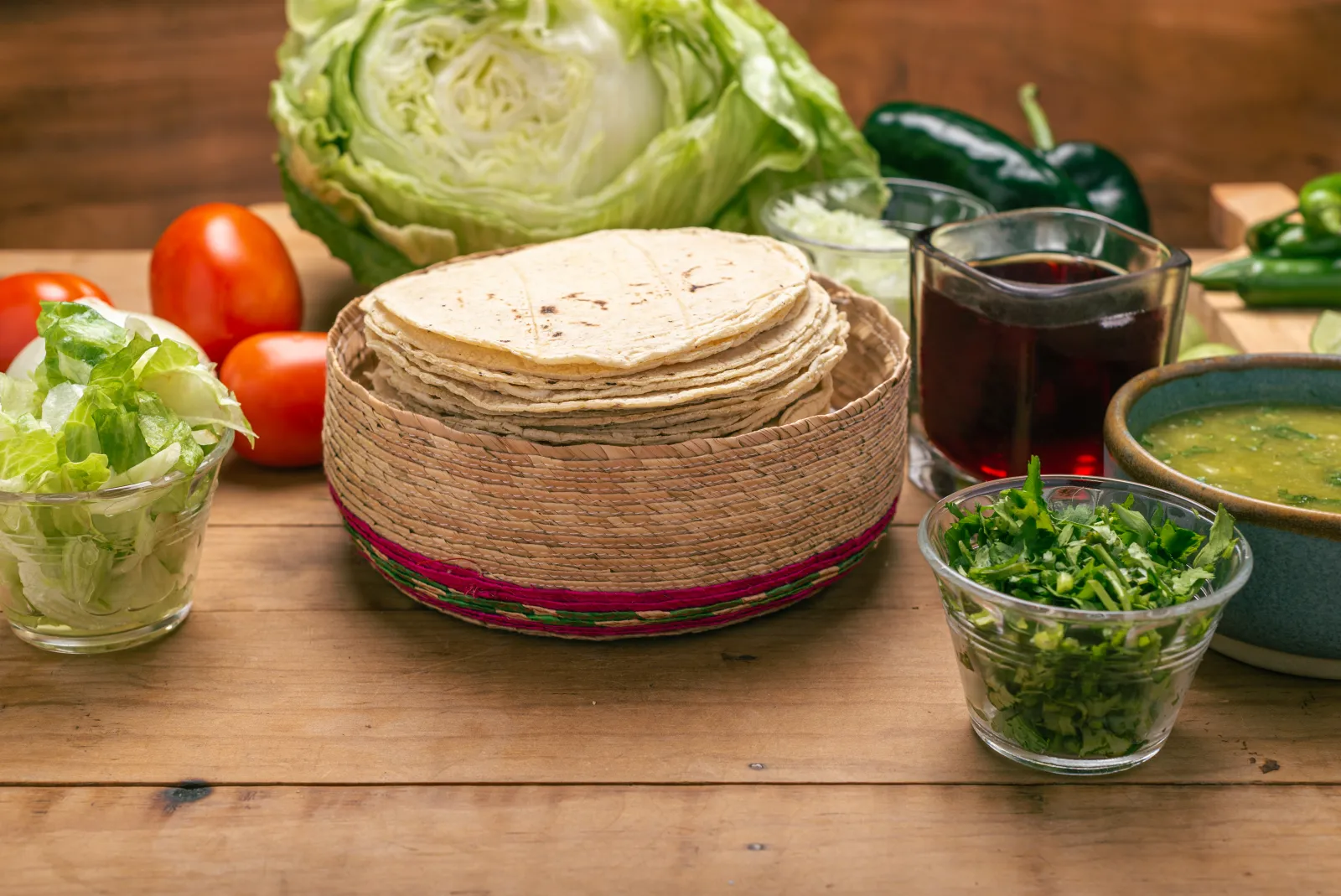

Corn tortillas are the round, thin flatbreads of Mexico made from nothing but nixtamalized corn and water, pressed flat and cooked on a dry griddle for about a minute and a half. Homemade ones are softer and thicker than the supermarket pack and taste clearly of toasted corn. The catch for most first-timers is the shopping, not the cooking: the bag has to say masa harina, and cornmeal, polenta and arepa flour will not work however much you knead them. Get the flour right and the rest comes down to how wet the dough is and how long the first side stays on the pan.
What corn tortillas are, and who should make them at home
How do you make corn tortillas from scratch? Mix 300 g (about 2½ cups) of masa harina with 400 ml (1⅔ cups) of hot water until a flattened ball no longer cracks at the edge, rest it 15 minutes and roll 24 balls of 1 oz (29 g). Press each to 5 inches (13 cm) between two sheets of plastic and cook on a hot skillet with three flips, about 90 seconds, until it puffs. 60 minutes for 24 servings.
They are worth making if you cook tacos, enchiladas or quesadillas more than once a month, or if the only corn tortillas near you come in a dry, crumbly pack. Fresh off the pan they bend around a filling without splitting.
Make them if you want a taco night where the tortilla tastes of something, or you need tortillas that hold up in sauce. Skip them if you can buy fresh ones from a local tortilleria; a good one is hard to beat.
Time and effort. 60 minutes, about 45 of them hands-on, most of it at the stove pressing one tortilla while the last one cooks. Difficulty is easy: the dough is three ingredients and forgiving, and the puff comes after the first four or five.
Nixtamal is dried corn cooked with lime, the mineral calcium hydroxide, then left overnight and ground. That step is what lets the dough hold together. Masa harina is that same corn, already nixtamalized, ground and dried, which is why you only add water.
Masa harina, not cornmeal, the flour that makes or breaks them
Use masa harina, sold in the US as instant corn masa flour. Maseca is the most common brand, in 4 lb (1.81 kg) bags in the Hispanic or baking aisle; Bob’s Red Mill sells one in 22 oz (624 g) bags. Check that the bag says masa, not tamal, which is a coarser grind for tamales.
- Cornmeal and polenta are raw, coarsely ground corn. They won’t form a dough at all.
- Masarepa (P.A.N., Goya masarepa) is precooked corn flour for arepas, made without lime. It feels similar in the bag and cracks the moment you press it. I keep both bags in my kitchen, and they are not interchangeable, either way round.
- Cornflour in the UK is what Americans call cornstarch. It is no use here.
In the UK, masa harina is sold mostly online and in Latin American shops; Sous Chef lists 1 kg bags. Fresh masa from a tortilleria is even better: 700 g (1½ lb) replaces the masa harina and its water, and it tastes more of corn. Ask for masa for tortillas, not masa preparada, which is mixed with lard for tamales. Use it the same day, because it starts to sour within a few hours.
The dough, ratio in grams and cups and the crack test
By weight, the water is a third more than the flour: 400 ml for 300 g, or 133 ml per 100 g of masa harina. In cups, that is about 1⅔ cups of hot water to 2½ cups of masa harina. Package directions and the usual recipes sit between 125 and 140 ml per 100 g.
Cups are where this goes wrong. A cup of masa harina weighs anywhere from about 114 g to 131 g depending on how you fill it, and that spread is enough to turn a soft dough into a crumbly one. Weigh it if you can. Either way, the hand test decides:
- Right → smooth like modeling clay, not sticky, and a ball flattened between your palms keeps a smooth edge.
- Too dry → the edge cracks. Knead in 1 tablespoon (15 ml) of water and test again. This is the usual problem.
- Too wet → it sticks to your hands and to the plastic. Knead in 1 tablespoon of masa harina.
Use hot tap water, 115-120°F (46-49°C). It hydrates the flour faster than cold. Rest the dough 15 minutes, covered, so the flour finishes absorbing it. Salt is optional; the package directions skip it, and ½ teaspoon (3 g) just rounds out the flavor.
Pressing them, with or without a tortilla press
A cast-iron tortilla press is cheap and makes even ⅛-inch (3 mm) rounds in seconds, but you can do without one. What you cannot skip is the plastic: a zip-top or produce bag cut into two squares, one under and one over the ball, or the dough sticks and tears.
Press with medium pressure into a 5-5½ inch (13-14 cm) round. Then peel the top sheet off, turn the tortilla onto your open palm and peel the bottom sheet away from it, rather than trying to lift the tortilla off the plastic. A tortilla that comes out of the press with a ragged, cracked edge is telling you the dough needs water; fix the dough before you cook it.
Cooking, the three flips that make them puff
Heat a cast-iron skillet, griddle or comal at least 10 inches (25 cm) across over medium heat for 8-10 minutes, until very hot. A thin pan loses heat with every tortilla.
- First side, 20-30 seconds. Only until the edges look dry and it lets go of the pan. If it stays longer, the top dries and cracks like mud and that tortilla won’t puff.
- Second side, 40-50 seconds. Until the underside has golden-brown freckles. This side builds the skin that will trap steam.
- Back to the first side, 15-20 seconds. The water in the dough turns to steam and pushes the layers apart. If it doesn’t balloon on its own, press the center gently with your fingertips or a spatula.
No puffing at all means the pan is too cool, so turn it up to medium-high. Black spots in the first 30 seconds mean it is too hot. On a long griddle over two burners, cook the first side over the cooler end and the rest over the hotter one.
Straight off the pan, each tortilla goes into a tortilla warmer or a folded towel, covered, with the next one stacked on top. The trapped steam is what makes them soft, so the ones at the bottom of the stack end up the most tender. Give the last one at least 1 minute under cover before serving.
Make-ahead plan and cooking for a crowd
Dough the night before. I wrap it tightly and leave it in the fridge overnight, then take it out 30 minutes before pressing; it usually wants a tablespoon or two of water when you knead it again. Cooked tortillas keep 3-4 days in the fridge, so you can make them a day or two ahead and reheat them.
For a crowd, count 4 tortillas per person for tacos, a little less if there are other dishes.
For 12 people, double everything: 600 g (about 5 cups) of masa harina and 800 ml (3⅓ cups) of water. For 20, use 1 kg (2.2 lb) and 1.33 liters (5⅔ cups), mixed in two batches so you can knead it, and start cooking an hour before you eat. Two pans and two people, one pressing and one flipping, is how it gets done. To hold them, wrap stacks of 10-12 in foil and keep them in a 275°F (135°C) oven, about 15 minutes, until serving.
Why corn tortillas crack, fall apart or turn stiff
- Dry dough → the number one cause. If the edge cracks in the press, it will crack in the taco. Add water a tablespoon at a time.
- The wrong flour → masarepa or cornmeal. No amount of water saves it.
- Pressed too thin → they tear coming off the plastic. Ease off the press; ⅛ inch (3 mm) is the usual thickness.
- First side overcooked → the cracked-mud surface that won’t puff. Flip at 20-30 seconds.
- Lukewarm pan → the tortilla dries out slowly instead of cooking fast. Very hot pan, about 90 seconds total.
- Left uncovered → they dry and stiffen within minutes. Into the warmer from the first one.
- Served cold → corn tortillas firm up as they cool, because the starch sets again. That isn’t a flaw; reheating brings them back.
Variations
- Blue corn → blue corn masa harina, with about the same water; its package asks for roughly 130 ml per 100 g. They come out a bluish gray.
- Fresh masa → 700 g (1½ lb), no water and no rest.
- Street-taco size → balls of half the weight, pressed to about 4 inches (10 cm).
- Short on time → a 10-minute rest and two pans going, about 40 minutes in all.
- Leftovers → cut day-old tortillas into wedges and fry them for the chips in chilaquiles verdes, where slightly dry tortillas work better than fresh ones.
If you want the other Mexican tortilla, the soft wheat one from the north for burritos, see homemade flour tortillas. Corn has about 45 kcal a tortilla here; an 8-inch flour one has about 170.
What it costs in the US and UK
In the US, a 4 lb (1.81 kg) bag of Maseca was $3.98 at Walmart and H-E-B in mid-October 2026. The 300 g in this recipe costs $0.66, under 3 cents a tortilla, and the salt is less than a cent. A double batch for 12 is $1.32; 1 kg for 20 people, about $2.19.
In the UK, a 1 kg bag of white masa harina was £4.70 at Sous Chef in October 2026, which puts a batch at £1.41, about 6p a tortilla.
Yield. 24 tortillas from about 700 g of dough. A kilo of masa harina makes about 80; a kilo of fresh masa, about 34.
Allergens, kids and spice level, 0 of 5
Corn tortillas contain none of the major allergens: no gluten, dairy, egg or nuts. Corn is naturally gluten-free, but for someone with celiac disease, buy a masa harina labeled gluten-free to rule out cross-contact at the mill. They aren’t spicy, and kids like them plain, salted or with melted cheese; they are also good at pressing the balls.
Serving and storing
Serve them warm from the tortilla warmer and let everyone build their own: carnitas tacos, green chicken enchiladas, quesadillas cooked on the comal, or rolled and fried as crispy tacos dorados. The same dough, pressed thicker, makes sopes. For a fast seafood taco, fill them with Mexican garlic shrimp and a spoonful of the toasted garlic from the pan.
Store cooled tortillas in a zip-top bag or wrapped in a towel inside a container. Fridge, 3-4 days; after that they turn hard. At room temperature, same day only.
Freeze for up to 3 months, with a square of parchment between each so you can pull out one at a time. I put them on the hot pan straight from the freezer, with a few seconds more per side.
Reheat
- Skillet or comal, the best way: 30 seconds a side on a hot pan. If they are very dry, wet your hand and pat them first.
- Microwave, in stacks of 5-6 wrapped in a damp towel or paper towel, 20-30 seconds. Any longer and they dry out.
- Oven, for a lot at once: wrapped in foil at 275°F (135°C) for 10-15 minutes.
FAQ
Can I use cornmeal instead of masa harina? No. Cornmeal is raw corn that hasn’t been treated with lime, and it won’t form a dough. Polenta and UK cornflour won’t either.
Can I use masarepa or P.A.N. for corn tortillas? No. It is precooked corn flour for arepas, made without lime, and it cracks when pressed. Use masa harina.
What is the water to masa harina ratio? About 133 ml of water per 100 g of masa harina: 400 ml (1⅔ cups) for 300 g (about 2½ cups). Adjust a tablespoon at a time until a flattened ball doesn’t crack.
Why are my corn tortillas cracking or falling apart? Almost always because the dough is too dry. Other causes are the wrong flour, pressing too thin, or serving them cold without reheating.
Why won’t my corn tortillas puff? The pan isn’t hot enough, the first side cooked too long, or the tortilla is thick. Turn up the heat, flip sooner on the first side and press the center after the last flip.
How do I make corn tortillas without a press? Flatten the ball between two pieces of plastic bag with the base of a heavy skillet or a glass baking dish, using even pressure. A rolling pin works too, with less even edges.
Do I need to rest the dough? Yes, 15 minutes covered. The masa harina finishes absorbing the water, and the tortillas crack less.
How do I keep corn tortillas warm for a party? In a tortilla warmer or a towel in a lidded basket at the table, and for a big group, in foil packets in a 275°F (135°C) oven.
Can you freeze homemade corn tortillas? Yes, for up to 3 months, with parchment between them. Reheat straight from frozen on a hot pan.
Are homemade corn tortillas gluten-free? Yes. Corn has no gluten; for celiac disease, choose a masa harina labeled gluten-free.
Nutrition per tortilla
Per tortilla, 5-5½ inches (13-14 cm), 1/24 of the recipe with salt, calculated from the weights above:
- Calories: 45 kcal
- Protein: 1 g
- Carbohydrates: 10 g
- Sugars: 0 g
- Fat: 0 g (under half a gram)
- Fiber: 1 g
- Sodium: 49 mg
Without salt, sodium drops to under 1 mg. Each tortilla holds 12.5 g of masa harina, which is why it lands at 45 kcal, a little under a 24 g packaged corn tortilla at around 52.
I grew up in Venezuela with a bag of arepa flour always open on the counter, so my first corn tortillas were made with the wrong one, and every edge split in the press. What fixed it was learning to look at that edge before worrying about the pan. These days Dylan works the press and I do the flipping, and we’re through 24 before the beans are hot. Josnaisis.