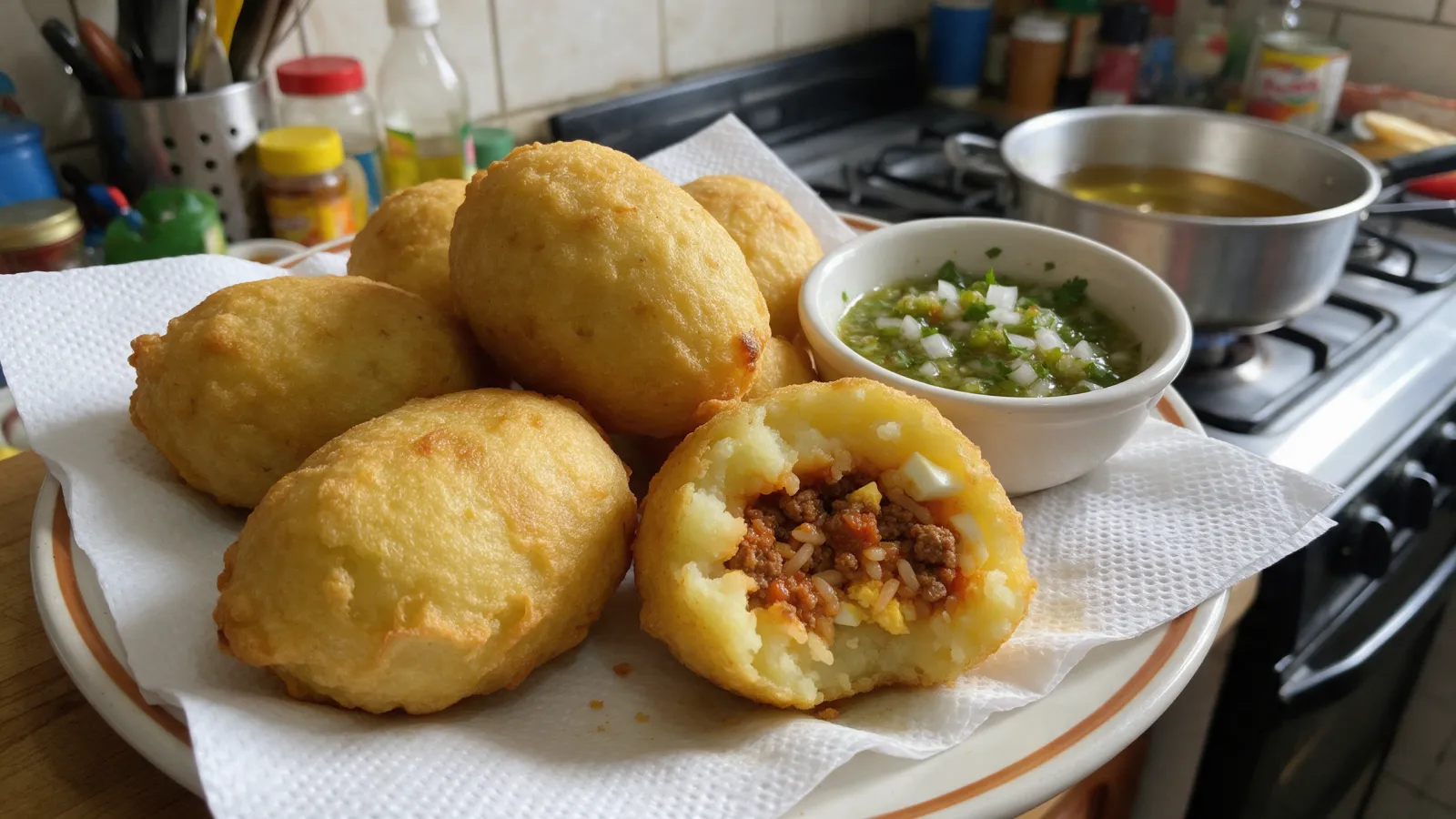

A Colombian papa rellena is a ball of mashed potato about 2½ inches (6 cm) across, wrapped around a seasoned beef filling, dipped in a thin batter and deep-fried. The Colombian version I make puts rice and chopped hard-boiled egg in the filling and uses a liquid batter of egg, flour and milk rather than breadcrumbs. The part most cooks rush is the one that matters, and it’s temperature, not technique.
Why papas rellenas fall apart in the oil
How do you make Colombian papas rellenas? Boil floury potatoes whole, mash them dry and let the mash cool next to a filling of ground beef cooked in tomato and scallion sofrito with rice and hard-boiled egg. Wrap 3 oz (85 g) of mash around 1¼ oz (35 g) of filling, dip in an egg, flour and milk batter and fry at 350°F (175°C) for about 5 minutes. 120 minutes for 6 servings.
It comes down to steam. Warm mash and a just-cooked filling sealed inside a ball hold hot moisture, and once that ball hits 350°F (175°C) oil the moisture pushes out through the weakest point, which is the seam. Every fix follows from that:
- A floury potato, dried. Russets boiled in their skins and steamed dry in the pot give a mash you can mold. A waxy potato absorbs water and the dough slumps.
- Everything cold before shaping. 30 minutes on a tray, mash and filling separate. This is the step people skip.
- A ⅜-inch (1 cm) wall. 85 g of mash per 35 g of filling, about 2½ to 1. More filling thins the wall.
- Oil in range. Above 375°F (190°C) the batter browns in 2 minutes while the center is still cool, and the shell cracks. Below 320°F (160°C) the batter slides off and the ball soaks up oil.
When a batch splits, the culprit is almost always a shell that’s too thin or oil that’s too hot. And if the shaped balls won’t hold together, chill them for a couple of hours before battering.
What Colombian papas rellenas are, and how they differ from Peruvian and Cuban ones
Papas rellenas are made across Latin America, in Colombia as well as Peru, Bolivia, Ecuador, Chile, Mexico and the Caribbean. The versions differ more than the shared name suggests:
- Colombian. Round, about 4 oz (120 g) before battering, with a ground beef filling cooked in a tomato and scallion base called hogao, often with rice and hard-boiled egg, and a liquid egg-flour-milk batter. Some Colombian cooks use shredded beef with peas instead.
- Peruvian. Usually oval, with olives, hard-boiled egg and sometimes raisins in the filling, seasoned with ají panca.
- Cuban. In Miami and Tampa, round balls stuffed with picadillo. Puerto Rico’s relleno de papa is rolled in cornmeal or breadcrumbs.
In Colombia they’re breakfast, mid-afternoon snack or party food, eaten hot or at room temperature, usually with ají on the side. If you like fried dough wrapped around a filling, Colombian carimañolas do the same thing with cassava.
Shopping list and substitutions for a US or UK kitchen
The full quantities are in the recipe card. Here’s what to buy and what changes if you swap.
Potatoes. You need a high-starch, floury potato. In Colombia that’s papa pastusa or sabanera; in the US, plain russets; in the UK, Maris Piper or King Edward. You’ll see red potatoes suggested now and then, but in my kitchen waxy potatoes make a sticky mash that’s hard to seal, so I don’t use them. Yukon Golds work if you dry the mash an extra minute.
Scallions. Colombian cebolla larga is a thick green onion. US scallions or UK spring onions are the closest match; use the white and light green parts.
Achiote (annatto). Ground achiote adds color more than flavor. Look for it in Latin aisles, or use Goya Sazón with achiote. Without it, ¼ tsp turmeric or sweet paprika gives color with a slightly different taste.
Ground beef. 85% lean is what I used for the nutrition numbers. Leaner beef works; fattier beef leaves juice in the pan, which you need to cook off.
Rice. Leftover rice is ideal. From scratch, 1 oz (30 g) raw long-grain rice gives the ½ cup you need; the method is the same as for Colombian white rice.
Equipment. A deep 7-inch (18 cm) pot, a slotted spoon, a potato masher and an instant-read or deep-fry thermometer. Don’t use a blender or food processor for the mash: it overworks the starch and turns it gluey.
Timeline, step by step
120 minutes start to finish, about 80 hands-on. The filling cooks while the potatoes boil, and the 30-minute cooling stage is the only real wait.
Cooking the filling
Cook the scallions and garlic in oil for 4 minutes, add the tomato, cumin and achiote, and give it 6 minutes until the tomato breaks down into a sauce. That’s the hogao. Add the beef and cook 10 minutes until no pink is left and the pan is nearly dry. Ground beef needs to reach 160°F (71°C), and since the oil later only heats the center, this is where the beef gets cooked. If liquid remains, keep going 2 more minutes: that juice is what soaks the dough from inside. Stir in the cold rice and chopped egg off the heat.
Making a dough that holds
Peel the potatoes while hot, mash without any liquid, salt the mash, and stir it in the pot over low heat 1 to 2 minutes. When you squeeze a bit in your palm it should hold its shape without sticking. If it sticks, give it another minute, or work in 1 tbsp flour.
Shaping and frying
Flatten 3 oz (85 g) of mash into a ⅜-inch (1 cm) disc, add 1¼ oz (35 g) of filling, close and roll smooth. Batter should coat the back of a spoon; let each ball drip 2 to 3 seconds before it goes in. Four at a time in a 7-inch (18 cm) pot, about 5 minutes, turning once. More than four drops the oil temperature. To patch bare spots, spoon a little batter on top and baste it with hot oil.
Who this recipe is for
- First time frying at home → use a thermometer and do a test ball first.
- Cooking for kids → make them smaller, 2 oz (60 g) mash and 1 oz (25 g) filling, and fry 4 minutes.
- Hosting → shape everything the day before, fry while people arrive.
- No fryer, no deep pot → see the air fryer method below.
Make-ahead and freezer plan
This is where papas rellenas earn their keep. Nothing about them needs to happen on the day except the frying.
- The day before. Cook the filling, rice and egg included, and refrigerate it covered. Or shape all 12 balls without batter, cover, and refrigerate up to 24 hours. Cold balls are easier to batter.
- Freezing raw. Freeze shaped, unbattered balls on a tray for 2 hours, then bag them. They keep best quality 2 to 3 months. Don’t freeze them battered: a liquid batter doesn’t survive the freezer.
- Frying from frozen. Move them to the fridge for 1 hour, batter, and fry at a slightly lower 340°F (170°C) for about 7 minutes, until the center reads 165°F (74°C).
- Leftovers. Refrigerate fried papas rellenas within 2 hours and eat within 3 to 4 days, as with any cooked leftovers. Reheat in the oven or air fryer at 400°F (200°C) for 8 to 10 minutes, to 165°F (74°C) in the center. The microwave heats them but turns the shell soft.
Quantities for a crowd
Two per person makes breakfast or a light meal; one each is enough as a party snack.
| Serves | Balls | Potatoes | Ground beef | Cooked rice | Eggs (boiled + batter) | Flour and milk |
|---|---|---|---|---|---|---|
| 4 | 8 | 800 g (1¾ lb) | 170 g (6 oz) | ⅓ cup (55 g) | 1 + 2 | ⅓ cup each |
| 6 | 12 | 1.2 kg (2⅔ lb) | 250 g (9 oz) | ½ cup (80 g) | 1 + 2 | ½ cup each |
| 12 | 24 | 2.4 kg (5¼ lb) | 500 g (1.1 lb) | 1 cup (160 g) | 2 + 4 | 1 cup each |
| 20 | 40 | 4 kg (8¾ lb) | 830 g (1¾ lb) | 1⅔ cups (270 g) | 3 + 7 | 1⅔ cups each |
For 24 or 40, have 1½ to 2 liters (6 to 8 cups) of oil on hand, strain it between batches and top it up. One pot at 4 per batch means 10 batches for 40, close to an hour at the stove, so I run two pots.
Mistakes that ruin papas rellenas
- Shaping warm mash. It molds beautifully and bursts in the oil. Wait the 30 minutes.
- Peeling before boiling. Cut potatoes absorb water, and wet mash won’t seal. Boil them whole in their skins.
- Overcrowding the pot. Oil drops below 320°F (160°C), batter slides off, the balls go greasy.
- Oil too hot. Over 375°F (190°C) they turn dark brown outside while the center is still cold.
- Unsalted mash. The teaspoon of salt goes in the potato, not only in the filling, or the outside tastes flat.
Versions worth knowing
- Air fryer. Liquid batter drips through the basket, so dip the balls in beaten egg and breadcrumbs instead, spray with oil and cook at 400°F (200°C) for 12 to 15 minutes. The shell is drier and less smooth, with far less oil.
- Vegetarian. Cook lentils in the same hogao, or fill with a low-melt cheese like queso fresco or farmer’s cheese in ¾-inch (2 cm) cubes.
- Chicken. Shredded chicken in hogao, same weight as the beef.
- Gluten-free. Use rice flour in the batter. In my kitchen it gives a thinner, paler shell.
- Party size. 1½ oz (42 g) mash and 0.6 oz (17 g) filling makes 24; fry 3 to 4 minutes.
Allergens. Wheat in the batter, egg in the batter and filling, milk in the batter. For dairy-free, use water in the batter. Heat level is zero; the ají brings the spice.
What papas rellenas cost to make
At US average prices for August 2026, the main ingredients come to $8.30 for 12 balls, about $1.38 per serving of two and 69 cents a ball. Ground beef at $6.92 a pound is 46% of that; potatoes, 31%.
Scallions, garlic, spices and frying oil aren’t in the total. The beef is where to save: 7 oz (200 g) instead of 9 still fills them, with the rice and egg doing more of the work.
What to serve with papas rellenas
Ají is the usual partner in Colombia: a loose, vinegary salsa of scallion, cilantro, tomato and hot pepper. My Colombian ají picante takes 15 minutes. For a fried-food spread, put them out with Colombian empanadas, or as part of a fritanga platter. For breakfast, a mug of hot chocolate or coffee and maybe a couple of Colombian cheese arepas; for a drink with some acidity, lulo juice.
Papas rellenas FAQ
What are Colombian papas rellenas made of? Floury potato mash wrapped around ground beef cooked in tomato and scallion sofrito, often with rice and hard-boiled egg, coated in an egg, flour and milk batter and deep-fried.
What’s the best potato for papas rellenas? A floury one: russet in the US, Maris Piper or King Edward in the UK. Avoid red and other waxy potatoes.
How do I keep papas rellenas from falling apart? Dry the mash in the pot, cool mash and filling 30 minutes before shaping, keep the wall ⅜ inch (1 cm) thick and fry at 350°F (175°C), four at a time.
What oil temperature for papas rellenas? 350°F (175°C), about 5 minutes per batch, turning once.
Can I freeze papas rellenas? Yes, shaped and unbattered, for up to 3 months. Thaw 1 hour in the fridge, batter, and fry at 340°F (170°C) for about 7 minutes.
Can I make papas rellenas in an air fryer? Yes, with egg and breadcrumbs instead of the liquid batter, at 400°F (200°C) for 12 to 15 minutes.
Are Colombian and Peruvian papas rellenas the same? No. Peruvian ones are usually oval with olives, egg and often raisins in the filling. Colombian ones are round, often with rice in the filling, and use a liquid batter.
How many calories are in a papa rellena? About 258 kcal per ball with this recipe, 515 per serving of two, including the oil absorbed in frying.
Nutrition per serving
Per serving (2 balls, ⅙ of the recipe), calculated ingredient by ingredient from the quantities above, using potato boiled in its skin, raw 85% lean beef and all of the batter:
- Calories: 515 kcal
- Protein: 17 g
- Carbohydrates: 50 g
- Fat: 28 g, of which 7 g saturated
- Fiber: 4 g
- Sugar: 4 g
- Sodium: 663 mg
The frying oil is my estimate of about 8 g absorbed per ball, 96 g for the batch. That’s roughly 139 kcal and 16 g fat per serving, more than half the fat. The air fryer version cuts most of it.
My first batch of papas rellenas went into the oil with the mash still warm, because warm mash is so easy to shape. Every single one split. Now the mash goes on a tray, I make a coffee, and I shape only when it’s cool to the touch. Josnaisis.