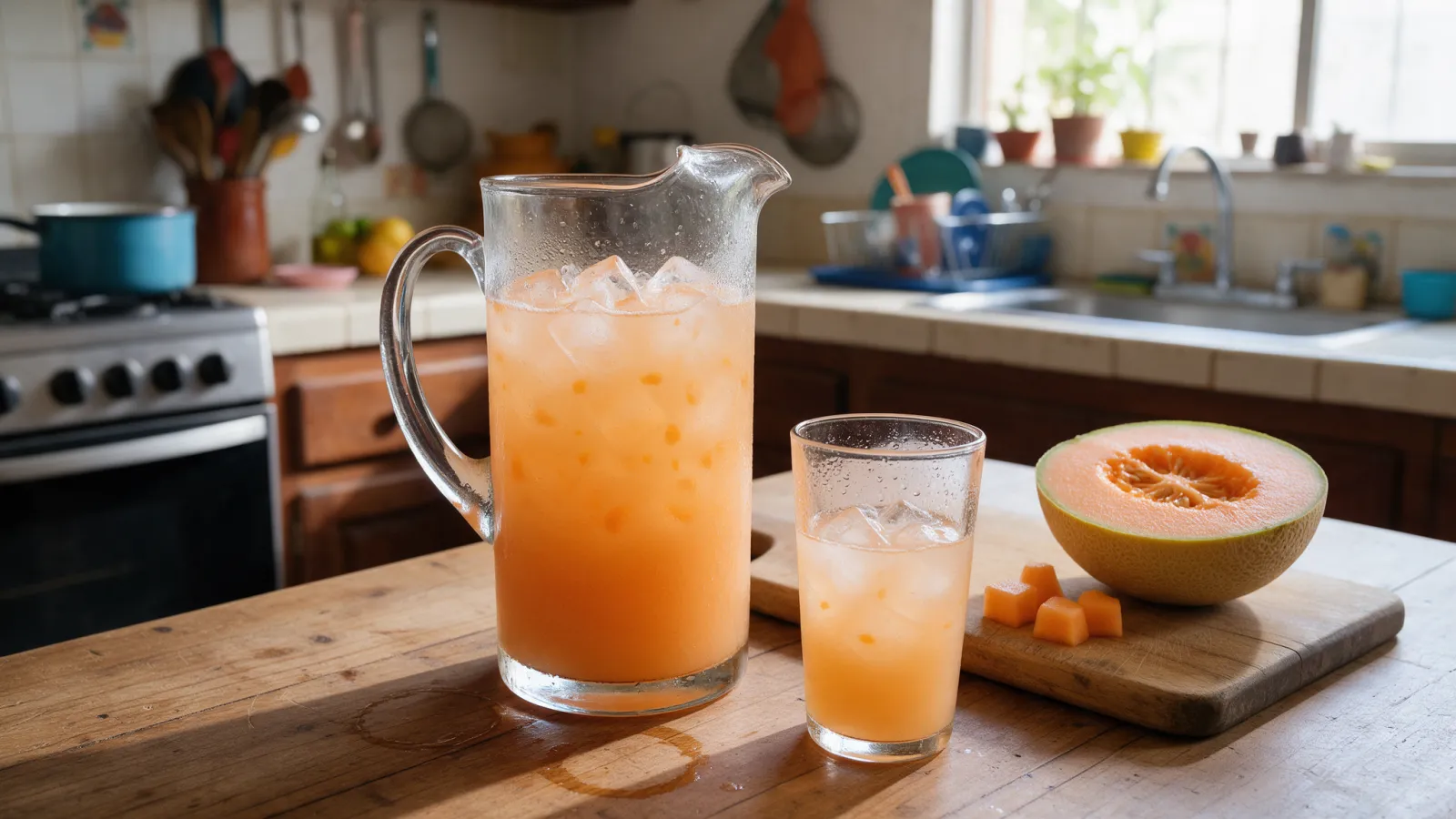

Agua de melón (AH-gwah deh meh-LOHN) is the cantaloupe version of the Mexican agua fresca: ripe melon blended with cold water and a little sugar, poured over ice. It’s thinner than a smoothie and far more flavorful than water with fruit floating in it, and in my house it’s the pitcher the kids empty first. The whole recipe hinges on one number most versions skip. “One cantaloupe” can mean 1 lb or 2 lb of flesh, so I weigh it: 350 g (12⅓ oz) of flesh per liter of finished drink, which is one 3 lb melon for a 2 quart pitcher.
How do you make agua de melón?
How do you make cantaloupe agua fresca? Scrub the cantaloupe rind with a brush under cold water, peel and seed it, then blend 700 g (1½ lb) of flesh with 1⅔ cups (400 ml) of cold water and 2 tbsp (25 g) of sugar for about 1 minute. Pour it into a pitcher without straining, add 3¾ cups (900 ml) of cold water and a squeeze of lime, and sweeten to taste. Ready in 15 minutes for 8 servings.
That’s the whole method: 15 minutes, no stove, nothing to strain. You get about 2 quarts (2 liters) of a pale orange drink that smells strongly of melon, with just enough body from the pulp.
Who it’s for. Anyone feeding a crowd in hot weather, and anyone serving spicy food: it sits nicely next to tacos al pastor or carnitas tacos. It’s also the best use I know for a cantaloupe that turned out bland when you cut it.
Who it isn’t for. People who want something tart. For that, a hibiscus agua de jamaica or a tamarind agua fresca is the better pitcher. And it isn’t a drink to leave on a picnic table all afternoon without ice.
Difficulty. Easy. What goes wrong is the melon you bought, not the technique.
Picking a ripe cantaloupe, the step that decides the flavor
Buy the ripest melon you can find, because it won’t improve at home. Cantaloupes soften after harvest but don’t gain sugar. An underripe one will turn soft on your counter and still taste like cucumber.
There are three signs I go by: the skin under the netting turns golden or cream, not green; the stem end is smooth and slightly sunken, with no piece of stem attached, and the opposite end gives a little under your thumb. I add a fourth, smell: a ripe cantaloupe smells of melon at the stem end. Skip bruised or damaged melons.
In the US this is simply cantaloupe, the netted, orange-fleshed melon in every supermarket. In the UK, look for cantaloupe or Charentais, which also has orange flesh. Honeydew and Galia work too, but the drink comes out pale green and much milder.
Why you scrub a melon you’re going to peel
Cantaloupe is one of the few fruits where washing the rind really matters, even though you never eat it. Its netted rind traps bacteria and makes them harder to remove, and bacteria on the rind reach the flesh when you cut into it. Scrub it with a clean produce brush under running water, and don’t use soap, detergent or commercial produce washes.
The risk is real. In the US, cantaloupes were behind a Listeria outbreak in 2011 that sickened 147 people in 28 states and killed 33, and to a Salmonella outbreak in 2023 with 407 illnesses in 44 states. Listeria can also grow on cantaloupe at refrigerator temperature, so cold slows it down but doesn’t make old melon safe.
- Scrub for about 1 minute under cold running water, then pat dry.
- Cut on a clean board and wash the knife after halving, before you peel.
- Refrigerate within 2 hours of cutting, or within 1 hour above 90°F (32°C), at 40°F (4°C) or below.
- Pregnant women, older adults and anyone with a weakened immune system are the groups most at risk from Listeria. For them: freshly washed melon, a same-day pitcher, nothing that’s sat out.
Ingredients and US and UK swaps
| Ingredient | What to use | Swap | What changes |
|---|---|---|---|
| Cantaloupe | 700 g (1½ lb) flesh | Charentais (UK) | same color, very similar flavor |
| Cantaloupe | 700 g (1½ lb) flesh | honeydew or Galia | pale green, milder, less perfume |
| Sugar | 50 g (¼ cup) | agave syrup or honey, added in the pitcher | start with half and taste |
| Sugar | 50 g (¼ cup) | piloncillo or light brown sugar | murkier color, a molasses note |
| Lime | 30 ml (2 tbsp), optional | lemon juice | softer, less sharp |
| Water | 1.3 liters (5½ cups) total | sparkling water for the last 900 ml | fizzy; add it just before serving |
How much sugar, and the calories per glass
The recipe uses 50 g (¼ cup) for 2 quarts, light for an agua fresca; the usual range runs from 26 to 63 g per liter. The melon already brings about 7 g of its own sugar per glass, which is why I blend with half and finish the rest in the pitcher once it’s diluted. A blender jar always tastes sweeter than the glass will.
Strain it or not, and what to do with the seeds
I don’t strain it. Blended cantaloupe is smooth enough, and the pulp gives the drink body. If you want it silky with no threads at all, pour it through an ordinary sieve and press the pulp with a spoon; it comes out lighter and separates more slowly. The foam on top is just air, so skim it or leave it.
The seeds never go in the blender for agua de melón. They become a different drink instead: horchata de semillas de melón, melon-seed horchata, a homemade classic in Mexico. You blend the seeds and their jelly-like pulp from 1 melon in short pulses with 2 cups (480 ml) of water, strain, then add 2 more cups of water, sugar and cinnamon or lime. Don’t grind them too fine, because they turn bitter, and drink it the same day.
Party batches and what to make ahead
Plan on 2 glasses of 8.5 fl oz (250 ml) per guest, 3 on a hot day with nothing else to drink.
| Guests | Finished drink | Melon flesh | 3 lb melons | Sugar |
|---|---|---|---|---|
| 4-6 | 2 liters (about 2 quarts) | 700 g (1½ lb) | 1 | 50 g (¼ cup) |
| 10-12 | 5 liters (about 5¼ quarts) | 1.75 kg (3.9 lb) | 2½-3 | 125 g (⅔ cup) |
| 20 | 10 liters (about 2⅔ gallons) | 3.5 kg (7¾ lb) | 5 | 250 g (1¼ cups) |
The day before, peel and cube the melon and keep it covered in the fridge; cut melon keeps up to 4 days refrigerated. Or go one step further and blend the bases, 700 g (1½ lb) of melon with 400 ml (1⅔ cups) of water and the sugar each, and refrigerate them covered. On the day, each base gets its 900 ml (3¾ cups) of cold water and the lime. For 20 people I allow about 40 minutes, most of it scrubbing and peeling five melons.
On the table, set the pitcher in a bowl of ice, keep the ice for glasses in a separate bucket, and top up from the fridge in smaller batches. Anything that’s been out for 2 hours goes.
Mistakes that make it bland, bitter or gritty
- Tastes like water → an underripe melon or too little of it. Weigh 350 g (12⅓ oz) per liter and choose the melon by color and smell.
- Tastes like rind or cucumber → the pale green layer next to the skin went in. Peel thickly.
- Gritty or bitter → seeds in the blender. Scoop out every one.
- Tastes fizzy or sour → it’s been in the fridge too long. Throw it out.
- Separates in the pitcher → that’s normal. Stir; a strained batch separates less.
What it costs
In US grocery ads on October 9, 2026, cantaloupe was $2.87 each and limes at $0.50 each. With 50 g of sugar at $1.024 per pound (US average, August 2026), about $0.11, the pitcher comes to roughly $3.48, or $0.44 a glass. The melon is over 80% of that, and those are sale prices, so expect a little more at full price. In the UK, do the math with your receipt: one melon per pitcher.
Storage, freezing and how it tastes the next day
Fridge. Covered, at 40°F (4°C) or below. Cut melon keeps up to 4 days, and the pitcher 1 to 3 days. I drink it within 2 days, 3 at most, because the aroma fades by day two, and I pour it out if it smells sour or fizzes.
Freezer. Freeze it in ice cube trays; the cubes chill a glass without watering it down. I use them within 1-2 months. A whole frozen pitcher separates when it thaws.
Serving. Tall glass, plenty of ice, alongside the meal. On a table of aguas frescas I put it between a red jamaica and a green cucumber lime agua fresca, and a pitcher of Mexican horchata for anyone who wants something creamy. For something sharper and fruitier, a passion fruit juice does that job.
FAQ
How much cantaloupe do I need for agua fresca? 350 g (12⅓ oz) of flesh per liter of finished drink. A 3 lb (1.3-1.4 kg) cantaloupe gives about 700 g (1½ lb), enough for a 2 quart pitcher.
Do I really need to wash a cantaloupe if I’m peeling it? Yes. The knife carries whatever is in the netted rind into the flesh. Scrub it with a clean brush under cold running water, no soap, and dry it before cutting.
Can you blend cantaloupe seeds into agua fresca? Not into agua de melón; they’re scooped out. The seeds are used for a separate drink, melon-seed horchata, blended briefly and strained.
Do you have to strain cantaloupe agua fresca? No. Unstrained has more body; strained is silkier and separates less.
How many calories are in a glass? With 50 g (¼ cup) of sugar per pitcher, 55 kcal per 8.5 fl oz (250 ml) glass. Unsweetened, about 31 kcal.
How long does cantaloupe agua fresca last? I drink it within 2 days, 3 at most, covered at 40°F (4°C). Out of the fridge, no more than 2 hours.
Why does my agua fresca taste like nothing? The melon was underripe, and cantaloupes don’t get sweeter after picking. Add sugar and lime, or more melon.
Nutrition per glass
Per 8.5 fl oz (250 ml) glass, unstrained, with 50 g of sugar and 30 ml of lime juice per 2 liters, calculated from the recipe’s weights: raw cantaloupe 34 kcal per 100 g (3.5 oz), lime juice 25 kcal, sugar 387 kcal.
- Calories: 55 kcal
- Protein: 1 g
- Carbohydrates: 14 g
- Sugars: 13 g, about 7 g of it from the melon
- Fat: 0 g
- Fiber: 1 g
- Sodium: 14 mg
Each glass also has about 234 mg of potassium, 33 mg of vitamin C and 148 µg of vitamin A, nearly all of it from the melon. Straining takes the fiber close to zero.
I used to judge cantaloupes by size and knock on them like everyone else. Now I turn them over, look for gold under the netting and sniff the stem end, and the pitchers have been better ever since. My son Dylan asks for his without lime. A ripe melon does most of the work; the sugar only fills the gaps. Josnaisis.