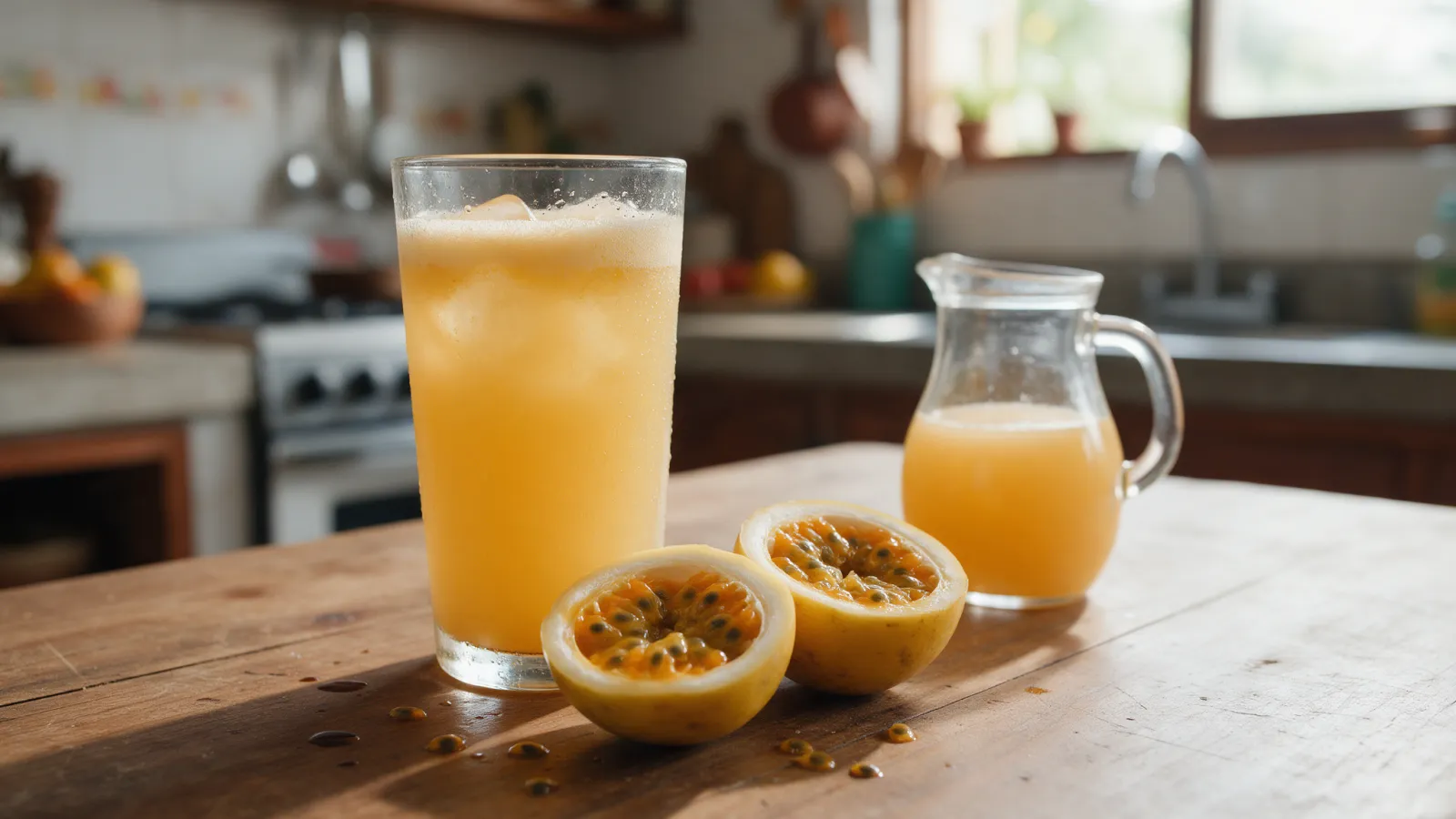

In Colombia, a pitcher of jugo de maracuyá is what lands on the table next to lunch on a hot day: passion fruit pulp, water, sugar and ice, sharp enough to wake you up. It takes 10 minutes and one piece of technique, which is knowing when to let go of the blender button. Passion fruit seeds are hard and oily, and if the blades crack them the juice turns gray and bitter. Pulse it, strain it, and you get a bright orange juice that tastes the way the fruit smells.
What is Colombian passion fruit juice, and is it worth making?
How do you make passion fruit juice from fresh fruit? Scoop the pulp of 4 ripe yellow passion fruits into a blender with 1 cup (250 ml) of water and pulse 3 or 4 times, just enough to free the pulp from the seeds. Strain, pressing hard, then stir in 2 more cups (500 ml) of cold water and ⅓ cup (60 g) of sugar. Ready in 10 minutes for 4 servings.
The fruit is Passiflora edulis, and the one Colombians use for juice is the yellow form, sold there as maracuyá. Venezuelans call it parchita, Dominicans chinola, Puerto Ricans parcha. It’s a different fruit from granadilla, its sweet, gray-fleshed cousin that’s eaten with a spoon.
Yes, it’s worth making. Yellow passion fruit juice carries about 12 °Brix of natural sugar against a pH averaging 3.1. That much acid and aroma means a whole liter (1 quart) of juice needs only 230 g (8 oz) of the pure stuff. A carton can’t come close for the price.
Good for: weekday lunches, hot afternoons, anything fried or rich that wants something sour beside it, and parties, because the base can be made a day ahead. Not for: anyone who dislikes sour drinks; even sweetened, it bites. Time: 10 minutes, all of it hands-on. Difficulty: easy.
What you need, and how many passion fruits per liter
For 1 liter (1 quart), 4 glasses of 250 ml (8.5 fl oz): 4 large yellow passion fruits, about 650 g (1 lb 7 oz), 750 ml (about 3 cups) of very cold water and 60 g (⅓ cup) of sugar. A yellow passion fruit weighs 161 g (5.7 oz) on average and breaks down into 36% juice, 51% rind and 11% seeds. Four fruits of that size come to about 230 g (8 oz) of juice, which is the amount I aim for. The traditional Colombian ratio is four or five fruits per liter.
Yellow, purple, or frozen pulp
Yellow passion fruit is the Colombian one, egg-shaped and smooth when just picked, and it’s what Latin grocers sell as maracuyá. If the passion fruit at your supermarket is small, purple and wrinkly, it’s the purple form: sweeter, less sour, and much smaller. One purple fruit holds about 18 g (0.6 oz) of edible pulp, so the 340 g (12 oz) of seedy pulp for a liter takes around 19 of them. Weigh rather than count.
Wrinkled skin is fine, and actually a good sign. The cyanogenic glycoside in passion fruit pulp is highest in very young, green fruit and drops so low in ripe, wrinkled fruit that it has no toxicological significance. Skip hard green fruit; wait for full color.
Frozen passion fruit pulp is the easiest route in the US. Goya sells Passion Fruit Pulp in 14 oz (396 g) packs in the freezer aisle of Latin supermarkets and many larger chains, with passion fruit pulp and ascorbic acid as the only ingredients; you may also see it labeled parcha or chinola. It’s already seedless, so it stands in for strained juice: use 230 g (8 oz) per liter, a little over half a pack. Let it sit 10 minutes out of the freezer and blend it half-frozen; with no seeds to crack, a straight 20-second blend is fine. Flavor and acidity match fresh fruit, with a flatter aroma. In the UK, look in Latin American and Caribbean grocers. If a pulp comes pre-sweetened, leave out the sugar and taste at the end.
Tools: a blender with a pulse button, a fine-mesh sieve and a 1.5-liter (1½-quart) pitcher. No pulse button? Switch the lowest speed on and off by hand. No blender? Press the pulp through the sieve with a spoon for about 3 minutes; you get a little less juice and no broken seeds.
How to make it, step by step
Ten minutes breaks down roughly as 4 minutes rinsing, halving and scooping, 3 pulsing and straining, and 3 sweetening and pouring over ice.
Pulse, don’t blend
Each seed sits inside a little sac of juice. The goal is to pop the sacs, not grind the seeds. Three or four pulses of 1 to 2 seconds turn the seedy mass into orange liquid dotted with whole black seeds, and that’s the moment to stop. The seeds are hard and about 23% oil, and once cracked they shed grit that slips through the sieve and a bitter, grayish edge that sugar won’t hide. That last part comes from my own kitchen, every time I let the blender run while I did something else.
Blend with just 250 ml (1 cup) of water, not the whole amount. With less liquid the pulp lets go of the seeds faster and the sieve has less to do.
How you know it’s right: strained juice is deep orange and cloudy, with a pale foam that settles in about a minute. The sieve holds whole black seeds, nearly dry.
Who this recipe is for
- If you have fresh yellow passion fruit → 4 per liter, pulsed and strained, exactly as written.
- If you only find purple ones → weigh out 340 g (12 oz) of pulp, around 19 fruits; expect a sweeter juice.
- If you’re using frozen pulp → 230 g (8 oz), blended half-frozen, no straining needed.
- If you’re cooking for kids → the milk version, or 75 g (6 tablespoons) of sugar plus 150 ml (⅔ cup) more water.
Making it ahead
The day before, or on Sunday for the week: scoop, pulse with the 250 ml (1 cup) of water, strain and sweeten. That base keeps 2 days covered in the fridge, or freeze it in ice cube trays. On the day, add cold water and ice.
Before you start, mistakes, sourness, kids and allergens
Mistakes that ruin passion fruit juice.
- Bitter or gray juice → the seeds got ground. Pulse 3 or 4 times; never run the blender continuously.
- Watery juice → too little pulp or small fruit. Aim for 230 g (8 oz) of strained juice per liter and weigh it once.
- So sour it scratches → it needs water more than sugar. Try 100 ml (scant ½ cup) more water first.
- Curdled milk version → warm milk, too much fruit, or it sat out. One fruit fewer, fridge-cold milk, serve at once.
- Pulp sinks in the pitcher → that’s normal. Stir before pouring.
Spice level: none. It’s sour, not hot. Kids: most like it, especially with milk. Allergens: none of the major allergens in the water version; the milk version contains dairy.
Which version, water, milk or mango
- Most refreshing → with water, 93 calories a glass, keeps 2 days.
- Creamy, or for kids → with milk, 193 calories a glass with whole milk.
- Too sour for you → with mango. Strain the juice of 3 passion fruits, then blend it for 20 seconds with 150 g (about 1 cup) of ripe mango chunks and the water. Thicker and rounder, 106 calories a glass.
- Lighter → 30 g (2½ tablespoons) of sugar per liter gives 64 calories a glass; no sugar at all, 35.
With milk, without curdling
Cow’s milk measures 6.4 to 6.8 on the pH scale; passion fruit juice, around 3.1. Casein, milk’s main protein, clumps once the mix drops to pH 4.6, about 1.5 points above the juice. It’s the same reason a Venezuelan merengada made with passion fruit can split.
So change the amount and the order. For 1 liter, pulse the pulp of 3 passion fruits, not 4, with 100 ml (scant ½ cup) water and the sugar, strain, and only then stir that base into 700 ml (3 cups) of whole milk straight from the fridge, at 40°F (4°C) or colder. Serve right away. One fruit fewer keeps the mix further from that threshold, cold milk is slower to curdle, and the pre-sweetened base means no more blending once the milk is in. Made like this, it has never split on me in the first 15 minutes; left on the table for half an hour, I’ve seen fine curds settle. If that happens, a 5-second blitz brings it back. Almond and oat drinks don’t curdle the same way and make a lighter juice.
Sugar and calories per glass
Yellow passion fruit juice has 60 calories per 100 g (3.5 oz), so the 230 g (8 oz) in a liter adds 138 calories in total, about 35 per glass. Everything above that is sugar: each 30 g (2½ tablespoons) per liter adds about 29 calories per glass. My standard is 60 g (⅓ cup), which gives 93 calories a glass. With a zero-calorie sweetener, add it last and taste, because the acidity fools you.
For a party, 4 to 6 or 12 to 20 people
The ratio per liter never changes: 4 fruits or 230 g (8 oz) pulp, 750 ml (about 3 cups) water, 60 g (⅓ cup) sugar. For 4 to 6 people, 1.5 liters (about 6 cups): 6 fruits, 1.1 liters (4⅔ cups) of water and 90 g (½ cup) sugar. For 12 to 20 people I plan a glass and a half each on a warm afternoon: 30 glasses is 7.5 liters (about 2 gallons), from 30 fruits, about 4.9 kg (10¾ lb), or 1.73 kg (3.8 lb) of frozen pulp, roughly 4⅓ Goya packs, plus 5.6 liters (about 1½ gallons) of water and 450 g (1 lb) of sugar.
Make a concentrate the day before: the pulp pulsed with 1.9 liters (2 quarts) of the water, strained, sweetened and chilled. On the day, finish it a liter at a time in the pitcher with the rest of the cold water and plenty of ice. The milk version can’t be made ahead; mix it in 1-liter batches as you pour.
What it costs in the US
With Goya’s 14 oz (396 g) pack of frozen pulp at $4.49 at one supermarket chain, the 230 g (8 oz) for a liter costs about $2.61, and the sugar, at $1.024 per pound (US average, August 2026), $0.14. That’s about $2.75 a liter, $0.69 a glass. The milk version uses less pulp and adds 700 ml (3 cups) of whole milk at $4.229 a gallon, for about $2.85 a liter.
In Colombia the fruit is far cheaper. In the week of September 12 to 18, 2026, wholesale passion fruit cost 5,068 pesos a kilo at Corabastos, Bogotá’s central market, and ranged from 3,467 in Armenia to 7,000 in Pamplona. Yield: 1 liter gives 4 glasses of 250 ml (8.5 fl oz), or 3 large glasses of 330 ml (11 fl oz).
What to expect, serving and storage
Flavor and texture. With water, orange, cloudy, sour and very fragrant, with a floral finish. With milk, pale yellow and creamy, the tartness coming in at the end. With mango, thicker and rounder.
How it’s served. Very cold, over ice, with lunch; one 8 to 12 oz glass per person. It’s the drink that cuts through a bandeja paisa, Colombia’s loaded platter of beans, pork and rice or anything fried. For a second fruit on the table, Colombian lulo juice is just as tart but green and herbal, and lulada from Cali is chunky enough for a spoon. For someone who wants nothing sour, a creamy Colombian soursop juice or a light cantaloupe agua fresca, and for a coastal spread, Colombian coconut lemonade. If you have extra fruit, the same pulse-and-strain juice is the base of a no-bake passion fruit dessert that sets in 3 hours.
Fridge. The water version keeps up to 2 days in a covered pitcher at 40°F (4°C) or below in my kitchen; it stays safe but loses aroma, and the pulp settles, so stir before pouring. The milk version is for drinking fresh, and leftovers go straight back in the fridge: perishable foods, milk included, shouldn’t spend more than 2 hours out of refrigeration.
Freezer. Freeze the strained base, before adding water, in ice cube trays or flat 230 g (8 oz) bags, one per liter. Frozen passion fruit juice keeps without deterioration for a year at 0°F (−18°C), and frozen food stays safe indefinitely at that temperature; I use mine within 3 months. Don’t freeze the diluted juice, which separates when it thaws.
Whole fruit. Ripe passion fruit keeps about a week in the fridge at 36 to 45°F (2 to 7°C). Leave underripe fruit at room temperature, around 68°F (20°C), until it colors.
Passion fruit juice FAQ
How many passion fruits do I need for 1 liter of juice? Four large yellow ones, about 650 g (1 lb 7 oz), for 230 g (8 oz) of strained juice. With small or purple fruit, go by weight: 340 g (12 oz) of seedy pulp.
Why is my passion fruit juice bitter? The blender broke the seeds. Pulse 3 or 4 times for 1 to 2 seconds, with only 1 cup (250 ml) of water, then strain.
Do you blend passion fruit seeds? They go into the blender with the pulp, but only for short pulses, and then you strain them out whole.
Can you make passion fruit juice with milk? Yes. Use 3 fruits per liter instead of 4, fridge-cold milk, sweeten the pulp first and serve at once, because the juice’s pH of 3.1 can curdle milk.
Is maracuyá the same as passion fruit? Yes, it’s the yellow passion fruit. Parchita, chinola and parcha are the same fruit; granadilla is a different one.
How many calories are in a glass of passion fruit juice? 93 calories for an 8.5 fl oz (250 ml) glass with ⅓ cup (60 g) sugar per liter; 35 without sugar, 193 with whole milk.
How long does fresh passion fruit juice last? Up to 2 days covered in the fridge for the water version. The milk version is best drunk fresh.
Passion fruit juice nutrition
Per 250 ml (8.5 fl oz) glass of the water version, one quarter of the recipe, calculated from the recipe’s weights (raw yellow passion fruit juice, granulated sugar):
- Calories: 93
- Protein: 0 g
- Carbohydrates: 23 g
- Fat: 0 g
- Fiber: 0 g, because it stays behind with the seeds
- Sugars: 23 g, of which 15 g is added sugar
- Sodium: 4 mg
Whole passion fruit has 10.4 g of fiber per 100 g (3.5 oz), almost all of it in the seeds. Made with whole milk instead, each glass carries 30 g of sugars, 6 g each of protein and fat, and 193 calories. A glass also brings roughly 30 mg of vitamin C, since the juice averages about 54 mg per 100 g (the range is 46 to 71), and less once the juice has sat for hours.
Back in Venezuela we made parchita juice by running the blender flat out, seeds and all, and straining afterwards, and I thought the dull color was just the fruit. It took moving to Colombia to learn to lift my finger off the button. Short pulses, whole seeds, and the juice comes out the color of the fruit itself. Josnaisis.