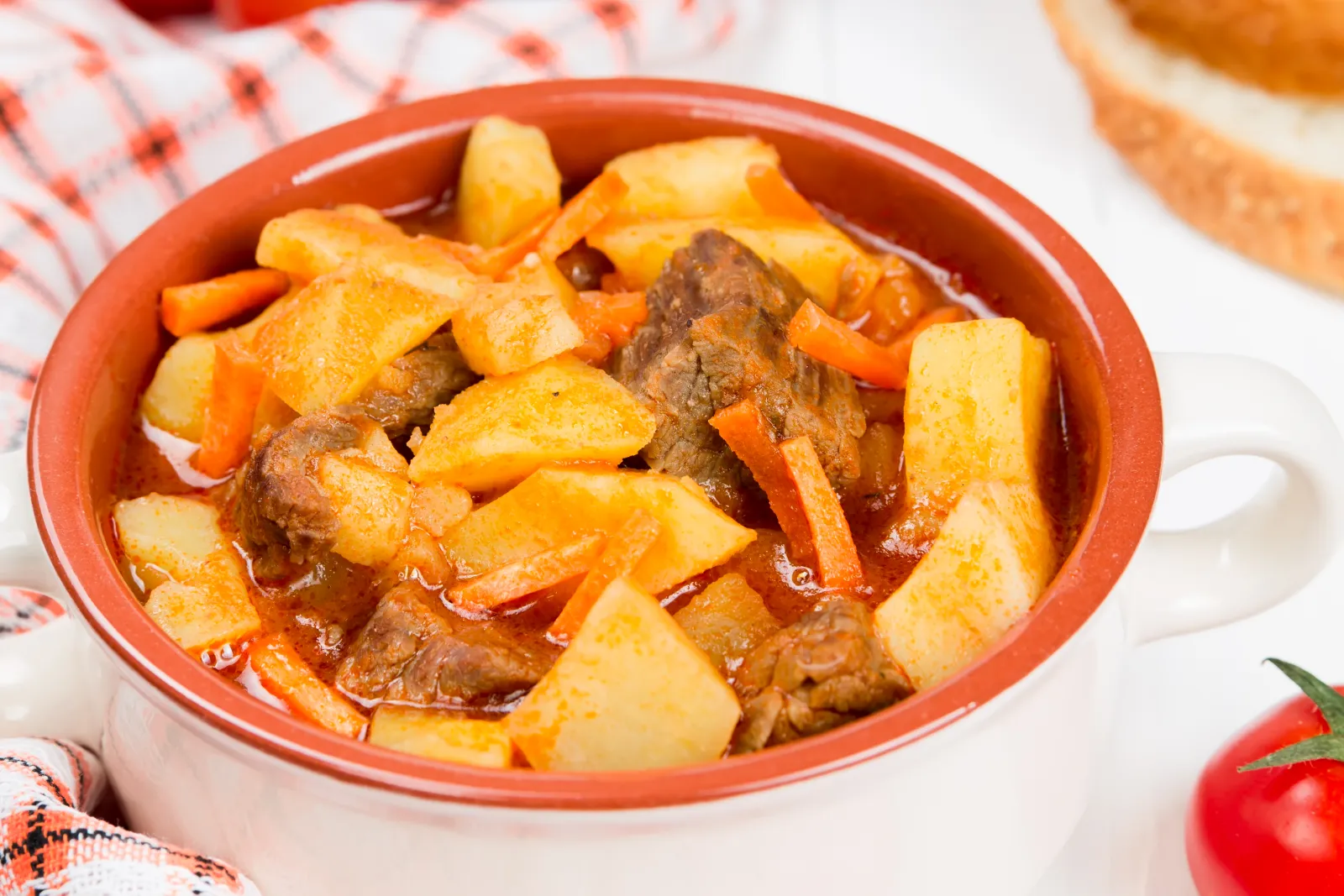

Carne sudada (CAR-neh soo-DAH-dah) means “sweated beef”, and it’s the everyday beef stew of Colombian home cooking: chunks of a tough, cheap cut cooked under a lid in hogao, the tomato and green onion base behind half of the country’s lunches, until they break apart under a spoon. Potatoes and yuca go into the same pot near the end and soak up the sauce, and it’s eaten with white rice and avocado. If you know Irish or American beef stew, the closest difference is the sauce: no flour, no wine, no browning required, and a lot more tomato. Here’s how to pick the cut in a US or UK store, how long it really takes on the stove and in an Instant Pot, how to cook it for 20 and what it costs.
Is carne sudada worth making at home?
How do you make Colombian carne sudada? Cook tomato, scallions, onion, red bell pepper and garlic into a thick base, add raw brisket in 2 inch (5 cm) chunks, cover and let it sweat its juices for 15 minutes. Simmer 75 minutes with 2 cups (500 ml) of water, then add yuca and potatoes with 1 more cup, small yellow potatoes at the end and 8 minutes uncovered to thicken. 165 minutes for 6 servings.
Yes, if you have an afternoon at home. About 45 minutes of the 165 are hands-on, and the rest is a covered pot on low heat that needs one check halfway. What you get is a one-pot meal where a cut that would be leathery in a skillet ends up tender enough to cut with a spoon.
When it shines. A weekend lunch for 6, a pot to eat from for three days, or a crowd dish made the day before. It reheats better than it eats fresh, because the sauce sets and the flavors settle.
When to skip it. On a weeknight without a pressure cooker. When you want beef pink in the middle; this is fully cooked. And if you want something closer to a skillet steak with onions, the Colombian carne en bistec uses pounded thin steaks and is on the table in 90 minutes.
Honest difficulty, easy. Nothing here is technical. What goes wrong is the cut (lean beef dries out), the order of the potatoes, and a heat that’s too high under a loose lid.
Which cut to buy, and what it’s called in a US or UK store
Buy brisket, trimmed of its thick fat cap, and cut it into 2 inch (5 cm) chunks: 2⅔ lb (1.2 kg) for 6, about 7 oz (200 g) raw per person. In Colombia it’s called pecho, and it’s one of the toughest cuts on the animal when cooked only to 158°F (70°C). That’s why it’s never fried, and why two hours under a lid suit it so well: the connective tissue softens and the meat stays moist.
- Chuck roast → the cut most English-language versions of this stew call for, and the easiest to find in the US. Chunks hold their shape and come out a little leaner. Same timing.
- Beef shank (UK: shin) → the cheapest and the one that gives the most gelatinous sauce. In my kitchen it needs 20 to 30 minutes more than brisket. Colombians call it murillo.
- Eye of round (UK: salmon cut) → lean. In small chunks it turns dry and stringy; if it’s what you have, cut it in 1¼ inch (3 cm) slices instead, the way Colombian cooks make sudado de posta.
- Pre-cut “stew meat” → I skip it when I can: you can’t tell which cuts are in the tray, and any lean pieces finish long before the rest.
The potatoes, the yuca and the tomato base
Russets do the thickening. Halved, they spend 38 minutes in the pot and release some starch into the sauce. Crush two halves at the end for a thicker stew. In the UK, Maris Piper or King Edward do the same job.
The small yellow ones are papa criolla. Colombia’s buttery little yellow potato, the same one that colors Colombian ajiaco, sold frozen in US Latin grocers. They go in whole for the last 23 minutes because they collapse long before russets. Baby Yukon Golds are the closest supermarket swap: same color, firmer, less buttery. If you only want one kind, use 2 lb (900 g) of russets.
Yuca (cassava) sits on the bottom of the pot, where it’s hottest, in 2 inch (5 cm) chunks with the woody core pulled out. It’s what gives the sauce its silky sheen. Frozen yuca, already peeled, is in most Latin grocers in the US and in Afro-Caribbean shops in the UK, and it goes straight into the pot. No yuca? Add 1.1 lb (500 g) more potatoes; the sauce comes out clearer.
The base is hogao. Grated tomato and scallions, plus onion and red bell pepper for more sauce. Grating the tomato turns it into a paste in 6 minutes with no loose skins. It’s the same base Colombians spoon over patacones, only here the beef cooks inside it.
Annatto (achiote) is for color. Half a teaspoon of sweet paprika gives the same orange with a faint smoky note. A tight-fitting lid on a 5 to 6 quart pot is the only equipment that matters; if your lid lets steam escape, lay a sheet of foil under it.
How to plan the afternoon
165 minutes start to finish and about 45 hands-on. Peel the potatoes and yuca during the 75 covered minutes, not before, so they don’t sit in water.
What to do the day before. Make the tomato base (it keeps 3 to 4 days in a jar in the fridge) and trim, cut and season the beef, covered in the fridge. Serving day then starts at the sweating step and saves 32 minutes. Or make the whole stew a day ahead: lift off any fat that sets on top when it’s cold.
How to tell each stage is right.
- Base → after 6 minutes with the tomato, the oil shines at the edges and a spoon leaves a trail that doesn’t close at once.
- Sweating → after 15 minutes covered, there’s about ¾ inch (2 cm) of liquid in the pot and the beef looks gray on the outside.
- Liquid level → halfway up the beef during the 75 minutes. Below that, add hot water a little at a time.
- Fork test at 90 minutes in the pot → the fork goes in with some resistance. If it bounces, 15 to 20 minutes more before the potatoes.
- Done → a fork slides in with no resistance, a chunk breaks when you press it with a spoon, and the sauce coats the back of the spoon.
Stovetop or Instant Pot
On the stovetop, the beef spends about 128 minutes on the heat between sweating, simmering and the potatoes, in line with the 1½ to 2 hours that most braised beef stews need for chunks this size.
In an Instant Pot or stovetop pressure cooker, make the base and sweat the beef 10 minutes on sauté, add 1½ cups (375 ml) of water, lock the lid and cook 30 minutes at high pressure, then let it release naturally for 10 minutes. That’s my timing for 2 inch chunks, and it sits within the 25 to 30 minutes most pressure-cooker beef stew recipes use. If a chunk still resists, 5 more minutes at pressure. Then cook the yuca and potatoes without pressure, lid on, with ½ cup (125 ml) more water and the same times as the stovetop recipe; under pressure they fall apart. About 130 minutes in total instead of 165.
Cooking for 12 or 20
- For 12 → 5⅓ lb (2.4 kg) of beef and double everything except the water: 3⅓ cups (800 ml) at first and 1⅔ cups (400 ml) with the potatoes, 1.2 liters instead of 1.5. An 8 to 10 quart pot loses about as much steam as a small one. Sweat the beef 20 minutes and add 15 to the covered simmer.
- For 20 → two pots with about 4½ lb (2 kg) of beef each rather than one packed to the brim; an overfilled pot scorches at the bottom before the top is cooked.
Before you start, mistakes, doneness and food safety
Doneness is about tenderness, not temperature. Whole cuts of beef, including chunks that aren’t ground, are safe at 145°F (63°C) with a 3-minute rest, and a stew at a gentle simmer passes that within its first minutes with water. What takes two hours is the connective tissue in brisket, and you judge that with a fork.
Common mistakes.
- Tough beef → a lean cut, oversized chunks or not enough time. Do the fork test before the potatoes and give it the minutes it asks for.
- Dry, stringy beef → it was eye of round or “stew meat” in small chunks, or the pot boiled hard. Brisket or shank, and low heat.
- Vanished yellow potatoes → they went in too early. Last 23 minutes only.
- Watery sauce → too much water or the lid on to the end. 8 minutes uncovered and crush 2 russet halves.
- Scorched bottom → high heat or a loose lid. Low heat, and the yuca always sitting in liquid.
Heat level, 0 out of 5. It isn’t spicy. Colombians add ají picante, a fresh scallion and cilantro hot sauce, at the table.
Kids. Usually a yes: soft beef and sweet little potatoes. Cut their portion small and check for chewy bits of tendon.
Allergens. None of the major ones: no gluten, dairy, egg, nuts, fish or soy. If you swap annatto for a bouillon cube or a seasoning packet, read the label, since many contain wheat.
Which version to make
- Short on time → Instant Pot, 30 minutes at high pressure plus a 10-minute natural release. About 130 minutes in total.
- Darker sauce → sear the chunks in batches, 3 minutes a side over high heat, before the base. Several Colombian cooks do it this way; I leave it out because the unbrowned version keeps the sauce bright.
- Lighter → skip the yuca, which takes off about 130 kcal a plate, and use 1½ tsp salt instead of 2 to bring sodium down to about 790 mg.
- Cheaper → beef shank, with 20 to 30 extra minutes.
- Vegetarian → there’s no honest beef-free version. The nearest is 1⅓ lb (600 g) of whole mushrooms and a 14 oz (400 g) can of chickpeas, drained, in the same base for 30 minutes. A good dish, a different one.
How it compares with other Colombian stews. Sudado de pollo uses the same unbrowned, covered method with chicken and about 1 cup (250 ml) of water per kilo, and takes 75 minutes; beef needs more time on the heat, so it gets more water. Sobrebarriga is a whole flank steak simmered 150 minutes and then sliced into a tomato sauce, and posta negra is a whole roast braised 150 minutes over a dark panela caramel. Carne sudada is the one cut into chunks with the potatoes and yuca cooked in the pot.
What it costs in the US
With US average prices for August 2026, the ingredients I priced come to $29.12 for the pot, about $4.85 a plate, or $30.34 ($5.06 a plate) with 1.1 lb of rice.
The beef is the bill. Chuck roast averaged $9.448 a pound ($20.83 a kilo), so the 2⅔ lb is about $25 of the total. Brisket, shank, yuca, bell peppers, onions and cilantro aren’t in the sum. In Colombian wholesale markets, shank (murillo) was the cheapest of the four cuts in the comparison above.
What to expect, serving, storing and reheating
Flavor and texture. Beef that breaks under a spoon, soft russets fraying at the edges, whole golden potatoes, translucent yuca, and about 2 ladles of orange sauce per plate, sweet from the tomato and onion with a background of cumin.
How it’s served in Colombia. In a wide bowl or plate, with Colombian white rice on the side to soak up the sauce and sliced avocado. Fried sweet plantain or a simple tomato and onion salad with lime are common extras.
Fridge. No more than 2 hours out of the fridge, then 3 to 4 days at 40°F (4°C) or below. Divide a big pot into shallow containers so it cools fast.
Freezer. 2 to 3 months for best quality, the usual window for stews with meat. The beef and yuca freeze well; potatoes turn grainy. If you plan to freeze, set aside beef and sauce before the potatoes go in and cook fresh potatoes when you reheat.
Reheating. The sauce thickens in the fridge. Add 2 to 3 tbsp of water per serving and reheat covered over low heat to 165°F (74°C) in the center. On high heat it catches and the potatoes break.
Carne sudada FAQs
What is the best cut for Colombian beef stew? Brisket with the fat cap trimmed, in 2 inch (5 cm) chunks. Chuck roast and beef shank work too; eye of round is too lean for chunks.
Is carne sudada the same as sudado de carne? Yes. Carne sudada, sudado de carne and sudado de res are the same dish: beef cooked covered in hogao with potatoes and yuca.
Do you brown the beef first? You don’t have to. Added raw, it releases its juices into the base and the sauce stays bright. Seared in batches, the sauce comes out darker; both are made in Colombian homes.
How long does it take in an Instant Pot? 30 minutes at high pressure for 2 inch chunks, plus a 10-minute natural release. The potatoes and yuca cook afterwards without pressure.
Can I use canned tomatoes? Yes. A 14 oz (400 g) can of diced tomatoes stands in for the 1.1 lb (500 g) of fresh ones; cook the base 2 to 3 minutes longer so the canning liquid reduces. In my kitchen the sauce comes out slightly more acidic.
When do the small yellow potatoes go in? For the last 23 minutes, whole. Added with the russets, they melt into the sauce.
How long does it keep? 3 to 4 days in the fridge and 2 to 3 months in the freezer. Potatoes change texture when frozen; the beef and yuca don’t.
Nutrition per serving
Per serving (one sixth of the pot, without rice or avocado), calculated ingredient by ingredient with this recipe’s quantities, using trimmed brisket for the beef and white potato for both kinds of potato:
- Calories: 650 kcal
- Protein: 46 g
- Carbohydrates: 64 g
- Fat: 24 g, of which 8 g saturated
- Fiber: 8 g
- Sugars: 8 g
- Sodium: 980 mg
Almost all the fat is the beef’s: with the fat cap left on, a serving would climb to about 830 kcal, which is why the recipe trims it. The yuca is about 130 kcal a plate, and the 2 tsp of salt account for 4,650 of the pot’s roughly 5,900 mg of sodium. A cup of cooked white rice adds about 200 kcal.
I grew up in Venezuela with beef stew that was always browned first, with carrots and potatoes, and the meat often ended up drier than the sauce around it. In Colombia I learned to put it in raw, cover the pot and leave it alone, and to wait for the fork before the potatoes go in. These days I season the brisket on Saturday and on Sunday the pot does the work. Josnaisis.