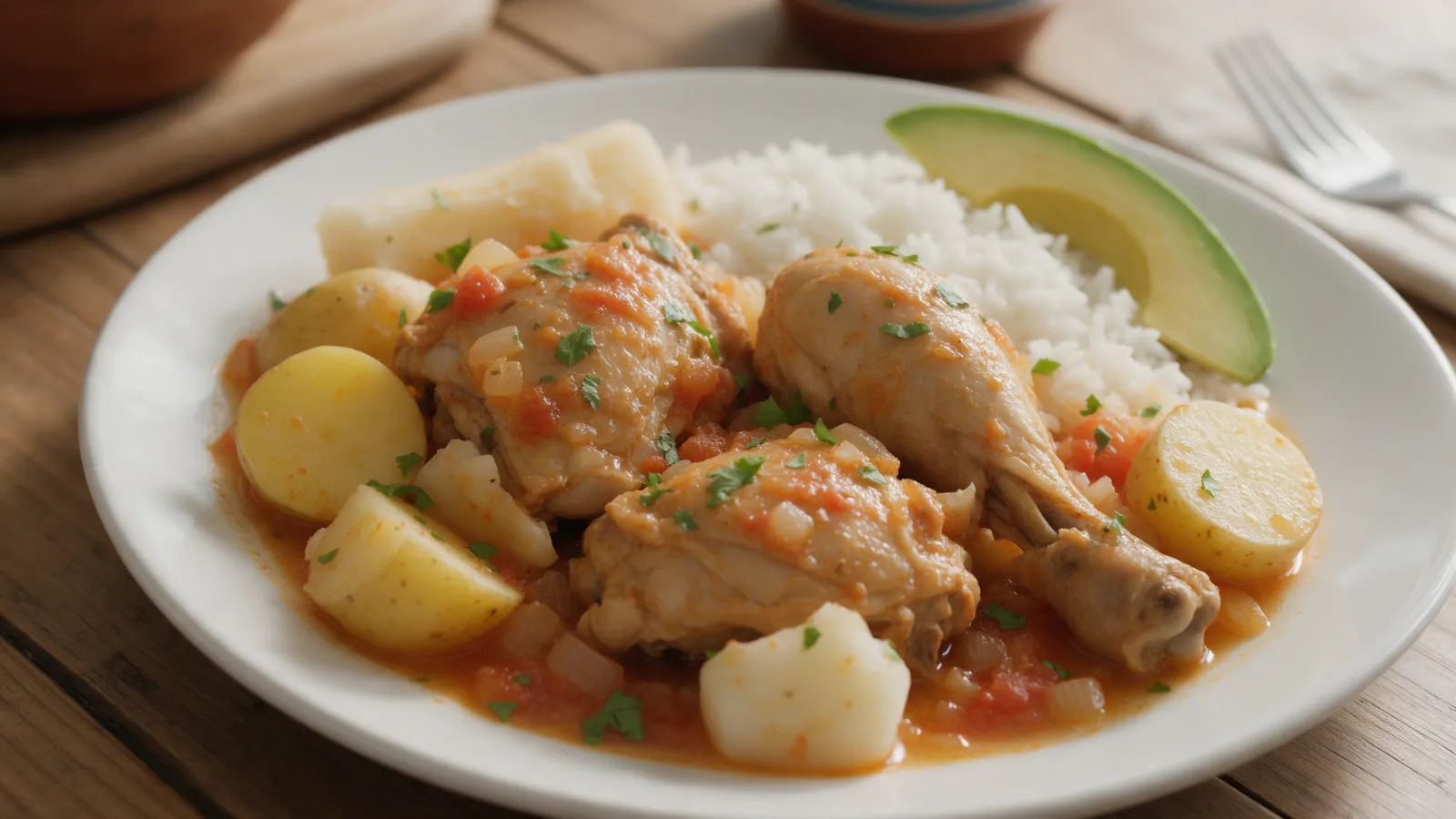

Sudado (soo-DAH-doh) de pollo means, word for word, “sweated chicken”, and the name is the method. Raw chicken goes into a cooked-down base of tomato and green onion, the lid goes on, and for 10 minutes the chicken cooks in nothing but the juice it gives off. Only then do potatoes, yuca and a small amount of water join it: 1½ cups (375 ml) for 3.3 lb (1.5 kg) of chicken. It’s one of the everyday lunches of Colombia, served with white rice, and it’s close to a braise in technique but lighter and brighter than any browned stew. Here’s whether it suits your week, how it differs from a regular Colombian stewed chicken, what to buy in a US or UK store, and how to make it for 12.
Is Colombian sudado de pollo worth making?
How do you make Colombian sudado de pollo? Cook tomato, scallions, onion, bell pepper and garlic into a thick base, add raw bone-in chicken legs, cover and let them sweat their juices for 10 minutes. Add yuca, potatoes and 1½ cups (375 ml) of water, simmer covered 30 minutes and uncovered 8 to thicken. Serve with white rice. 75 minutes for 6 servings.
Yes, if you want a one-pot dinner where the stove does most of the work. Nothing gets browned, so there’s no splatter and no batch searing; the chicken ends up falling off the bone, the potatoes and yuca soak up the sauce, and the sauce stays loose and orange, made for spooning over rice.
When it shines. A weeknight or weekend lunch for 6, a pot to eat from for two or three days, or cooking for people who like their chicken very tender.
When to skip it. If you want crisp skin or a dark, roasted-tasting sauce, you want the browned version, Colombian stewed chicken with hogao. And it isn’t a recipe for boneless breast on its own: 40 minutes in the pot dries breast meat out.
Real time. 75 minutes start to finish, about 30 of them hands-on. The 40 minutes under the lid ask for one stir.
Honest difficulty, easy. Two things go wrong, both about liquid: too much water gives you soup, and high heat with a loose lid scorches the bottom.
What you need, with US and UK swaps
Everything is in the recipe card: 3.3 lb (1.5 kg) of bone-in legs, 1.1 lb (500 g) of tomatoes, 2 lb (900 g) of potatoes, 1.1 lb (500 g) of yuca and 1½ cups (375 ml) of water for 6 plates.
Bone-in legs, and why the skin comes off
Thighs and drumsticks, bone in. Dark meat holds up to 40 minutes of simmering, and the bones add body to the sauce. Breast doesn’t have the connective tissue to stay juicy that long.
Skin off, unless you brown it. In a sudado nothing is seared, so skin turns soft and rubbery and its fat floats on the sauce. I pull it off before cooking: grip the edge with a paper towel and it comes away in one piece. If you’d rather keep it, sear the pieces skin side down for 8 minutes and pour off the fat. At that point you’re halfway to a browned stew, which is fine, just a different dish.
Yuca, and what happens without it
Yuca, also sold as cassava or manioc, is a starchy root with waxy brown bark and white flesh. In this stew it does the thickening: it releases starch and gives the sauce a slight gloss. Frozen yuca is the easy option, already peeled and cut, sold in Latin grocery stores in the US and in the frozen section of many big supermarkets; in the UK, look in Afro-Caribbean and Asian grocers, fresh or frozen. It goes into the pot straight from frozen. Fresh yuca should be bright white inside with no gray streaks; remove the stringy core.
No yuca at all? Use 1.1 lb (500 g) more potato. The sauce comes out thinner and less silky, and it’s still a good sudado; plenty of Colombian kitchens make it with potatoes only.
| Colombian ingredient | US swap | UK swap | What changes |
|---|---|---|---|
| Cebolla larga (long green onion) | scallions, green onions | spring onions | a little sharper, nothing important |
| Tomate chonto | Roma tomatoes; canned whole in winter | plum tomatoes; tinned in winter | canned makes a darker, sweeter sauce |
| Papa capira or pastusa | Yukon Gold | Maris Piper | russet breaks down faster and thickens more |
| Color (ground annatto) | achiote powder in Latin aisles | ½ tsp sweet paprika | paprika adds a faint smoky note |
| Yuca | frozen yuca | frozen cassava | without it, thinner sauce |
Equipment, and what to use if you don’t have it
A 5 to 6 quart (5 to 6 liter) pot with a tight lid, a box grater and a knife. The lid is the only thing that matters: if steam escapes, the water evaporates and the bottom catches. A Dutch oven is ideal. If your lid is loose, lay a sheet of foil over the pot before closing it. An instant-read thermometer is optional but ends the guessing.
How to plan it, and how to tell each stage is right
75 minutes on the clock, about 30 of them hands-on. Peel the potatoes and yuca while the tomato base cooks, not before, and the timeline below holds.
Make ahead. Cook the tomato base up to 3 days ahead and keep it in a jar in the fridge; serving day drops to about 50 minutes. Peeled yuca keeps overnight covered in water in the fridge. The whole stew can be made the day before, and the sauce is better for it.
How to tell it’s going right.
| Stage | What you should see |
|---|---|
| Tomato base, 6 min after the tomato | oil shines at the edges; a spoon leaves a trail that doesn’t close right away |
| Chicken sweating, 10 min covered | ½ to ¾ in (1 to 2 cm) of pinkish liquid in the pot, chicken white on the outside |
| After adding water | liquid comes halfway up the potatoes, not over them |
| Roots, 30 min | a knife slides into the potato without splitting it; yuca edges turn translucent |
| Chicken | 165°F (74°C) next to the bone of the thickest thigh; juices run clear |
| Sauce, 8 min uncovered | coats the back of a spoon; if not, crush 2 potato halves |
What “sweating” means, and why the water waits
For the first 10 minutes under the lid, heat draws water out of the chicken; with nowhere to go, it condenses on the lid and drips back. That juice, mixed into the tomato base, becomes the sauce. Pour the water in at the start and the chicken boils instead of sweating, and the sauce tastes watered down.
My rule is about 1 cup of water per 2 lb of chicken (250 ml per kg). Double that and you have a brothy stew; at 6 cups per 2 lb (1.5 liters per kg) you’re making soup.
Before you cook, mistakes, safety, spice and allergens
The one critical point is the heat after the lid goes on: medium-low, a lazy bubble. On high, the 1½ cups evaporate in about 20 minutes, the yuca on the bottom sticks and everything above it steams dry.
Food safety. The USDA Food Safety and Inspection Service puts safe chicken at 165°F (74°C) internal, measured in the thickest part away from bone contact. Forty minutes of covered simmering takes leg quarters well past that, which is why the meat slides off the bone.
Mistakes and how to fix them.
- Watery sauce → too much water, or the lid stayed on. Cook uncovered 8 minutes and crush 2 potato halves.
- Scorched bottom → heat too high or loose lid. Medium-low, and the yuca sits in the liquid, never dry.
- Potatoes fell apart → small cubes, or very floury potatoes fully submerged. Big halves, half submerged.
- Hard yuca → old yuca or the core left in. Simmer it 10 more minutes separately in a ladle of sauce; frozen yuca doesn’t have this problem.
- Dry chicken → it was breast, or it boiled hard. Legs and thighs, gentle heat.
- Greasy sauce → skin left on. Remove it first, or skim at the end.
Spice level, 0 out of 5. Nothing in the pot is hot. Colombians put the heat on the table: a Colombian ají picante of green onion, cilantro and chili is the classic.
Will kids eat it? Usually. It’s mild, tender and the potatoes are soft. Pull the meat off the bone for small children and check for bone splinters.
Allergens. No gluten, dairy, egg, nuts, fish or soy. If you swap the annatto for a seasoning packet or bouillon cube, read the label: many contain wheat or MSG.
Which version should you make?
Sudado or stewed chicken? The ingredients are nearly the same; the difference is browning and liquid. The way I draw the line in my kitchen: if the chicken is browned first, it’s guisado (stewed); if it goes in raw and cooks covered in its own juice, it’s sudado. Many Colombian families use the two words almost interchangeably, and in Peru sudado usually means fish. For a slow, rich version with a gelatin-thick sauce, Colombian stewed hen takes two hours with a laying hen. The same idea of finishing meat in a tomato sauce works with beef in Colombian sobrebarriga, a flank steak that simmers 150 minutes before it meets the sauce.
- Instant Pot or pressure cooker → make the base on sauté, add the chicken and let it sweat 5 minutes uncovered, then the halved potatoes, yuca and only 1 cup (250 ml) of water. High pressure 12 minutes, quick release, then 5 minutes on sauté to thicken. About 45 minutes total.
- Feeding 12 → double everything except the water: 2½ cups (600 ml), not 3, because a big pot loses about the same amount to evaporation as a small one. Sweat the chicken 15 minutes instead of 10 and add 10 minutes to the covered simmer. Two pots beat one overfilled 10-quart pot.
- Only have breast → 2.4 lb (1.1 kg) boneless breast in large chunks, added when the potatoes have had 15 minutes, so it cooks 25 rather than 40.
- Lighter → skip the yuca and add 1.1 lb (500 g) carrots and green beans; each plate drops from 540 to about 430 kcal. With 1½ tsp salt instead of 2, sodium falls to about 800 mg.
- Vegetarian → nothing tastes like a sudado without chicken. The closest is 1.3 lb (600 g) whole mushrooms and 14 oz (400 g) cooked chickpeas in the same base with 1 cup (250 ml) vegetable stock: a good dish, a different dish.
- Country style → add chunks of corn on the cob and arracacha (a Colombian root, similar to parsnip), as chef Jorge Rausch showed on MasterChef Colombia, or green plantain instead of yuca.
What it costs, and what makes it expensive
At the US city average retail prices the Bureau of Labor Statistics published for August 2026, the four ingredients it tracks come to $10.86, about $1.81 a plate, rice included.
What drives the cost is the chicken: bone-in legs at $1.670 a pound make $5.52 of the total. The same amount of meat as boneless breast, at $4.173 a pound, would be about $10.12 on its own, and drier. BLS has no series for cassava, peppers, onions or cilantro, so they’re not in the sum; in my experience they add a few dollars, with frozen yuca the largest of them. For 12 plates, double it: about $21.70 for the tracked ingredients.
What to expect, how to serve it and how to store it
Flavor and texture. Chicken that comes off the bone with a fork, potatoes and yuca that are soft but whole, and a loose, orange sauce, sweet from tomato and onion with cumin underneath. Expect about 2 ladles of sauce per plate.
How it’s served in Colombia. In a wide bowl or on a plate, one or two pieces with potato, yuca and sauce, and Colombian white rice on the side to soak it up. Avocado slices, and often fried sweet plantain. It’s a full meal; no soup course needed. If you have friends over, Colombian patacones make a good starter, and the same tomato base is their topping.
Fridge. USDA FSIS guidance for cooked chicken: no more than 2 hours at room temperature, then 3 to 4 days in the fridge at 40°F (4°C) or below. Store it in shallow containers so it cools fast.
Freezer. The chicken and sauce freeze well for 2 to 6 months (FSIS). Potatoes turn mealy and a little watery after thawing; yuca holds up better. If you plan to freeze, leave the potatoes out and cook fresh ones when you reheat.
Reheating without ruining it. The sauce thickens overnight from the yuca starch. Add 2 to 3 tablespoons of water per serving and reheat covered over low heat to 165°F (74°C), the FSIS figure for leftovers. On high it sticks and the potatoes break. In the microwave, covered, in 1-minute bursts.
Frequently asked questions
What does “sudado” mean? “Sweated.” The chicken cooks covered with almost no water, in the juice it releases. The first 10 minutes without added water are what give it the name.
What’s the difference between sudado de pollo and pollo guisado? Browning and liquid. In a guisado the chicken is seared first and the sauce reduces darker; in a sudado it goes in raw, cooks covered and the sauce stays light and plentiful.
How much liquid does sudado de pollo need? About 1 cup per 2 lb of chicken (250 ml per kg): 1½ cups (375 ml) for 3.3 lb (1.5 kg). It should reach halfway up the potatoes.
Can I make it in an Instant Pot? Yes. Sauté the base, sweat the chicken 5 minutes, add roots and 1 cup (250 ml) water, high pressure 12 minutes, quick release, 5 minutes on sauté to thicken.
What can I use instead of yuca? Extra potato, 1.1 lb (500 g). The sauce is thinner and less glossy. Frozen yuca from a Latin grocer is the better option.
Can I use chicken breast? Yes, but add it later: boneless chunks go in after the potatoes have cooked 15 minutes, so they get 25 minutes, not 40.
How long does it keep? 3 to 4 days in the fridge and 2 to 6 months in the freezer, per USDA FSIS. Freeze it without the potatoes if you can.
What do you serve with sudado de pollo? White rice is non-negotiable in Colombia. Add avocado, fried sweet plantain and a spoonful of ají if you like heat.
Nutrition per serving
Per serving (a sixth of the pot, without rice or avocado), calculated ingredient by ingredient from USDA FoodData Central (SR Legacy) using this recipe’s amounts. I count 2.4 lb (1.1 kg) of edible meat from the 3.3 lb (1.5 kg) of bone-in legs, which is what I get when I strip them:
- Calories: 540 kcal
- Protein: 41 g
- Carbohydrates: 64 g (potato and yuca)
- Fat: 14 g, of which 3 g saturated
- Fiber: 7 g
- Sugars: 7 g
- Sodium: 1,000 mg
The yuca is about 130 kcal of each plate. Nearly all the sodium comes from the 2 teaspoons of salt. A cup of cooked white rice adds about 200 kcal.
In my kitchen sudado is the Tuesday dish. I make the tomato base on Sunday with whatever tomatoes are going soft, and on Tuesday it’s chicken in, lid on, heat down, while I make the rice. The Venezuelan stewed chicken I grew up with always started with browning; this one skips it, and I don’t miss the splatter. Tight lid, low heat, little water. Josnaisis.