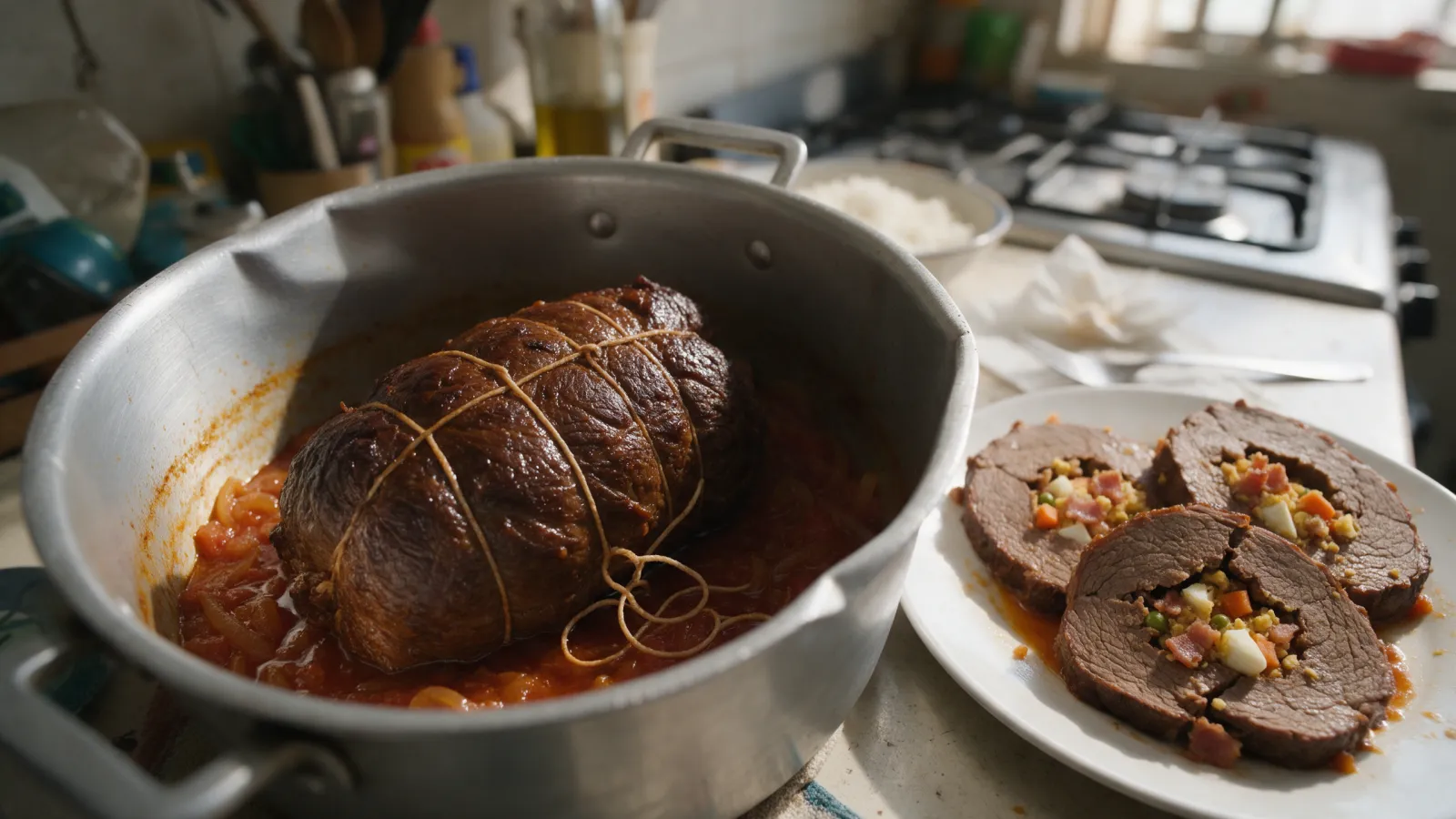

Muchacho relleno (moo-CHAH-cho reh-YEH-no) is what Colombians make when there are ten people to feed and a birthday to mark: a whole eye of round with a tunnel bored through its center, packed with bacon, carrot sticks, peas and hard-boiled eggs, tied up, browned and braised for two and a half hours in a tomato and pepper sauce. Sliced crosswise, every round of beef has an egg in the middle, like a bullseye. Muchacho is simply the Colombian butcher’s name for eye of round. Below is how to tunnel the roast without splitting it, how to tie it, stovetop, pressure cooker and oven times, the safe temperature once a roast has been stuffed, and what it costs in the US.
What is muchacho relleno, and is it worth making?
How do you make Colombian stuffed beef (muchacho relleno)? Tunnel a 4.4 lb (2 kg) eye of round lengthwise with a long knife, season it with garlic, Worcestershire and cumin, and stuff it with bacon, carrot sticks, peas and 4 hard-boiled eggs. Tie it every 1½ inches, sear it on all sides and braise it covered for 150 minutes in a base of onion, red pepper and tomato. Rest 20 minutes, blend the sauce and slice across. Ready in 250 minutes for 10 servings.
It’s a celebration roast, the Colombian answer to a holiday centerpiece. In the department of Santander it’s called capón, and in Bucaramanga it’s one of the Christmas Eve dishes, served with plum sauce and bread. Elsewhere in Colombia you’ll hear muchacho relleno or posta rellena.
Is it worth it? Yes, if you’re feeding 8 to 12. One 4.4 lb (2 kg) roast makes 10 servings, almost all the work can be done the day before, and it comes to the table whole and tied, which is half the fun.
The real time. 250 minutes, about 90 of them hands-on. For two and a half hours the covered pot only needs turning every half hour.
Who might skip it. Anyone who wants dinner tonight; Colombian carne en bistec, steak braised with onions and tomato, is on the table in 90 minutes. And anyone who’d rather not do knife work: a Colombian sobrebarriga, flank braised in creole sauce, takes as long but needs nothing more than a pot.
The cut, the filling and US and UK swaps
The recipe card has everything: a 4.4 lb (2 kg) eye of round and about 1.3 lb (600 g) of filling, which is 5.3 oz (150 g) of bacon, 5.3 oz (150 g) of carrots, 3.5 oz (100 g) of peas and 4 eggs.
| Ingredient | Use | US | UK | What changes with the swap |
|---|---|---|---|---|
| Muchacho | eye of round | eye of round roast, 4-4½ lb | salmon cut or eye of silverside | Bottom round or top round work but are wider and less even, so the tunnel is harder to center and the slices come out oval |
| Tocineta | smoked bacon | thick-cut bacon | streaky bacon or smoked pancetta | Turkey bacon or chicken chorizo if you avoid pork; the center of each slice is a little drier |
| Arveja | green peas | frozen peas | frozen garden peas | Green beans in long strips, as in the Santander versions; no real change |
| Salsa negra | Worcestershire | Lea & Perrins or store brand | Lea & Perrins | Soy sauce at two thirds the amount; saltier, less tangy |
| Cebolla larga | scallions | scallions | spring onions | The white part of a leek, slightly sweeter |
How to buy the beef
Eye of round is a long, cylindrical, very lean muscle from the back leg, the same even width from end to end, and that tube shape is what makes it possible to bore through and get round slices. Ask the meat counter for a whole roast of 4 to 4½ lb (about 2 kg), untied; if yours comes in a net, take it off before you start. Two 2 lb (900 g) roasts work too, with the filling split between them. Raw, it has 173 kcal and 21.7 g of protein per 100 g (3.5 oz), and almost no marbling, which is why it’s braised low and slow rather than roasted.
The filling, and why each part is there
The bacon is the fat the roast doesn’t have: it bastes the meat from the inside. The eggs make the slice; with 4 in a row, nearly every slice gets a yellow center. Carrots go in as long sticks, never cubes, so they show as orange dots and stay put when you cut. Peas fill the gaps and can go in frozen. I don’t put raw ground meat or rice in a narrow tunnel: they pack solid and the center takes longer to heat through.
Equipment
A long, thin knife of about 10 in (25 cm), like a boning or fillet knife; a wooden spoon for its handle; cotton twine (never plastic, it melts); a 6-quart (6-liter) Dutch oven with a lid; and an instant-read thermometer. A knife-sharpening steel pushed in from each end can replace the long knife. The thermometer has no substitute here.
Tunnel or butterfly, how to stuff and tie it
There are two ways to get the filling inside, and for a first attempt I’d tunnel.
Tunneling without splitting the wall
Find the center of one end and push the knife in straight and slow to the middle of the roast. Give it a quarter turn so you leave a cross-shaped cut, and pull it out. Turn the roast around and do the same from the other end; when the two cuts meet the knife suddenly stops meeting resistance. Then work the handle of the wooden spoon in and twist it to open a channel of 1½-2 inches (4-5 cm), just wide enough for an egg, with at least ¾ inch (2 cm) of meat all round. Hold it up: you should see daylight through it. If a wall splits, stuff it anyway and put a loop of twine right over the tear.
To butterfly instead, cut lengthwise ¾ inch (2 cm) above the board without going all the way through, then keep unrolling the meat in a spiral until you have an even sheet about ¾ inch (2 cm) thick. Lay the filling in rows along the grain, roll it up tightly in the same direction and tie it every 1¼ inches (3 cm).
Tying it so the filling stays put
One loop of twine crosswise every 1¼-1½ inches (3-4 cm), knotted firmly, then a long loop from end to end that passes over both openings and hooks under the crosswise ties. That long loop is what stops steam from pushing the eggs out. Snug, not strangling: twine that sinks into the meat can split it as it braises.
How to plan the day, and how to make it ahead
Make-ahead option one. Everything up to the tying. Tunneled, seasoned, stuffed and tied, the roast keeps covered in the fridge for up to 24 hours, and the seasoning gets a full night to work. Take it out 30 minutes before searing.
Make-ahead option two, my choice for a party. Braise it completely the day before, chill it whole in its sauce and slice it cold the next day. Cold, it cuts cleanly into ⅜ inch (1 cm) slices without the eggs slipping out, and you reheat the slices in the sauce.
Signs it’s going right
- The tunnel → you can see light through it and an egg slides in with a gentle push.
- The sear → each side releases from the pot on its own once it’s browned; if it sticks, it isn’t ready.
- The base → after about 10 minutes the tomatoes have collapsed and the oil shines at the edges.
- The braise → small, slow bubbles, never a rolling boil, which turns lean beef stringy and tough.
- Doneness → at 150 minutes a skewer slides into the center with almost no resistance and the stuffing reads 165°F (74°C) or more.
- The sauce → blended and reduced, it coats the back of a spoon.
Scaling for 4 to 20
I count 7 oz (200 g) of raw beef per person, and for each 2.2 lb (1 kg) of beef, 2.6 oz (75 g) of bacon, 2 eggs, 2.6 oz (75 g) of carrots and 1.8 oz (50 g) of peas.
- 4 to 6 people → a 2.2-2.6 lb (1-1.2 kg) piece with 2 eggs and half the base and water. It’s just as thick, so the time drops only a little: start testing with a skewer at 120 minutes.
- 8 to 12 → the recipe as written, 4.4-5.3 lb (2-2.4 kg).
- 20 → two 4.4 lb (2 kg) roasts, each with its own filling, in two pots or side by side in a deep roasting pan in the oven. Time stays the same, because it depends on thickness, not total weight. For a bigger crowd, a whole-pork centerpiece like Colombian lechona, which serves 20 per batch, is easier to manage.
Safe temperatures for a stuffed roast
The safe minimum for a whole beef roast is 145°F (63°C) with a 3-minute rest, because on an intact cut the bacteria sit on the surface and the sear takes care of them. Tunneling changes that: it drags surface meat into the center, which is the same reason ground beef has to reach 160°F (71°C). On top of that, the filling holds raw bacon. So I go by the 165°F (74°C) required for the center of stuffing cooked inside a bird, and I check it in the stuffing, the last part to heat up. A 150-minute covered braise gets there comfortably; the rest of the time is for tenderness.
Stovetop, pressure cooker or oven?
- Stovetop → the recipe as written: 150 minutes covered at a bare simmer, turning every 30. The cleanest slices, and the most attention.
- Pressure cooker → after searing and the vegetable base, use 500 ml (2 cups) of water, cook 50 minutes at pressure plus 15 of natural release. The sauce comes out thin and needs 15-20 minutes of reducing, and the slice edges are a bit more ragged. The whole day drops to about 2 hours 55 minutes.
- Oven → 325°F (160°C) for 180 minutes, covered, in an ovenproof Dutch oven or a deep roasting pan sealed with foil, turned once halfway. About 4 hours 40 minutes all in, and the stove stays free. For a party, this is the one I use.
Mistakes, kids and allergens
- The filling came out → no lengthwise loop of twine, or it was stuffed to the brim. Leave ⅜ inch (1 cm) empty at each end.
- The knife came out the side → it went in crooked. Go slowly, from both ends, not all the way from one.
- Tough meat → it boiled hard or needs more time. Lowest heat, and another 20-30 minutes if the skewer meets resistance.
- Slices fall apart → cut hot with no rest, or too thin. Rest 20 minutes and slice ⅝ inch (1.5 cm) thick, or chill it and slice ⅜ inch (1 cm).
- Too salty → the bacon and Worcestershire already bring salt. That’s why there are only 2 tsp in all, and the last ½ tsp is tasted for.
Heat level, 0 out of 5. No chile at all; serve hot sauce on the side if you like.
Kids. It’s mild and the egg-in-the-middle slice tends to win them over. Trim off the bacon if they don’t like fat, and make sure no twine ends up on a plate.
Allergens. Egg in the filling. UK Worcestershire sauce is made with malt vinegar, which contains gluten, and it contains anchovies, so check the label for celiac or fish-allergic guests. Bacon is cured with nitrites. No dairy or nuts.
How it compares with asado negro, posta negra and matambre
Venezuelan asado negro uses the same 4.4 lb (2 kg) eye of round, unstuffed, blackened in raw-sugar caramel and braised 165 minutes in red wine. Cartagena’s Colombian posta negra is another whole cut from the leg, braised 150 minutes in panela caramel with vinegar. Muchacho relleno has no caramel at all; its sauce is a red tomato base, and what sets it apart is what’s inside.
Argentine and Uruguayan matambre arrollado looks similar on the plate but is a different cut and a different idea: a thin sheet of beef taken from between the hide and the ribs, rolled around hard-boiled egg, carrot, red pepper and spinach, boiled for hours, pressed and eaten cold as a cold cut.
What it costs
With US average prices, the priced ingredients come to about $45.35, or $4.54 a serving for 10. The beef is 87 % of that.
The beef is priced as boneless Choice round roast, the closest match to eye of round, at $8.959 a pound in August 2026. Peas, bell pepper, scallions, oil, Worcestershire and spices aren’t in the total. In Colombia, with wholesale prices for 12 to 18 September 2026, the same roast costs about 79,215 pesos in Bogotá, roughly 7,921 a serving, and the beef alone ran from 44,000 pesos in Manizales to 82,500 in Bucaramanga that week.
What to expect, how to serve it and how to store leftovers
Taste and texture. Firm, tender rounds of beef that cut with a fork, with a yellow egg center, orange carrot, green peas and melted bacon around them, in a thick, mild red sauce of tomato and pepper.
How to serve it. In slices with plenty of sauce, with Colombian white rice, boiled potatoes or mash, avocado and a tomato and onion salad. Cold and thinly sliced, it makes a good sandwich. For a different celebration cut that takes far less time, Colombian salt-crusted tenderloin is the opposite approach: beef tenderloin, direct coals, 45 minutes.
Fridge. No more than 2 hours at room temperature, then 3 to 4 days at 40°F (4°C) or below. Cut the roast into 2 or 3 big pieces and store them in their sauce in shallow containers so they chill fast.
Freezer. Slices in sauce keep 2 to 3 months at good quality, but hard-boiled eggs don’t freeze well: the white turns rubbery. Pick the egg out of slices you plan to freeze, or accept the texture.
Reheating. Slices in the sauce, covered, over low heat, to 165°F (74°C) in the center, 10-15 minutes. Add 3-4 tbsp of water if the sauce has thickened in the fridge.
Frequently asked questions
What cut of beef is muchacho? Eye of round. In the UK, ask for the salmon cut or eye of silverside; in Venezuela it’s muchacho redondo and in Spain redondo de ternera.
Is muchacho relleno the same as capón? Yes, the same dish under a different name. In Santander it’s called capón, and the filling there may include pork, raisins and green beans.
How long does it take to cook a stuffed eye of round? For a 4.4 lb (2 kg) roast, 150 minutes covered at a bare simmer on the stovetop, 50 minutes in a pressure cooker plus 15 of natural release, or 180 minutes in a 325°F (160°C) oven.
What temperature should a stuffed beef roast reach? At least 165°F (74°C) in the center of the stuffing. A tunneled roast is no longer an intact cut, and the filling holds raw bacon.
Can I make it ahead? Yes. Stuff and tie it up to 24 hours ahead, or braise it the day before, chill it whole and slice it cold.
How many people does it feed? Ten servings of 2 slices; 8 hearty eaters, or 12 with plenty of sides.
Is it served hot or cold? Both. Hot in its sauce for lunch, or cold and thinly sliced as a cold cut.
How is it different from Argentine matambre? Matambre is a thin sheet of beef rolled around the filling, boiled and served cold. Muchacho relleno is a whole, thick eye of round stuffed through a tunnel and braised in sauce.
Nutrition per serving
Per serving (2 slices ⅝ inch / 1.5 cm thick with sauce, one tenth of the recipe), calculated ingredient by ingredient with the amounts above, counting all the bacon fat:
- Calories: 518 kcal
- Protein: 50 g
- Carbohydrates: 10 g
- Fat: 30 g, including 10 g saturated
- Fiber: 2 g
- Sugars: 5 g
- Sodium: 805 mg
Two thirds of the calories and nearly all the protein come from the beef. Of the sodium, 465 mg is from the 2 tsp of salt and about 113 mg from the bacon.
Back home in Venezuela, eye of round meant asado negro, and nobody would have thought to put anything inside it. Colombia taught me the same roast can hide a whole lunch. These days I always make it the day before and slice it cold, because that’s when the egg stays exactly where it belongs. Josnaisis.