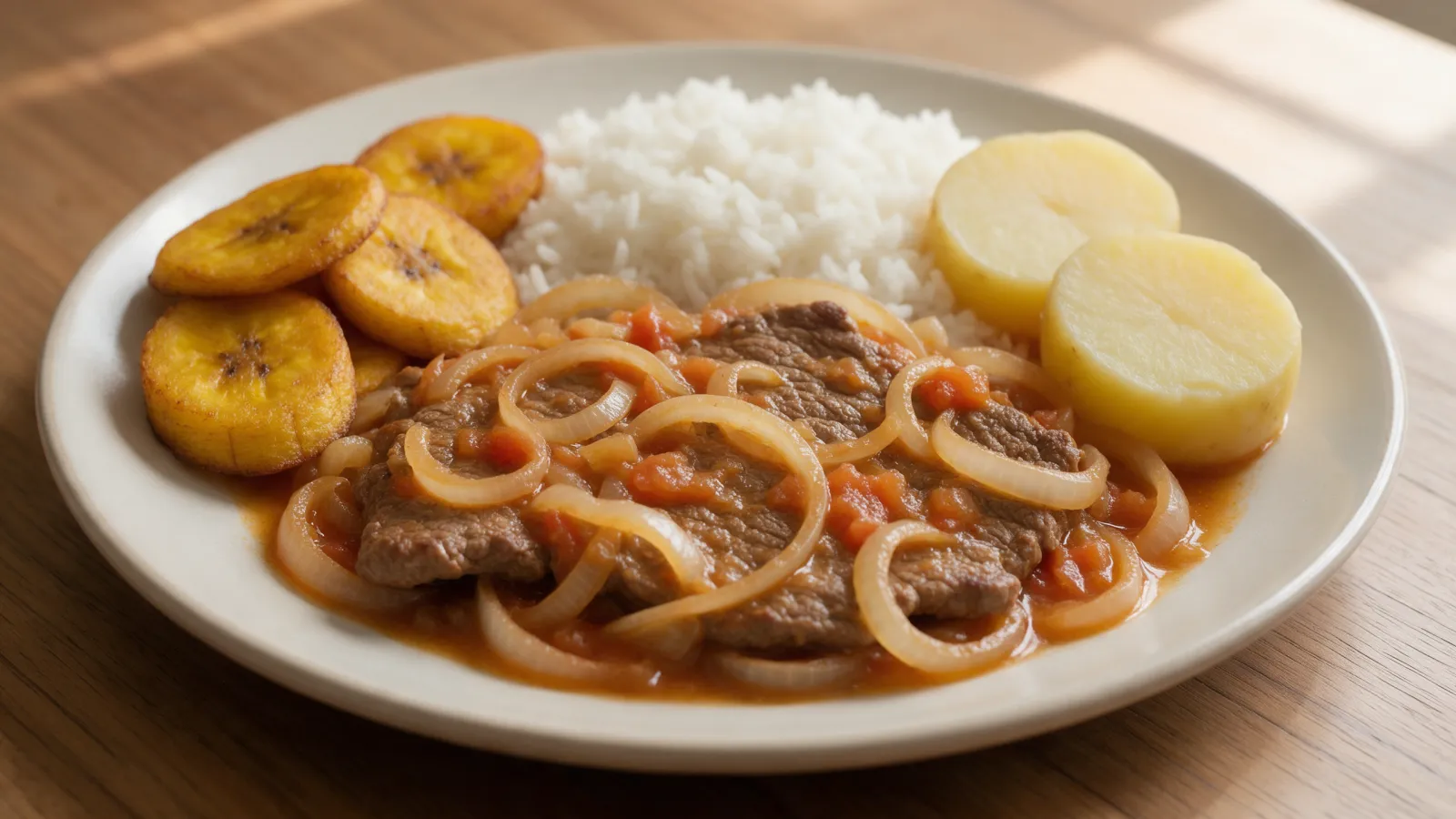

Ask for “carne en bistec” at a set-lunch place in Bogotá or Medellín and you get thin beef steaks braised under a heap of soft onion rings and tomato, next to rice, potatoes and sweet fried plantains. It is everyday Colombian food, the beef cousin of a weeknight stew, and the name simply means “beef as steak”. The part most versions online skip is that the cut Colombians use is lean round, which turns to shoe leather in a quick sear. It goes tender only when it is pounded thin and braised with the lid on.
What carne en bistec is and whether it’s worth making
How do you make Colombian carne en bistec? Pound top round steaks to 1/4 inch (5 mm), marinate them 30 minutes with garlic, cumin and Worcestershire, and sear them in batches over high heat. Cook onion rings and diced tomato in the same pan, return the beef with 1 cup (250 ml) of water and braise it covered on low for 25 minutes. Ready in 90 minutes for 6 servings.
It is worth it if you want a cheap cut to eat like a better one. You spend about 35 minutes hands-on, the dish makes its own sauce, it keeps 3 to 4 days in the fridge, and a fried egg on top turns it into bistec a caballo (“horseback steak”), the version with a sunny egg riding on the beef.
Good for. Weekday lunches, meal-prep boxes, and feeding 12 or 20 without a second recipe.
Not for. Anyone after a pink, medium-rare steak. This beef is braised well done and the flavor lives in the onion-tomato sauce. If you want a fast stir-fry with chiles instead, Mexican bistec a la mexicana cooks strips of beef in 30 minutes with tomato and serrano.
Honest difficulty, easy. Nothing here is technical. It fails in three predictable ways, all covered below.
Which beef to buy in the US or UK, and the swaps that work
Buy top round (topside in the UK) and ask for it sliced 3/8 inch (1 cm) thick, or slice it yourself while it is slightly frozen. Plan on 5 oz (150 g) raw beef per person; that is the Colombian lunch portion. At the August 2026 US city average, Choice-grade boneless round steak cost $9.69 a pound, against $14.36 for boneless sirloin.
The supermarket swaps and what they change
| Colombian ingredient | What to buy in the US / UK | What changes |
|---|---|---|
| Bola de pierna or cadera (round or rump) | Top round, sirloin tip / topside, rump | Nothing, once pounded to 1/4 inch (5 mm) |
| Cebolla cabezona (white onion) | White or yellow onion | Yellow onion makes a sweeter, browner sauce |
| Tomate chonto | Plum or Roma tomatoes | A 14 oz (400 g) can of diced tomatoes works out of season; redder sauce |
| Salsa negra | Worcestershire sauce, the same thing | Soy sauce, 1 tbsp, is saltier and less tangy |
| Cebolla larga | Scallions, the thick white ends | Or 50 g (1.75 oz) more onion |
| Plátano maduro (to serve) | Plantains with black skin, at Latin or Asian grocers | Unripe green ones won’t caramelize |
Pound, marinate, cover
Pounding to 1/4 inch (5 mm) shortens the muscle fibers. The 30-minute marinade seasons a steak that thin all the way through; longer adds flavor more than tenderness. The 25-minute covered braise finishes the job, keeping the meat moist in steam and sauce while the connective tissue softens. I don’t bother with meat tenderizer powder; with the mallet and the lid I’ve never needed it.
Equipment
A wide 11 inch (28 cm) skillet or braiser with a lid, a meat mallet and plastic wrap. A rolling pin or the bottom of a heavy pan replaces the mallet. No lid that fits? A sheet pan or tight foil does the same job; what matters is that the steam stays in.
How to plan it, make-ahead and cooking for a crowd
The working order is pound and marinate first, slice the onions while the beef sits in the fridge, and make the rice and plantains during the 25-minute braise.
Make-ahead and freezer plan
- The night before → pound and marinate the steaks and keep them covered in the fridge up to 24 hours. Slice the onions into a sealed box. On the day, 50 minutes to the table.
- The whole dish, a day ahead → braise it, cool it within 2 hours, refrigerate it in its sauce and reheat covered. It holds up well.
- Freezer → beef and sauce together, in flat bags, 2 to 3 months for best quality, as with any meat stew. Thaw overnight in the fridge. The onions soften a little more.
Scaling it
- For 4 → 600 g (1⅓ lb) beef, 2 onions (400 g), 350 g (12 oz) tomatoes, 180 ml (¾ cup) water. Same timings.
- For 12 → 1.8 kg (4 lb) beef seared in 6 batches or two pans at once, 1.2 kg (2⅔ lb) onions, 1 kg (2.2 lb) tomatoes, 400 ml (1⅔ cups) water in a 6 L (6 quart) braiser. Braise 30 minutes.
- For 20 → 3 kg (6⅔ lb) beef, 2 kg (4½ lb) onions, 1.7 kg (3¾ lb) tomatoes, 600 ml (2½ cups) water, split between two wide pans rather than one deep pot: stacked four layers deep, the bottom steaks fall apart and the top ones stay underdone.
Signs it’s going right
- Pounded steak → about 1/4 inch (5 mm) and nearly double the surface. Torn edges mean you started at the edge.
- Sear → the steak releases on its own after 1½ minutes and is browned underneath.
- Onions → translucent and floppy at 8 minutes, but you can still lift whole rings.
- Tomato → no visible cubes at 7 minutes and a shiny ring of oil at the edge.
- Done → at 25 minutes a fork goes in with no pressure and about 3/8 inch (1 cm) of sauce covers the pan.
Mistakes that ruin carne en bistec, plus safety, spice and allergens
- Tough beef → not pounded enough, or braised under 20 minutes. Go to 1/4 inch and give it the full 25; chuck needs 40.
- Grey beef, pale sauce → the pan was crowded and the meat steamed. Two steaks per batch, smoking-hot pan.
- Sauce dried out → lid off or heat too high. Add 1/4 cup (60 ml) hot water, scrape, cover.
- Watery sauce → uncover for the last 5 minutes on medium.
- Too salty → Worcestershire carries salt too: 2 tbsp is about 440 mg sodium. If you swap in soy sauce, halve the added salt.
- Onions dissolved → rings thinner than 1/4 inch, or cooked more than 10 minutes before the tomato went in.
Safe temperature. Whole cuts of beef are safe at 145°F (63°C) in the center with a 3-minute rest, and the same number applies to mechanically tenderized beef. A 1/4-inch steak braised for 25 minutes is far past it, so no thermometer needed for the beef. The egg is a different story.
Heat level, 0 out of 5. No chile in the pot. Colombians add heat at the table with ají picante, a scallion-and-cilantro hot sauce.
Kids. Usually a hit: soft, a little sweet from the onions. Cut their beef across the grain into strips and cook their egg through.
Allergens. No gluten, dairy or nuts in the base recipe, but many Worcestershire brands contain anchovy (fish) and some use malt vinegar from barley, so check the label for celiac guests. Bistec a caballo adds egg.
Bistec a caballo and other versions
- Bistec a caballo → one fried egg per plate on top of the steak. If you like a runny yolk and are feeding anyone at risk, use pasteurized eggs.
- Short on time → marinate the night before, or use tenderloin steaks seared 3 minutes per side with the sauce made separately and spooned over. Tender, but drier, and a pricier cut.
- Pressure cooker or Instant Pot → sear and make the sauce in the pot, add only 150 ml (⅔ cup) water and cook 12 minutes at high pressure; that is my timing for top round. Chuck, 15 minutes. If the sauce is thin, reduce it 5 minutes on sauté.
- Lighter → 1 tbsp oil instead of 3 and no Worcestershire: about 45 kcal and 75 mg sodium less per plate.
- Vegetarian → 3/8 inch (1 cm) eggplant slices or portobello caps, same marinade and sauce, braised 10 minutes. A different dish, with the same sauce.
How it differs from other Colombian beef dishes. Sobrebarriga is a whole flank piece braised two and a half hours; posta negra is a roast glazed in dark panela caramel; Colombian shredded beef is simmered 2 hours and pulled into threads; and muchacho relleno, a Colombian stuffed beef roast, is a whole eye of round tunneled, filled with bacon, carrots and eggs, and braised for a crowd. Carne en bistec is the weeknight one, built on steaks that come pre-cut.
Regional variations. On the Caribbean coast it often gets strips of bell pepper with the onion, which sweetens the sauce. In Venezuela, where I grew up, “bistec encebollado” is griddled with raw-ish onions on top, no braise.
How much carne en bistec costs to make
With US city average prices for August 2026, the round steak, tomatoes and eggs for 6 plates come to about $22.55, or $3.76 a serving, before onions, garlic and pantry items. The beef is 85 % of it.
Yield. 6 plates, each a cooked steak of about 3.5 oz (100 g) with 2 to 3 spoonfuls of onions and sauce. With rice, potatoes and plantains it is a full lunch.
What drives the price. Only the cut. Boneless sirloin was $14.36 a pound that same month, 48 % more than round steak, and in a braise you can’t taste the difference.
What to expect and what to serve it with
Taste and texture. Fork-tender beef tasting of cumin and garlic, in a red, slightly sweet sauce full of soft onion rings. More stew than steak.
How it’s served in Colombia. On a flat plate with Colombian white rice, boiled or fried potatoes and fried sweet plantains, with the sauce spooned over the beef and some over the rice. Swap the sweet plantains for patacones, the twice-fried green ones, if that is what you have. A tomato and onion salad or sliced avocado gives the fresh contrast.
Fridge. Cooked beef leftovers keep 3 to 4 days at 40°F (4°C) or below, refrigerated within 2 hours. Store the beef in its sauce, in shallow containers. Never store the fried eggs; fry them fresh.
Reheating. Covered on low heat with 2 tbsp of water per serving until it reaches 165°F (74°C) in the center, the safe point for any leftovers. In the microwave, covered, in 1-minute bursts. High heat glues the sauce to the pan and toughens the beef.
Carne en bistec FAQ
What cut of beef is used for carne en bistec? In Colombia, bola de pierna or cadera, lean cuts from the round and rump. In the US buy top round or sirloin tip; in the UK, topside or rump. Slice 3/8 inch thick and pound to 1/4 inch.
How do you make bistec tender? Pound it to 1/4 inch (5 mm), marinate it at least 30 minutes, and braise it covered on low for 25 minutes. All three together.
What is bistec a caballo? Carne en bistec with a fried egg on top of each steak, served with rice, potatoes and plantains.
Is carne en bistec the same as bistec encebollado? Close cousins. In Colombia the names are often used for the same plate; when people separate them, encebollado is onion only and carne en bistec has onion and tomato braised with the beef.
Can I use cube steak? Yes, it is already tenderized. Skip the pounding and braise only 15 minutes, or it shreds.
Can I make carne en bistec in a slow cooker? I don’t. Thin steaks overcook on a long low setting and the sauce turns watery. The covered skillet is faster and gives a better sauce.
What do you serve with carne en bistec? White rice, potatoes and fried ripe plantains, the standard Colombian lunch plate, plus avocado or a simple tomato salad.
Nutrition per serving
Per serving (5 oz / 150 g raw beef with its onions and sauce, no egg, rice or sides), calculated ingredient by ingredient from the quantities in this recipe, using raw top round:
- Calories: 375 kcal
- Protein: 35 g
- Carbohydrates: 15 g
- Fat: 19 g, of which 6 g saturated
- Fiber: 3 g
- Sugars: 7 g
- Sodium: 560 mg
A fried egg for bistec a caballo adds about 72 kcal, 6 g protein and 5 g fat, plus the frying oil. A third of the fat comes from the 3 tablespoons of oil; with one, a plate drops to about 335 kcal.
Back in Venezuela, bistec meant a griddled steak with onions thrown on at the end, eaten right away. What won me over to the Colombian way was the second day: braised in its own sauce, the beef reheats soft and the onions taste better, which a griddled steak never manages. Now I make a double batch on Sundays and the week’s lunches are half done. Josnaisis.