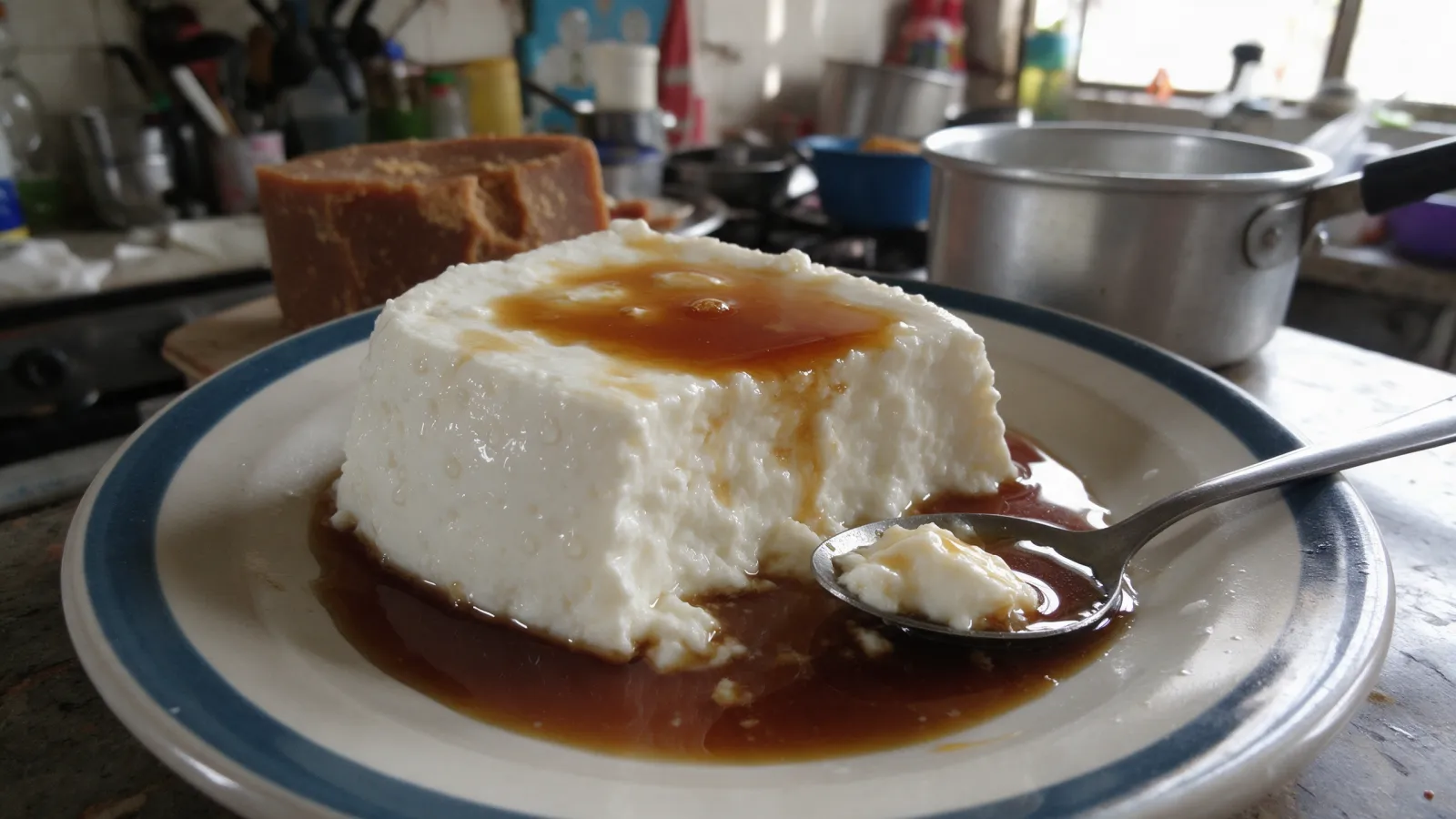

Colombians from the highlands around Bogotá end a meal with a plain white cheese and a spoonful of syrup, and it works because of the contrast: a soft, unsalted curd that tastes of fresh milk, and melao, a dark syrup of unrefined cane sugar boiled with cinnamon and clove. Two numbers decide it: rennet at 95°F (35°C) and a syrup pulled before thread stage. If you would rather skip the cheesemaking, store-bought queso fresco gets you to the table in 25 minutes.
What is cuajada with melao, and is it worth making?
How do you make cuajada with melao? Warm 1 gallon (4 liters) of pasteurized whole milk to 95°F (35°C), stir in diluted rennet and leave it 40 minutes to set. Cut the curd, drain it an hour in cloth without pressing, and chill. Meanwhile simmer 8.8 oz (250 g) of panela with 1 cup (250 ml) water, cinnamon and clove into a light syrup. 155 minutes for 6 servings.
Cuajada (kwah-HAH-dah) is a fresh cow’s-milk cheese set with rennet, drained but not pressed, and left unsalted. Melao (meh-LAH-oh), also called melado, is panela melted in water and reduced. Together they are a classic dessert of the Cundiboyacense highlands, the Andean plateau of Cundinamarca and Boyacá.
Make it if you like simple dairy desserts, have a thermometer, and want a project that is mostly waiting. Skip the homemade curd if you are cooking for someone pregnant, over 65 or immunocompromised (see the safety section), or if you only have ultra-pasteurized milk.
Time and effort. 155 minutes, about 35 of them hands-on, rated medium only because two temperatures matter. The store-bought route is easy and takes 25 minutes.
Ingredients, and what to buy in a US or UK supermarket
The card above has the amounts: 1 gallon (4 liters) of milk, rennet for that volume, 8.8 oz (250 g) of panela, 1 cup (250 ml) water, a cinnamon stick, 3 cloves and a teaspoon of lime juice. You get roughly 500 g (1.1 lb) of curd, at about 8 liters of milk per kilo of fresh cheese. Yours will vary with the milk and how long it drains.
The milk, and the carton problem
Buy whole milk labeled pasteurized, not ultra-pasteurized or UHT. Ultra-pasteurized milk is heated to about 280°F (138°C), which damages the proteins that form the curd. In the UK, ordinary fresh pasteurized whole milk works; long-life UHT does not. Use whole or 2% milk, never less, because whole milk gives a bigger yield.
Raw milk. Raw-milk fresh cheeses can carry Listeria and other pathogens. If raw milk is what you have, hold it at 145°F (63°C) for 30 minutes in an uncovered pan, restarting the timer if it dips, then cool it below 90°F (32°C) before adding rennet. That adds about an hour.
Rennet, how much
Rennet strength varies by brand, so follow the package for 1 gallon (4 liters). For single-strength liquid animal rennet, the usual dose is ½ tsp for 2 gallons, which is ¼ tsp for this recipe, setting in about 45 minutes. Dilute it in cool, non-chlorinated water just before use; rennet left sitting in water loses strength. Vegetarians can use microbial or vegetable rennet. In the UK, look for it from home cheesemaking suppliers.
Panela substitutes, and what changes
| Sweetener | Where to find it | What changes |
|---|---|---|
| Panela | Latin grocers, online | The original: dark, molasses-like syrup |
| Piloncillo | Mexican aisle in US supermarkets | Practically the same thing, sold in cones |
| Jaggery or gur | South Asian shops, US and UK | Close; also unrefined cane sugar |
| Dark muscovado | UK supermarkets | Closest UK swap; softer cane flavor |
| Dark brown sugar | Everywhere | Works, but paler and sweeter, less depth |
Cheese substitutes if you buy instead of make
- Latin queso fresco (US) → easiest to find, crumblier and saltier, 751 mg sodium per 100 g. Slice it thin and use a little more syrup.
- Queso de Burgos (Spain, and Spanish delis) → soft, moist, rennet-set and lightly salted; the closest texture.
- Farmer’s cheese (US) → drier and mild; better crumbled into the bowl.
- Paneer (UK and US) → acid-set, firmer and squeakier, unsalted. It tastes right but chews more.
- Ricotta → grainy; drain it for 2 hours first, the same trick I use for Colombian almojábanas.
Equipment
A pot of at least 5 quarts (5 liters), a kitchen thermometer, a large colander, and cheesecloth or a clean, fine kitchen towel. Boil the cloth and utensils before you start.
How to plan it, from milk to plate
The syrup fits entirely inside the hour the curd drains. The timeline also keeps the cheese within the 2-hour rule for dairy out of the fridge: about 110 minutes from rennet to refrigerator.
The temperature that matters
Rennet goes in at 95°F (35°C). The usual range runs from 90°F (32°C) to 97°F (36°C). Rennet works fastest around 104-108°F (40-42°C) and very slowly in cold milk.
How to tell each stage is right
- Milk at 95°F (35°C) → warm, no steam rising. Steam means too hot.
- Clean break at 40 minutes → the curd splits in smooth faces over clear, greenish whey.
- After draining → it holds its shape but still wobbles and feels moist.
- Syrup → bigger, slower bubbles, coats the spoon, drops in fat beads. A thin thread between your fingers means thread stage, 230-235°F (106-112°C), and it will set very thick.
Syrup at altitude
Boil a little plain water first and measure it, then take the melao off 7-9°F (4-5°C) above that. At sea level that is 219-221°F (104-105°C). In Denver or Bogotá, where water boils well below 212°F (100°C), a fixed sea-level number would overcook it.
Make-ahead and party math
- A day ahead → make the curd and keep it covered in the fridge.
- Up to a month ahead → the syrup, in a sealed jar in the fridge, as I do for the syrup in Colombian aguapanela.
- For 12 → 8 liters (2.1 US gallons) of milk, rennet for that volume, 17.6 oz (500 g) panela and 2 cups (500 ml) water. Two pots set more evenly than one crowded one.
- For 18-20 → 12 liters (3.2 US gallons) of milk and 26.5 oz (750 g) panela with 3 cups (750 ml) water, or 3.3 lb (1.5 kg) store-bought cheese. A bigger batch of syrup takes longer to reduce; trust the spoon.
Before you start, mistakes, safety and allergens
Mistakes that ruin it.
- Ultra-pasteurized milk → no set, or a weak one.
- Milk too hot → the rennet weakens and the curd never forms.
- Moving the pot while it sets → grainy curd that dumps its whey.
- Squeezing the cloth → dry, dense cheese instead of a soft curd.
- Syrup taken too far → it turns almost to candy in the fridge. Loosen it with a spoonful of hot water over low heat.
Who shouldn’t eat it. The standard advice is that pregnant women, adults 65 and older and people with weakened immune systems avoid all queso fresco-type cheeses, whether made from raw or pasteurized milk, because they have repeatedly been linked to listeriosis. At home, the controllable part is pasteurized milk, boiled utensils, under 2 hours out of the fridge, and storage at 40°F (4°C) or below.
Heat, kids and allergens. No chili at all. Kids usually like it for the syrup. The main allergen is milk; it has no gluten, egg or nuts. Animal rennet is not vegetarian.
Which version should you make?
- Short on time → store-bought cheese and just the syrup, 25 minutes.
- No rennet → lemon juice or vinegar curd: 4-6 tablespoons for 3 liters (about 3 quarts) of milk heated to the first bubbles, then at least 6 hours in the fridge. Firmer and faintly tangy, closer to paneer than to cuajada.
- For a party → curd the day before and syrup a week before; on the day, warm the syrup and slice.
- Lighter → half the syrup saves about 80 kcal a serving.
- Spiced differently → the classic is cinnamon alone; some cooks add cloves and allspice, or a strip of lime peel.
What does cuajada with melao cost?
With US average prices for August 2026 and two store prices, the homemade batch comes to $6.09, or about $1.01 a serving. Buying queso fresco instead of milk and rennet raises it to $8.18, about $1.36 a serving.
The milk is three quarters of the homemade cost: 1.06 gallons at $4.229. Piloncillo is H-E-B’s 8 oz cone at $1.28; the rennet is ¼ tsp from New England Cheesemaking’s $9.95 bottle, which sets up to 48 gallons; the queso fresco is H-E-B’s 10 oz Cacique at $3.84. I’m not giving a UK figure here.
What to expect, how to serve it and how to store it
Taste and texture. A soft, moist, milky curd that wobbles, under a dark, thick syrup that smells of cinnamon and clove.
Serving. In a shallow bowl, cheese cold or at room temperature, melao warm on top, the way it’s served hot in Bogotá’s La Candelaria. It goes well with a cup of Colombian hot chocolate or, for adults, a cold glass of chicha andina, the Venezuelan fermented corn drink sweetened with the same cane sugar, and it makes a light finish after a bowl of Colombian ajiaco. The same curd, crumbled, fills Boyacá-style arepas, and it is the cheese Colombians put next to figs in syrup.
Storage. Curd, covered at 40°F (4°C) or below: up to one week; I eat it within 2-3 days. It can be frozen for up to a month, but in my kitchen it weeps and turns grainy after thawing, so I don’t. Syrup, in a sealed jar in the fridge, up to a month.
Reheating. Only the syrup: low heat, or 20-second bursts in the microwave. A spoonful of water rescues it if it crystallizes. Don’t warm the curd; it turns rubbery and leaks whey.
Cuajada with melao questions
What is cuajada? A Colombian fresh cheese: cow’s milk set with rennet, drained without pressing and unsalted. In Spain, “cuajada” means something else, set milk eaten from a pot with honey.
Can I make cuajada without rennet? Lemon or vinegar will curdle the milk, but you get a firmer, tangier cheese, more like paneer.
Why didn’t my milk set? Usually ultra-pasteurized milk, milk well above 97°F (36°C), or rennet that was old or diluted too early.
What can I use instead of panela? Piloncillo is the same product. Jaggery and dark muscovado are close; dark brown sugar works but tastes lighter.
Is cuajada the same as queso fresco? Both are fresh cheeses. Latin queso fresco is usually saltier and crumblier; cuajada is softer, wetter and unsalted.
Is it served hot or cold? Cheese cold or at room temperature, syrup warm or hot.
Is it safe during pregnancy? Pregnant women are advised to avoid queso fresco-type cheeses, including pasteurized ones, because of Listeria.
Nutrition per serving
Per serving (about 80 g / 2.8 oz of curd with the syrup from 42 g / 1.5 oz of panela), calculated from this recipe’s quantities. Cuajada was calculated as queso fresco (299 kcal per 100 g), and panela as brown sugar.
- Calories: 408 kcal
- Protein: 15 g
- Carbohydrates: 43 g
- Sugars: 42 g
- Fat: 20 g
- Saturated fat: 11 g
- Fiber: 0 g
Nearly all the sugar is the syrup; nearly all the fat and protein is the cheese. Unpressed homemade curd holds more water than standard queso fresco, so the real figure is likely a bit lower. Sodium is left out because this curd has no added salt and the reference cheese does.
In Venezuela I grew up drinking panela, as papelón, in papelón con limón, and the fresh cheese I knew was salted and went on arepas. An unsalted curd only made sense to me once it met the syrup. My first batch in Bogotá I cooked by eye, and it set like toffee in the fridge; now I boil water first and measure. Josnaisis.