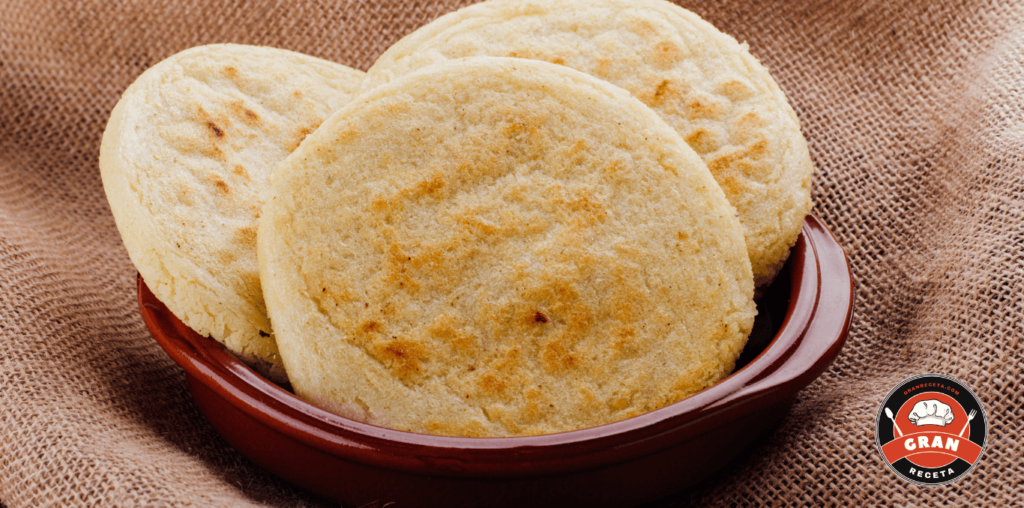
Of all Colombian arepas, the boyacense is the only one with wheat flour in the dough — 28% of the total — and that is structural rather than regional. Corn has no gluten, so a pure corn dough splits exactly where you have to close it over the filling. With wheat in it, the dough stretches and wraps the cheese. Eight arepas at 320 calories, half an hour.
How do you make boyacense arepas? Knead 2 cups of yellow masarepa with ¾ cup of wheat flour, panela, butter and ¾ cup of warm milk, and rest it 5 minutes. Fill with fresh curd mixed with panela, shape 8 arepas ⅝ inch thick and brown them in butter, 6 minutes a side. 8 arepas, 30 minutes.
What separates it from the other arepas
Four arepas, four doughs. The santandereana is hulled corn with cassava and ground pork cracklings; the Colombian cheese arepas carry the cheese inside the dough rather than as a filling; the sweet corn arepas are made from ground fresh corn and are sweet.
The boyacense is the only one with wheat and the only one that is sweet and savoury at the same time: panela in the dough, panela in the filling, unsalted curd in the middle. That contrast is what people remember.
It is also the thickest at ⅝ inch, because it has to hold a whole filling. The other three run between a quarter and three eighths.
The 28% of wheat flour
Wheat gluten forms an elastic network that corn cannot. Without it the dough behaves like damp sand: you can shape it, but stretching it to close a filling opens it at the thinnest point.
At 28% — that is ¾ cup of wheat to 2 cups of corn flour — the dough stretches just enough. Push it to half the flour and it starts tasting of bread and turns gummy; past that it is not an arepa any more.
The 5-minute rest matters as much as the ratio. Precooked corn flour keeps absorbing liquid through those minutes, and freshly worked gluten needs to relax before being stretched again.
The cheese, and what to use instead
Cuajada is fresh curd, unripened and unsalted, and inside the arepa it softens without melting. That is the requirement: a filling that is still a filling when you bite in.
Farmer’s cheese from a US supermarket is the closest substitute, slightly firmer. Ricotta works very well drained for 2 hours. Queso fresco works too, but it is salted, so cut back the panela in the filling. Mozzarella and other melting cheeses turn into a puddle and run out the side.
The tablespoon of panela in the filling is not extra sweetness for its own sake: with an unsalted curd, it is what makes the inside taste of something rather than just of dairy.
Where the 30 minutes go
Eight minutes of kneading, five of resting, seven of shaping and a dozen in the pan. Two flours and one pan, which is why this is everyday breakfast in Boyacá rather than special-occasion food.
Make it ahead
Shaped and filled arepas keep 24 hours covered in the fridge and brown straight from cold with a minute extra. They also freeze raw for a month, cooked from frozen with 2 extra minutes a side. What does not work is browning them in advance: the curd dries and the dough hardens on reheating.
What goes wrong
Leaving out the wheat flour. Without gluten the dough splits as you seal the filling.
Skipping the rest. Freshly kneaded dough tears when you stretch it.
Flattening below ⅜ inch. The filling breaks through as it heats.
High heat. They scorch outside while the cheese inside is still cold.
Overfilling. More than 1 oz per arepa and the edge will not close.
Variations
Unfilled. With the curd mixed into the dough instead, as some towns make them.
Sweeter. Double the panela in the dough, for the afternoon version.
With a stretchy cheese. Half curd, half mozzarella, so it pulls slightly.
On a dry griddle. No butter, 2 extra minutes a side and less fat.
What to serve with them
In Boyacá they are breakfast with Colombian hot chocolate or aguapanela: sweet-savoury arepa against a hot drink is the highland combination. Two arepas come to about 640 calories, a full breakfast.
At midday they go beside cuchuco de trigo or cocido boyacense, the region’s two big pots. And if you want to cross Colombia’s arepas, the santandereana from the next department is its exact opposite: savoury, thin and built on pork cracklings.
Frequently asked questions
Can I make them with corn flour only? You can, but they split as you seal the filling. The wheat is what gives the dough stretch.
What cheese if there is no cuajada? Farmer’s cheese, or ricotta drained 2 hours. Melting cheeses escape the edge.
Are they sweet or savoury? Both: panela in the dough and the filling, unsalted curd in the middle.
Can I freeze them? Raw and filled, up to 1 month. Cook from frozen with 2 extra minutes a side.
Why are mine raw inside? The heat was too high. Six minutes a side over medium-low.
Nutrition
Per arepa of about 4 oz with its filling, calculated from each ingredient according to the USDA SR Legacy database:
- Calories: 320 kcal
- Protein: 10 g
- Carbohydrates: 42 g, 9 g of it sugar
- Fat: 13 g, 7 g of it saturated
- Fibre: 2 g
- Sodium: 400 mg
The curd supplies half the protein and much of the saturated fat; the panela, nearly all the sugar. Halve the panela in the dough and cook them on a dry griddle and each arepa lands near 275 calories, keeping the sweet-savoury contrast that defines it.
In Boyacá they told me the arepa is eaten “with chocolate and without hurry”, and that the curd inside should be warm rather than melted. It took me a while to accept that an arepa could be sweet, until I tried one with the hot chocolate beside it. Josnaisis.