
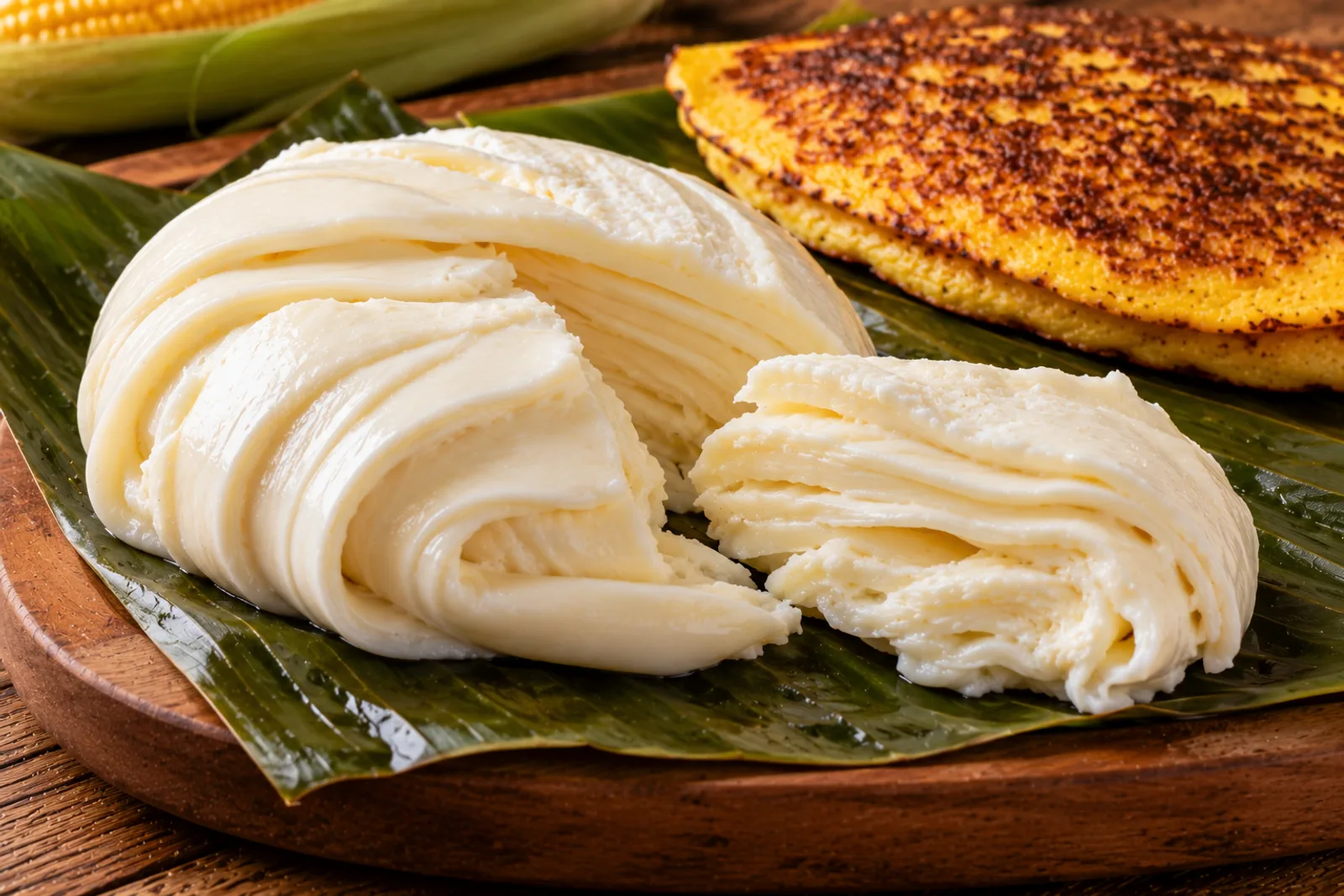

Queso de mano (KEH-so deh MAH-no, “hand cheese”) is Venezuela’s everyday fresh cheese: a soft, mild, lightly salted white round made by stretching warm curd by hand and folding it over itself, so it comes apart in thin layers when you slice it. It’s the cheese folded inside cachapas, the sweet corn pancakes, and tucked into split arepas. Outside Venezuela it’s hard to find, but about a gallon of supermarket milk, citric acid and rennet turn into roughly 14 to 16 oz of it in an hour, provided the milk is the right kind.
What queso de mano is, and how hard it is to make
How do you make queso de mano? Acidify 4 liters (about 1 gallon) of pasteurized whole milk with 1½ tsp citric acid, warm it to 90°F (32°C) and set it with rennet for 5 to 10 minutes. Cut the curd, warm it to 110°F (43°C), drain it, then stretch it in 175°F (80°C) water, folding it into layers with salt, and chill it in brine. About 60 minutes, if it sets on the first try, for about 15 oz (420 g), 8 servings.
If you’ve made fresh mozzarella, you already know the method: it’s the same family of stretched-curd cheese, called pasta filata. The difference is the finish. Mozzarella is pulled into a smooth ball; queso de mano is stretched into a sheet, salted and folded several times into a flat round, which gives it its layers and a little more salt. On Venezuelan farms the curd is left to sour on its own for hours before stretching. At home, citric acid does that in minutes, with a milder flavor.
It is not the same as Colombian cuajada, the soft unsalted curd served with panela syrup, which uses the same set milk but is never stretched.
Time. About an hour, roughly 40 minutes of it hands-on; if the curd is slow to set, it can run up to half an hour longer. Difficulty: medium. The ingredient list is short, but you need a thermometer and two temperatures matter: the milk and the stretching water.
Ingredients, and the milk that works
| Ingredient | Metric | US / UK | Notes |
|---|---|---|---|
| Whole milk, pasteurized | 4 liters | 1 US gallon + 1 cup / 7 UK pints | Not ultra-pasteurized, UHT or long-life |
| Citric acid | 1½ level tsp | 1½ level tsp | Level, not heaped |
| Liquid rennet, single strength | 1.25 ml | ¼ tsp | Or the tablet dose for 1 gallon |
| Cool unchlorinated water | 120 ml | ½ cup | Half for the acid, half for the rennet |
| Fine salt, for layers | 6 g | 1 tsp | |
| Brine | 1 liter water + 36 g salt | 1 quart + 2 tbsp salt | Ice-cold |
Why ultra-pasteurized milk won’t stretch
Ultra-pasteurized and UHT milk is heated so hard that its proteins change and can no longer knit into a firm curd. What you get is soft and grainy, like ricotta, and it won’t stretch however much heat you give it. Check the label before buying:
- US. Ordinary whole milk is fine, but many organic and some store brands are ultra-pasteurized; it says so on the carton.
- UK. Fresh whole milk from the chiller works. Long-life cartons from the shelf are UHT.
- Homogenized or not makes no difference. Skim or low-fat milk gives a drier, blander cheese.
- Raw milk is how it’s made on farms, but stretching doesn’t reliably make raw milk safe. This recipe is written for pasteurized milk.
Citric acid and rennet
Citric acid lowers the milk’s acidity to the point where the curd stretches. It’s sold as a powder in baking and canning aisles, home-brew shops, cheesemaking suppliers and online. Measure it level: too much and the curd breaks into grains.
Rennet sets the milk. Liquid rennet and tablets are sold by cheesemaking suppliers and online; vegetarian (microbial) rennet works the same way. Brands differ in strength, so follow the package dose for 1 gallon (4 liters). Dissolve it in unchlorinated water just before using it, because chlorine in tap water weakens it.
Equipment. A thermometer is the one thing you can’t skip. Add a 6-quart (6 L) stainless steel or enameled pot, a long knife that reaches the bottom, a slotted spoon, a colander, a heatproof bowl and thick rubber dishwashing gloves (or two wooden spoons).
Step by step, from milk to layered cheese
Setting the milk at 90°F (32°C)
Warm the milk slowly and turn off the heat as soon as it reads 90°F (32°C). Once the rennet is in, don’t touch it: stirring while it sets breaks the curd. In 5 to 10 minutes it should look like custard. Slide a knife in at an angle and lift: a clean split with clear, yellow-green whey means it’s ready. Milky whey and a curd that falls apart mean it needs up to 30 more minutes, covered. If it still won’t set, warm it carefully to 95°F (35°C) and wait again.
Cutting and warming to 110°F (43°C)
Cut 1 in (2.5 cm) squares, all the way to the bottom. As the curds warm to 110°F (43°C) they shrink and release whey. Stir only enough to keep them from sticking; breaking them up dries the cheese. The 2 to 5 minutes of stirring off the heat set the texture: 2 or 3 minutes for a soft cheese to melt into cachapas, 5 for a firmer one to slice.
Stretching without burning your hands
Work in a bowl on the counter, never in the pot on the burner, and wear thick rubber gloves. Water at 175°F (80°C) scalds in seconds.
What has to reach 135°F (57°C) is the center of the curd, not the water, so push the thermometer into the mass. Without one, watch for gloss and stretch: the curd turns smooth and pulls like taffy without breaking. If it tears, it’s still cold inside; give it another minute in the water.
Folding the layers
This is where it stops being mozzarella. Pull the curd into a 12 to 16 in (30 to 40 cm) sheet, sprinkle a pinch of salt over it and fold it in thirds like a letter. Pull, salt and fold 3 or 4 times. Each fold becomes a layer you’ll see when you cut it. Finish with a round about 6 in (15 cm) across and 1¼ in (3 cm) thick, and stop once it’s smooth and glossy: overworked curd turns rubbery.
Chilling in brine
7 to 10 minutes in ice-cold brine stops the cooking, firms the round and adds a little salt. Leave it up to 30 minutes for a saltier cheese. Farm cheese is wrapped in banana leaves; at home, waxed paper or a lidded container works.
Troubleshooting
- Never sets, or looks like ricotta. Almost always ultra-pasteurized milk. Nothing fixes it: drain that curd, salt it and eat it as a spread, then start over with different milk.
- Soft curd, milky whey. It needs more time, the milk didn’t reach 90°F (32°C), or the rennet was weak. Wait up to 30 minutes more, covered.
- Tears when stretched. The center is cold or the water has cooled. Reheat the water to 175°F (80°C) and dip the curd again.
- Hard, dry or rubbery. Stirred too hard, stirred too long at 110°F (43°C), or kneaded too much while stretching. Less time and fewer hands next batch.
Allergens. Contains milk. Gluten-free. Animal rennet isn’t vegetarian; microbial rennet is.
Pregnancy and vulnerable eaters. Pregnant women, adults 65 and older and people with weakened immune systems are advised not to eat fresh, unripened cheeses of this type cold, even pasteurized ones, because of the risk of Listeria: for them, only heated until steaming hot all the way through (165°F / 74°C), melted into a cachapa or arepa, never in cold slices. What you control at home: pasteurized milk, utensils scalded with boiling water, no more than 2 hours out of the fridge, and storage at 40°F (4°C) or below.
Where to buy it, and what to use instead
Queso de mano turns up in Venezuelan shops and Latin supermarkets in US cities with large Venezuelan communities, and online. In the UK it’s rare outside specialist Latin shops.
- Fresh mozzarella (cow’s milk, in whey). The closest swap: the same stretched curd, softer and less salty, in a ball rather than layers. One 8 oz (225 g) ball is enough for two cachapas, and a pinch of salt over the slices brings it nearer.
- Oaxaca cheese from Mexican groceries. Also stretched, wound into a rope; it pulls into strings and is a little drier. Works well in cachapas.
- Queso fresco and Greek-style feta don’t stretch. Fine crumbled on an arepa, not inside a cachapa.
How to use it, how much you get and how long it keeps
Yield. Regular supermarket whole milk gives about 3½ oz per quart (100 to 110 g per liter): 14 to 16 oz (400 to 450 g) from this batch. Richer milk yields a bit more.
Serving. About 3½ oz (100 g) goes inside each Venezuelan cachapa, folded over while the corn cake is hot. It also goes into hot split arepas, in slices beside sweet Venezuelan golfeados, and inside baked sweet plantains with cheese. It’s the wrong cheese for Venezuelan tequeños: it melts and leaks out of the dough in the fryer, which is why those use a firm cheese that holds its shape.
Fridge. Wrapped or in a lidded container with a splash of brine, up to 1 week at 40°F (4°C) or colder. It’s best in the first 3 or 4 days, then it starts weeping whey and turning sour.
Freezer. In wrapped 3½ oz (100 g) portions for up to 6 months for best quality. Thawed in the fridge it’s slightly grainier: still fine melted into cachapas and arepas, less nice eaten cold.
Queso de mano FAQ
Can I make it with lemon juice instead of citric acid? I don’t. Citric acid is measured and the same every time; lemon juice varies in acidity, and the stretch depends on getting the acid right.
Why is mine milder than the one I bought in Venezuela? Commercial queso de mano is usually made from curd left to sour for hours, and that fermentation is the flavor. The traditional way skips the citric acid, sets the milk with rennet at about 99°F (37°C) and lets the drained curd acidify for 8 to 24 hours until it reaches pH 5.1 to 5.3, checked with pH strips, before stretching it in water at about 167°F (75°C). With pasteurized milk it needs a splash of soured whey from a previous batch to get going. It tastes closer to the real thing but takes practice.
What do I do with the leftover whey? You’ll have about 3½ quarts. Use it instead of water in bread dough, or in place of some of the water in the storage brine. Keep it in the fridge and use it within 2 or 3 days.
Nutrition per serving
Per 1¾ oz (50 g) serving (8 from 14 oz / 400 g), calculated from a fresh whole-milk stretched-curd cheese: 150 kcal, 11 g protein, 1 g carbohydrate, 11 g fat of which 7 g saturated, 0 g fiber, 0 g sugar and 243 mg sodium. Sodium rises the longer it sits in the brine.
Most of the queso de mano I make goes straight onto cachapas, so I keep it on the soft side: two minutes of stirring, a short brine and into the fridge for the next morning. If you’ve never stretched curd before, make your first batch on a quiet afternoon with the thermometer within reach, and don’t worry if the layers come out uneven; it still melts the way it should. Josnaisis.