
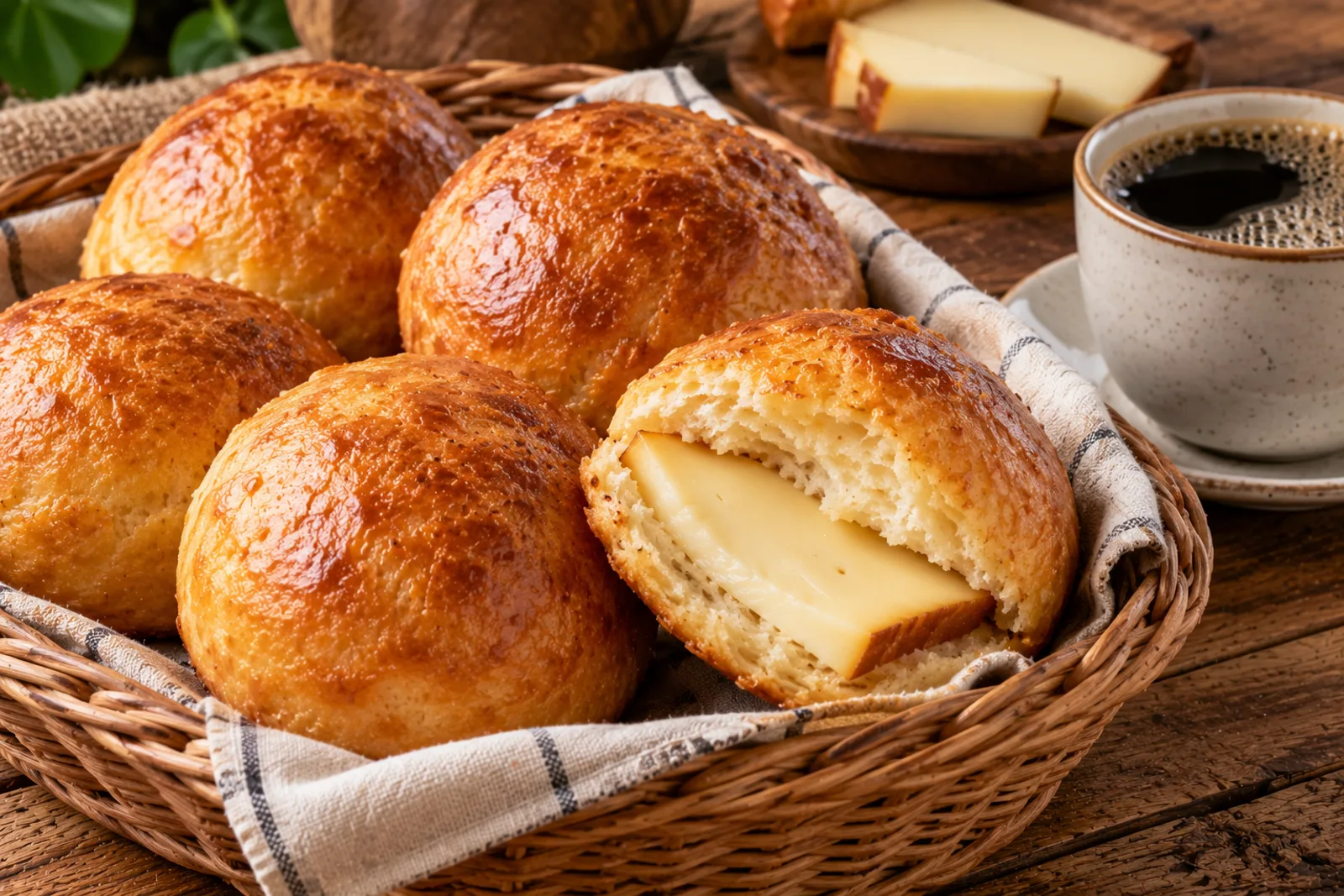

Acemas (ah-SEH-mahs) are the everyday sweet bread of the Venezuelan Andes, from the states of Mérida, Táchira and Trujillo: flat-topped rounds about 12 cm (4¾ in) across, sweetened with papelón, Venezuela’s unrefined cane sugar, and speckled with whole anise seed. The classic ones are baked plain, with no filling, and only moderately sweet, about 15 g of sugar each, because they are meant to be split and stuffed with smoked cheese or spread with natilla, a thick, tangy cream, and eaten with coffee. This batch makes 10 from 500 g (about 4 cups) of flour.
What acemas taste like, and how long they take
How do you make Venezuelan acemas? Dissolve 125 g (4.4 oz) of papelón or panela in 150 ml (⅔ cup) of water with a cinnamon stick, cool it to 95-104°F (35-40°C), and knead it with 500 g of flour, milk, an egg, 60 g (4 tbsp) of butter, instant yeast and whole anise seed. Let it double for 90-120 minutes, shape 10 flat rounds, proof 45-60 minutes and bake 20-24 minutes at 350°F (180°C), glazing with cane syrup as they come out. 230 minutes for 10 servings.
If you know brioche or challah, an acema sits somewhere less rich: there is only one egg and 60 g of butter in the whole batch. The crumb is tighter and toffee-colored from the cane sugar, with little bursts of anise. Think of it as a breakfast roll that holds a thick slice of cheese without falling apart, not a pastry.
Time. 230 minutes start to finish, about 50 of them hands-on: the syrup, the kneading, the shaping and the glaze. If you knead the night before and let the dough sit in the fridge, the morning takes about 155 minutes, mostly waiting.
Difficulty, medium. The dough is easy to handle. The cane sugar is what asks for attention: it slows the rise and makes the crust brown before the inside is done.
Ingredients and US or UK swaps
Full amounts are in the recipe card. The three that matter most:
Papelón. Venezuelan papelón, Colombian panela and Mexican piloncillo are the same thing: cane juice boiled down and set in blocks. Any of them works gram for gram. Grate it finely so it dissolves in 5 minutes.
In the US, piloncillo and panela are sold in Latin grocers and in the Hispanic aisle of many supermarkets. Dark brown sugar is the fallback; the bread comes out paler and tastes less of molasses. In the UK, dark muscovado from any supermarket baking aisle is the closest match in color and flavor.
Flour. Bread flour or all-purpose in the US; strong white bread flour in the UK. Cake flour or soft plain flour cannot hold up a dough this sweet, and the rounds spread sideways. The 50 g of whole wheat (wholemeal) gives brown flecks and a rustic note; swap it for more white flour and the acemas turn lighter and softer.
Anise seed, whole. It’s in the spice aisle next to fennel seed, and it is not star anise. Fennel seed works if that’s what you have, but it tastes greener and less sweet. For young kids, use 1 tsp instead of 2.
Yeast. One 7 g (¼ oz) packet of instant yeast goes straight into the flour. With active dry yeast, dissolve it in the warm syrup for 10 minutes first; if it doesn’t foam, replace it before you add the egg.
Equipment. A stand mixer with a dough hook helps but isn’t essential. You need 2 sheet pans, parchment, a pastry brush and a cooling rack. An instant-read thermometer takes the guesswork out of the two critical temperatures.
How to make acemas, step by step
Here is how the 230 minutes break down:
Warm syrup, not hot
Melt the papelón in the water with the cinnamon over low heat, then let it cool with the stick in. The cold milk goes in afterwards and brings the temperature down faster. Before the yeast touches it, the mixture should be 95-104°F (35-40°C), comfortable on your fingertip. Hot syrup is the costliest mistake in this recipe: the dough simply won’t rise.
Knead to a thin sheet
Mix the flours with the yeast and anise, add the syrup, milk and egg, then the salt once there’s no dry flour left. Butter goes in last, in 2 additions. Knead 10-12 minutes by machine or 15 by hand, until a piece stretched between your fingers turns thin enough to see light through before tearing. With whole wheat in the mix it tears a little sooner; that’s fine.
The dough should stay a touch tacky. Every extra spoonful of flour you add to stop the sticking shows up later as a dry acema.
First rise until doubled
Covered, at 75-80°F (24-27°C), it takes 90-120 minutes to double. Mark the level on the bowl with tape. The sugar slows the yeast, so in a cool kitchen it can take longer than 2 hours. Wait for the volume, not the timer.
Shape flat rounds
Divide into 10 pieces of 100 g (3½ oz), round each one tight against the counter and rest them 10 minutes so they flatten without shrinking back. Press each into a disc 10 cm (4 in) across and 1.5 cm (⅝ in) thick. They grow to about 12 cm (4¾ in) in the oven, so put just 5 on each pan.
The finger test
Proof 45-60 minutes. Press a floured finger 1 cm (⅜ in) into the edge of one round. Springs back slowly and leaves a small dent: ready. Springs back fast: give it 10 more minutes. No spring at all and the surface wrinkles: overproofed, bake right away and expect them flatter.
Bake by sound and temperature, not color
Brush with the yolk and milk, then bake at 350°F (180°C), or 325°F (160°C) with convection, both pans at once, 20-24 minutes, swapping racks at 11 minutes.
Cane sugar browns early, so an acema can look finished at 15 minutes and still be gummy inside. They’re done when the crust is evenly mahogany, the bottom sounds hollow when tapped and the center reads 190-194°F (88-90°C). If they’re very dark at 12 minutes, tent with foil and finish the time.
Brush with the glaze (25 g papelón boiled 2 minutes with 2 tbsp water) the moment they come out. It goes on at the end because in the oven it would burn. Then 20 minutes on the rack before you split them, so the crumb can set.
Troubleshooting
- Dense and short. The syrup was too hot or the yeast was old. Measure 95-104°F (35-40°C) and proof the yeast if in doubt.
- Flat, split at the sides. Overproofed, or a soft cake flour.
- Dark outside, raw inside. Oven above 350°F (180°C).
- Dry the next day. Too much flour at kneading, more than 24 minutes of baking, or stored in the fridge.
- Sticky sugar lumps in the crumb. Papelón chunks that never dissolved. Grate it finely.
Variations
More whole wheat. For something closer to the semi-whole-wheat flour used in the Andes, use 250 g bread flour and 250 g whole wheat. The crumb turns denser and darker, the dough wants 1-2 tbsp more milk, and the first rise may need the full 120 minutes.
Sugar-topped. Skip the glaze and sprinkle 1 tsp sugar on each round after the egg wash, before baking, as in the acemas from Carache, in Trujillo state.
Filled with guava paste and cheese. Flatten a round, place about 15 g (½ oz) guava paste and 15 g (½ oz) fresh white cheese in the center, pinch the dough closed over it and flip it seam side down. Proof and bake the same.
Double batch. For 20, double everything including the yeast (14 g / two packets). With 4 pans, shape the second batch 25 minutes after the first so it isn’t overproofed while it waits.
How acemas are eaten in the Andes
Split warm, with a slice of queso ahumado, about 30 g (1 oz) of firm Andean smoked cheese, or spread with natilla, a thick, slightly sour cream. Away from Venezuela:
- US. Latin grocers sometimes stock a Venezuelan or Central American smoked cheese; otherwise smoked provolone or smoked mozzarella. Latin crema or sour cream covers the natilla.
- UK. A firm smoked cheese from the deli counter, or smoked Cheddar, and crème fraîche for the natilla.
With coffee or hot chocolate. For a full Andean breakfast, put them next to a bowl of pisca andina, the milky potato and egg soup, and a stack of Andean wheat arepas. In the afternoon, a glass of chicha andina goes well. If you’ve made golfeados, the sticky papelón-and-cheese rolls, acemas are their plainer cousin, and Andean pastelitos are the savory pastry sold beside them.
Cost. The dough is pantry staples; the smoked cheese and the butter are what make breakfast expensive.
Storing, freezing and reheating
- Room temperature. Fully cooled, in a closed bag or tin, 2-3 days. On day two the crumb is firmer and best for dunking in coffee.
- Not the fridge. It stales bread faster than the counter.
- Freezer. Cooled, in a freezer bag with the air pressed out, up to 2 months. Freeze them split so they go straight into the toaster.
- Reheat. Thaw overnight in the fridge or a couple of hours on the counter in the bag, then 5-8 minutes at 350°F (180°C). In the microwave, 15 seconds wrapped in a damp paper towel, only if you’re eating it right away; it hardens as it cools.
FAQ about Venezuelan acemas
Can I make them without eggs? Yes. Replace the egg in the dough with 50 ml (3½ tbsp) more milk and brush with milk instead of yolk. They come out paler and a little less soft.
Can I use white sugar? The yeast won’t mind, but you lose what makes an acema: the toffee color and cane flavor. Dark brown sugar or dark muscovado is a much better fallback.
Why is my crumb gummy? Almost always underbaking, because the color fooled you. Give them the full 20-24 minutes and check for 190°F (88°C) in the center.
How many from 1 kg (2.2 lb) of flour? Twenty 100 g rounds, doubling every ingredient.
Nutrition per acema
Per acema (1 of 10), unfilled, calculated ingredient by ingredient from the recipe card:
- Calories: 303 kcal
- Protein: 8 g
- Carbohydrates: 52 g
- Fat: 7 g, of which 4 g saturated
- Fiber: 2 g
- Sugars: 15 g
- Sodium: 251 mg
The cane sugar supplies almost all the sugar, and the flour most of the rest. A 30 g (1 oz) slice of smoked cheese adds about 100 kcal. Main allergens: wheat (gluten), egg and milk.
I don’t pull acemas by the clock. I flip one over with a towel, tap the bottom, and if it sounds hollow they’re out. I always bake all 10, because the leftovers from Sunday are the ones that dunk best in Tuesday’s coffee, and the frozen halves toast in a couple of minutes. Josnaisis.