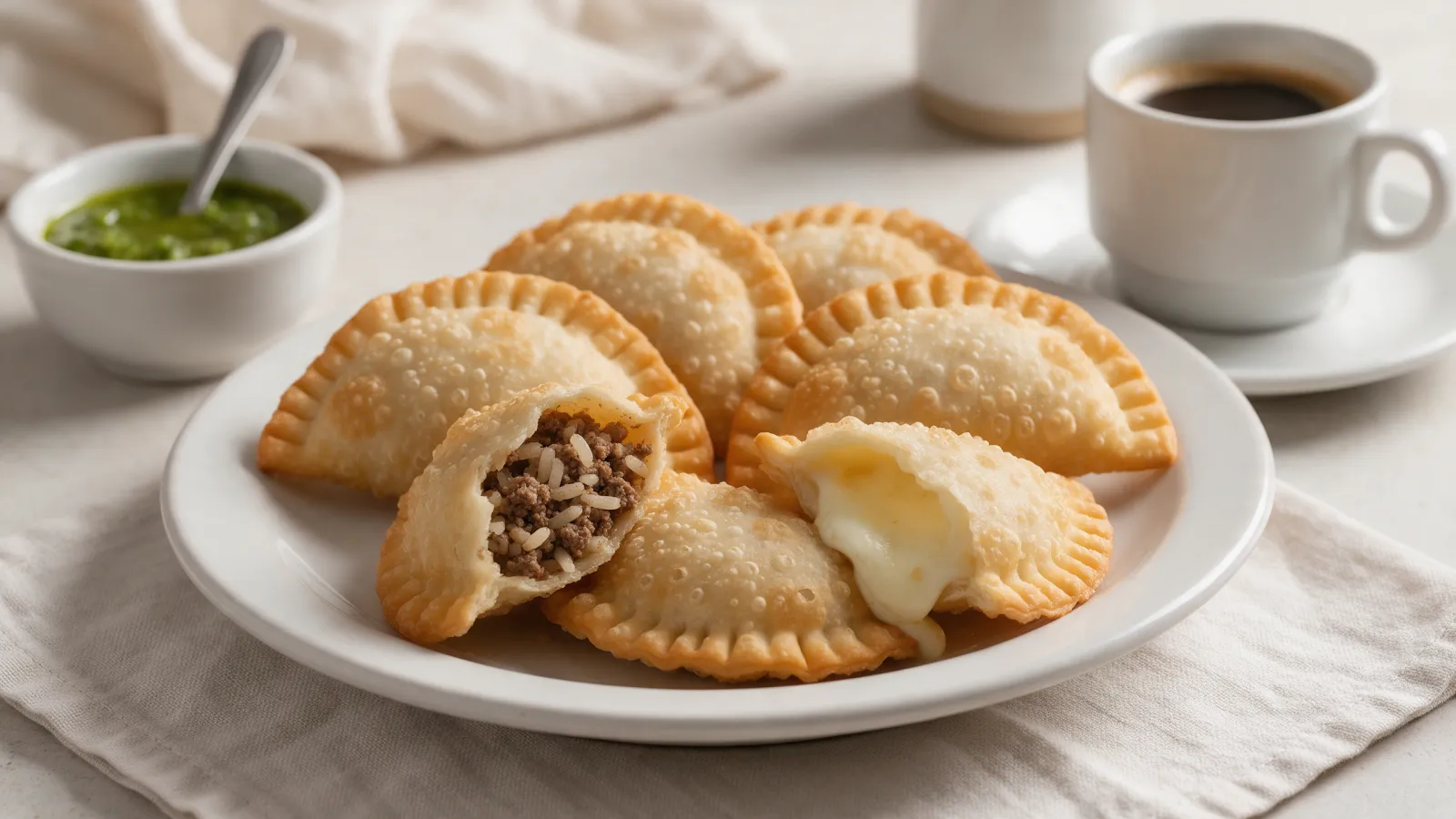

Pastelitos andinos (pah-steh-LEE-tohs ahn-DEE-nohs) are small fried turnovers from the Venezuelan Andes, made with a plain wheat dough rolled almost paper-thin, filled with a spoonful of beef and rice, cheese, potato or chicken, and fried until the crust puffs into dozens of tiny blisters. EcuRed places them at the breakfast table in Mérida, Táchira and Trujillo, the three Andean states, and English-language Wikipedia notes they’re usually eaten in the morning. The blisters are the point, and they come down to a thickness you can measure with a ruler: 2 mm (1/16 inch). Below you’ll find the dough, the four classic fillings, scaling up for a party of 40, the freezer, and an honest look at the air fryer.
Are Venezuelan pastelitos andinos worth making at home?
How do you make pastelitos andinos? Knead all-purpose flour with water, a little oil, 1 tablespoon of sugar and salt, rest it 30 minutes and roll it to 1.5-2 mm (1/16 inch). Spoon cold filling onto one sheet, cover with a second, press out the air, cut 3½-inch (9 cm) rounds and crimp with a fork. Fry at 350°F (175°C) for 3-4 minutes until blistered. 105 minutes for 6 servings (24 pastelitos).
Yes, if you’re cooking for more than two. One batch of 500 g (4 cups) flour gives 24 pastelitos, and they freeze raw and fry straight from frozen, so a single afternoon covers several breakfasts. What sets them apart from other fried turnovers is the shell: very thin, crackly, a little sweet from the sugar, and barely greasy when the oil is hot enough.
Best for. A weekend breakfast with coffee, a brunch where people eat with their hands, a party tray, or a freezer stash.
Maybe not for. A weeknight, because the first time takes 105 minutes. Anyone who won’t deep-fry, since the oven and the air fryer give a decent turnover but not the blisters (compared below). And anyone avoiding gluten: the dough is wheat and has no honest swap.
Real time. 105 minutes total, about 75 hands-on, or 80 on the day if you make the filling the night before.
Difficulty, medium. The filling is easy. The skill is rolling to 2 mm without tearing and sealing without trapping air, and your first four will look worse than the next twenty.
Not the same as empanadas, tequeños or Cuban pastelitos
In a Cuban bakery, pastelitos are puff-pastry pastries such as guava and cheese. In Argentina, pastelitos criollos are layered pastries filled with quince or sweet potato paste. The Venezuelan Andean ones are neither: no puff pastry, no sweet filling, just a lean wheat dough that blisters in the fryer.
Inside Venezuela, the closest relatives are Venezuelan empanadas, which use precooked white cornmeal instead of wheat, roll to 3-4 mm and hold twice the filling, and tequeños, whose wheat dough is enriched with butter and egg and wrapped in strips around a stick of cheese. In Maracaibo, in the west, pastelitos are sold with ground beef, cheese, cheese and potato, or chicken. I couldn’t find a reliable source on how that dough differs from the Andean one, so I won’t guess.
What you need, and what to buy in a US or UK store
The card above has every quantity: for the dough, 500 g (4 cups) flour, 230 ml (1 cup minus 1 tbsp) water, 40 g (3 tbsp) oil, 15 g (1 tbsp) sugar and 6 g (1 tsp) salt. At 230 ml per 500 g of flour, the dough rolls to 2 mm without sticking; the eggless doughs in the ten published Venezuelan recipes I checked range from 150 to 265 ml.
The dough, ingredient by ingredient
- Flour → regular all-purpose, or UK plain flour. Not self-rising: some recipes add baking powder, but I leave it out, because steam already puffs the dough and leavening makes it thicker and less crisp.
- Water → about 46% of the flour weight, and it’s what creates the blisters. Drier dough cracks when you roll it and puffs less.
- Oil → makes the dough tender and easier to roll. Butter, margarine or lard in the same amount also appear in family recipes; the flavor shifts, the method doesn’t.
- Sugar → 1 tablespoon doesn’t make them sweet and doesn’t cause the bubbles. It helps the crust brown within 3-4 minutes; more than 2 tablespoons and it darkens before it crisps.
- Egg → several recipes add 1 or 2 per 500 g (4 cups) flour for a yellower, softer dough. Take out about 40 ml (2½ tbsp) of water per egg.
- A splash of aguardiente or vinegar → some families add 1 tablespoon for extra bubbles. I found no evidence that it works, and my blisters are the same without it. If it’s your family’s way, swap it for the same amount of water.
The four classic fillings, sized for 24
- Beef and rice → the recipe card version: 250 g (9 oz) ground beef and 150 g (1 cup) cooked rice.
- Cheese → 400 g (14 oz) firm white cheese, coarsely grated rather than cubed so it spreads evenly and leaves the edge clean. In the US, queso blanco, queso para freír or a firm queso fresco; in the UK, halloumi or paneer. Mozzarella and cheddar melt into liquid and find their way out of the seal.
- Potato and cheese → 300 g (10½ oz) boiled potato, mashed cold, with 150 g (5 oz) grated cheese and a chopped scallion. The usual meatless choice.
- Chicken → 300 g (10½ oz) cooked breast, finely shredded and cooked down with the same vegetables as the beef until dry.
Where to find the Latin ingredients. Ají dulce is a small, sweet, perfumed pepper with no heat; US Latin markets sell it fresh or frozen, and in the UK it’s hard to find, so mini sweet peppers or a pointed sweet pepper stand in. Annatto (achiote) is in the Latin aisle as powder or paste; sweet paprika only replaces its color.
Equipment. A rolling pin, a 3½-inch (9 cm) cutter or a glass that size, a fork, an 8-inch (20 cm) pot, a cooking thermometer and a wire rack. A pasta roller makes the 2 mm sheet much easier; start at the widest setting and work down.
Make-ahead plan and cooking for a crowd
The night before. Make the filling and refrigerate it; the USDA FSIS gives cooked meat 3-4 days at 40°F (4°C), and cold filling is firmer and easier to portion. The dough keeps up to 24 hours wrapped in the fridge; give it 20 minutes at room temperature before rolling. Don’t refrigerate assembled raw pastelitos overnight, because the filling dampens the dough. Freeze them instead.
Freezing raw pastelitos. Freeze them on a tray, not touching, for about 2 hours until hard, then bag them. They keep good quality for up to 3 months; at 0°F (-18°C) the FSIS considers frozen food safe indefinitely, it’s the texture that slowly fades. Fry them straight from the freezer at 340°F (170°C) for 5-6 minutes. Thawed first, the dough sweats and tears.
How many to make. I plan on 3 per person at a breakfast with other food on the table and 4 when they’re the main event, as on the recipe card.
| Guests | Pastelitos | Flour | Ground beef | Cooked rice | Batches of 4 |
|---|---|---|---|---|---|
| 6 | 24 | 500 g (4 cups) | 250 g (9 oz) | 150 g (1 cup) | 6, about 25 min |
| 20 | 60 | 1.25 kg (10 cups) | 625 g (1⅜ lb) | 375 g (2½ cups) | 15, about 1 hour |
| 40 | 120 | 2.5 kg (20 cups) | 1.25 kg (2¾ lb) | 750 g (5 cups) | 30, about 2 hours |
For 40, frying is the bottleneck; two pots of oil at once halve it. Knead in 500 g (4-cup) batches, the size that’s comfortable by hand, and spread the assembly over two or three days with the freezer.
Rolling, sealing and frying, and how to tell each stage is right
Why the dough blisters
Water boils at 212°F (100°C). When a 2 mm sheet of dough hits oil at 350°F (175°C), its water flashes to steam within seconds, the surface dries into a skin, and the steam trapped beneath pushes it up into blisters. Snack manufacturers have studied this in detail: patents on fried sheeted doughs, such as US4931303, state that blistering increases as dough moisture increases, and that docking the dough (pricking it) lets steam escape. That gives three rules: thin dough, hot oil, and a dough moist enough to make steam. The two toothpick holes don’t stop the small blisters; they stop the whole pastelito from ballooning and bursting at the seam.
Rolling thin without tearing
Rest is what lets you reach 2 mm; freshly kneaded dough shrinks every time you roll it. Work with half the dough and keep the rest covered, since exposed dough crusts over in about 10 minutes. Use as little flour as possible, because extra flour on the surface stops the two sheets from sealing. Roll from the center outward and keep turning. A tear can be pinched closed; a sheet that springs back needs another 10 minutes under cover.
Sealing so they don’t burst
- Trapped air expands in the oil and forces the seam. Press from the filling outward before cutting.
- A dusty or greasy edge won’t stick. Keep ¾ inch (2 cm) clean and dab it with water.
- Warm or wet filling steams from the inside. Cold and dry, every time.
The fork finishes the seal; it doesn’t replace pressing.
Oil temperature and timing
350°F (175°C) for fresh pastelitos, 3-4 minutes total, turning once. Published recipes range from 350 to 375°F (175-190°C); I stay at the low end because the dough is so thin that at 375°F it browns before it finishes puffing. Fry 4 at a time, since each cold pastelito drags the temperature down.
| Moment | What you should see |
|---|---|
| Going in | vigorous bubbling, and the surface covers in blisters within 10-15 seconds |
| Turning, after 1½-2 min | pale gold underneath, blisters set and firm |
| Coming out | even gold color, and they sound hollow when tapped with tongs |
| Between batches | wait for 350°F (175°C) again, usually about 1 minute |
Mistakes, spice level, kids and allergens
- Smooth, no blisters → dough too thick or oil too cool. Roll thinner and wait until a test scrap rises in 2-3 seconds.
- Greasy → oil below 320°F (160°C) or too many in the pot. Batches of 4.
- They split in the oil → trapped air, a floured edge or warm filling.
- Dough shrinks back → not enough rest. Another 10 minutes, covered.
- Brown outside, raw dough inside → oil above 365°F (185°C). Lower the heat and wait a minute.
- Frozen ones burst → they were thawed first. Fry straight from frozen at 340°F (170°C).
Heat level, 0 out of 5. Ají dulce is a sweet pepper. Serve hot sauce on the side if you want it.
Kids. Usually a hit, especially cheese or potato and cheese. The filling comes out very hot, so give them 3-4 minutes.
Allergens. Wheat (gluten) in the dough; milk in the cheese fillings; egg only if you use the egg dough. The beef and rice filling is dairy-free.
Deep-fried, oven or air fryer, which version to make
- Short on time → the cheese filling needs no cooking and saves 35 minutes.
- Oven → 400°F (200°C) for 15-18 minutes, brushed with beaten egg. Golden and dry, closer to a biscuit, no blisters.
- Air fryer → 375°F (190°C) for 8-10 minutes, brushed with 1 teaspoon of oil per 4 pastelitos and flipped halfway; 12-14 minutes from frozen. The best option if you won’t deep-fry, but they come out flat with only a few blisters.
- Vegetarian → potato and cheese, or cheese alone. Vegan → the dough on the card already is; fill it with potato, scallion and ají dulce.
- Andean extras → chopped hard-boiled egg and chickpeas with the beef, as chef Sumito Estévez suggests, or stewed trout, another filling found in the Andes.
What pastelitos andinos cost
With US city average prices from the Bureau of Labor Statistics for August 2026, the flour (0.548 $/lb), ground beef (6.923 $/lb), rice and sugar for 24 pastelitos come to $4.58, about 19 cents each, and the beef is 83% of it. The BLS doesn’t track frying oil, onions or ají dulce, so the real figure is a little higher. The cheese version costs more: firm white cheese isn’t tracked either, and at the cheddar average of 5.983 $/lb as a floor, 400 g (14 oz) is at least $5.28.
The expensive part is the oil if you throw it away after one session. Let it cool, strain it, and use it for the next round of frying.
What to expect, how to serve them and how to store them
Taste and texture. A shell that shatters, faintly sweet, with a juicy but not wet filling. Two or three bites each, best within 10 minutes of the fryer.
Serving. At breakfast with café con leche. I put out guasacaca, the Venezuelan avocado and herb sauce, and Venezuelan garlic sauce for dipping. For a full Andean breakfast, add a bowl of pisca andina, the milky potato and egg broth; on a cold day they also work as a starter before chupe andino. If you’re building a Venezuelan brunch spread, ham-filled cachitos are the other wheat-dough classic.
Fridge. Cooked food can sit out 2 hours at most and then keeps 3-4 days at 40°F (4°C), according to the USDA FSIS. Fried pastelitos lose their crunch in the fridge; raw ones go in the freezer, not the fridge.
Reheating. Air fryer or oven at 350°F (180°C) for 4-5 minutes, to 165°F (74°C) in the center. The microwave turns the dough rubbery.
Frequently asked questions
Why don’t my pastelitos blister? The dough is too thick or the oil too cool. Roll to 1.5-2 mm (1/16 inch) and fry at 350°F (175°C).
Why do they burst open when frying? Trapped air, a floury or greasy edge, or warm, wet filling. Press the air out, dampen a clean ¾-inch (2 cm) border and fill them cold.
What’s the difference between pastelitos andinos and empanadas? Venezuelan empanadas use precooked cornmeal, are thicker and smooth, and hold about 40 g of filling. Pastelitos use a kneaded wheat dough rolled to 2 mm that blisters, with about 20 g of filling.
Can I fry pastelitos from frozen? Yes, without thawing, at 340°F (170°C) for 5-6 minutes.
Can I make pastelitos andinos in an air fryer? Yes, at 375°F (190°C) for 8-10 minutes, brushed with oil. Crisp, but flat and with few blisters.
Can I use store-bought empanada discs? You can, but the ones I’ve tried are thicker than 2 mm and fry smooth rather than blistered. If you use them, roll each disc thinner before filling.
Which cheese works in the US or UK? A firm cheese that softens without running: queso blanco, queso para freír or firm queso fresco in the US; halloumi or paneer in the UK.
How many pastelitos per person? 3 at a breakfast with other food, 4 as the main dish. For 20 people, 60 pastelitos from 1.25 kg (10 cups) of flour.
Nutrition per serving
Per serving of 4 beef and rice pastelitos, calculated ingredient by ingredient from USDA FoodData Central (SR Legacy) with the quantities in this recipe and 5 g of absorbed oil per pastelito, my own estimate and the figure that varies most with oil temperature:
- Calories: 706 kcal
- Protein: 18 g
- Carbohydrates: 76 g
- Fat: 36 g, of which 5 g saturated
- Fiber: 3 g
- Sugars: 4 g
- Sodium: 613 mg
One pastelito is about 177 kcal, and frying oil accounts for about 44 of them. Air-fried with a teaspoon of oil per 4, a serving drops to about 570 kcal. The cheese filling is saltier: 400 g (14 oz) of queso blanco adds about 470 mg of sodium per serving.
The first batches I made in my own kitchen came out smooth and heavy, because I rolled the dough like empanada dough. The day I rolled it thin enough to be nervous about lifting it, the whole surface bubbled up in the pot. Thin dough, hot oil, cold filling. Josnaisis.