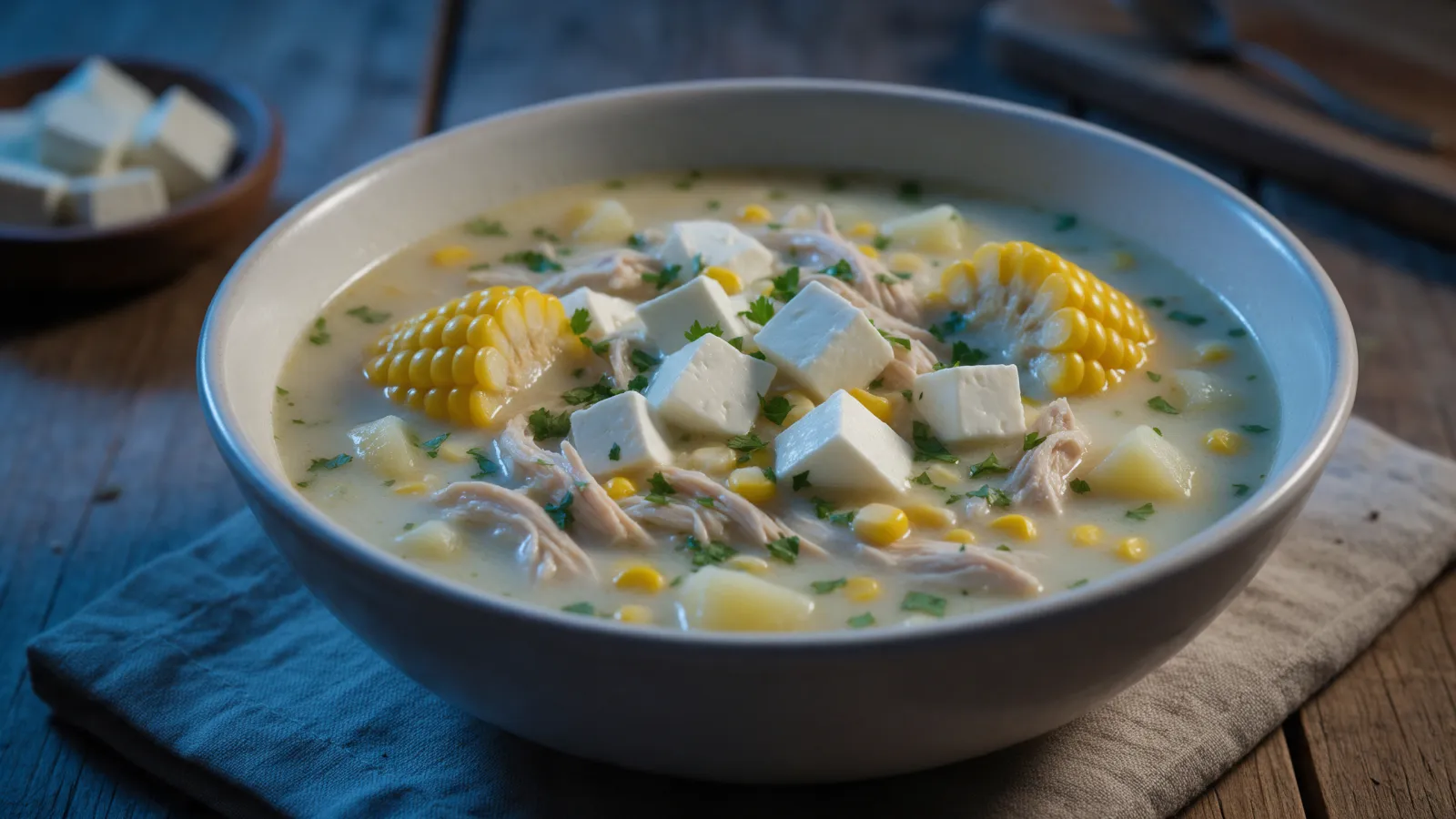

Chupe andino (CHOO-peh ahn-DEE-noh) is what Venezuelans in the Andes, the states of Mérida, Táchira and Trujillo, make when they want one bowl to be the whole meal: a creamy chicken soup with potato, sweet corn, milk and cream, poured over cubes of fresh white cheese. If you know corn chowder, you’re halfway there, with two differences. There’s no flour or roux; the potato thickens it. And the cheese never goes into the pot. It waits in the bottom of each bowl and softens as the hot soup lands on it. Below is a version for 8 that you can split over two days, what to buy in a US or UK supermarket, how to stop the milk from curdling, and what it costs.
What is Venezuelan chupe andino, and is it worth making?
How do you make Venezuelan chupe andino? Simmer 1.2 kg (2.6 lb) of bone-in chicken in 2 liters (8½ cups) of water with parsley, mint and scallions for 40 minutes, then shred the meat. Soften onion, bell pepper and garlic in butter, add the strained stock, potatoes and corn and simmer 18 minutes. Return the chicken, then stir in milk and cream over the lowest heat without boiling, and ladle over cubes of queso fresco. 90 minutes for 8 servings.
It’s worth it if you’re feeding a group or want lunch sorted for two days. Each bowl holds about 700 g (1½ lb) of soup with chicken, potato, corn and cheese, 641 kcal, so nothing else needs to go on the table except bread or arepas.
When it shines. A cold weekend, a family lunch for 8 to 20, or any day you want to cook ahead: the base keeps in the fridge, and finishing it takes 15 minutes.
When to skip it. On a weeknight with 40 minutes to spare (there’s a 35-minute rotisserie-chicken version further down). If someone at the table avoids dairy, since milk, cream and cheese are half the dish. Or if you want a light starter; this is a main course.
Time and effort. 90 minutes on the clock, about 45 of them hands-on. The 40-minute stock looks after itself, and peeling and cutting fit inside it.
Difficulty, medium. No hard techniques. Two rules decide whether it works: the dairy goes in last and never boils, and the cheese goes in the bowl.
Chupe andino vs corn chowder, pisca, ajiaco and Peruvian chupe
The word chupe covers different dishes in different countries, so here’s how this one compares.
- Corn chowder → the closest thing in an American kitchen. Chowder is usually thickened with flour or a roux and often starts with bacon; chupe has neither, gets its body from potato starch, and adds fresh cheese in the bowl.
- Pisca andina → the Venezuelan Andes’ breakfast soup. Also milk, potato and cheese, but made in 20 minutes with water and milk, an egg poached in the pot, and no chicken or corn.
- Colombian ajiaco → Bogotá’s thick chicken and potato soup, built on three potatoes and an herb called guascas. It has no milk in the pot; the cream goes on at the table with capers and avocado.
- Peruvian chupe → the famous one is chupe de camarones, a shrimp chowder associated with Arequipa. Same family idea, seafood instead of chicken.
- Chilean chupe → baked. Marca Chile’s chupe de queso is a potato and carrot purée topped with cheese and browned at 180°C (356°F).
For a clear chicken broth with vegetables and no dairy, a Mexican caldo de pollo is the better fit; for a hen soup with plantain and cassava, a Colombian sancocho.
Shopping list, with US and UK swaps
The full quantities are in the recipe card: 1.2 kg (2.6 lb) bone-in chicken, 1 kg (2.2 lb) peeled potatoes, 4 ears of corn, 750 ml (3⅛ cups) whole milk, 250 ml (1 cup) cream and 400 g (14 oz) cheese for 8 bowls. I settled on them after comparing six published Venezuelan recipes, which range from a single chicken breast to a whole stewing hen, and scaling to 8 bowls of about 700 g. Four items need a word.
Chicken with the bone in
The bones make the stock. Bone-in, skinless pieces, half thigh and half breast, give about 1.7 liters (7 cups) of full-bodied stock in 40 minutes, and the thigh meat stays moist where breast alone dries out. Boneless breast gives a thin, flat broth. Skinless means almost no fat to skim.
The herb bundle is a mix Andean cooks call compuesto: parsley, spearmint and scallions tied together. Spearmint is the one you’ll notice, a cool note that sets this apart from a standard chicken soup. Any fresh mint works; the supermarket kind sold simply as “mint” is usually spearmint.
Corn, fresh, frozen or canned
Venezuelans call fresh corn jojoto. The soup uses it two ways, rounds you pick up and gnaw, and loose kernels so every spoonful has some. USDA figures put a medium ear at about 102 g of kernels, so 4 ears give roughly 400 g (14 oz), the amount to use if you swap.
Cheese that softens without turning stringy
The cheese should be a fresh white cheese that softens in hot liquid but doesn’t melt into strands. In the US that’s queso fresco or queso blanco, sold in the Latin dairy section of most supermarkets. In the UK, Latin grocers and online shops carry it, and paneer is the easiest supermarket swap.
Plenty of Venezuelan recipes put the cheese in the pot near the end. I put it in the bowl: everyone gets whole cubes that soften in about 2 minutes, nothing catches on the bottom of the pan, and the leftovers reheat without a cheesy crust.
Milk and cream
Use whole milk; skim curdles more easily and makes a thinner soup. For the cream, US heavy cream or UK double or whipping cream. The higher the fat, the better it copes with heat. UK single cream has much less fat and splits far more readily, so leave it for coffee.
Equipment
A 6-liter (6-quart) pot, a strainer, a cutting board and a heavy knife for the corn. An instant-read thermometer isn’t essential, but it’s the only reliable way to confirm 165°F (74°C) for the chicken and for leftovers.
The plan, and how to tell each stage is right
90 minutes start to finish, about 45 hands-on. Chupe has two stages: the base, which is everything until the chicken goes back in at minute 84, and the dairy, the last 6 minutes. The base can be made the day before; the dairy is always added on the day.
Make-ahead, the day before
Make the whole base (stock, aromatics, potatoes, corn and chicken), cool it within 2 hours and refrigerate. On the day, bring it to a boil, turn the heat to the lowest setting and add the milk and cream: 15 minutes to the table. The potatoes keep releasing starch in the fridge, so the base thickens; loosen it with ½ cup (120 ml) of water per liter if needed.
Signs it’s going right
- Stock → the water shivers without rolling bubbles; a hard boil makes it cloudy. You should strain out about 1.7 liters (7 cups).
- Chicken → the meat pulls away from the bone and reads 165°F (74°C).
- Aromatics → onion translucent and pepper soft after 5 minutes, no browned edges.
- Potatoes → at 18 minutes a knife slides in and the cube edges look ragged; the liquid turns from clear to opaque.
- Thickness → the soup lightly coats the back of a spoon, like a thin cream sauce, not a purée.
- Dairy → steam rises and the surface shivers; if bubbles start rising, pull the pot off the heat for 30 seconds.
Why the milk goes in last
Milk curdles when its proteins clump, and heat, salt and acid all push it that way; the hotter and longer, the more likely. This soup already has salt and salty cheese, so heat is the one thing you can control. That’s why the dairy goes in last, warmed, over the lowest heat, for just 5 minutes, and why there’s cream in the mix: fattier dairy is more forgiving. Curdled chupe is safe to eat, but grainy, and there’s no fixing it.
Keeping the base dairy-free has a second payoff. USDA FSIS advises bringing leftover soup to a boil, which the base can take and milk can’t.
Scaling for 4, 16 or 20
Per bowl, allow 150 g (5¼ oz) bone-in chicken, 250 ml (1 cup) water, 125 g (4½ oz) peeled potato, half an ear of corn, about 95 ml (⅓ cup) milk, 30 ml (2 tbsp) cream and 50 g (1¾ oz) cheese.
- For 4 → halve everything and use a 4-liter (4-quart) pot. The stock needs about 35 minutes; everything else stays the same.
- For 16 → double it in a 10 to 12-liter pot, or two 6-liter pots. Allow about 10 extra minutes for the stock to come back to a boil and 2 to 3 extra for the potatoes.
- For 20 → 3 kg (6.6 lb) chicken, 5 liters (5¼ quarts) water, 2.5 kg (5.5 lb) potatoes, 10 ears of corn, 1.9 liters (8 cups) milk, 625 ml (2⅔ cups) cream and 1 kg (2.2 lb) cheese. Make the base the day before in two pots and, on the day, add dairy only to the amount you’ll serve in the next half hour.
To hold it on a buffet, FSIS says hot food should stay at 140°F (60°C) or above: a pot on the lowest burner or a slow cooker on warm, stirred now and then.
Before you cook, mistakes, spice, kids and allergens
The critical points. The dairy goes in at minute 84 on the lowest heat, the cheese goes in the bowl, and the chicken reaches 165°F (74°C), the USDA FSIS safe temperature for poultry.
Common mistakes.
- Curdled milk → it boiled, or cold milk hit very hot soup. Lowest heat, warmed dairy, pull the pot off at the first bubble.
- A cheese clump stuck to the pan → the cheese went into the pot over heat. Put it in the bowls.
- Thin and watery → not enough potato, or the cubes didn’t break down at the edges. Press 6 to 8 cubes against the side of the pot and simmer 3 more minutes before the dairy.
- Thick as mashed potato → too much potato or too much reduction. Add stock or hot water before the dairy, never once it’s simmering with milk.
- Too salty → the cheese adds more than you’d think, about 350 mg of sodium per 50 g (1¾ oz) of queso blanco by USDA figures. Taste before the last salt.
- Dry chicken → breast only, or overcooked. Use thighs too, and return the meat only for the last 6 minutes.
Heat level, 0 out of 5. It isn’t spicy at all. Put hot sauce on the table if your household likes it.
Kids. Usually a hit: mild, a little sweet from the corn and milk, with soft cheese. Check for small bones when shredding and let bowls rest 2 minutes, because the soup comes out very hot.
Allergens. Dairy (milk, cream, butter, cheese). No gluten, egg, nuts, soy or fish. If you buy stock or packaged cheese, read the label.
Which version should you make?
- Short on time → one store-bought rotisserie chicken, skinned and shredded, plus 1.7 liters (7 cups) of low-sodium chicken stock. Aromatics, potatoes and corn 18 minutes, chicken 6, dairy 5: 35 minutes. You lose the herb bundle and the depth of a bone stock.
- Pressure cooker or Instant Pot → chicken, water and herbs; in mine, 15 minutes at pressure. Release, check for 165°F (74°C), strain, then carry on in the open pot. Saves about 25 minutes. Never add the dairy under pressure.
- For a party → base the day before, dairy in batches, cheese in bowls on the table so people help themselves.
- With a stewing hen → the older style, with a richer stock. A hen needs 90 to 120 minutes of gentle simmering instead of 40; the rest is the same.
- Cheese in the pot → how many Andean recipes do it: the cheese goes in when the potatoes are nearly done and melts into the soup. Smoother and thicker, but don’t reheat it that way.
- Lighter → skip the cream and use 200 g (7 oz) cheese instead of 400 g. That saves about 180 kcal a bowl, and the potato still keeps it creamy.
- Vegetarian → vegetable stock with the herb bundle and 300 g (10½ oz) sliced mushrooms in the aromatics. Different flavor, same texture.
- With canned cream-style corn → some Venezuelan cooks add a can for extra body and sweetness. Stir it in with the milk and skip the last ½ tsp salt.
What it costs in the US
Using the BLS US city average prices for August 2026, the three ingredients the BLS tracks come to about 7.63 dollars for 8 bowls: 2.6 lb of bone-in chicken legs at 1.670 a pound, 4.42; 2.4 lb of potatoes at 0.976, 2.37; and 3⅛ cups of whole milk at 4.229 a gallon, 0.84. The BLS doesn’t track queso fresco, cream or fresh corn, so the rest of the bill depends on your store; between them, the chicken and the cheese are the two items to shop around for.
Yield. 8 deep bowls of about 700 g (1½ lb) as a main course, or about 14 cups of 400 g as a starter.
Cheaper without anyone noticing. Use thighs and drumsticks only, which also make better stock. Swap half the cream for milk if you’re watching cost and fat, accepting a slightly thinner soup.
I don’t have a reliable source for UK or Venezuelan prices, so I’m not giving them.
What to expect, how to serve it and how to store it
Taste and texture. An ivory, lightly creamy broth that tastes of chicken and mint, sweet corn, and potato that collapses at the edges. The cheese goes in cold, softens in a couple of minutes and stretches just a little when you bite it. The cilantro keeps it fresh.
How it’s served. In deep bowls, cheese at the bottom, a corn round on top, cilantro over everything, with arepas on the side: Colombian cheese arepas are an easy start if you’ve never made them. For a long lunch, Venezuelan cachitos keep early arrivals happy, and if you have spare corn, the Venezuelan corn cake uses it well. For a meatier Venezuelan pot with no dairy at all, there’s hervido de res.
Fridge. USDA FSIS: refrigerate within 2 hours (1 hour above 90°F / 32°C), and eat within 3 to 4 days at 40°F (4°C) or below. Store the base and any finished soup separately, in shallow containers so they cool fast, and the leftover cheese on its own.
Freezer. The dairy-free, cheese-free base freezes well for 2 to 3 months, the FSIS quality window for soups and stews. The potato turns slightly mealy, which hardly shows in a thick soup. Once milk is in, the soup tends to separate on thawing, so I don’t freeze it that way.
Reheating without curdling. Bring the base to a boil, as FSIS recommends for soups, then drop to the lowest heat and add milk and cream as on the first day. If your leftovers already contain milk, warm them over low heat, stirring, to 165°F (74°C) on a thermometer without letting them boil; in the microwave, 1-minute bursts with a stir in between. If it has thickened, add ½ cup (120 ml) of warm milk per 2 cups of soup.
Frequently asked questions
How do I keep the milk from curdling in chupe? Add it last, warmed, over the lowest heat, and heat for about 5 minutes until it steams without boiling. Whole milk and heavy cream handle heat better than low-fat dairy.
What can I use instead of queso fresco? Queso blanco or paneer are the closest; halloumi works if you cut the salt. Avoid mozzarella and Monterey Jack, which melt into strings.
Can I use frozen or canned corn? Yes. 400 g (14 oz) frozen kernels, straight from the freezer, for the last 6 minutes before the dairy is the best swap. Canned works too: 400 g drained, about 1½ standard cans, in the last 3 minutes with ½ tsp less salt.
Is chupe the same as corn chowder? Close, but chupe has no flour or bacon, is thickened by potato, gets a mint-scented chicken stock, and finishes with fresh cheese softening in the bowl.
Can I make it ahead? Yes. Make the whole base without dairy or cheese up to 3 to 4 days ahead, or freeze it. On the day, bring it to a boil, lower the heat, add the milk and cream: 15 minutes.
How much do I need for 20 people? 3 kg (6.6 lb) chicken, 5 liters water, 2.5 kg (5.5 lb) potatoes, 10 ears of corn, 1.9 liters milk, 625 ml cream and 1 kg (2.2 lb) cheese, split between two pots.
Can I freeze chupe? Freeze the base without dairy for 2 to 3 months. With milk and cream it separates when thawed.
Is chupe andino spicy? No. Nothing in the pot is hot; any chili goes on the table.
Nutrition
Per bowl (about 700 g / 1½ lb, including 50 g / 1¾ oz cheese), calculated ingredient by ingredient from USDA FoodData Central (SR Legacy) using this recipe’s quantities, counting about 900 g of meat in the 1.2 kg of bone-in chicken and 1½ tsp salt:
- Calories: 641 kcal
- Protein: 43 g (chicken and cheese)
- Carbohydrates: 42 g (potato and corn)
- Fat: 34 g, of which 19 g saturated
- Fiber: 5 g
- Sugars: 13 g (corn and milk sugar)
- Sodium: 961 mg
It’s a full meal in a bowl, high in protein and fairly high in saturated fat, most of it from the cream and cheese. The cheese adds 155 kcal and 352 mg sodium per bowl; the cream, 106 kcal and 11 g of fat. Without cream and with half the cheese, a bowl drops to about 460 kcal.
Friends here who try chupe for the first time call it chicken corn soup right up until they find the cheese softening at the bottom of the bowl. That is the moment it becomes its own dish, and the reason I never melt the cheese into the pot. Josnaisis.