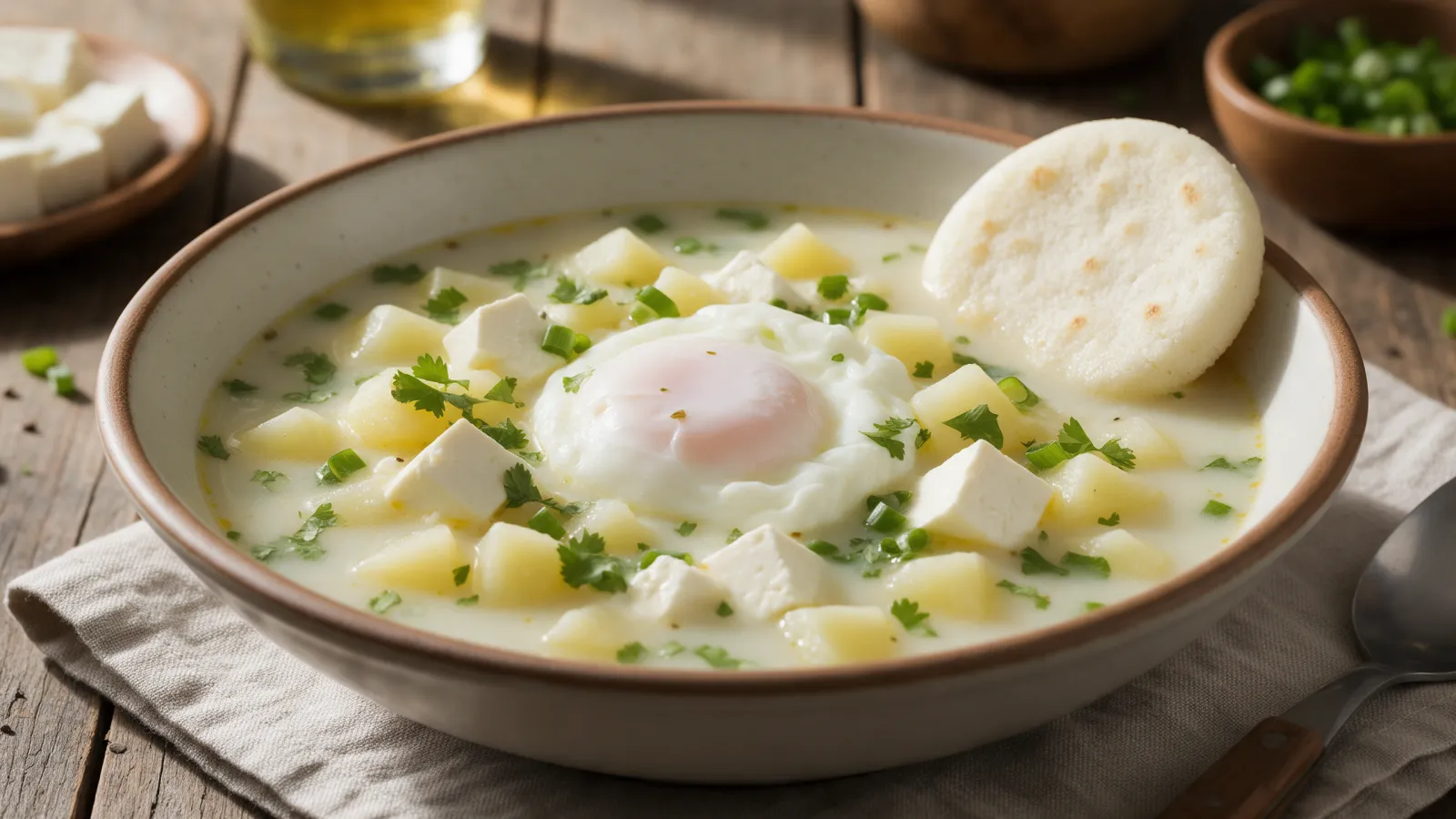

Pisca andina (PEES-kah ahn-DEE-nah) is what people eat for breakfast in the Venezuelan Andes, the mountain states of Mérida, Táchira and Trujillo: a light milk-and-water broth with cubed potatoes, scallions and cilantro, an egg poached right in the pot, and soft white cheese waiting in the bottom of the bowl. If you know Colombian changua, it’s a close cousin with more substance. If you don’t, picture a thin, savory potato soup that takes 20 minutes and gives you a whole breakfast in one bowl. The method has one rule worth learning before anything else, and it’s the order the liquids go in.
What is pisca andina, and how is it made?
How do you make pisca andina? Soften scallions and garlic in butter, simmer cubed potatoes in water for 7 minutes, then add an equal amount of milk over the lowest heat until it just shivers. Slide in whole eggs, cover, and poach 4 minutes. Ladle over cubes of fresh white cheese and finish with cilantro. Ready in 20 minutes for 4 servings.
It’s a broth, not a chowder. Nothing thickens it except a little starch from the potatoes and the yolk you break into each spoonful. A bowl weighs about 620 g (22 oz) and comes in at 430 kcal with the cheese, which is why it works as a full breakfast and also as a quick supper.
In the Andes it comes with arepas de trigo, flat wheat-flour arepas, rather than the corn arepas most people know from Venezuelan cafés. Corn arepas are just as good with it, and so is a slice of toasted bread.
Is it worth making?
Yes, if you want a hot breakfast that needs one pot and no frying. It’s 20 minutes on the clock, about 9 of them hands-on, and it’s hard to get wrong once you know the two danger points: boiling milk and moving the eggs.
Skip it if you’re avoiding dairy or eggs, since they are the dish. It also isn’t a make-ahead soup in its finished form, because a reheated poached egg goes hard.
The rule that keeps the milk from splitting
Most milk soups go wrong in the same way: the potatoes cook in milk, the milk has to boil for several minutes, and it foams over, catches on the bottom, or breaks into curds. Pisca andina avoids all of that by cooking the potatoes in 750 ml (3 cups) of water first. Only when a knife slides into a cube does the milk go in, with the heat already turned down, and it only needs about 2 minutes to go from fridge-cold to shivering.
Signs you’re on track.
| Stage | What you should see |
|---|---|
| Scallions and garlic, 2 min | glossy and soft, not golden |
| Potatoes, 7 min | a knife slides in, but the cubes keep their edges |
| Milk, 2 min | the surface trembles with wisps of steam, no bubbles rising |
| Eggs, 4 min | whites fully opaque; yolks wobble when you nudge the pot |
| Eggs, 6 min | yolks no longer wobble |
| Salt | taste last, after the cheese, which adds its own |
Poached eggs in milk, timing and food safety
Egg white sets at around 145°F (63°C) and the yolk thickens from about 158°F (70°C), so a broth held at 185-195°F (85-90°C) gives you a few minutes of margin. 4 minutes covered gives set whites and a thick, runny center. 6 minutes gives a firm yolk.
Per the FDA Food Code, eggs cooked for immediate service should reach 145°F (63°C). The USDA FSIS goes further and advises cooking eggs until both white and yolk are firm, with egg dishes taken to 160°F (71°C). If you’re feeding young children, pregnant women, older adults or anyone with a weakened immune system, use the 6-minute timing.
Crack each egg into a small cup first, then tip it in from the edge of the pot. Don’t stir until the whites are opaque, or they tear into ribbons and cloud the broth.
What to buy in a US or UK supermarket
The recipe card has exact amounts. Three choices decide how it turns out.
Milk to water. I use 1 to 1, 750 ml (3 cups) of each. More milk makes a richer broth that boils over more easily; 1 part milk to 2 parts water makes a lighter, cheaper bowl where the scallions come through. A water-only pisca also exists in the Andes, closer to a potato and scallion broth.
Potatoes. You want cubes that hold their shape after 7 minutes: Yukon Gold or red potatoes in the US, Charlotte or Maris Peer in the UK. Russets and Maris Pipers are floury and fray at the edges, which clouds the broth. Not a disaster, but you lose the clear soup.
Scallions and cilantro. Venezuelan cebollín is the long green onion sold as scallions in the US and spring onions in the UK; use the white and green parts. Cilantro is what the UK calls fresh coriander.
Which cheese, and which to avoid
In Venezuela the cheese is queso blanco andino or a smoked Andean white cheese, both fresh cheeses that soften in hot broth without melting. In the US, queso fresco or queso blanco from the Latin dairy case is the direct match. In the UK, paneer is the easiest swap (add a pinch more salt) and halloumi works if you cut the added salt.
What you want to avoid is any cheese that melts: mozzarella, Oaxaca cheese, cheddar, Monterey Jack. At 185°F (85°C) they turn into strings that wind round the spoon. And put the cheese in the bowl, not the pot, so it warms through and softens without dissolving.
| Ingredient | In Venezuela | US swap | UK swap | What changes |
|---|---|---|---|---|
| Queso blanco andino | fresh white cheese | queso fresco, queso blanco | paneer, halloumi | paneer is milder; halloumi is saltier |
| Papa | white Andean potato | Yukon Gold, red | Charlotte, Maris Peer | nothing noticeable |
| Cebollín | long green onion | scallions | spring onions | nothing |
| Arepa de trigo | wheat-flour arepa | corn arepas, English muffins | crumpets, toasted bread | different side, same breakfast |
Equipment. A wide 3 to 4 liter (3 to 4 quart) pot with a lid, a small cup for the eggs, a ladle. Wide matters more than deep: four eggs need room so they don’t fuse. No kettle? Heat the water in the same pot and cook the scallions in a small skillet, then tip them in.
Mistakes that ruin pisca andina
- The milk split or foamed over → it boiled. Turn the heat to its lowest before the milk goes in and pull the pot off at the first sign of foam. Use fresh milk.
- Hard potatoes → the milk went in too early. Test with a knife at 7 minutes; if it resists, 2 more minutes in water.
- Mushy potatoes → floury variety or cubes under 1 cm (⅜ in). Waxy potatoes, 1.5 cm (⅝ in).
- Stringy cheese → a melting cheese, or cheese added to the pot. Fresh cheese, in the bowl.
- Ragged egg whites → stirred too soon, or the egg was dropped from height. Small cup, edge of the pot, 4 minutes untouched.
- Flat flavor → not enough salt at the end. Taste after the cheese is in.
Spice, 0 out of 5. It isn’t spicy. Hot sauce, if you like it, goes on the table.
Kids and allergens. Kids usually like it: mild, with potatoes and cheese. Give them the 6-minute egg. The soup contains milk and egg; it has no gluten, but wheat arepas or bread do, so serve corn arepas for a gluten-free breakfast.
Make-ahead, and scaling for a crowd
The night before. Cook the potatoes in water with the scallions and garlic (steps 1 to 3), cool, cover and refrigerate. In the morning bring the base back to a simmer, add the milk and eggs, and breakfast is ready in 8 minutes. Don’t add milk or eggs ahead.
Scaling up.
- 6 people → 1.1 liters (4⅔ cups) of each liquid, 750 g (1⅔ lb) potatoes, 6 eggs, in a wide 5 liter (5 quart) pot.
- 12 people → triple everything (2.25 liters / 9½ cups each of water and milk, 1.5 kg / 3.3 lb potatoes, 12 eggs, 480 g / 1 lb cheese) split between two pots. Eggs are the bottleneck: my 28 cm (11 in) pot fits 6 without touching.
- 20 people → multiply by 5 and poach the eggs in batches of 6 in a separate pot with some of the broth, lifting them into bowls with a slotted spoon. A large volume of milk takes about 5 minutes to reach a shiver.
Pisca andina versions, and how it compares with changua
- Short on time → make the potato base the night before; 8 minutes in the morning.
- Lighter → 1 part milk to 2 parts water and 100 g (3½ oz) cheese instead of 160 g: about 345 kcal a bowl.
- Lactose-free → lactose-free milk behaves the same; look for lactose-free queso fresco too.
- More savory → chicken stock instead of water, and halve the salt.
- No milk → water-only pisca, with twice the scallions.
- Vegetarian → it already is if your cheese uses microbial or vegetable rennet; many fresh cheeses use animal rennet, so check the label.
Pisca andina or changua? Colombian changua is the breakfast milk soup of Bogotá, and the two share the milk-and-water broth and the egg poached in it. The differences are real, though: changua is lighter, made for 2 in 15 minutes, with the green onion boiled in the water and dry bread (calado) placed in the bowl. Pisca adds 500 g (1.1 lb) of potatoes, a butter-softened base of scallions and garlic, and cheese, and the arepa stays on the side. If you want a breakfast that lasts until lunch, make pisca. For other breakfast soups, caldo de costilla is the beef rib version, and Colombian egg soup does the opposite of pisca and whisks the egg into threads. For the Andean lunch soup, with chicken stock, corn and cream, see Venezuelan chupe andino.
What it costs to make
At the BLS’s August 2026 US city averages, whole milk ($4.23 a gallon), eggs ($2.27 a dozen), white potatoes ($0.98 a pound) and butter ($4.02 a pound) put the core of the soup at $2.81 for 4 bowls, about $0.70 each.
The cheese isn’t in that total, because the BLS doesn’t track queso fresco, and it is the line that changes the bill most: 160 g (5.6 oz) can cost as much as the rest of the soup. If you’re cutting costs, 100 g (3½ oz) is enough.
Yield. 4 deep bowls of about 620 g (22 oz), each with one egg, about 125 g (4½ oz) of potato and 40 g (1.4 oz) of cheese.
Serving and storing pisca andina
Serve it in deep bowls of 400-500 ml (1⅔ to 2 cups), cheese at the bottom, one egg each, cilantro on top. Alongside, warm arepas: Colombian cheese arepas or Boyacá-style arepas stuffed with cheese if you have masarepa. For a long weekend breakfast, add a basket of Venezuelan ham-and-cheese cachitos or a pan of huevos pericos for anyone who doesn’t want soup.
Fridge. For leftovers, according to the USDA FSIS, no more than 2 hours at room temperature, then 3 to 4 days at 40°F (4°C) or below. Store the base without eggs or cheese if you can; a poached egg reheated goes rubbery.
Freezer. I don’t freeze the finished soup: cooked potatoes turn grainy when thawed and milk broth tends to separate. Freeze the water-and-potato base instead, for 2 to 3 months, and add milk and eggs on the day.
Reheating. Over low heat, stirring, to 165°F (74°C), the FSIS temperature for leftovers, without letting it boil. For a fresh egg, poach one in the reheated base for 4 minutes.
Pisca andina FAQ
What is pisca andina? A breakfast soup from the Venezuelan Andes (Mérida, Táchira, Trujillo) made with water and milk, potatoes, scallions, cilantro, an egg poached in the broth and fresh white cheese. It’s eaten with wheat or corn arepas.
Is pisca andina the same as changua? No, though they’re related. Both are milk-and-water broths with a poached egg; pisca adds potatoes, a scallion-garlic base and cheese, while changua is lighter and has bread in the bowl.
Why did my milk curdle? It boiled, usually because the potatoes cooked in the milk. Cook the potatoes in water and add the milk last, on the lowest heat, only until it shivers.
How long do the eggs poach? 4 minutes covered for a jammy yolk, 6 for a firm one. USDA FSIS recommends firm yolks, so use 6 minutes for vulnerable groups.
What can I use instead of queso fresco? Paneer or halloumi, which soften without melting. Avoid mozzarella and cheddar, which go stringy.
Can I make pisca andina ahead? The potato base, yes, up to 3 to 4 days in the fridge. Add the milk and eggs on the day: 8 minutes.
How many calories are in a bowl? About 430 kcal for a 620 g (22 oz) bowl with one egg and 40 g of cheese, or about 310 without the cheese.
Nutrition per serving
Per bowl (about 620 g / 22 oz, with one egg and 40 g / 1.4 oz of cheese, without the arepa), calculated ingredient by ingredient from USDA FoodData Central (SR Legacy) using this recipe’s quantities and ¾ tsp of salt:
- Calories: 430 kcal
- Protein: 22 g
- Carbohydrates: 32 g
- Fat: 24 g, of which 12 g saturated
- Fiber: 4 g
- Sugars: 13 g, mostly lactose from the milk
- Sodium: 890 mg
The cheese carries the most weight: 160 g (5.6 oz) of queso fresco adds 478 kcal and about 1,200 mg of sodium to the pot, roughly 120 kcal and 300 mg per bowl.
I’m Venezuelan, but from the hot lowlands, so pisca was always a mountain dish to me rather than a home one. Living in Colombia, I found its cousin in changua, and now I make whichever suits the morning: changua when I want something light, pisca when breakfast has to carry me through to the afternoon. Water first, milk last, eggs left alone. Josnaisis.