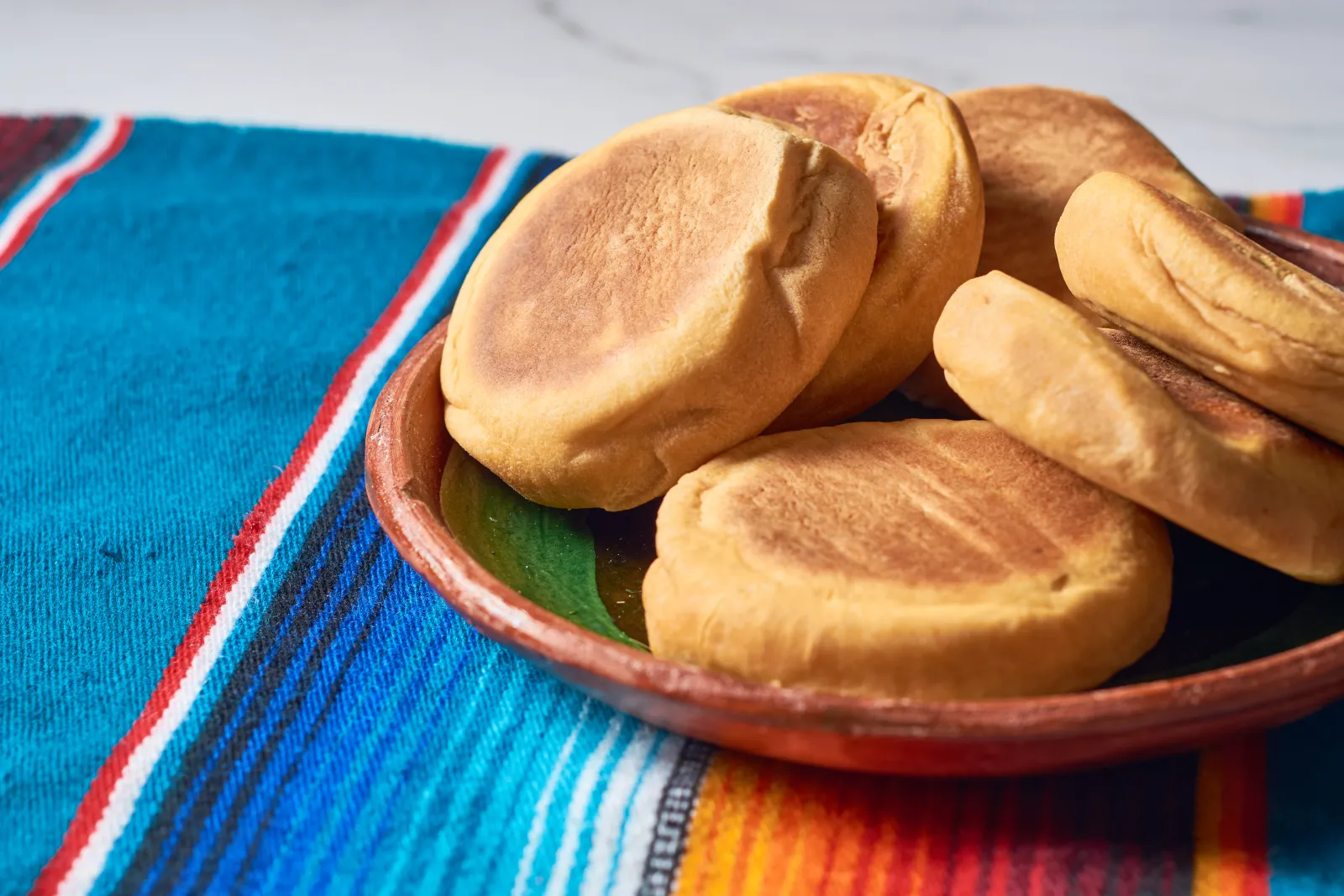

Think of a gordita de nata as a soft, lightly sweet cake about 7 cm (3 in) across, mixed in one bowl and cooked on a dry griddle instead of in the oven. The dough is wheat flour, sugar, egg, baking powder and nata, a thick, sweet cream that Mexican cooks skim off boiled milk, and that’s where most English-language readers get stuck. This recipe tells you what to buy instead in a US or UK supermarket, how much difference it makes, and the one thing that decides whether they come out cooked through: low heat and a 1 cm (⅜ in) thickness.
What are gorditas de nata, and are they worth making?
How do you make gorditas de nata? Whisk 500 g (4 cups) of flour, 200 g (1 cup) of sugar and 23 g of baking powder, then stir in 350 g (1½ cups) of nata or heavy cream beaten with 2 eggs and vanilla, just until a soft dough forms. Chill 15 minutes, shape 20 disks 1 cm (⅜ in) thick and cook them on a dry griddle over low heat, 4 minutes per side, in batches of 5. 70 minutes for 20 servings.
Gorditas de nata (gor-DEE-tahs deh NAH-tah, “little fat ones with cream”) are a griddle-cooked sweet bread from central Mexico, eaten warm with coffee, hot chocolate or atole for breakfast or an afternoon snack. They puff on the griddle and end up with a thin golden crust and a soft, tight, milky crumb. Maricruz Ávalos, a Mexican cook writing in English, compares them to an English muffin, and that’s a fair picture of the shape. To me the flavor is closer to a sweet cream scone.
Worth it if you have a heavy skillet and an hour. There’s no yeast, no oven and no mixer, and one batch makes 20 for a brunch or a week of snacks.
Maybe not for you if you avoid gluten, eggs or dairy, since all three are in the dough, or if you were hoping for a pastry-shop sweet. Each one has about 11 g of sugar, less than a Mexican concha.
Real time. 70 minutes, about 25 of them hands-on: 10 to mix, 15 in the fridge, 8 to shape and 35 at the griddle.
Honest difficulty, easy. The only skill is heat control, and the first batch teaches you that.
Not the same as savory gorditas
If you’ve had gorditas at a taquería, those were something else. Savory Mexican gorditas are made from corn masa, split into a pocket and stuffed with a stew. Gorditas de nata share only the name and the round, chubby shape: they’re wheat flour, sweet and leavened with baking powder. Search “gorditas” alone and you’ll mostly get the corn kind.
Where they started isn’t documented. México Desconocido, a Mexican travel and food magazine, says there’s little information and lists accounts placing them in Mexico City, Pachuca in Hidalgo, Guerrero or Michoacán.
Ingredients, and what to buy instead of nata
Exact amounts are in the recipe card: 500 g (4 cups) of flour, 200 g (1 cup) of sugar, 23 g of baking powder, 2 eggs and 350 g (12 oz) of nata for 20 gorditas.
What nata is
Nata is the thick, pale yellow layer that forms on top of milk after it’s boiled and left to cool, then lifted off and saved. Mexico News Daily describes it as very thick cream or mashed butter, naturally sweet and unsalted, and not tangy like Mexican crema or sour cream. It’s the same family as British clotted cream and Indian malai. You won’t find it in a US or UK supermarket. In Mexico it’s also sold packaged in 8 oz tubs, which Mexico News Daily says isn’t quite the same as the fresh kind.
Can you make it at home? Yes, but it takes days. A liter (about a quart) of whole milk has roughly 33 g (1.2 oz) of fat, per USDA data, and the skin can’t hold more than that. In my kitchen, non-homogenized milk gives about 50 g of drained nata per liter (1.7 oz per quart), and regular homogenized whole milk about half that; ultra-pasteurized milk barely forms any. Mexico News Daily says homogenized milk doesn’t produce it at all. For this recipe’s 350 g you’d need roughly 7 liters (about 1.8 US gallons) of cream-top milk, so it’s something you collect over a week, a skin a day, kept covered in the fridge. If you buy raw milk, always boil it: the FDA warns it can carry Salmonella, E. coli and Listeria.
US and UK swaps, and what changes
- Heavy cream (US) or double cream (UK). Heavy cream is 36% fat (USDA); UK double cream must be at least 48% by law. The easiest swap. Heavy cream is runnier than nata, so the dough comes out a little softer: add 1 to 2 tablespoons of flour.
- Clotted cream. At least 55% fat in the UK. Mexico News Daily calls it the closest thing to nata, and the dough is rich and firm. Some US stores sell it in jars.
- Mascarpone. Maricruz Ávalos’s preferred substitute. Sweet and firm.
- Crème fraîche. Works, with a slight tang.
- Sour cream or Mexican crema. Sour cream is 19% fat (USDA) and noticeably sour. On its own I find the gorditas taste lean and tangy.
- Butter alone. Doesn’t work: it adds fat but not the liquid the dough needs.
How much nata, and why this amount
I compared nine published recipes. For every 4 cups of flour, the leanest uses ½ cup of nata and the richest almost 3. With very little, as in the Larousse recipe that uses 5 eggs instead, they turn dry and bready. With 2 cups or more, the dough is sticky and the centers stay soft and are easy to undercook. My 350 g (1½ cups) lands mid-pack: the other eight recipes have a median of 1.6 cups.
Flour, baking powder, eggs and sugar
All-purpose flour (plain flour in the UK). I don’t use bread flour here; the extra protein makes them chewy.
Baking powder, 1¼ tsp per cup of flour. Across the eight recipes that give an amount it runs from ¼ to 1⅔ tsp per cup, with a median of about 1.4. Too little and a 1 cm cake stays dense in the middle. In the UK, use ordinary baking powder, not self-raising flour.
Eggs, half an egg per cup of flour, the figure four of the eight egg-based recipes use. Sugar, a quarter cup per cup of flour, the median of the recipes that don’t use condensed milk.
Equipment
A comal, the flat Mexican griddle, or a 12-inch (30 cm) cast-iron skillet, which fits 5. A nonstick pan works on low but browns less. A glass or a 7 cm (2¾ in) cutter, a spatula, a rack and, if you have one, an instant-read thermometer.
How to plan it, and how to tell it’s working
The night before. Measure the dry mix into a covered bowl and whisk the nata, eggs and vanilla into a jar in the fridge, but keep them apart. Double-acting baking powder releases gas in two stages, once when it gets wet and again with heat; in the Rumford formula Wikipedia describes, about two-thirds of the gas comes off within minutes of mixing. Dough mixed the night before reaches the griddle with less lift.
Signs it’s going right.
- Dough: soft, doesn’t stick to a clean hand, doesn’t crack when flattened.
- Heat: the first side takes about 4 minutes to turn golden. Dark brown at 2 minutes means the heat is too high.
- Flip: the edge looks matte and dry and the cake has puffed.
- Done: sounds hollow when tapped, the side springs back, and the center reads 200°F (93°C).
Thickness, heat and the doughy-center problem
Every recipe I read gives some version of “low heat” and then a time: 3 minutes a side on medium (Cookpad), about 3 on low (México Desconocido), 4 to 5 on low (Vanguardia, a newspaper in Saltillo), and 1 then 5 to 6 on medium-low for the yeasted version (Maricruz Ávalos). I cook them on low, 4 minutes a side, at 1 cm (⅜ in) thick. The heat has to reach the middle before the sugar on the surface scorches. The Mija Chronicles, a Mexican-American blog, nearly burned a batch on medium-high.
There’s no published internal temperature for gorditas de nata, so I borrow King Arthur’s for quick breads, which counts the center as baked at 200-205°F (93-96°C). No thermometer? Split the first one open.
Feeding 10, 20 or 40
| Gorditas | Flour | Sugar | Baking powder | Eggs | Nata or cream | Griddle |
|---|---|---|---|---|---|---|
| 10 | 250 g (2 cups) | 100 g (½ cup) | 12 g (2½ tsp) | 1 | 175 g (¾ cup) | 2 batches, 16 min |
| 20 | 500 g (4 cups) | 200 g (1 cup) | 23 g | 2 | 350 g (1½ cups) | 4 batches, 32 min |
| 40 | 1 kg (8 cups) | 400 g (2 cups) | 46 g | 4 | 700 g (3 cups) | 8 batches, or 2 pans |
For 12 people, make 20 and enjoy the leftovers. For 20, one each works on a brunch table with other food; two each if they’re the main event.
Before you start, mistakes, kids and allergens
- Medium or high heat. The number one reason for raw centers. Low heat, 4 minutes a side.
- Thicker than 1.5 cm (½ in). The heat can’t reach the middle in time.
- Kneading like bread. This dough only needs to come together; 10 minutes of kneading makes them tough.
- Cold nata straight from the fridge. It stays lumpy and the dough mixes unevenly. Let it sit out 30 minutes.
- Crowding the pan. They puff and stick together. Leave 2 cm (¾ in) between them.
- Skipping the test cake. Split the first one before cooking the rest.
Spice level. None. Kids usually love them: soft, sweet and eaten by hand. Rolling and flattening the balls is a good job for them; the griddle is for an adult. Main allergens: wheat (gluten), egg and milk.
Which version should you make?
- Short on time → skip the 15-minute chill and shape with floured hands. Stickier, but done in 55 minutes.
- No nata → heavy or double cream, plus 1-2 tablespoons of flour.
- For a party of 40 → double the batch, two pans or an electric griddle on low, dry mix and cream prepped the night before.
- Softer and sweeter → the condensed-milk versions from Vanguardia, Mexico News Daily and The Mija Chronicles. They brown faster, so go even lower on the heat.
- Yeasted → Maricruz Ávalos’s version, with a starter and 1 to 3 hours of rising. Airier, closer to an English muffin, and no longer a 70-minute recipe.
- Cinnamon → 1 tsp ground cinnamon in the flour, as in the Larousse recipe.
- Mini, for kids or a dessert table → 30 pieces of about 39 g (1⅓ oz), 3 minutes a side. 132 kcal each.
- Filled → split them warm and spread with cajeta (goat’s milk caramel), dulce de leche or jam.
What a batch costs
About $3.85 for 20, or 19 cents each, using BLS average prices for August 2026 (flour 0.548 $/lb, sugar 1.024 $/lb, eggs 2.272 $/dozen) and Walmart prices for Great Value heavy cream ($2.96 for 16 fl oz) and baking powder ($1.98 for 8.1 oz). The cream is 58% of the cost. If you collect nata from milk you’d drink anyway, the batch drops to under $2. I didn’t find reliable UK prices for every item, so there’s no pound total.
Serving, storing and reheating
How they’re eaten. Warm, straight off the griddle, with something hot: Mexican café de olla, atole, champurrado or a cup of hot chocolate. They’re less sweet than Mexican conchas, which is why a smear of cajeta or jam works so well.
Room temperature. Maricruz Ávalos keeps them up to 4 days in an airtight container, wrapped individually in plastic so they stay soft. I eat mine within 3.
Freezer. Frozen at 0°F (-18°C) they’re safe indefinitely according to USDA FSIS; for quality I keep them 2 months at most, wrapped one by one in a zip-top bag. Thaw 30 minutes on the counter.
Reheating. On a griddle over medium heat for about 2 minutes, flipping 2 or 3 times (Maricruz Ávalos’s method), or in a toaster oven, which The Mija Chronicles says crisps the crust. The microwave softens them and they turn chewy as they cool.
Gorditas de nata FAQ
What does nata mean? Nata is the thick, sweet skin of cream that forms on boiled milk. In Spain the word means ordinary cream, which is why Spanish recipes can be confusing.
What can I use instead of nata? Heavy cream (US) or double cream (UK) with 1-2 extra tablespoons of flour. Clotted cream is the closest in flavor.
Why are my gorditas de nata raw inside? Heat too high or cakes too thick. Keep them 1 cm (⅜ in) and the heat low. Rescue a doughy batch with 10 minutes at 350°F (180°C).
Do gorditas de nata have yeast? Most recipes use baking powder only. Maricruz Ávalos’s yeasted version is airier and takes about 3½ hours.
Can I bake them instead? I haven’t found a tested all-oven version. Brown them on the griddle and finish in the oven if the centers need it.
How long do they keep? About 2 months in the freezer, or up to 4 days airtight on the counter.
Nutrition per gordita
Per gordita (1/20 of the batch, about 59 g / 2 oz of dough), calculated from USDA FoodData Central (SR Legacy) using all-purpose flour, sugar, baking powder, salt, whole egg, heavy whipping cream as a stand-in for nata, and vanilla extract.
- Calories: 198 kcal
- Protein: 4 g
- Carbohydrates: 30 g
- Fat: 7 g, of which 4 g saturated
- Fiber: 1 g
- Sugars: 11 g
- Sodium: 193 mg
Sugar accounts for 20% of the calories, the cream 30% and flour 46%. Homemade nata varies in fat with the milk, so treat these as close estimates.
In Venezuela, where I grew up, nata was the tangy cream we spread on arepas; in Colombia I learned to skim the skin off boiled milk for a Christmas dessert. These gorditas solved what to do with the jar of nata that builds up in my fridge between one batch of boiled milk and the next. My first batch went on medium heat because I was impatient, and they came out beautiful and raw in the middle. Now the burner stays on low and I always split the first one. Josnaisis.