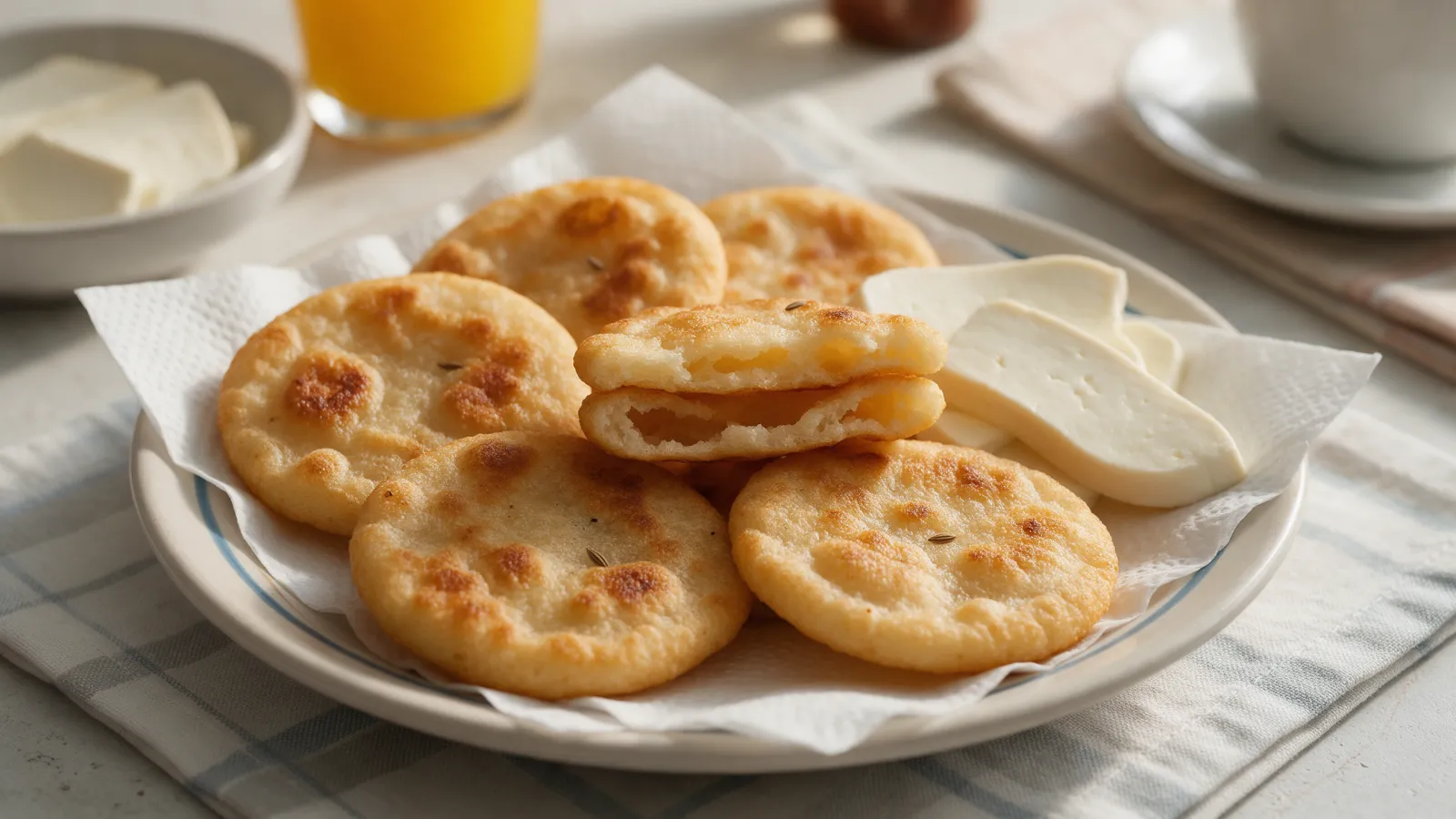

Sweet arepitas (ah-reh-PEE-tahs) are Venezuela’s answer to a sopaipilla: palm-sized discs of corn dough sweetened with unrefined cane sugar, scented with anise seed and deep-fried until they swell into hollow, golden pillows. Venezuelans slit them open and stuff them with salty white cheese and a spoonful of thick, tangy cream, then eat them for breakfast with coffee. They use the same precooked corn flour as an everyday arepa, and nothing about them is hard. The one thing that trips people up is getting them to puff, and that comes down to thickness and oil temperature.
What sweet arepitas are and why they are worth 70 minutes
How do you make Venezuelan sweet arepitas? Melt papelón (unrefined cane sugar) with anise seed in water, knead it into precooked corn flour with a little all-purpose flour, and press 30 g (1 oz) balls into discs a scant ¼ in (5 mm) thick. Fry at 350°F (175°C), basting the tops with hot oil until they puff, 3 to 4 minutes per batch. Ready in 70 minutes for 6 servings of 5.
If you like sweet and salty together, they are worth every minute. The shell is thin, crisp and the color of toffee, with a faint bitter edge from the browned cane sugar. Inside there is a pocket of air and a soft layer of corn dough that smells of anise. The salty cheese tucked inside is what makes them taste Venezuelan rather than like a fried cookie.
Good for. A weekend breakfast for 6, a brunch spread, or a side for something savory: in my house they sit next to pabellón criollo, sweet against the salty shredded beef. Kids love helping press the discs.
Maybe not for. Anyone avoiding deep-frying. They can be made in an air fryer or on a griddle, but they will not puff (the reason is below).
Time. 70 minutes total, about 50 of them hands-on. Mixing takes 15; the rest is frying 30 discs four at a time. Make the dough the night before and breakfast day drops to 45 minutes.
Difficulty. Easy. You will have the thickness right by the second batch.
Ingredients and US or UK substitutes
The card above has exact amounts for 30 arepitas. Most of these ingredients are in a regular supermarket; two need a Latin grocer or an online order.
The ratio that makes them puff
I use 240 g (2 cups) precooked corn flour, 60 g (½ cup) all-purpose flour, 150 g (⅔ cup packed) papelón and 480 ml (2 cups) water. That is about 1.6 parts water to 1 part flour by weight, with the dissolved sugar adding to the liquid. For reference, the everyday arepa recipe from Harina P.A.N. calls for 1¼ cups of water per cup of flour. A drier dough cracks at the edges when pressed, and a cracked disc lets the steam out instead of puffing.
The sugar sits at half the weight of the flour. Under 100 g (3.5 oz) the arepitas taste more like plain arepas and stay pale; much over 150 g (5.3 oz) the dough turns soft and the crust darkens before the disc has time to inflate.
Precooked corn flour, not cornmeal or masa harina
Masarepa is corn that has been cooked, dried and ground, so it turns into dough the moment it meets water. Harina P.A.N. is the brand most US supermarkets stock in the Latin aisle; in the UK, look in the world-foods aisle of larger supermarkets, in Latin shops or online. Cornmeal, polenta and Mexican masa harina are different products and will not make this dough: cornmeal stays gritty and loose, and masa harina gives a tortilla-like dough with a different taste.
What papelón is and what to buy instead
Papelón (pah-peh-LOHN) is sugarcane juice boiled down and set into a hard block, with all its molasses left in. The same thing is sold as panela (Colombian and Central American brands) and piloncillo (Mexican cones) in US Latin aisles. Grate it on a box grater or chop it with a heavy knife.
If you cannot find any of those, dark brown sugar in the US or dark muscovado in the UK, at the same 150 g (5.3 oz), gets you very close. White sugar works, but the arepitas come out pale and taste only of sweetness.
Anise seed, not star anise
You want whole anise seed (Pimpinella anisum), small grey-green ridged seeds, in the spice aisle in the US and UK. Star anise is a different plant with a harsher, medicinal taste and should not go in. I simmer the seeds in the syrup so the whole dough tastes of anise, not just the bites that land on a seed.
Why a little wheat flour
Plenty of Venezuelan cooks make arepitas with corn flour alone, and they puff. I swap a fifth of the flour for all-purpose (the 60 g, or ½ cup, in the card) because the gluten makes the dough stretchier: it cracks less when pressed and holds the steam better. For gluten-free arepitas, use 300 g (2½ cups) corn flour and no wheat, and smooth every edge carefully.
I skip baking soda, which some recipes include. Steam does the puffing, not a leavener, and alkaline dough browns faster, which with cane sugar means a dark crust too early.
The cheese and the cream
Venezuelans use queso llanero or queso de año (hard, salty, grated) or softer queso telita and queso guayanés. In the US, queso fresco or cotija from the Latin dairy case are the closest; in the UK, feta. Nata is a thick, slightly sour cream; sour cream, Mexican crema or crème fraîche all stand in well.
Equipment
A deep 10-inch (24 cm) skillet, a deep-fry or candy thermometer, a large spoon for basting, a slotted spoon and a rack. For pressing, cut open a zip-top bag and use the bottom of a plate; a tortilla press is even better.
Game plan and make-ahead
70 minutes on the clock. Dissolving the sugar in half the water and topping up with cold water means the syrup is usable at minute 8. The oil heats while you press the last discs.
Up to 2 weeks ahead. The papelón and anise syrup keeps in a closed jar in the fridge.
Up to 24 hours ahead. The dough, wrapped tightly, in the fridge. Take it out 30 minutes before frying and knead in 1 to 2 tablespoons of water, because precooked corn dough firms up when cold.
What I do not freeze. Raw discs. They weep water as they thaw, stick to the plastic and lose their shape. Freeze the fried arepitas instead (see storage below).
How you know each step is right.
- Syrup → no lumps, warm to the touch but not hot.
- Dough → soft, not sticky, and a flattened ball shows no cracks at the edge.
- Disc → even, a scant ¼ in (5 mm) thick, 3 in (8 cm) across, smooth rim.
- Oil at 350°F (175°C) → a pea of dough floats up fizzing in 2 to 3 seconds.
- Done → puffed, toffee-colored on both sides after 3 to 4 minutes, hollow-sounding when tapped.
Scaling up for a crowd
- Breakfast for 4 to 6 → the recipe as written, 30 arepitas, 5 each.
- As a side for 10 to 12 → same batch, 2 to 3 each.
- Party nibbles → make 15 g (½ oz) balls pressed to 2½ in (6 cm): 60 mini arepitas, 3 per guest.
- Breakfast for 12 to 20 → triple everything: 720 g (6 cups) corn flour, 180 g (1½ cups) all-purpose flour, 450 g (2 cups packed) papelón in 1.44 liters (6 cups) water, 2 tablespoons anise seed and 1½ teaspoons salt. That makes 90. One skillet means 1½ hours of frying; two skillets halve it. Or fry them ahead and reheat at 350°F (180°C) for 5 minutes right before serving.
Getting them to puff, thickness and oil temperature
An arepita puffs the same way an Indian puri or a pita does. The water in the dough boils into steam, and if both faces set into a crust at the same moment, the steam is trapped and forces them apart. That only happens when the disc is thin and even, the oil is hot, and hot oil is also reaching the top face. A shallow ¾ to 1 in (2 to 3 cm) of oil lets the disc float without sinking, and basting with a spoon for the first 20 to 30 seconds heats the top as fast as the bottom.
The sugar is why the window is narrow. Papelón contains glucose and fructose, which brown far sooner than the starch in a plain dough, so these cannot take the 365 to 375°F (185 to 190°C) you might use for other fritters. Each batch of cool dough drops the oil a few degrees; let it climb back to 350°F (175°C) before the next. The sugar also darkens the oil quickly, and if it looks very dark by the fifth batch, strain or replace it, or the last arepitas will taste bitter.
A disc thicker than about ⅓ in (8 mm) will not puff no matter how hot the oil: the center cannot reach boiling before the crust closes, and you get a dense, tasty arepita with no pocket. One thinner than ⅛ in (3 mm) dries out first and turns into a crisp cracker.
Mistakes, kids and allergens
- Flat, no pocket → disc too thick or oil too cool. Press to 5 mm (a scant ¼ in) and check the oil.
- Only half puffed → you skipped basting the tops for the first 20 to 30 seconds.
- Dark and bitter → oil above 365°F (185°C), too much sugar, or baking soda in the dough.
- Greasy → oil below 330°F (165°C), or more than 4 discs in a 10-inch (24 cm) pan.
- Edges crack when pressed → dough too dry or not rested. Add water 1 tablespoon at a time and wait the full 10 minutes.
- Tastes of medicine → star anise instead of anise seed. No rescue for that batch.
Heat level. None, 0 out of 5.
Kids. They are a hit: small, sweet and eaten by hand. Wait 3 to 4 minutes before handing one over, because the steam inside burns when the arepita is split.
Allergens. Wheat (gluten) from the all-purpose flour; leave it out for a gluten-free batch and check that your corn flour is labeled gluten-free if cooking for someone with celiac disease. Milk in the cheese and cream for serving. No egg, no nuts.
Air fryer, griddle and other versions
- Short on time → make the dough the night before; in the morning, press while the oil heats. 45 minutes for 30.
- Air fryer → 375°F (190°C) for 10 to 12 minutes, brushed with ½ teaspoon oil each and flipped halfway. I’ll be straight with you: they do not puff, because hot air does not hit both faces at once the way oil does. You get a flat arepita, crisp outside and tender inside, that you split with a knife. Good, but a different thing.
- Griddle or dry skillet → make the discs ⅓ in (8 mm) thick and cook over medium heat 3 to 4 minutes per side. No puff; think sweet griddled arepa.
- Party → the 15 g (½ oz) minis fry in 2 minutes. Serve with a pitcher of papelón con limón, the cane-sugar lemonade made from the same block of papelón.
- Gluten-free → all corn flour, as above.
- Less sweet → 100 g (3.5 oz) papelón. They still brown well and sit better next to savory food.
- Spiced → some cooks add cinnamon or cloves to the syrup. I keep it to anise.
How sweet arepitas compare with other puffed and fried breads
| Sweet arepitas | Venezuelan mandocas | New Mexico sopaipillas | Indian puri | |
|---|---|---|---|---|
| Flour | Precooked corn + 20 % wheat | Precooked corn + ripe plantain | Wheat | Whole wheat |
| Sweetness | Cane sugar and anise in the dough | Cane sugar and plantain in the dough | Honey added at the table | None |
| Shape | 3 in (8 cm) disc | Ring or teardrop | Square or triangle | Round |
| Puffs? | Yes, hollow | No, dense | Yes, hollow | Yes, hollow |
| Served with | Salty white cheese and cream | Butter and cheese | Honey | Curries |
Venezuelan mandocas are the closest cousin, with the same corn flour and cane sugar, but ripe plantain makes them dense. Colombian buñuelos are cheese-and-starch balls with no corn flour at all. If what you want is a sweet arepa that is not fried, Venezuelan cachapas and Colombian sweet corn arepas are both made with fresh corn on a griddle, and for a savory breakfast arepa, Colombian cheese arepas carry the cheese inside the dough. Papelón and anise baked into a wheat dough instead give you Venezuelan catalinas, soft spiced bakery cookies.
What a batch costs
Using US city averages from the Bureau of Labor Statistics for August 2026, the 60 g (½ cup) of all-purpose flour ($0.548 per lb) comes to about $0.07 and 150 g of sugar ($1.024 per lb, white sugar as a floor price for papelón) to about $0.34. The cheese is the expensive part: with cheddar ($5.983 per lb) as the nearest series and a floor for queso fresco, 200 g (7 oz) is about $2.64. The BLS does not track masarepa, cane sugar blocks, frying oil or anise seed, so I am not putting a number on those. In Bogotá’s Corabastos market the same week, per the Colombian DANE price bulletin, the arepitas without cheese came to about 82 Colombian pesos each.
Yield. 30 arepitas of 30 g (1 oz) raw, about 3 in (8 cm) fried: breakfast for 6 or a side for 10 to 12. The frying oil absorbed is my estimate, about 70 g (⅓ cup) for the whole batch. The rest of the 750 ml (3 cups) can be strained once cool and reused for another sweet fry.
Serving, storing and reheating
How they are eaten. Hot, split along one edge with a knife and stuffed with crumbled white cheese and a spoonful of nata, with milky coffee. Butter instead of cream is just as common, or the cheese grated on top without splitting them. Straight from the oil they crackle; after 15 to 20 minutes they soften into something closer to a sweet bread, still good.
Fridge. Per USDA FSIS guidance for cooked leftovers: no more than 2 hours at room temperature, then 3 to 4 days at 40°F (4°C) or below in a closed container lined with paper towel.
Freezer. Freeze fried, cooled arepitas on a tray for 1 hour, then bag them. FSIS gives 3 to 4 months for best quality. The pocket flattens a little in the freezer, but the crust comes back when reheated.
Reheating. Oven or air fryer at 350°F (180°C) for 4 to 5 minutes (6 to 7 from frozen) brings back most of the crunch. A dry covered skillet works too, 2 minutes per side. The microwave makes them rubbery. Reheat until hot in the center, 165°F (74°C), as FSIS recommends for leftovers.
Sweet arepitas FAQ
Why didn’t my arepitas puff? Usually the disc is too thick: above 5 mm (a scant ¼ in) the center cannot boil in time. Next most likely is oil below 340°F (170°C), then skipping the basting.
Can I use regular cornmeal? No. It has not been precooked, so it will not form a dough with water. You need masarepa, such as Harina P.A.N.
What can I use instead of papelón? Panela or piloncillo are the same product. Otherwise dark brown sugar (US) or dark muscovado (UK) at the same 150 g (5.3 oz).
Are sweet arepitas the same as sopaipillas? They puff the same way, but sopaipillas are wheat dough served with honey, while arepitas are corn dough with the sugar and anise already inside.
Can I bake them or use an air fryer? Yes, at 375°F (190°C) for 10 to 12 minutes in the air fryer, brushed with oil. They come out flat and crisp rather than puffed.
How many per person? Four or five for breakfast, two or three as a side.
Can I make the dough ahead? Yes, up to 24 hours in the fridge, tightly wrapped. Knead in a splash of water, a tablespoon or two, before pressing.
Are they gluten-free? Not as written, because of the 60 g (½ cup) wheat flour. Make them with corn flour only and they are.
Nutrition per serving
Per serving (5 arepitas, a sixth of the batch), without the cheese and cream, calculated ingredient by ingredient from USDA FoodData Central (SR Legacy) for the amounts in this recipe. I used degermed cornmeal for the precooked corn flour, brown sugar for the papelón, and counted about 70 g (⅓ cup) of absorbed oil for the whole batch.
- Calories: 385 kcal (about 77 per arepita)
- Protein: 4 g
- Carbohydrates: 64 g
- Fat: 13 g, of which 1 g saturated
- Fiber: 2 g
- Sugars: 25 g, almost all from the papelón
- Sodium: 204 mg
Adding 35 g (1¼ oz) of white cheese per serving brings about 109 kcal, 7 g protein and 246 mg sodium; 20 g (about 1½ tablespoons) of sour cream adds about 40 kcal.
In Colombia, where I live now, people hear “sweet arepa” and picture a griddled corn cake with sugar on top, so the first time friends see these balloon in the oil they think something has gone wrong. My son Dylan’s job is pressing the discs between the plastic sheets, and he has learned the hard way that a fat one never puffs. Thin disc, hot oil, a spoonful of oil on top: that is the whole trick. Josnaisis.