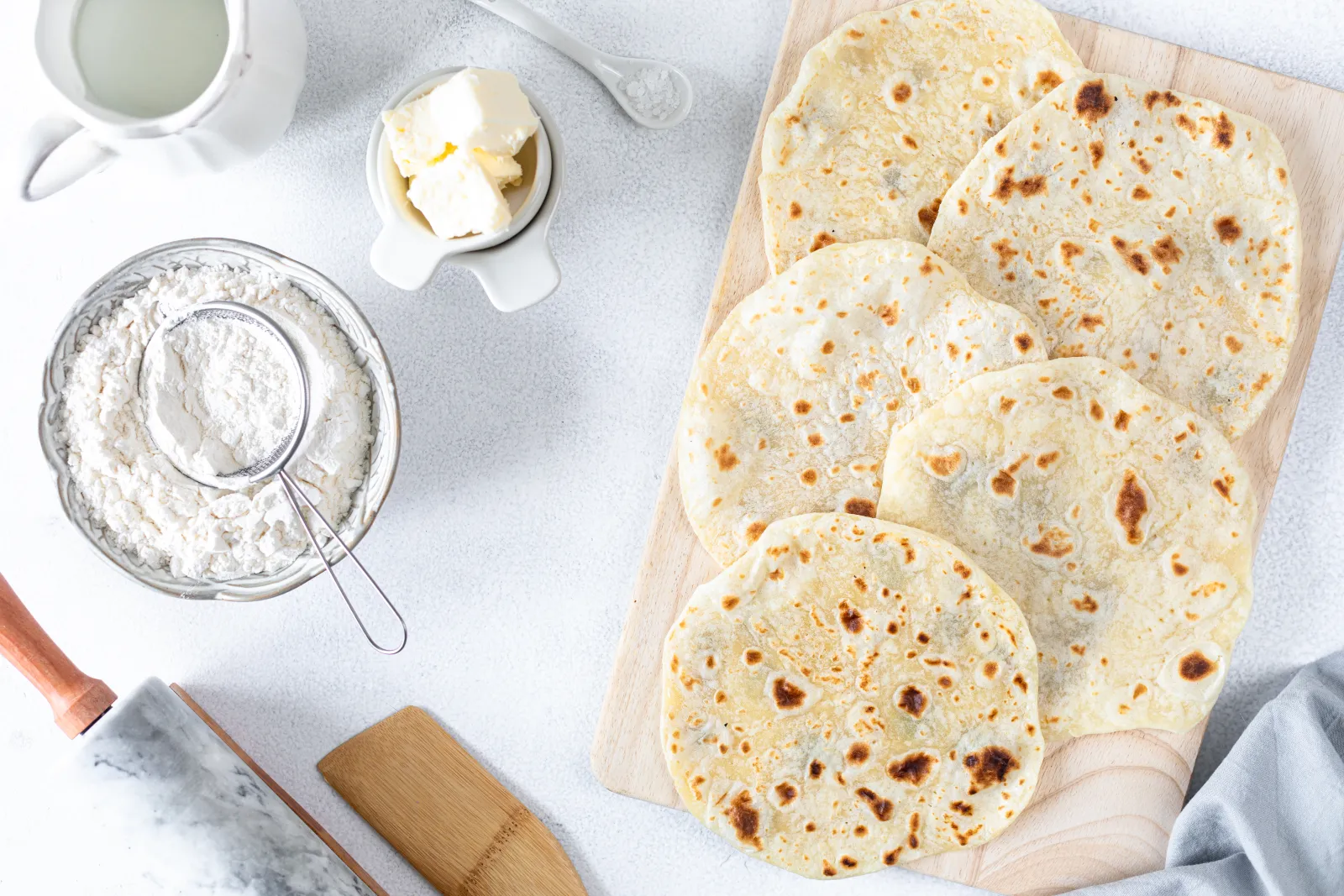

A flour tortilla is a soft, round flatbread from northern Mexico made with wheat flour, fat, salt and hot water, rolled thin and cooked for about a minute on a dry pan. It is the wrap around a burrito and the tortilla in a cheese quesadilla. Homemade ones need four ingredients and taste of toasted wheat and lard. The dough is forgiving. The part that decides whether they come out soft or stiff is the last 75 seconds on the skillet, so most of this page is about that.
What are flour tortillas, and are homemade ones worth it?
How do you make soft homemade flour tortillas? Rub 3.5 oz (100 g) of lard into 4 cups (500 g) of flour with salt, knead with 1 cup plus 4 tsp (260 ml) of hot water at 115-120°F (46-49°C), and divide into 16 balls that rest covered for 30 minutes. Roll each to 8 inches (20 cm) and cook on a hot skillet for 60-75 seconds in total, flipping twice, then stack them in a towel. 80 minutes for 16 servings.
Yes, they are worth it, especially if your only reference is the supermarket pack. A fresh one is thicker and more tender, with layers that separate when you tear it, and it bends in half cold without cracking.
Make them if you want breakfast burritos, huevos rancheros or quesadillas that taste of the tortilla and not only the filling. Skip them if you need gluten-free, since these are wheat, or if you want tortillas in 20 minutes: the rest cannot be skipped without a fight at the rolling pin.
Time and effort. 80 minutes start to finish, about 50 hands-on: 20 to make the dough and balls, a 30-minute rest, and 30 minutes at the stove, rolling one while the last one cooks. Difficulty is medium. The dough is easy; rolling round circles takes five or six tries before your hands get it.
Flour tortillas are the tortillas of northern Mexico, Sonora above all, where they are made with wheat instead of the corn masa used further south, as the Sonoran newspaper El Imparcial notes.
The ratio, in grams and cups
By weight, the fat is a fifth of the flour and the water a little over half, 100 : 20 : 52, with salt at 1.6%. In cups, that is 4 cups of flour, ½ cup of lard and a little over 1 cup of water for 16 tortillas.
I compared nine published recipes that give amounts. The fat runs from about 16 g per 100 g of flour (Maricruz Ávalos, and America’s Test Kitchen’s Sonoran version) to 25 g (Larousse Cocina, Mexico), and most cluster at 18-20: KQED, King Arthur and Rick Bayless all land there. Water varies more because flours absorb differently: Rick Bayless uses about 52 ml per 100 g of all-purpose flour, King Arthur 57 and America’s Test Kitchen 63, both with bread flour.
Why weigh it. A cup scooped straight from the bag packs in more flour than a spooned one, and that extra flour is the difference between a soft dough and one that cracks. If you use cups, spoon the flour in and level it; USDA puts a cup of all-purpose flour at 125 g.
Which fat to use, lard, shortening, butter or oil
Fat is what keeps a flour tortilla tender and layered: it coats the flour and shortens the gluten strands. All four common fats work, but they don’t give the same tortilla.
- Lard is traditional and gives the softest, flakiest tortilla, with a mild flavor you won’t notice under a filling. In the US it sits by the shortening in 1 to 4 lb tubs; KQED’s recipe recommends good lard from a butcher. In the UK it is sold in 250 g blocks.
- Vegetable shortening (Crisco in the US, Trex in the UK) at the same weight gives nearly the same result with a neutral taste. El Imparcial’s Sonoran recipe uses vegetable fat.
- Butter needs 125 g (4.4 oz) instead of 100 g, and 4 teaspoons less water, because butter is about 16% water (USDA). It tastes of butter and the milk solids brown sooner, so watch the spots.
- Vegetable oil at the same weight, a scant ½ cup, makes vegan tortillas. KQED notes the dough comes out stickier, so flour the counter a little more. Expect a chewier tortilla with fewer layers.
Flour, baking powder and where to shop in the US and UK
All-purpose flour in the US, plain flour in the UK. Bread flour, which King Arthur and America’s Test Kitchen use, makes a stretchier dough that fights back more when you roll it and needs more water; I only use it when there is nothing else. Self-rising flour already has baking powder, so drop the baking powder if that’s what you have.
Baking powder is optional. El Imparcial and America’s Test Kitchen leave it out of their Sonoran tortillas. With 1 tsp (5 g) per 4 cups of flour they come out slightly thicker and fluffier, with fewer layers. I skip it for burritos and quesadillas and add it when the tortillas are going next to a bowl of soup.
Equipment. A large bowl, a rolling pin, a clean kitchen towel and a cast-iron skillet, griddle or comal at least 10 inches (25 cm) across. No rolling pin? A smooth, dry, floured wine bottle. A thin pan cools down with every tortilla and cooks them too slowly, so use the heaviest one you have.
How to make them, step by step and why
Water temperature
Use hot tap water, 115-120°F (46-49°C). King Arthur calls for 110°F (43°C), and Rick Bayless and America’s Test Kitchen for very warm or hot tap water; the US Department of Energy recommends setting water heaters to 120°F (49°C).
Milk Street explains why: warm liquid softens the lard so it spreads through the flour. Cold water still makes tortillas, but El Imparcial warns the dough then needs half an hour before rolling, while hot water lets you roll almost straight away.
Resting the dough
30 minutes, covered, after you shape the balls. That is what King Arthur, Rick Bayless and America’s Test Kitchen do; KQED rests twice for 15 minutes. Resting relaxes the gluten. Skip it and every ball shrinks as you roll, so you end up with a small, thick tortilla, and thick tortillas are the ones that go stiff. Keep the balls covered: an uncovered ball forms a skin in about 10 minutes that won’t roll smooth.
Rolling them round and thin
Flatten the ball with your palm. Roll from the center out, one stroke up and one down, then give the dough a quarter turn and repeat, always turning the same way. Rick Bayless turns a sixth of a turn and America’s Test Kitchen 90 degrees; either way, the turning is what makes the circle.
A 54 g ball rolled to 8 inches (20 cm) is about 1/16 inch (2 mm) thick. Use as little flour as you can and brush off the excess before cooking, as King Arthur says, because loose flour toasts on the pan and dries the tortilla.
The skillet, heat and timing
Medium-high, 5 minutes of preheating, 60-75 seconds per tortilla. America’s Test Kitchen preheats its comal for 3 minutes over medium; KQED gives a cast-iron pan at least 10 minutes. You don’t need a thermometer: King Arthur’s test, a water drop that sizzles and evaporates almost instantly, is the one to use.
- First side, 20-30 seconds, until bubbles appear.
- Second side, about 30 seconds, until golden spots show.
- Quick third turn, 10-15 seconds, pressing the edge with a folded towel to push steam inside so it puffs.
Black spots in under 15 seconds mean the heat is too high. No bubbles after 45 seconds means it’s too low, and that tortilla is drying out.
Make-ahead plan and cooking for a crowd
Night before. Make the dough and balls, wrap them in plastic and refrigerate. I keep them up to 24 hours and give them 30 minutes on the counter so the lard softens before rolling.
Day before. You can also cook them a day ahead: cooled, wrapped in foil and kept at room temperature for up to 2 days (Milk Street’s guideline), they reheat in 20 seconds a side.
How many to make. Plan 2 to 3 per person at breakfast and 3 to 4 next to carne asada and refried beans.
| Feeds | Flour | Lard | Salt | Hot water | Makes |
|---|---|---|---|---|---|
| 4-6 | 500 g (4 cups) | 100 g (½ cup) | 8 g (1⅓ tsp) | 260 ml (1 cup + 4 tsp) | 16 |
| 12 | 1 kg (8 cups) | 200 g (1 cup) | 16 g (2⅔ tsp) | 520 ml (2 cups + 3 tbsp) | 32 |
| 20-24 | 1.5 kg (12 cups) | 300 g (1½ cups) | 24 g (4 tsp) | 780 ml (3¼ cups) | 48 |
With one skillet, 32 tortillas take about an hour at the stove. For 48, use two pans and two people, one rolling and one cooking, and count on about 50 minutes.
Why homemade flour tortillas turn stiff, and how to fix it
- They cooked too long. A lukewarm pan keeps each tortilla on the heat for 2 minutes or more. Rick Bayless warns that overcooking turns them crisp. Hot pan, off at 75 seconds.
- They cooled uncovered. King Arthur and America’s Test Kitchen stack them in a towel as they come off the heat; the trapped steam keeps them pliable.
- Too much flour on the counter. America’s Test Kitchen notes excess flour makes the dough stiff and dusty. About a tablespoon covers the whole batch.
- They’re too thick. An unrested ball won’t roll thin. Give it 30 minutes.
- The dough is dry. If it cracks while kneading, it needs water, a teaspoon at a time. Below about 15 g of fat per 100 g of flour, they also lose tenderness.
They don’t puff. The pan is too cool, the tortilla too thick, or it missed the last short flip with the towel. They still taste fine, just with fewer layers.
They’re oval. You didn’t turn the dough between passes. Trim with an 8-inch plate and reroll the scraps.
Flour vs corn tortillas
| Flour tortilla | Corn tortilla | |
|---|---|---|
| Made from | wheat flour, fat, water, salt | nixtamalized corn masa and water |
| Gluten | yes | no |
| One tortilla | 8 in (20 cm), 170 kcal, 7 g fat, 1 g fiber (this recipe) | 6 in (15 cm), 24 g, 52 kcal, 0.7 g fat, 1.5 g fiber (USDA) |
| Cold | folds without cracking | cracks unless warmed |
| Best for | burritos, quesadillas, breakfast | carnitas tacos, enchiladas, tostadas |
Chicken flautas work with either: flour rolls without warming and browns faster. For enchiladas in sauce, stick to corn; flour goes limp.
Variations
- Short on time → water at 120°F (49°C) and a 15-minute rest, as El Imparcial does. Harder to roll, but they work.
- Burrito size → 12 balls of 72 g (2.5 oz) rolled to 10 inches (25 cm). El Imparcial rolls Sonoran ones to 10-12 inches (25-30 cm).
- Taco size → 24 balls of 36 g (1.3 oz) rolled to 6 inches (15 cm).
- Vegan → shortening at the same weight, or vegetable oil.
- Fluffier → add 1 tsp (5 g) baking powder.
- Half whole wheat → swap half the flour for whole wheat and start with 4 tsp (20 ml) extra water. Less stretchy.
- Leftovers → fry in oil at 350°F (175°C) and toss in cinnamon sugar for a quick dessert.
What it costs in the US
Using BLS average prices for August 2026, all-purpose flour at $0.548 a pound and butter at $4.021, plus an Armour 4 lb lard tub listed at $11.12 at Walmart, a batch of 16 costs about $1.22 with lard, 8 cents a tortilla, or $1.71 with butter. Salt and baking powder add pennies. I couldn’t find an official UK price series for lard, so there’s no pound figure here.
Allergens, kids and spice level, 0 of 5
Allergens. Wheat (gluten): not suitable for celiacs. Made with lard they are not vegetarian; with shortening or oil, they are vegan. Butter adds milk.
Kids. Almost always a hit, plain with butter or around melted cheese, and shaping the 16 balls is a job children can really do.
Spice level, 0 of 5. No heat at all.
Serving and storing
Serving. Warm, wrapped in a towel or a tortilla warmer. Spread with butter and salt; folded around cheese; rolled around eggs, beans and cheese for a breakfast burrito; or next to grilled meat.
Keeping them soft. Stack in a towel while they cool, then seal in a zip-top bag or wrap in foil. At room temperature, up to 2 days (Milk Street). In the fridge, up to 3 days with good texture (Maricruz Ávalos).
Freezing. Up to 3 months, with parchment between each tortilla in a freezer bag so you can pull out one at a time (Maricruz Ávalos); New Mexico State University gives 2 to 3 months for frozen tortillas. Reheat straight from frozen on the skillet.
Reheating. On a hot skillet, 20 seconds per side (King Arthur). In the microwave, wrapped in a damp towel, in 5-second bursts. For a crowd, wrapped in foil in a 350°F (175°C) oven for 10-15 minutes (Milk Street).
FAQ
What is the secret to soft flour tortillas? A short cook on a hot pan, no more than 75 seconds; a half-hour rest; and fat at a fifth of the flour’s weight. Then straight into a towel.
Can I use butter instead of lard? Yes. Use 125 g (4.4 oz) instead of 100 g and 4 teaspoons less water. They brown faster and taste of butter.
Can I use oil? Yes, the same weight, a scant ½ cup. The dough is stickier and the tortillas are chewier, with fewer layers.
Why are my homemade tortillas stiff? Usually the pan was not hot enough, so they cooked too long. Too much flour when rolling, thick tortillas and leaving them uncovered also dry them out.
Do flour tortillas need baking powder? No. Sonoran-style recipes skip it. With 1 tsp per 4 cups of flour they are fluffier and less layered.
How long should tortilla dough rest? 30 minutes, covered, after you shape the balls. With very hot water, 15 minutes is the minimum.
Should the water be hot or cold? Hot, 115-120°F (46-49°C). It softens the fat so it spreads through the flour, and the dough rolls sooner.
Why don’t my tortillas puff? The pan is too cool or the tortilla too thick. Give it one more quick flip and press the edge with a folded towel; that pushes the steam inside and the layers separate.
Can I freeze homemade flour tortillas? Yes, up to 3 months with parchment between them. Reheat them frozen on the skillet.
Can I make them without lard? Yes, with vegetable shortening (Crisco, Trex) at the same weight. The result is nearly identical and vegan.
Nutrition per tortilla
Per tortilla, one 8-inch (20 cm) round, 1/16 of the recipe made with lard and no baking powder, calculated from USDA FoodData Central (SR Legacy). Rolling flour is not counted:
- Calories: 170 kcal
- Protein: 3 g
- Carbohydrates: 24 g
- Sugars: 0 g
- Fat: 7 g (3 g saturated)
- Fiber: 1 g
- Sodium: 194 mg
The lard supplies about a third of the calories, 56 kcal a tortilla. Butter instead of lard keeps the calories about level but brings saturated fat up to 4 g, and the optional baking powder adds 34 mg of sodium a tortilla.
I grew up in Venezuela with corn dough under my nails, and in Colombia I moved on to cheese arepas, so wheat tortillas taught me to stop being shy with the heat. My first batch went on a medium flame so nothing would burn and came out like crackers. Now I wait until a drop of water dances on the pan, and they stay soft even when Dylan eats the leftovers for breakfast the next day. Josnaisis.