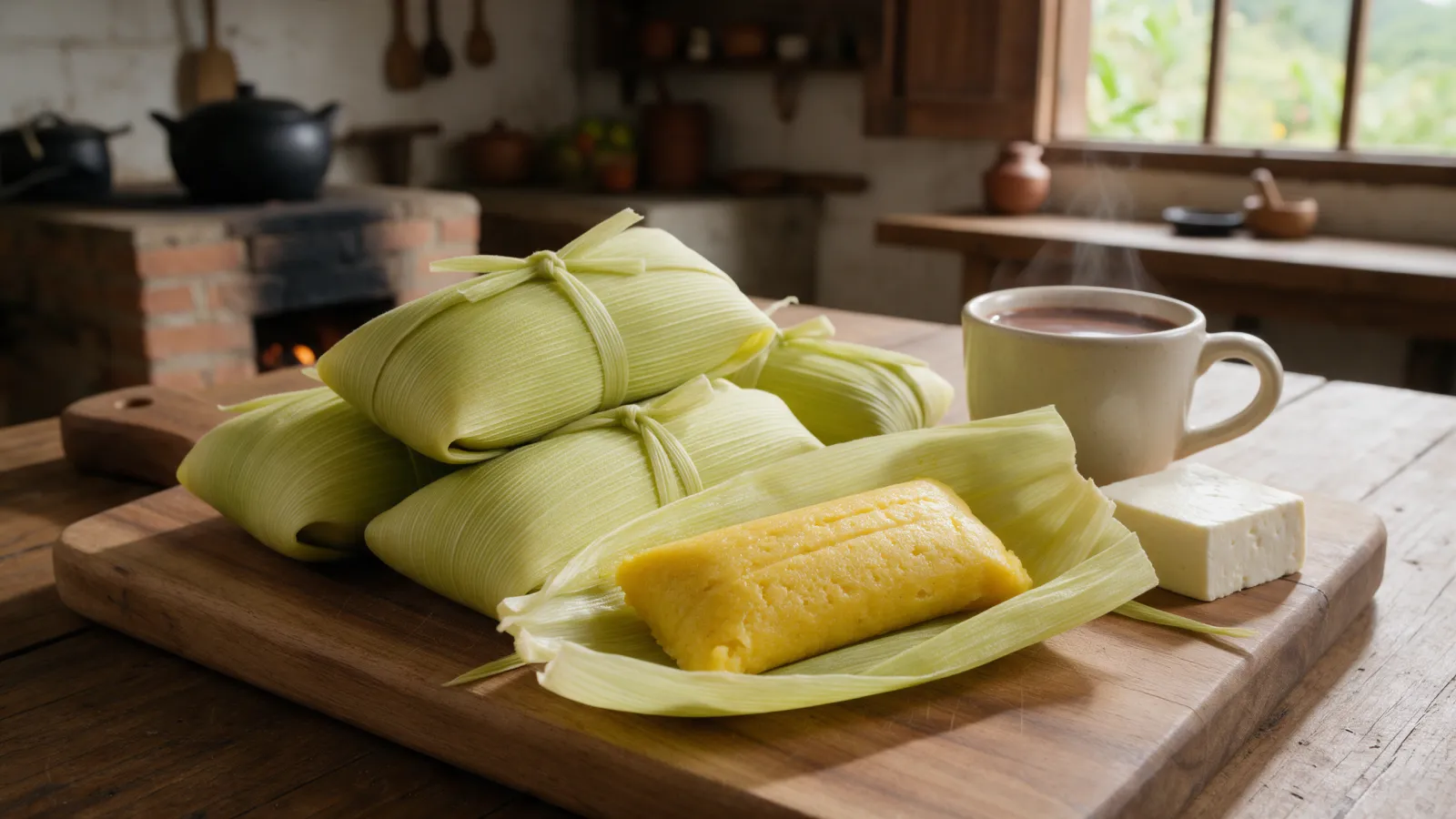

Grind 1 kg (2.2 lb) of kernels cut from fresh ears with butter and a little sugar, wrap the batter around a stick of fresh cheese in the corn’s own husks, steam it for an hour, and you have a tamale with no masa dough and no meat. That’s an envuelto de mazorca (en-BWEL-toh deh mah-SOR-kah), a breakfast and afternoon snack across Colombia’s Andean region. The town of Chocontá, north of Bogotá, is known for them, with a sweet-and-salty batter in which, according to the food pages of colombia.com, the salt wins. The tricky part for a cook in the US or the UK is the corn itself, which is sweeter and wetter than Colombian corn, and this page is mostly about handling that.
Are Colombian corn envueltos worth making?
How do you make Colombian corn envueltos? Grind 1 kg (2.2 lb) of fresh corn kernels without water into a thick batter, stir in 80 g (5½ tbsp) of butter, 60 g of sugar and salt, and spoon 100 g portions onto pairs of corn husks with a stick of fresh cheese. Fold, tie, and steam them over a bed of corn cobs for 60 minutes, then rest 10. 120 minutes for 12 servings.
They are, if you can get corn with its husks. What you end up with is somewhere between a corn pudding and a soft tamale: dense, moist, spoonable, with bits of kernel you can feel and a half-melted core of cheese. Steam sets the batter without browning it, and the husk gives it a cooked-corn smell that foil can’t.
When they shine. A slow weekend breakfast, brunch for guests, or a freezer batch you can reheat two at a time on weekday mornings. Making 12 takes barely longer than making 6, since the hour of steaming is the same.
When to skip them. If you want breakfast in 20 minutes: this is two hours on the clock. If canned corn is all you have, because it’s already cooked and won’t set. And if you’re expecting something fluffy: there’s no baking powder and no egg here, and the result is compact on purpose.
Real time. 120 minutes, about 50 of them hands-on: 10 for the husks, 15 to cut the kernels, 10 to grind and 15 to wrap.
Honest difficulty, medium. Your first half-dozen ties will look crooked. Getting the batter thick enough is the only real skill, and the section on corn below covers it.
How they differ from tamales, humitas and bollos
All four wrap corn in a husk, and the corn decides the result.
On Colombia’s Caribbean coast, the fresh-corn version goes by bollo de mazorca, as the author of My Colombian Recipes notes, while bollo limpio is made from dried corn. Fresh corn ground and fried on a griddle with more flour is a different breakfast, Colombian sweet corn arepas, and baked with eggs in a pan it becomes a Venezuelan corn cake.
What you need, and which corn to buy in the US or UK
For 12: 2.5 kg (5½ lb) of corn in the husk, which gives 1 kg (2.2 lb) of kernels and the 24 husks, plus 80 g (5½ tbsp) of butter, 60 g (¼ cup plus 1 tbsp) of sugar, 5 g (1 tsp) of salt and 200 g (7 oz) of fresh cheese. A large ear of sweet corn yields about 143 g (5 oz) of kernels according to the USDA, so 7 large ears cover it.
Sweet corn versus Colombian corn, and how to compensate
The ears sold as chócolo in Colombian markets are, in my kitchen, starchier and less sugary than anything in a US or UK supermarket, where the corn is sweet corn, bred to store sugar instead of starch. Farm extension guides describe it exactly that way: high sugar, low starch. Two things follow. The batter comes out runnier, because there’s less starch to set it, and sweeter, because the sugar is already in the kernel. The author of My Colombian Recipes says her first batch in the US came out watery and that she adds cornmeal for that reason; I do the same.
The fix, in order: drain the ground corn for 10 minutes in a sieve, pressing with your hand; add 30 g (3 tbsp) of masarepa; and halve the sugar to 30 g (2½ tbsp) with yellow sweet corn. White sweet corn has about half the sugar of yellow by the USDA figures, so it needs less correction, and it’s what I reach for in a Latin market.
| What you can buy | What happens to the batter | What to do |
|---|---|---|
| Fresh yellow sweet corn (US, UK) | runny, sweet | drain 10 min, 30 g (3 tbsp) masarepa, half the sugar |
| Fresh white corn, elote (Latin markets) | slightly runny, less sweet | drain if it runs, full sugar |
| Frozen kernels | watery once thawed, low sugar | thaw in a sieve, 2 tbsp masarepa, full sugar |
| Canned corn | already cooked, salty | don’t use it |
| Ears that are old and starchy | dry, mealy | add milk a tablespoon at a time |
How to tell if fresh ears are right. Press a kernel from the middle of the ear with your thumbnail. A thick, creamy juice is perfect. A thin, watery squirt means very young corn and a runny batter. A hard kernel with almost no juice is past it. Purdue University’s corn growth guides put kernels at about 80 % moisture at the milk stage and 70 % at the dough stage; envueltos want the moment in between.
Cheese, butter and sugar swaps
| Colombian ingredient | US swap | UK swap | What changes |
|---|---|---|---|
| Cuajada (fresh unsalted curd) | queso fresco or farmer’s cheese | queso fresco from Latin grocers, or paneer | paneer stays firmer and less milky |
| Salted butter | salted butter | salted butter | with unsalted, use 6 g (1 heaped tsp) salt |
| Sugar | granulated | caster or granulated | grated panela or dark brown sugar makes it darker, molasses-y |
| Harina precocida | masarepa (precooked arepa flour) | masarepa, or cornflour (cornstarch) | cornstarch binds the same and is invisible |
Husks, fresh, dried or foil
Fresh husks come off the ears you’re using. In the UK, supermarket corn is often sold trimmed with only a few husks left, so buy loose ears in summer or plan on dried ones.
Dried corn husks (sold for tamales in the Latin aisle in the US, and from Mexican grocers online in the UK) work almost as well. Excélsior’s fresh-corn tamal recipe soaks them in warm water for 30 to 60 minutes until they bend without cracking. They’re smaller, so use three per envuelto.
Foil in 25 cm (10 in) squares, folded into a sealed parcel, cooks in the same 60 minutes. My Colombian Recipes lists it as a stand-in for husks. You lose the corn-husk aroma, and the surface comes out wetter because foil traps the steam.
Equipment
An 8 to 10 quart (8 to 10 liter) pot with a lid, a sieve, a wide bowl and a long knife. A food processor is the best home substitute for the hand-crank corn mill Colombians use, because it grinds without water. A blender only works with liquid, which is exactly what you don’t want; if it’s all you have, blend 250 g (9 oz) at a time in short pulses and stop to scrape down. A tamale steamer is handy, but the bed of cobs does the same job.
How to plan it, and how to tell it’s working
Two hours on the clock, 50 minutes of work. Put the pot on before you start wrapping, so the water is boiling when the last envuelto is tied.
Make ahead. The day before, strip and rinse the husks and keep them in a damp towel inside a bag in the fridge; you can cut the kernels too and refrigerate them covered. I grind on the day, because raw ground corn left overnight weeps liquid and loses its fresh smell. That leaves about 95 minutes on the day, 25 of them hands-on.
| Stage | What you should see |
|---|---|
| Batter | a spoonful holds for a second, then drops in one lump |
| Wrapped envuelto | lifted by its tie, it doesn’t open or leak at the ends |
| Water under the cobs | you can hear it boiling, but it doesn’t splash the envueltos |
| 50 minutes | firm through the husk like a set custard, peels cleanly off when opened |
How to fold and tie the husks
Two husks per envuelto, overlapped by their wide ends about 3 cm (1¼ in), as in the My Colombian Recipes version. Batter in the center, 100 g (3½ oz), with the cheese stick pushed in so it doesn’t show. Fold one long side over the batter and the other on top, loosely. Fold both pointed ends underneath, one over the other, and tie a husk strip around the middle with a double knot. If the strips snap, use kitchen twine. Wrap them loose rather than tight: the batter swells a little and will split a tight husk.
Steaming over the cobs
I learned the bed of cobs from colombia.com’s recipe: cobs on the bottom, water to just below their top, spare husks on top, so the envueltos sit above the water instead of in it. They steam rather than boil, and the batter doesn’t get soggy.
Steaming time is where recipes disagree most. Excélsior’s tamales de elote take 60 to 75 minutes, the cheese envueltos on My Colombian Recipes and Tropical Cheese an hour, the smaller bollos on My Colombian Recipes 30 to 40, and colombia.com says 30. For envueltos of 100 g (3½ oz), 60 minutes from first steam is what sets mine to the center, and I check one at 50. Altitude plays a part. Water boils at 212°F (100°C) at sea level but at about 196°F (91°C) in Bogotá, at 2,640 m (8,660 ft), so near the coast yours may be done sooner.
Before you start, mistakes, kids and allergens
Two things decide the batch: how thick the batter is when you wrap, and keeping water in the pot for the whole 60 minutes.
Mistakes and how to avoid them.
- Batter leaking out of the ends → it was too runny, or the ends weren’t folded under. Drain and add masarepa, and fold both ends, not just one.
- Pasty or raw in the middle → not enough time, or the steam stopped. Check the water every 15 minutes and add 10 minutes.
- Dry and mealy → the corn was old. Add milk to the batter, a tablespoon at a time.
- Tastes watery → the envueltos sat in the water. Keep them on the cobs or a rack.
- Husks tearing as you fold → they dried out. Soak them 10 minutes in hot water, or double them up.
- Falling apart on the plate → unwrapped straight from the pot. Give them 10 minutes off the heat.
Spice level, 0 out of 5. None. The savory version takes hot sauce on the side.
Kids? The sweet version, always. The cheese in the middle stays hotter than the batter around it, so wait out the 10-minute rest.
Allergens. Dairy (butter, cheese) and corn. No gluten, egg or nuts; check that your masarepa is labeled gluten-free if that matters.
Which version should you make?
- Sweet, the default → as written, 60 g (¼ cup plus 1 tbsp) of sugar with Colombian or white corn, 30 g (2½ tbsp) with yellow sweet corn.
- Savory → 15 g (1 tbsp) sugar and 8 g (1⅓ tsp) salt, with a salty crumbly cheese such as Colombian queso costeño (feta is the nearest supermarket match) instead of the fresh cheese. That’s the sweet-and-salty style colombia.com describes in Chocontá.
- With guava paste or raisins → a 10 g (⅓ oz) piece of guava paste next to the cheese, or 1 tablespoon of raisins per envuelto. Both are fillings colombia.com mentions in the region.
- With eggs → 2 beaten eggs in the batter, as in the My Colombian Recipes envueltos de chócolo: firmer, drier, closer to a cake.
- Faster → 1 kg (2.2 lb) frozen kernels, drained, with 2 tablespoons of masarepa and soaked dried husks. No husking, no cutting: about 95 minutes.
- Dairy-free → 60 g (¼ cup) coconut oil instead of butter, and no cheese. Plainer; serve with something to spread on top.
- For 12 to 20 people → 1.5 times the recipe gives 18 envueltos (1.5 kg / 3.3 lb kernels, about 11 large ears); double it for 24. Use two pots or a tamale steamer and keep to two layers; stacked three deep, the middle ones lag behind and the 50-minute check stops being reliable.
Freezer plan. Cooked envueltos freeze far better than raw ones, whose batter weeps on thawing. Cool them in their husks, bag them with the air pressed out, and steam them from frozen.
| Stored | How long | To reheat |
|---|---|---|
| Room temperature | 2 hours at most (USDA FSIS) | — |
| Fridge, 40°F (4°C) or below | 3 to 4 days (FSIS) | steam 15 minutes |
| Freezer, 0°F (−18°C) | best within 3 to 4 months (FSIS) | steam 25 to 30 minutes from frozen |
What it costs, and what makes it expensive
The US Bureau of Labor Statistics doesn’t track sweet corn in its average retail prices, so the corn is the one figure I can’t give you from an official source. With the August 2026 city averages for the rest, the 80 g of butter costs about $0.71 ($4.021 per pound), the 60 g of sugar $0.14 ($1.024 per pound), and 200 g of cheese about $2.64 using cheddar ($5.983 per pound) as the stand-in, since there’s no series for queso fresco. That’s $3.48 before the corn, or 29 cents an envuelto.
Yield. 12 envueltos of about 110 g (4 oz). One per person with coffee for breakfast, two as a meal.
What drives the price. In the US and UK, the cheese. In Colombia it’s the corn: the DANE’s SIPSA wholesale bulletin for 12 to 18 September 2026 had ears at 3,554 pesos per kilo at Corabastos in Bogotá and 1,713 at the Central Mayorista in Medellín, so the same 2.5 kg cost less than half as much in Medellín.
What to expect, how to serve them and how to store them
Taste and texture. A firm, moist, yellow block you eat with a spoon. Corn sweetness up front, salt underneath, kernels you can feel, and soft cheese in the center that doesn’t fully melt. The husk leaves a cooked-corn aroma.
How they’re served. Hot, opened on the plate and eaten out of the husk, with butter on top and grated or sliced cheese, which is how both colombia.com and My Colombian Recipes serve them. In the morning they go with milky coffee or a mug of Colombian hot chocolate. On a brunch table they sit well next to Colombian cheese arepas or Venezuela’s griddled version of the same fresh corn, cachapas. For a corn-based dish built on dried kernels and meat instead, look at Colombian tamales, and for corn cooked soft and eaten cold with milk, Colombian mazamorra.
Reheating without ruining them. Steam them in their husks to 165°F (74°C) in the center: 15 minutes from the fridge, 25 to 30 from frozen. In a dry skillet, still wrapped, 4 to 5 minutes a side toasts the husk and gives the batter a smoky edge. In the microwave, wrapped in a damp paper towel, 1 minute per envuelto; fine, if a little softer.
Frequently asked questions
What is a Colombian envuelto? A portion of fresh corn ground with butter, sugar or salt, often with fresh cheese inside, wrapped in corn husks and steamed. It’s eaten for breakfast or as an afternoon snack.
Is an envuelto the same as a tamale? No. A tamale uses masa from dried corn and usually has a meat filling. An envuelto is fresh corn only, closer to a Mexican tamal de elote, though without baking powder.
Can I use sweet corn from the supermarket? Yes. Drain the ground corn for 10 minutes, add 30 g (3 tbsp) of masarepa, and halve the sugar with yellow sweet corn.
Can I use frozen or canned corn? Frozen, yes: thaw it in a sieve and add 2 tablespoons of masarepa. Canned, no; it’s already cooked and salted, and the batter won’t set properly.
How long do you steam envueltos? 60 minutes from first steam for 100 g (3½ oz) envueltos, then 10 minutes off the heat. Check one at 50 minutes, sooner at sea level.
Can I make envueltos without corn husks? Use dried tamale husks soaked 30 to 60 minutes in warm water, 3 per envuelto, or foil parcels. Foil cooks in the same time but loses the husk aroma.
Can I freeze envueltos? Yes, cooked and in their husks, best within 3 to 4 months at 0°F (−18°C), and steamed straight from the freezer for 25 to 30 minutes.
Nutrition
Per envuelto, about 110 g (4 oz), without the butter or cheese on top, calculated ingredient by ingredient from the USDA FoodData Central database (SR Legacy) with the quantities in this recipe. The corn is calculated as raw sweet corn and the cuajada as queso fresco, the closest USDA entries:
- Calories: 198 kcal
- Protein: 6 g
- Carbohydrates: 23 g
- Fat: 11 g, of which 6 g saturated
- Fiber: 2 g
- Sugars: 11 g
- Sodium: 342 mg
Butter is close to 60 % of the saturated fat, and the cheese nearly all of the rest. A teaspoon of butter on top at the table adds about 34 kcal. Cutting the sugar to 15 g, as in the savory version, brings an envuelto down to about 183 kcal and 7 g of sugars.
I’d eaten fresh corn in Venezuela as cachapas and as torta, never wrapped in its own husk, and my first batch in Colombia oozed out of every fold because I’d blended the corn with water. Now I grind it dry, test the batter on a spoon before touching a husk, and half of every batch goes straight into the freezer. Josnaisis.