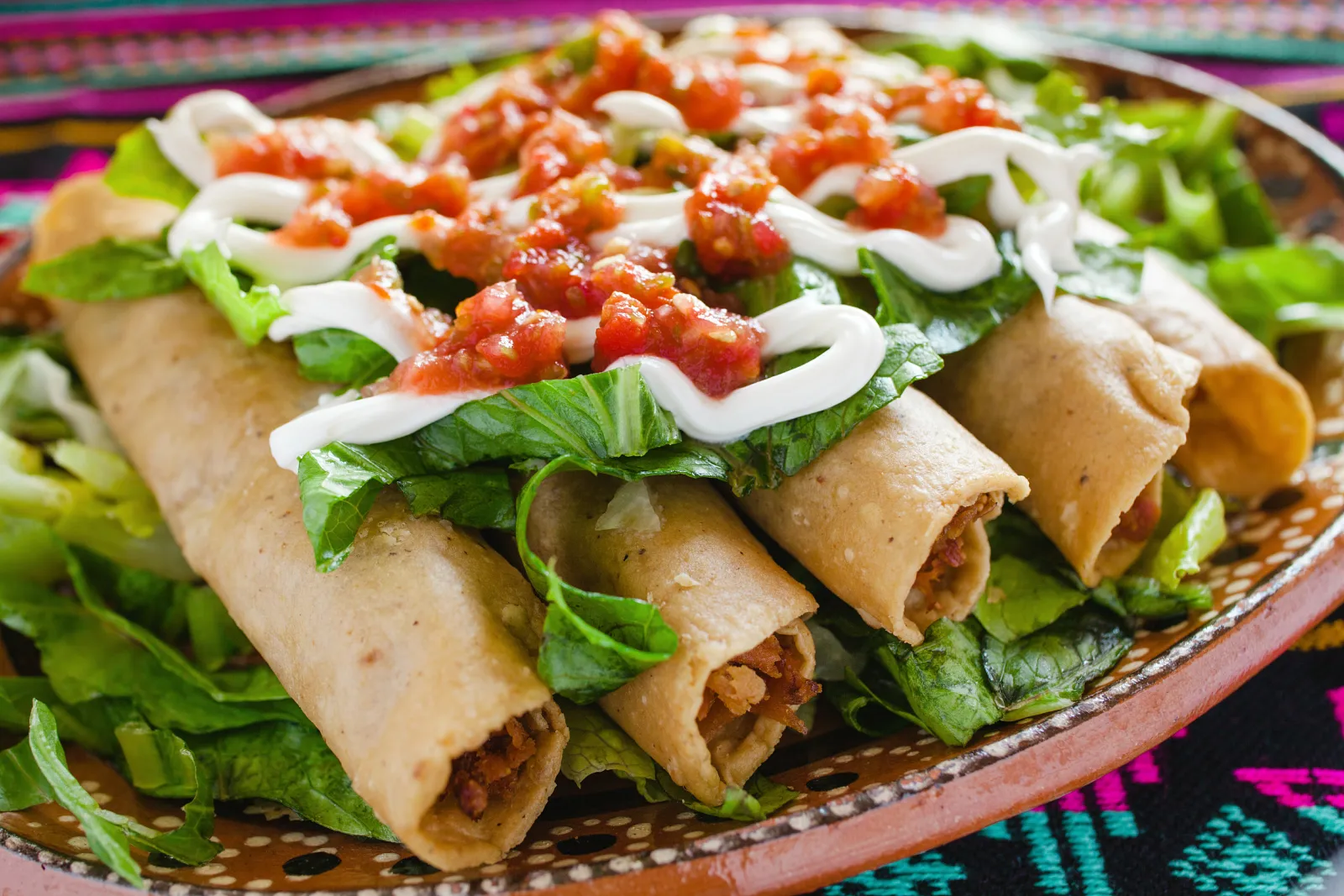

Flautas (FLOUT-ahs, Spanish for flutes) are Mexico’s rolled tacos: a corn tortilla wrapped tight around shredded chicken and fried until it shatters when you bite it. The Mexican Spanish dictionary from El Colegio de México defines one as a taco made from a large tortilla, long and fried golden in oil. If you’ve only met the frozen taquitos from the supermarket freezer, homemade flautas are a different thing, and lighter too, gram for gram. What follows is the version I make with 6-inch tortillas from any US or UK store, plus the three ways flautas go wrong and the exact numbers that stop each one.
What are chicken flautas, and how do they differ from taquitos?
How do you make chicken flautas? Simmer 1.3 lb (600 g) of chicken breast for 20 minutes, shred it finely and cook it with onion until dry. Warm 16 corn tortillas for 30 seconds a side, roll 2 tablespoons of filling into each, pin with toothpicks, and fry in ¾ in (2 cm) of oil at 350–355°F (175–180°C), 3 to 4 minutes per batch, seam side down first. 65 minutes for 4 servings of 4 flautas.
Flautas, taquitos and tacos dorados are close cousins, and people argue about the lines between them. In Mexico, taco dorado (golden taco) is the umbrella term for any taco fried crisp. The flauta is the long one: Excélsior, the Mexico City daily, puts it at twice the length of a regular taco or more, 8 to 16 in (20 to 40 cm). In the US, taquito usually means the small, tightly rolled corn version sold frozen as a snack, and some Mexican-American kitchens call a rolled taco a flauta when the tortilla is flour.
The honest answer for a home cook is that length comes from the tortilla. With standard 6 in (15 cm) supermarket tortillas you get 6 in flautas, and that is what this recipe uses. For the long kind, overlap two warm tortillas by about 2 in (5 cm) and roll them as one.
Is it worth making? Yes, if you like crisp food and have an hour. One pound and a bit of chicken and a pack of tortillas make 16 flautas, and leftover chicken from almost anything turns into a new meal. The catch is the oil: a fried serving is 558 kcal and 24 g of fat before toppings. The difficulty is medium, for two moments only, rolling without cracks and keeping the oil in range.
Ingredients, with US and UK swaps
The full list is in the recipe card: 1.3 lb (600 g) chicken, 16 corn tortillas, an onion, 2 cups of frying oil, and lettuce, crema, queso fresco and salsa verde to finish.
Corn or flour tortillas. In Mexico, flautas are corn: Pati Jinich and Maricruz Ávalos both use 16 corn tortillas for about 2 cups of chicken. Flour works and is common in Northern Mexico and the US; Lil’ Luna rolls 6-inch flour tortillas and fries them at 375°F (190°C). Flour rolls without warming and fries softer and flakier. Corn is crisper, tastes of nixtamalized corn and is the gluten-free choice, though check the label, because some packaged “corn” tortillas contain wheat.
Breast or thigh. Cooked breast has 151 kcal and 3 g of fat per 100 g (USDA) and shreds into long, thin strands that roll neatly. Thigh has 195 kcal and nearly 10 g of fat, stays juicier and forgives overcooking. A rotisserie chicken is the fastest route: skin off, shredded in 10 minutes, and you skip the poaching. For a smoky filling, use well-drained chicken tinga, 2 tablespoons per flauta.
Equipment. A deep 10 in (25 cm) skillet, tongs, toothpicks and ideally a clip-on thermometer. No toothpicks? Fry the seam side first and don’t move the flauta for 30 seconds; the seam seals itself.
How to roll flautas so the tortillas don’t crack
Corn tortillas crack for two reasons, cold or dry. Warm each one for 30 seconds per side in a dry skillet over medium heat and keep the stack wrapped in a towel, where the steam keeps them supple. A microwave does the job too: wrap a stack of eight in a damp towel and heat for under a minute.
Then the amount: two heaped tablespoons of filling, roughly 1 oz (28 g), laid in a line ¾ in (2 cm) from the edge and rolled tight with your fingers on the first turn. Pati Jinich’s instruction is that they should be thin, not chubby. Overfill and the tortilla can’t make a full turn, the seam ends up short, and it opens in the oil.
Pin two flautas side by side with one toothpick through both, near the seam. They hold each other in shape, fry evenly and you use half the toothpicks. If a tortilla splits as you roll, lay a second warm tortilla over it and roll the two together.
Who this recipe is for
- First time frying at home → make 8, use a thermometer, and fry 3 at a time until you get a feel for it.
- Cooking for a crowd → roll and freeze them days ahead; the freezer plan is below.
- Avoiding deep frying → the air fryer gets closest; the oven is easiest for big batches.
- Feeding kids → pull every toothpick before serving and let the filling cool for 2 minutes.
Frying temperature, timing and why flautas get greasy
350–355°F (175–180°C), 3 to 4 minutes a batch. Pati Jinich fries hers at 350°F in 1 in (2.5 cm) of oil for 2 to 3 minutes, then about a minute after turning. I start them seam side down because the first seconds of heat seal the tortilla in that position.
Greasy flautas come from cool oil. Below about 320°F (160°C) the shell is slow to set and drinks oil while it waits. That’s why I fry 4 at a time in a 10 in skillet rather than 8: every cold flauta drops the temperature, and a small batch recovers in 30 seconds. Drain them on a rack or standing on end in a container lined with paper towels, never flat on a plate, where the bottom steams soft.
Baked or air fryer flautas, an honest comparison
Both work, and both are a step down in texture. Baked at 375°F (190°C), brushed with oil all over, they take 15 to 20 minutes according to Pati Jinich; Maricruz Ávalos goes to 400°F (200°C) for 10 to 15 minutes, turning halfway. They come out crisp but drier and flatter, without the blistered shell, and the ends brown before the middle.
In an air fryer at 400°F (200°C), brushed and seam side down, allow 8 to 10 minutes, turning halfway, 6 to 8 per basket with space between them. The color is better than the oven’s. Brushing is what makes or breaks both methods: a dry corn tortilla goes leathery and cracks. Half a teaspoon of oil brushed over every pair is enough, and it brings each flauta down to about 117 kcal from roughly 140 fried.
Make-ahead, freezer plan and party amounts
The day before, poach, shred and cook the filling, and make the salsa verde. Cooked chicken keeps 3 to 4 days in the fridge, according to USDA FSIS, and raw chicken should be cooked within 1 to 2 days of buying it. Don’t roll flautas and refrigerate them: the tortilla absorbs moisture from the filling and tears in the oil.
The freezer is the real make-ahead. Roll the flautas with cooled filling, freeze them seam side down on a lined tray for 2 hours until firm, then bag them. Maricruz Ávalos keeps them up to 3 months; FSIS gives 2 to 6 months for frozen cooked dishes, and I use mine within 2 months because the tortillas dry out. Fry straight from frozen at 340°F (170°C) for 6 to 7 minutes a batch, or air-fry brushed at 350°F (180°C) for 10 to 12 minutes, and check that the first one reaches 165°F (74°C) inside.
As a main, count four flautas a head; next to other dishes, two or three.
| People | Flautas | 6 in corn tortillas | Raw chicken | Frying oil | Salsa verde |
|---|---|---|---|---|---|
| 4 | 16 | 16 (15 oz / 420 g) | 1.3 lb (600 g) | 2 cups (500 ml) | 1 cup |
| 8 | 32 | 32 (1.85 lb / 840 g) | 2.6 lb (1.2 kg) | 2 cups (500 ml) | 2 cups |
| 12 | 48 | 48 (2.8 lb / 1.25 kg) | 4 lb (1.8 kg) | 3 cups (750 ml) | 3 cups |
| 24 | 96 | 96 (5.5 lb / 2.5 kg) | 8 lb (3.6 kg) | 4 cups (1 l) | 6 cups |
Per person, add about 1¾ oz (50 g) lettuce, 2 tablespoons crema and ¾ oz (20 g) queso fresco.
For a buffet, FSIS says hot food should stay at 140°F (60°C) or above and sit out no longer than 2 hours.
Mistakes that ruin flautas
- Tortillas crack while rolling → they’re cold. 30 seconds a side, then into a towel.
- Flautas unroll in the oil → too much filling or seam side up. 2 tablespoons, a toothpick, seam down for the first 2 minutes.
- Greasy and heavy → oil below 320°F (160°C) or a crowded pan. Thermometer, 4 per batch, 30 seconds between batches.
- Golden outside, cold inside → oil above 375°F (190°C) or filling straight from the fridge. Let the filling sit out 20 minutes.
- Oil spits violently → wet filling. Cook it until the pan is dry.
- Soft by the time they’re served → stacked, covered or drained flat. Rack, uncovered, and serve fast.
Spice level, 0 out of 5. Chicken and tortilla aren’t hot; the heat lives in the salsa. Allergens: milk in the crema and cheese; gluten only with flour tortillas or wheat-blend corn ones.
What it costs to make chicken flautas
With US city averages from the Bureau of Labor Statistics for August 2026, boneless chicken breast was $4.17 a pound, so the 1.3 lb comes to $5.52, and 7 oz of iceberg lettuce, at $1.47 a pound, to $0.65. Tortillas, crema, queso fresco and oil have no BLS series, so I leave them out rather than guess. The chicken is what you’re paying for; bone-in chicken legs averaged $1.67 a pound the same month, less than half the price per pound of breast, though some of that weight is bone you’ll pick out after poaching.
What to serve with flautas
A full plate is 3 or 4 flautas with Mexican red rice and refried beans. Swap the crema for guacamole if you want richness without dairy, and keep a bowl of cooked salsa verde on the table, since the acidity is what fried food needs. For a spread of Mexican snacks, quesadillas made on a dry skillet cook in the same pan while the flautas drain, and griddled masa gorditas can be made ahead and filled with the same shredded chicken.
Storing and reheating
Per USDA FSIS, leftovers go into the fridge within 2 hours and keep 3 to 4 days at 40°F (4°C) or below. Store them without toppings, on a paper towel in a closed container. Reheat in an air fryer at 350°F (180°C) for 4 to 5 minutes, or on a rack in a 400°F (200°C) oven for 8 to 10, until they reach 165°F (74°C) in the center. The microwave heats them through and turns the shell chewy.
Frequently asked questions
What is the difference between flautas and taquitos? Mostly size. Both are rolled and fried; flautas are the long version, traditionally from a large tortilla. In the US, taquitos are usually the small frozen kind, and some cooks call the flour-tortilla version a flauta.
Are flautas made with corn or flour tortillas? In Mexico, almost always corn. Flour versions are common in Northern Mexico and the US, and they roll without warming.
How do you keep flautas from unrolling? Use about 2 tablespoons of filling, roll tightly, pin two flautas together with one toothpick, and fry seam side down first.
Can you make flautas in the air fryer? Yes. Brush them with oil and cook at 400°F (200°C) for 8 to 10 minutes, turning halfway. They’re crisp but drier than fried.
Can you freeze flautas before frying? Yes. Freeze them on a tray for 2 hours, then bag. Fry from frozen at 340°F (170°C) for 6 to 7 minutes.
How many flautas per person? Four as a main, two or three with other dishes. For 12 people, roll 48 with 4 lb (1.8 kg) of raw chicken.
What sauce goes on flautas? Salsa verde is the classic, with crema and crumbled queso fresco over shredded lettuce. Guacamole works in place of crema.
Nutrition per serving
Per serving of 4 flautas (about 9 oz / 255 g, without toppings), calculated with USDA SR Legacy from 104 g corn tortilla, 112 g cooked chicken breast, onion, the cooking oil and an estimated 3.5 g of absorbed oil per flauta. That absorption is my own estimate: USDA’s fried taco shell holds roughly 12 g more oil than the corn tortilla it starts from, per 100 g of tortilla. The salt counted is the filling’s, not the poaching water’s.
- Calories: 558 kcal
- Protein: 39 g
- Carbohydrates: 48 g
- Fat: 24 g, of which 4 g saturated
- Fiber: 7 g
- Sugars: 2 g
- Sodium: 410 mg
Toppings add up: 2 tablespoons of sour cream, ¾ oz of queso fresco and a handful of lettuce bring about 128 kcal, 11 g of fat and 164 mg of sodium per plate.
In my Colombian kitchen I fry patacones and empanadas all the time, so the oil never scared me; the rolling did. My first batch of flautas unrolled in the pan, every one of them, because I packed them like a stuffed arepa. A flauta wants to be skinny. Once I accepted that, the toothpicks became almost optional, and now my son eats them with his hands, lettuce on the side. Josnaisis.