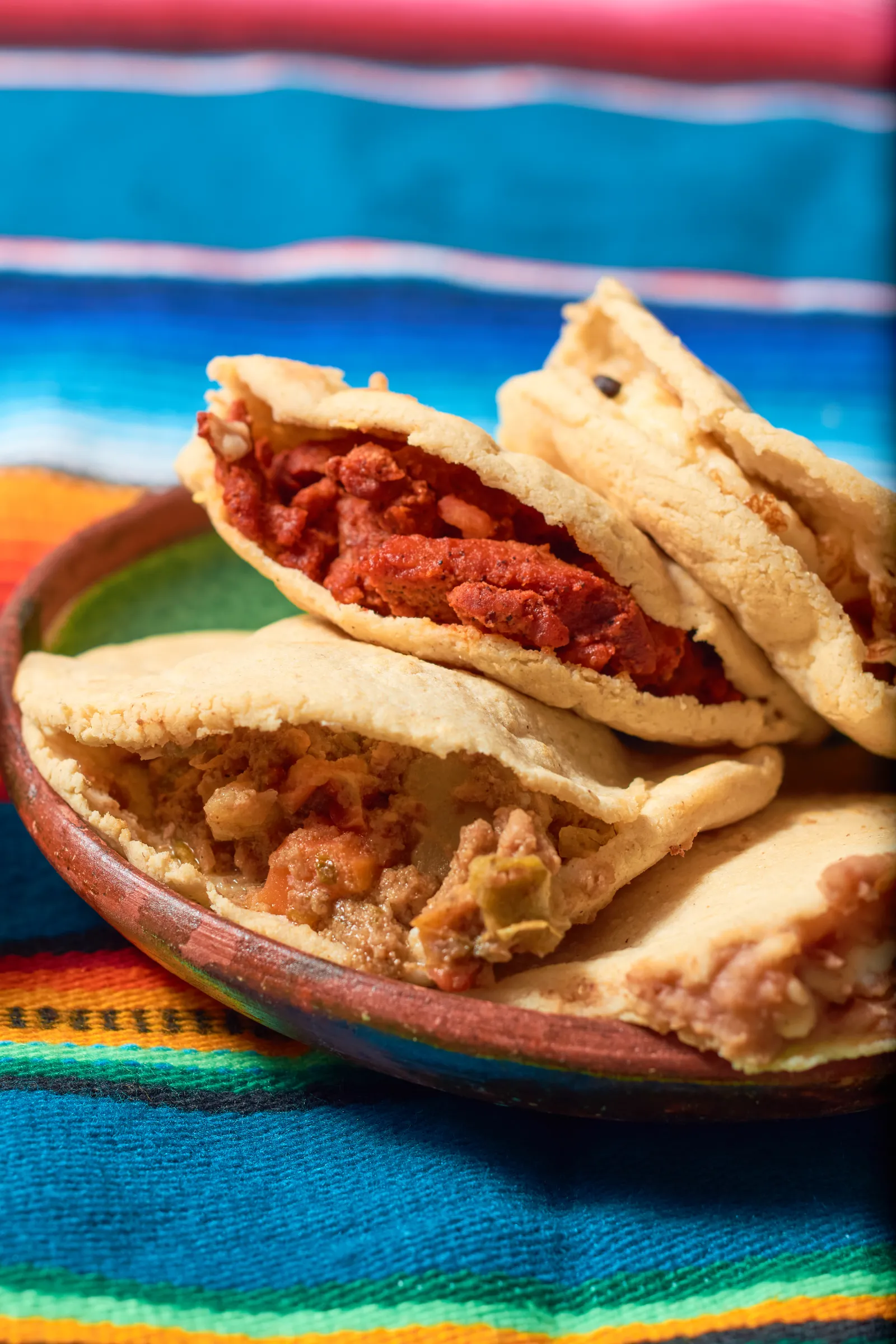

Think of a gordita (gor-DEE-tah, “little fat one”) as a thick corn tortilla cooked on a dry griddle until it puffs, then split along the edge like a pita and stuffed. The dough is the same nixtamalized corn masa that makes tortillas, which is why it tastes like a fresh tortilla rather than cornbread, and the classic street filling is chicharrón prensado, pressed pork cracklings, stewed in salsa verde. This recipe makes 12, tells you which flour actually works (cornmeal and arepa flour don’t), what to buy in a US or UK supermarket, how to split them without tearing, and how to turn the whole thing into a make-ahead gordita bar.
Are gorditas worth making at home?
How do you make gorditas? Knead 360 g (3 cups) masa harina with 540 ml (2¼ cups) warm water, 30 g (2 tbsp) lard and salt, press 12 rounds 7 mm (¼ in) thick, and cook them on a dry griddle over medium heat for about 7 minutes, flipping twice until they puff. Split them hot along the edge with a paring knife and fill with chicharrón stewed in salsa verde, queso fresco, onion and cilantro. 55 minutes for 6 servings.
Yes, especially for a crowd. Every filling can be made a day or two ahead, the dough takes five minutes to mix, and on the day you’re only working the griddle. What you get is something a tortilla can’t do: a crusty, toasted outside, a soft, steamy corn crumb inside, and a pocket sturdy enough to hold a saucy stew without collapsing.
When to make them. A weekend lunch, a casual party where people choose their own fillings, or game day. Two gorditas with a filling are a full meal.
When to skip them. On a weeknight if you’ve never handled masa, because the first two always come out lopsided. And if you can’t find masa harina: there’s no workable substitute, as the table below shows.
Real timing. 55 minutes start to finish, about 45 of them hands-on, because the griddle needs you. With the filling made the day before, it’s 40 minutes.
Difficulty, honestly medium. Two things go wrong: dough that’s too dry, and a griddle that’s too hot. Treat the first two as test gorditas; by the third you’ll know your pan.
Gordita, sope, arepa or pupusa?
They all start with corn dough, and they’re easy to mix up. A sope is an open base with a pinched rim and toppings piled on top. A pupusa, from El Salvador, is sealed all the way around with the filling inside. A gordita is cooked whole and split afterward (some regions fill and seal it before cooking). A Venezuelan arepa is also griddled and split, like a reina pepiada arepa, but it’s made from precooked corn flour that was never treated with lime, so it tastes of plain corn, not of tortilla.
What you need, with US and UK swaps
For 12 gorditas you need 360 g (3 cups) masa harina, 540 ml (2¼ cups) warm water and 30 g (2 tbsp) lard, plus 400 g (14 oz) chicharrón prensado and 500 g (1.1 lb) tomatillos for the filling. Exact amounts are in the recipe card.
Masa harina, and the flours that won’t work
Masa harina is corn cooked with lime (calcium hydroxide), ground and dried; the only ingredient on a bag of Maseca reads “corn treated with hydrated lime.” That treatment, nixtamalization, is what lets the dough stretch instead of crumble. The ratio I use is 1 part flour to 1.5 parts water by weight, which matches Maricruz Avalos (3 cups Maseca and 2¼ cups water for 12) and America’s Test Kitchen (567 g / 20 oz and 3⅔ cups water for 12).
Fresh masa from a tortilleria is even better: 900 g (2 lb) replaces the flour and water together. Ask for plain masa for tortillas, not masa preparada for tamales, which usually has lard and baking powder already mixed in.
Chicharrón prensado, and what to use instead
This isn’t the puffy pork rind sold in bags. It’s the scraps of meat and skin left at the bottom of the pot after frying pork cracklings, fried again and pressed into a block to squeeze out the fat. It’s dark brown; a reddish block has curing salt (saltpeter) added. In the US, look for it at Mexican butcher counters and Latin supermarkets, where it’s sold by the pound.
In the UK you won’t find it. The closest thing I’ve used is slow-cooked pork shoulder, shredded and crisped in its own fat, like the meat for carnitas tacos. Without pork, chicken tinga is a classic gordita filling and also keeps for days.
Tomatillos, chiles and cheese
- Tomatillos: fresh in most US supermarkets; in the UK, canned, from Mexican food shops online. Canned ones are already cooked, so just drain and blend. If you already have a jar of Mexican salsa verde, 400 ml (1⅔ cups) replaces the whole salsa step.
- Serranos: one jalapeño gives about the same heat as two serranos.
- Queso fresco: in US supermarkets next to the Mexican cream. In the UK, a mild crumbly cheese such as Wensleydale is closer than feta, which is much saltier.
Equipment
A cast-iron skillet, griddle or comal at least 28 cm (11 in) across, a tortilla press or a heavy flat-bottomed plate, two squares cut from a freezer bag, and a small paring knife. A nonstick pan works but browns less.
How to plan it, and how to tell each stage is right
The salsa and the stewed chicharrón fit inside the 15 minutes the dough rests, and once the first batch is off the griddle you split and fill it while the next one cooks. That’s how 12 gorditas land in 55 minutes with a single pan.
What to make ahead. The filling keeps 3 to 4 days in the fridge at 40°F (4°C) or below, per USDA FSIS, and tastes better on day two. Make the dough on the day; America’s Test Kitchen keeps shaped raw rounds, tightly wrapped, in the fridge for up to 2 hours, and no longer, because the edges dry out.
Signs it’s going right.
- Dough: soft as play dough, not sticky, and a pressed ball has smooth edges.
- Rounds: 10 cm (4 in) across and about 7 mm (¼ in) thick, roughly the thickness of a pencil.
- First side: after 3 minutes it lets go of the pan without a spatula.
- Done: brown spots on both sides and a hollow sound when tapped.
- Filling: thick enough to sit on a spoon. A runny filling soaks the masa.
Why gorditas puff, and how to split them
The puff is steam. Water at the center of the dough boils, and once both faces have set into a crust the steam can’t escape, so it pushes one layer away from the other. Masienda, a US heirloom corn and masa company, explains tortilla puffing this way and recommends a comal at 400 to 500°F (205 to 260°C). A gordita is far thicker than a tortilla, so it needs gentler heat; at tortilla temperatures the outside burns before the middle cooks, a warning Maricruz Avalos gives too.
It rarely puffs completely, and it doesn’t need to. A bubble across part of the round is enough: when you cut into the edge, the knife finds that seam and follows it. Pressing gently with a spatula on the last flip spreads the steam.
How to split it. Straight off the griddle, holding it in a towel, push the tip of a paring knife into the edge and cut about halfway around, 180 degrees, as America’s Test Kitchen does. Leave the other half attached; you want a pocket, not two lids. A cooled gordita’s top layer sticks and tears.
Gordita bar for a party
Allow 3 gorditas per person as a main course or 2 alongside other dishes. Make the fillings the day before, keep them over the lowest heat at 140°F (60°C) or above, the USDA FSIS minimum for hot buffet food, and let guests fill their own.
| People | Gorditas | Masa harina | Warm water | Lard | Filling meat | Tomatillos |
|---|---|---|---|---|---|---|
| 4 | 12 | 360 g (3 cups) | 540 ml (2¼ cups) | 30 g (2 tbsp) | 400 g (14 oz) | 500 g (1.1 lb) |
| 12 | 36 | 1.08 kg (9 cups) | 1.6 l (6¾ cups) | 90 g (7 tbsp) | 1.2 kg (2.6 lb) | 1.5 kg (3.3 lb) |
| 20 | 60 | 1.8 kg (15 cups) | 2.7 l (11¼ cups) | 150 g (¾ cup) | 2 kg (4.4 lb) | 2.5 kg (5.5 lb) |
Mix big batches in two or three bowls; one huge bowl of masa is hard to knead evenly. Stack the cooked gorditas in a towel-lined basket or an empty picnic cooler, which holds the heat well.
Before you cook, mistakes, spice, kids and allergens
Common mistakes and how to fix them.
- Edges crack when you press the dough: too dry. Knead in water a tablespoon at a time.
- Tears when you split it: the round is too thin, or it cooled first. Keep it 7 mm (¼ in) thick and split it hot.
- Burnt outside, raw inside: the pan is too hot. Medium heat, 3 minutes a side.
- Hard as a cracker: too long on a pan that’s too cool. If it passes 8 or 9 minutes with no brown spots, turn the heat up a notch.
- Tastes like an arepa or falls apart: wrong flour. Only masa harina or fresh masa will do.
Spice level, 2 out of 5, from the two serranos in the salsa. Use one, seeded, for 1 out of 5.
Kids usually love them filled with refried beans and cheese. Make smaller 50 g (1¾ oz) rounds for small hands, and go light on the salsa with the chicharrón.
Allergens. Corn masa is gluten-free, but check the bag; some recipes add wheat flour or baking powder, and not every brand is certified free of cross-contact. Dairy comes in with the queso fresco; the FDA advises pregnant women to eat only queso fresco labeled as made with pasteurized milk. The chicharrón is pork.
Which version should you make?
- Short on time: make the filling the day before, or use canned refried beans and cheese. Same-day work drops to 40 minutes.
- No tortilla press: a heavy plate, or your palm on the plastic. Less round, just as good.
- Crispier: fry them. America’s Test Kitchen fries ½-inch (13 mm) rounds in oil at 375°F (190°C), 5 minutes a side, holding the oil between 350 and 375°F (175 and 190°C). They absorb oil and are best eaten right away.
- Lighter: skip the lard and fill with beans and cheese. About 210 kcal a gordita instead of 272.
- Vegetarian: beans and cheese, or roasted poblano strips with a melting cheese (the poblano roasting and peeling is the same as for chiles rellenos). Beans and salsa only make them vegan.
- Picadillo: ground beef with diced potato and tomato, the filling most US Tex-Mex versions use.
What it costs, and what makes it expensive
The meat is the expensive part. The BLS doesn’t track chicharrón prensado, but if you make the filling from pork, the August 2026 US city average for “all other pork” was $3.737 per pound, so 400 g (14 oz) comes to about $3.30. A bean filling costs a fraction of that: 150 g (5 oz) of dried beans, which cook up to about 2 cups, is about $0.54 at the BLS average of $1.630 a pound. The BLS doesn’t price masa harina, tomatillos or queso fresco, so I won’t invent a total.
Yield. 12 gorditas of 75 g (2.6 oz) dough: 6 servings of 2 with sides, or 4 of 3 as a main.
To stretch it, I fill half with chicharrón and half with beans and cheese: 200 g (7 oz) of chicharrón and 2 cups of refried beans make the same 12.
What to expect, how to serve it and how to store it
Taste and texture. A toasted, spotty crust, a soft and moist corn crumb inside that tastes like a just-made tortilla, and a rich, tangy, mildly hot filling cut by cool crumbly cheese and raw onion.
How to serve them. Hot, filled, topped with onion, cilantro and queso fresco, with salsas on the table: a red taqueria salsa for more heat and a bowl of guacamole. Eat them with your hands.
Fridge. USDA FSIS: no more than 2 hours out of the fridge (1 hour above 90°F / 32°C), then 3 to 4 days at 40°F (4°C) or below. Store the gorditas unfilled and the filling separately; filled, the masa goes soggy.
Freezer. The filling freezes well; FSIS gives 3 to 4 months for best quality. Cooked, unfilled gorditas freeze too, separated with parchment, and go straight from the freezer onto the griddle.
Reheating. On the griddle over medium-low heat, 2 to 3 minutes a side, until soft inside again; sprinkle very dry ones with a few drops of water first. Bring the filling to 165°F (74°C) in a pan (FSIS). The microwave turns them rubbery, then hard.
Frequently asked questions
What are gorditas made of? Corn masa (nixtamalized corn dough), water, salt and often a little lard. They’re cooked on a dry griddle or fried, split into a pocket and stuffed.
What’s the masa harina to water ratio for gorditas? 1 to 1.5 by weight: 360 g (3 cups) masa harina to 540 ml (2¼ cups) warm water makes 12. If the edges crack when pressed, add water a tablespoon at a time.
Can I use cornmeal or corn flour instead of masa harina? No. Cornmeal and ordinary corn flour aren’t nixtamalized, so the dough won’t hold together. Arepa flour holds together but makes an arepa, not a gordita.
Why won’t my gorditas puff? Usually dry dough, rounds that are too thick, or a pan that’s too cool. At 7 mm (¼ in) on medium heat they puff at least in part, which is enough to split them.
How do you cut open a gordita without tearing it? While it’s hot, with the tip of a paring knife pushed into the edge and drawn about halfway around.
Are gorditas fried or griddled? Both. Griddled ones are toasty with no added fat; fried ones, at 350 to 375°F (175 to 190°C), are crisp and golden but absorb oil.
What’s the difference between a gordita and a sope? A gordita is a pocket with the filling inside. A sope is an open base with a pinched rim and toppings on top.
Is a Taco Bell gordita the same thing? No. Taco Bell’s is a soft wheat flatbread folded like a taco; a Mexican gordita is corn masa, split and stuffed.
Can I make gorditas ahead? Make the fillings up to 3 days ahead. Gorditas can be cooked earlier, stored unfilled and reheated on the griddle, but freshly made ones split more easily.
Nutrition
Per serving of 2 filled gorditas with queso fresco and onion, calculated ingredient by ingredient from USDA FoodData Central (SR Legacy) using the amounts in this recipe. Chicharrón prensado isn’t in that database, so I used braised pork shoulder in its place; real chicharrón from a butcher is saltier and a little fattier, so treat fat and sodium as minimums.
- Calories: 544 kcal
- Protein: 26 g
- Carbohydrates: 54 g
- Fat: 26 g, of which 9 g saturated
- Fiber: 6 g
- Sugars: 6 g
- Sodium: 740 mg
A plain gordita with no filling is 132 kcal with lard and 109 without.
I grew up splitting arepas every morning, so slicing open a gordita felt natural; it was the dough that humbled me. My first batch was made with arepa flour out of pure habit, and what came off the pan were nice little arepas, which was not the assignment. Since switching to masa harina and weighing the water, I sacrifice one test gordita to read the pan and the rest open at the first cut. Josnaisis.