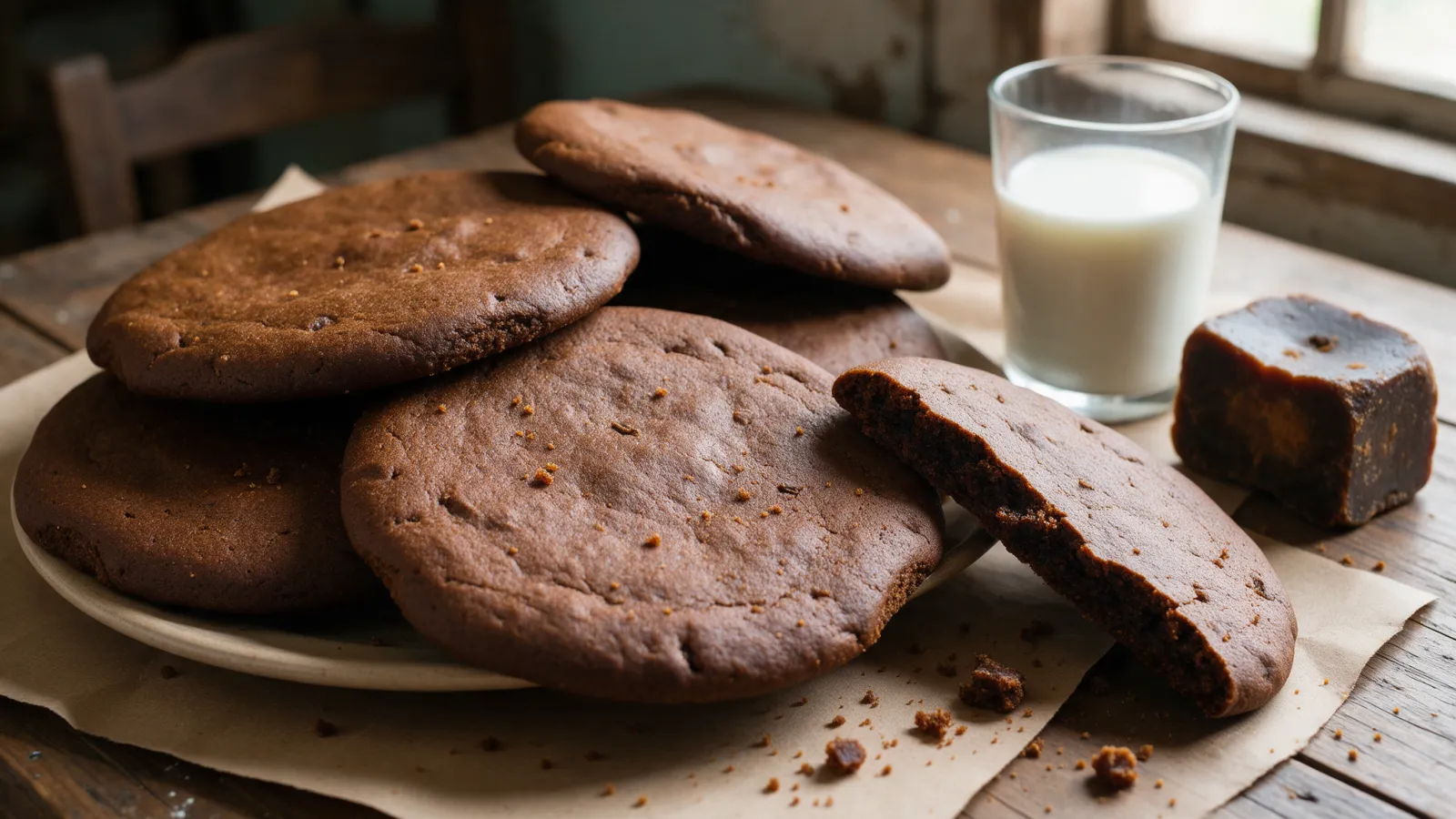

Catalinas are what a Venezuelan bakery puts next to the cash register: dark brown cookies about 4 inches (10 cm) across, sweetened with papelón, Venezuela’s unrefined cane sugar, and spiced with clove and cinnamon. If you know American molasses cookies, picture one that is thicker, flatter, less buttery and soft like cake in the middle. You eat them with a glass of cold milk or a slice of fresh white cheese. This recipe makes 12 from pantry staples, and the one part that needs care is a sticky dough that wants to be chilled, not floured.
What are Venezuelan catalinas and are they worth making?
How do you make Venezuelan catalinas? Simmer 8.8 oz (250 g) of papelón or piloncillo with ½ cup (125 ml) of water, cloves and cinnamon, then let the syrup cool to warm. Stir it into 4 cups (500 g) of flour with baking soda, ground spices, an egg and 7 tbsp (100 g) of butter without kneading, chill the sticky dough 1 hour, roll it ⅓ inch (8 mm) thick, cut 4-inch rounds and bake 15-18 minutes at 350°F (175°C). 160 minutes for 12 servings.
Yes, if you like spice cookies and have an afternoon. They keep for days, travel without breaking and taste better on day two.
What makes them different. The sugar goes in as a syrup, not creamed with butter. That gives a moist, cakey crumb with very little fat: 7 tbsp (100 g) of butter for 4 cups of flour.
Good for. Lunch boxes, an afternoon snack with milk, coffee in the morning, a holiday cookie box that isn’t another batch of shortbread.
Maybe not for. Anyone who wants a crisp, buttery cookie, or who avoids gluten.
Real time. 160 minutes start to finish, about 55 of them hands-on. The rest is waiting for the syrup to cool and the dough to chill.
Honest difficulty, easy. No mixer and no kneading. The only trick is rolling a sticky dough, and cold handles that.
The English Wikipedia article on Venezuelan cuisine lists them with paledonias, brown sugar cookies “also called cucas or catalinas,” and a Venezuelan home baker publishing on Hive places them mainly in Zulia, Lara and the Andes.
Ingredients for catalinas and what to buy in the US and UK
The recipe card has the exact amounts. Three choices matter: the sugar, the flour and how much spice.
Papelón and the closest supermarket swaps
Papelón is cane juice boiled down and set into a hard block, with nothing refined out. Colombian panela and Mexican piloncillo are the same product under other names, and either one works gram for gram.
- In the US, piloncillo is in the Latin or Hispanic aisle of most big supermarkets, sold in 8-oz (225 g) cones. You need one cone plus a little extra; top it up with brown sugar. Chop it with a serrated knife or grate it so it melts faster.
- In the UK, dark muscovado sugar is on the baking shelf of every large supermarket and is the easiest match. Panela turns up in Latin American shops and online.
- The dark brown sugar plan. 200 g (a scant cup, packed) dark brown sugar plus 3 tablespoons molasses (treacle in the UK), the same pairing the Colombian cucas recipe from Sweet y Salado uses. The cookies come out a shade more bitter, which some people prefer.
Flour, baking soda and spices
All-purpose flour, 500 g (4 cups spooned and leveled). Bread flour makes them chewier and tougher. If you only have self-rising flour, cut the baking soda to ¼ teaspoon, as the Hive recipe does, because self-rising already carries its own leavening.
Baking soda, 1 teaspoon (5 g). It lifts the cookies and deepens the color. Directo al Paladar uses 1 teaspoon for 560 g of flour; Sweet y Salado, 1 teaspoon for 420 g. More than that tastes metallic.
Spices. Cinnamon and cloves show up in every version I checked; ginger in two of them; whole anise seed is how the bakeries I grew up with made them, and it’s optional. Go easy on ground cloves: ¼ teaspoon is plenty when the syrup already steeped six whole ones.
Equipment and workarounds
A small saucepan, a strainer, a large bowl, a rolling pin, two baking sheets with parchment and a 4-inch (10 cm) round cutter. No cutter? Use the rim of a wide glass or a small bowl. No rolling pin? A smooth wine bottle, floured. For even thickness, roll between two ⅓-inch (8 mm) wooden strips or chopsticks laid flat.
How to make the papelón syrup and when it’s ready
Two parts sugar to one part water by weight: 250 g (8.8 oz) to 125 ml (½ cup). That’s the ratio in both the Hive recipe (a quarter kilo with half a cup of water) and Directo al Paladar’s (250 g with 125 g).
Stir over medium heat until every lump has melted, then let it boil 2 minutes without stirring. A thermometer would read around 217-219°F (103-104°C). That’s below thread stage, which the Exploratorium’s sugar chart puts at 223-235°F (106-112°C); syrup boiled that far holds less water, the dough needs more flour and the cookies end up hard. If yours sets like toffee as it cools, stir in 2 tablespoons of water over low heat.
Strain out the whole spices and let it cool to 104°F (40°C) or below, about 30 minutes. Hot syrup melts the butter, starts to cook the egg and gives you a greasy dough.
Make-ahead plan and baking day
You can split this over two days, and I usually do. Night before: syrup, cooling and mixing, about 50 minutes (most of it waiting). Wrap the dough and chill. Baking day: under an hour.
Take the dough out 10 minutes before rolling so it doesn’t crack at the edges. The syrup alone also keeps overnight, covered, at room temperature; warm it for 20 seconds in the microwave if it thickens.
Rolling a sticky dough without toughening it
Work with half the dough at a time, straight from the fridge, on a floured counter with a floured pin. Roll from the center out and lift the dough with a bench scraper every few passes, dusting underneath only where it sticks. The whole batch shouldn’t take more than about 30 g (¼ cup) of extra flour.
Gather and re-roll the scraps once. The Hive recipe warns against overworking the dough so the cookies don’t harden, and the re-rolled ones are always the firmest. I bake those last and keep them for home.
Thickness, size and oven
⅓ inch (8 mm) thick, 4 inches (10 cm) across, about 80 g (2.8 oz) of dough each. Thinner than ¼ inch (5 mm) and they dry out; thicker than ½ inch and the edges harden before the middle sets.
350°F (175°C), conventional, middle rack. With a fan oven, 325°F (160°C). Two sheets at once in a fan oven work if you swap them halfway and allow 18-20 minutes.
How to tell they’re done: edges set, tops matte with a few fine cracks, centers that give slightly under a fingertip and spring back. The bottoms should be deep brown, never black.
Scaling for 4-6 or for a party of 24
| Small batch | This recipe | Party batch | |
|---|---|---|---|
| Cookies | 6 | 12 | 24 |
| Papelón or piloncillo | 125 g (4.4 oz) | 250 g (8.8 oz) | 500 g (1.1 lb) |
| Water | 60 ml (¼ cup) | 125 ml (½ cup) | 250 ml (1 cup) |
| Flour | 250 g (2 cups) | 500 g (4 cups) | 1 kg (8 cups) |
| Butter | 50 g (3½ tbsp) | 100 g (7 tbsp) | 200 g (14 tbsp) |
| Egg | ½ beaten (25 g) | 1 large | 2 large |
| Baking soda | ½ tsp | 1 tsp | 2 tsp |
| Baking sheets | 1 | 2 | 4 (about 65 min in one oven) |
Scale the spices the same way. For the party batch, use a 2-quart (2-liter) pan for the syrup so it doesn’t boil over.
Why catalinas turn out hard, and other things to know first
- Too much flour → the dough is meant to be sticky. Chill it rather than flouring it until it stops sticking.
- Kneading → builds gluten and makes them tough. Stir only until the flour disappears.
- Long bake → 20-25 minutes gives a firm dunking cookie. For soft ones, pull them at 15-18.
- Over-reduced syrup → 2 minutes of boiling is enough.
- Rolled too thin → under ¼ inch (5 mm) they dry out.
- Metallic or soapy taste → too much baking soda or poorly mixed. Whisk it into the flour first.
- Scorched bottoms → dark pans or a hot oven. Unrefined sugar browns fast; use parchment and the middle rack.
Heat level: none. The clove and ginger warm the mouth a little.
Kids: usually a hit because they’re soft and sweet. For small children, skip the ground cloves and keep only the whole ones in the syrup.
Allergens: wheat (gluten), egg and milk from the butter. With plant-based butter and no egg (the Hive recipe has none), they’re vegan; add 2 tablespoons of water to the syrup and expect a slightly denser cookie. No nuts.
Catalinas vs molasses cookies, gingerbread and golfeados
- Molasses cookies are creamed, richer in butter, rolled into balls and coated in sugar; they bake up chewy and crackled. Catalinas are rolled and cut into flat rounds, with about half the butter.
- Gingerbread cookies are rolled thin and cut into shapes, with ginger in the lead and a crisp or firm bite. In catalinas, ginger is a background note.
- Colombian cucas are close cousins made with panela; Colombia.com lists catalinas and paledonias as other names for them.
- Venezuelan golfeados share the papelón but are yeasted sweet rolls with cheese, soaked in syrup, and take most of a morning.
For a different kind of holiday tin, Mexican polvorones go the opposite way: lots of butter, no syrup, and they crumble.
Other versions. Firm dunking cookies: 25 minutes at 340°F (170°C), as in the Hive recipe. Big bakery-style rounds: Directo al Paladar makes 8 from a 1½-cm (⅝-inch) sheet at 300°F (150°C) for 20 minutes. No time to chill: work in up to 60 g (½ cup) extra flour and accept a firmer cookie.
What catalinas cost in the US
With BLS average prices for August 2026 (flour $0.548 per pound, butter $4.021 per pound, eggs $2.272 per dozen) and an 8-oz piloncillo cone at $1.28 from H-E-B, a batch of 12 costs about $3.13, or 26 cents a cookie, before spices. The piloncillo is the biggest line; butter comes second.
I couldn’t find an official UK price for panela or muscovado, so I’m not giving a pound figure.
Yield: 12 cookies from just over 2 lb (1 kg) of dough. One per person for a snack.
Serving and storing catalinas
Taste and texture. Deep cane-sugar sweetness close to caramel, clove and cinnamon up front, ginger behind. Matte, lightly cracked tops and a soft, cakey middle. On day two they settle and firm up a little.
How they’re eaten. On their own with cold milk, with milky coffee, or with a slice of fresh white cheese; queso fresco or a mild farmer’s cheese is the closest US match. A Venezuelan merengada milkshake and a catalina is a serious after-school snack. Pair them with papelón con limón only if you love sweet on sweet.
Storing. Cool completely, then keep in an airtight tin at room temperature. Homemade cookies keep 2-3 weeks in the cupboard in an airtight container, according to Kansas State University’s food storage guide; mine are best in the first week. A slice of bread in the tin keeps them soft.
Freezing. Up to 6 months, layered with parchment in a freezer bag; the same Kansas State guide gives 6-12 months for baked or unbaked cookies. Thaw an hour at room temperature. Cut, unbaked rounds freeze too: bake from frozen and add 2-3 minutes.
Warming. Not needed, but 10 seconds in the microwave under a damp paper towel, or 3-4 minutes at 300°F (150°C), brings back the just-baked softness.
If you’re baking for the holidays, the Venezuelan black cake uses the same papelón and spices and makes a good companion in the gift box. Venezuelan sweet arepitas use papelón and anise too, but they’re fried corn. For a no-bake papelón sweet to share the box, Venezuelan coconut candy sets in the pot and gets wrapped piece by piece.
Catalinas FAQ
What does papelón taste like? Like dark brown sugar with more depth: caramel, a little smoky, slightly mineral. Piloncillo and panela taste the same.
Can I use dark brown sugar instead of papelón? Yes. Swap the 8.8 oz (250 g) of papelón for 7 oz of dark brown sugar plus 3 tablespoons of molasses, and keep the water the same. Light brown sugar alone makes pale, mild cookies.
Why are my catalinas hard? Too much flour while rolling, kneading the dough, or baking past 18 minutes. Keep the dough sticky and chilled, and pull them while the centers still give.
Are catalinas the same as molasses cookies? No. They’re leaner, rolled and cut instead of balled, and sweetened with cane sugar syrup. The flavor is close; the texture is softer and more cake-like.
Do catalinas have eggs? This recipe uses one for a more tender crumb. Some Venezuelan versions, like the Hive recipe, use none.
How long do catalinas keep? Kansas State University gives homemade cookies two to three weeks in an airtight container; they are softest in the first week. Frozen, they keep up to 6 months.
Can I make the dough ahead? Yes, up to the next day, wrapped in the fridge. It rolls more cleanly than dough chilled for just an hour.
Nutrition per catalina
Per cookie, made with butter, egg and anise, calculated from USDA FoodData Central (SR Legacy) using the amounts above. USDA has no entry for papelón, so it was counted as brown sugar; rolling flour isn’t included:
- Calories: 298 kcal
- Protein: 5 g
- Carbohydrates: 53 g
- Sugars: 20 g
- Fat: 8 g, of which 4 g saturated
- Fiber: 1 g
- Sodium: 151 mg
Almost all the sodium comes from the baking soda.
In Venezuela I never made catalinas; you bought them at the bakery, still warm on a good day. I learned to bake them in Colombia, and my first batch was more flour than cookie because the dough stuck to everything. Now it goes in the fridge for an hour, comes out of the oven while the middle still gives, and Dylan eats one after school and tries for a second before bed. Josnaisis.